Showing posts with label True Crime. Show all posts

Thursday, June 1, 2023

Anne Perry and the Murder of the Century

Anne Perry and the Murder of the Century by Peter Graham, 325 pages

On a sunny winter day in 1954, Honorah Rieper went for a walk in a park in her hometown of Christchurch, New Zealand, with her teenage daughter, Pauline, and her daughter's close friend, Juliet Hulme.  A short distance down the path, the two girls began taking turns bludgeoning the older woman with a brick wrapped in a stocking.  When the stocking broke, they used the bare brick to finish her off.  They then ran up the path and sought help, claiming Honorah had fallen and struck her head on a stone.  Even the first person to reach the body knew this was a lie, but the truth took longer to ascertain, and may never be fully known.  What could possibly have motivated two girls, particularly intelligent girls of seemingly good families and decent upbringing, to have committed such a bloody and unnatural crime?

The question remains open to this day.  The simple answer is that Juliet was being sent by her family to South Africa, and the Hulmes had allowed the girls to believe that the only obstacle to Pauline joining her was her mother's permission, which she refused to give (as the Hulmes knew she would).  The girls therefore decided to remove this obstacle to their happiness.  How the girls were able to coldly plot matricide, and why they believed that they would get away with it, is the complicated part, involving matters of sin and madness.  Anne Perry and the Murder of the Century is Peter Graham's attempt to unravel some of the threads of the case, following its consequences even fifty years later, including the Peter Jackson film Heavenly Creatures and the career of Juliet Hulme as a world famous mystery novelist.  Graham does a remarkably solid job, drawing upon a wide array of sources while generally refraining from unwarranted speculation and avoiding sympathizing too much with his subjects. 

Saturday, April 1, 2023

The Only Plane in the Sky: An Oral History of 9/11


 The Only Plane in the Sky: An Oral History of 9/11 by Garrett M. Graff 560 pages
 

In some ways, when I think of it, 9/11 could have happened a few months ago, the images are still that crystal clear in my mind. However, there is a whole generation, or more, to whom 9/11 is just another historical event, like Pearl Harbor is to most of us. But author Garrett M. Graff spent years compiling the one book that, I believe, should be required reading (or listening as the audiobook is approximately 16 hours) for all Americans.


The book tells the story of that day’s events from hundreds of people, in their own words—from air traffic controllers to people on the street to President George W. Bush. These are the people who witnessed the event, who were part of it, who were left behind. Readers are able to get a much fuller look at what was happening that the news teams were able to depict. The story of that day is told in snippets from many individuals, coalescing into one heartbreaking narrative.


It has been at least a month since I finished The Only Plane in the Sky, and there are several images that have not left me, much like the images of those planes hitting the Towers. Images like:


·       As a firefighter was exiting one of the Towers, he was startled by the number of women’s shoes that were lying on the ground. Hundreds of pairs in every shape and size. After commenting on how it looked like the floor of Macy’s after a big sale, the firefighter was told was had happened:  As women exited the buildings, the kicked off their shoes and ran.


·       After the buildings fell, a group of people were trapped in a pocket in a stairwell. They heard a ping, then another, then another. One of the firefighters who was with them told them that that meant that a firefighter and down and movement was undetected (much like a Life Alert necklace). Suddenly all they could hear was ping, ping ping ping ping ping ping ping ping ping ping ping ping ping ping ping ping ping ping ping ping ping ping ping ping ping ping ping ping ping ping ping ping ping ping ping ping ping ping ping ping ping ping ping ping ping ping ping ping ping ping ping ping ping ping ping ping ping ping ping ping ping ping ping ping ping. 

    ·       I knew people had jumped from the Towers to avoid the flames. I had no idea how many there really were. Graff does an amazing job of making the reader hear every one of those bodies hitting the ground. 

·       The thickness of the ash and how survivors had to scrap it form their eyes and mouths.

The Only Plane in the Sky receives at least three thousand stars in Julie’s world, but I’m only allowed to give five.


Friday, March 4, 2022

White Mischief

White Mischief by James Fox, 288 pages

January 1941.  While German bombs fell on England, a very different act of violence took place in the British colony of Kenya.  Josslyn Hay, the Earl of Erroll, was found murdered in his car on the road leading away from the home shared by his lover and her husband.  Said husband was swiftly arrested, but eventually acquitted of the crime, which came symbolically to mark the end of a wild, hedonistic era in the colony's history.  The question of who had actually killed Erroll, and why, remained unanswered for decades despite widespread curiosity and an in-depth investigation by the journalist and critic Cyril Connolly.

James Fox worked closely with Connolly during that investigation.  His account of the goings on amongst the British colonists may not have much in the way of literary merit, but it is fine journalism.

Wednesday, December 22, 2021

Playing Dead

Playing Dead: A Journey through the World of Death Fraud by Elizabeth Greenwood, 244 pages

Many people, it seems, have pondered faking their own death.  Some enjoy the fantasy of the ultimate escape from the traps they have fallen into.  Others long to pit their own cleverness against 21st century technology and investigative techniques.  Every year, a small number of people actually try it.  Why they do it is mostly predictable - usually to escape money or legal problems.  How they try it is the more interesting matter.

Unfortunately, Playing Dead keeps the discussion of how people fake their own deaths largely in the background.  Instead, it profiles a half dozen people involved in death fraud, some as fraudsters, others as investigators, and a couple who are somewhere in between.  The book has the chatty tone of a true crime podcast, so that the reader's enjoyment is likely to be largely a matter of how much they like the author.

Tuesday, August 24, 2021

Don't Call It A Cult

 Don't Call It a Cult: The Shocking Story of Keith Raniere and the Women of NXIVM by Sarah Berman, 289 pages

In 2018, shocking headlines announced that a little-known professional development company called NXIVM hid an inner circle of advanced students, all of them female, who had vowed themselves as slaves and been branded with their master's initials.  That the slaves included millionaire heiresses and recognizable Hollywood actresses only made the news more sensational and seemingly inexplicable.  What really happened, and more importantly, how could it have happened?

Sarah Berman was not among those who were blindsided by the revelations.  She had already been investigating the group for years for VICE, one of a number of investigative journalists who had begun to explore the dark business going on behind the bright facade.  Her account of the group and its development, from its roots in a multi-level marketing company through its remarkable growth to the final breakdown, follows a journalistic model.  This is not a comprehensive history of NXIVM, but a series of perspectives anchored in the experience of those who were actually there.  This is both an advantage and a disadvantage, but in this case it is unfortunately weighted towards the latter.  One problem is that there are key perspectives missing - most obviously that of Raniere himself, a problem which Berman is aware of but which is beyond her power to correct.  Another, more subtle, issue arises from Berman's framing.  Early on she describes the different reactions NXIVM inspired from different parts of the political spectrum, the right citing it as an "example of moral breakdown among the monied elite," the left "textbook toxic masculinity blown up to epic criminal proportions."  That these are not contradictory she does not seem to have noticed, and in her eagerness to prove the latter she almost entirely neglects the former.  That Keith Raniere was a manipulative, abusive guru is well established, but how strong, successful women were duped by such a shallow conman into becoming not just his victims but also his enablers is scarcely addressed.

Friday, August 21, 2020

Stealing Rembrandts

Stealing RembrandtsStealing Rembrandts: The Untold Stories of Notorious Art Heists by Anthony M Amore and Tom Mashberg, 203 pages

In 1990, thieves stole three Rembrandts from the Isabella Stewart Gardner Museum in Boston.  When he became the head of security at the museum in 2005, Anthony Amore set out to solve the crime, and in addition to analyzing that specific theft, also embarked upon a study of the thefts of other Rembrandts around the world.  Unsurprisingly, there are many - Rembrandt combines a large body of work with a household name and headline-making prices at auction.  As Amore relates, museums are easy targets - designed for exhibition rather than protection, with security more accustomed to providing directions to the bathroom than thwarting thefts.  Also unsurprisingly, however, art thieves are unlikely to ever earn anything close to the value of the works they steal, as there does not exist a real market for recognizable, stolen art, and the biggest paydays seemingly come to those who ransom their loot back to the rightful owners.

In their book, Amore and Mashberg compile a list of over 80 Rembrandt-related thefts over the course of a century.  Only a fraction of these receive much attention in the text itself, but each one proves to be unique in its methods - from an elaborate operation involving car bombs and a getaway boat to a pair of criminals casually boosting paintings in full view of unconcerned museum goers lulled by their nonchalance and matching windbreakers - and remarkably diverse in their motivations - from simple greed to political ideology to an attempt to leverage the loot into a lighter sentence for another crime.  The matter is fascinating, but unfortunately the presentation is somewhat lacking - the authors' flat writing seems contrived to diminish the drama rather than accentuate it.  Worse, they repeat themselves frequently - the International Foundation for Art Research is introduced twice in the span of twenty pages.

Tuesday, October 22, 2019

True Crime Addict

True Crime AddictTrue Crime Addict: How I Lost Myself in the Mysterious Disappearance of Maura Murray by James Renner, 278 pages

On February 4th, 2004, Maura Murray left her dorm room in Amherst, Massachusetts for the last time.  She stopped at an ATM to empty out her bank account, then at a liquor store.  Four hours later, a passing motorist found her in her disabled vehicle on New Hampshire Route 112.  She declined his offer of help, claiming to have already called roadside assistance on her cell phone.  He called the police upon returning home, but when they arrived Murray was gone.  She has never been seen again, nor have her remains been located.

The Maura Murray disappearance is almost the ideal unsolved mystery, full of rabbit holes and enough fragmentary evidence to support endless speculation.  Even basic information like where Murray was going - she had searched for hotels in Vermont, but was headed in the wrong direction, her family had vacationed in Bartlett but Route 112 doesn't go there - and why - she had packed up her dorm room, as if she was planning on leaving permanently, but she brought several  textbooks with her, as if she was planning on spending some time on classwork - are unknown.  Meanwhile, complicating details and rumors have gradually trickled out - Murray had left West Point after being caught shoplifting and had subsequently been caught in Amherst using a stolen credit card number, Murray's boyfriend had cheated on her with a classmate and she had cheated on him with a track coach, she had totaled her father's car on her way home from a party a few weeks before her disappearance, a supervisor once found her nearly catatonic at work, a woman who saw Murray's car before police arrived reported that there was a man inside, on an anniversary of her disappearance a man calling himself "112dirtbag" released a YouTube video entitled "Happy Anniversary" which consisted of nothing but him laughing and winking - offering both tantalizing clues and maddening distractions to a remarkably large community of internet sleuths dedicated to finding the truth - or, at least, proving their pet theories.

James Renner's book is less about the unraveling of the mystery of Maura Murray than mapping the rabbit holes, and discovering that the underground realms they lead to can unexpectedly include your own unexpressed fears and pieces of your own buried past.  The title is "True Crime Addict" and not "Finding Maura Murray", the subtitle is not "The Truth Revealed" but "How I Lost Myself..."  This should serve as ample warning that Renner has chosen to write not about Maura Murray but rather himself looking for Maura Murray, indeed, himself as virtually the only person really interested in finding her.  Although this might have been interesting, his narcissism quickly becomes annoying, and his posturing exasperating by the time the book stumbles to its end.

Tuesday, October 1, 2019

Hit Charade

The Hit CharadeThe Hit Charade: Lou Pearlman, Boy Bands, and the Biggest Ponzi Scheme in US History by Tyler Gray, 265 pages

In 2007, Lou Pearlman, the svengali behind the Backstreet Boys, *NSYNC, Aaron Carter, Take 5, and O-Town, was arrested in Bali and extradited to the US for trial.  He would be convicted and sentenced to 25 years in prison for having been the architect of a web of fraud that cheated investors out of hundreds of millions of dollars.  This fraud began long before he assembled his first boy band, and continued long after his success had faded.  In fact, the most surprising thing about Pearlman's crimes may be that they hardly involved his music business at all.

As untangled by Tyler Gray, much of Pearlman's life seems to be a long series of failures from each of which he managed to emerge in a better position than before.  The key to his success was appearances - Pearlman took care to appear rich, and to give his financial house of cards the illusion of solidity.  The music business was both the perfect field for these tactics and the ultimate weapon - a wall of platinum records goes a long way towards convincing investors their money is secure.  Of course, it is the nature of Ponzi schemes to collapse, and the larger they become, the more spectacular that collapse.  Unfortunately, Gray writes with a detached outsider's view, denying the reader any kind of drama or emotional involvement.  The book's flat retelling of the high life of a lowlife suggests that most of the research consisted of rewriting old news stories, although alternatively it may primarily be a byproduct of the author's naked contempt for his subject.  Whatever the cause, the result is a book that manages to make pop superstardom and massive financial fraud both seem dull.

Saturday, September 28, 2019

Bad Blood


It's a familiar story.  A brilliant college student with a revolutionary idea dropped out of school to start her own business and chase her dreams.  Through hard work and pluck, she managed to impress a series of movers and shakers, earning investment dollars for her company and plaudits for herself.  A decade later, the company was worth billions and she was hailed as a role model for a new generation of girls looking to change the world and get rich in the process.  But there's a twist - it was all a sham.  The company's products never actually worked.  The dream was never more than a dream - and marketing.

Elizabeth Holmes founded Theranos ("THERApy" and "diagNOSis") in 2003 with the tuition money she saved by dropping out of Stanford.  Wearing a signature black turtleneck in imitation of Steve Jobs, she managed to win the endorsement of influential men and women from Henry Kissinger to Bill Clinton with her promise to revolutionize health care with a new technology that would allow quick, easy, cheap, and mobile blood tests.  By 2014, the company was valued at over $9 billion, and in 2015 Holmes was named "Woman of the Year" by Glamour magazine and listed among the "Most Influential People in the World" by TIME.  Later that same year, Wall Street Journal reporter John Carreyrou revealed that Theranos was falsifying its results, conducting standard blood tests and then attributing the results to their devices.  After initial denials and threats of lawsuits, the company slowly walked back nearly all of the claims it had made, before collapsing into bankruptcy amid criminal investigations.  Bad Blood is Carreyrou's book-length account of how things reached that point, and how so many people were fooled, cheated, and, in some cases, endangered.

The most remarkable thing about Bad Blood is how sympathetic Holmes remains.  She is presented as a powerfully driven young woman who desired nothing more than to become a billionaire and help people - or, at least, to be seen to be helping people.  She seems to have genuinely believed that if she just wanted it enough - believed it enough - eventually the devices would work, and the multi-billion dollar business she had founded would thrive.  This spiraled into new age megalomania - at one point, Holmes told employees that they were working on the "best thing humans have ever built" and at another that they were "building a religion."  Carreyrou skillfully weaves the personal stories of Theranos insiders into the bigger picture, creating a rich and compelling narrative.

Saturday, March 16, 2019

Dark Night in Aurora


On July 19th, 2012, James Holmes wrote "Embraced the hatred, a dark k/night rises" in the notebook he had been keeping for the past few months.  By this time Holmes' apartment was cluttered with weapons, bombs, and booby-traps, some genuinely dangerous and others merely meant to look dangerous, and similarly his notebook contained a combination of threat and pretense.  When, several hours later, Holmes surrendered to police after opening fire on the audience of a midnight screening of The Dark Knight Rises, killing 12 and injuring dozens more, it became the labor of experts to separate the two - explosives specialists to disarm the trapped apartment, psychological experts to untangle his true thoughts and motivations.  One of these latter was forensic psychologist William Reid, and this book presents his process and conclusions.

More often than not, mass murderers do not survive their rampages - indeed, self-destruction is often their end goal.  Yet Holmes' survival is, from the standpoint of understanding, a mixed blessing, since human beings generally, and criminals especially, tend to be dishonest when accounting for their own past actions.  Thankfully, as might be expected given his professional background, Reid is well aware of this.  Unfortunately, his profession does not include some of the skills of novelists and journalists, so that his account, while clear, is not particularly compelling.  Nor does he have much in the way of answers - in his view, Holmes' actions were influenced but not determined by his very real mental health issues.  He does, however, provide an interesting inside look at how the legal system adjudicates oftentimes competing claims of culpability and mental illness.

Tuesday, February 26, 2019

The Library Book

The Library Book by Susan Orlean    310 pages

"On the morning of April 28, 1986, a fire alarm sounded in the Los Angeles Public Library. As the moments passed, the patrons and staff who had been cleared out of the building realized this was not the usual fire alarm. As one fireman recounted, “Once that first stack got going, it was ‘Goodbye, Charlie.’” The fire was disastrous: it reached 2000 degrees and burned for more than seven hours. By the time it was extinguished, it had consumed four hundred thousand books and damaged seven hundred thousand more. Investigators descended on the scene, but more than thirty years later, the mystery remains: Did someone purposefully set fire to the library—and if so, who?"

I was really excited when my hold arrived for this book --- the waiting list was long, and is still long.  Now that I have read it, I feel like this is definitely a book I'm going to buy for myself --- not only to share with my family, but so I can have my own copy to put post-it notes and notes in.  This is a fascinating and entertaining read!!!  

I had never known about this fire until I read about this book.  Admittedly, in April of 1986, I was at boarding school in Wisconsin and while I sometimes would read the newspapers in the library, I didn't make a habit of it until around 1988.  I did, though, ask my husband if he knew about the fire, since he had attended boarding school, as well, but in Los Angeles, and would have been there in 1986.  He said he had a vague recollection, but he never went to that library.  Considering the news about the Chernobyl disaster eclipsed any news about the library, I guess I'm not too surprised.

I really enjoyed how the author went back in forth in time, so you would get a clear picture of the library today and the people who work there, but then you also get the history of the library and all the people who in charge of it up until the day of the fire. Her descriptions of the fire are horrifying, yet fascinating.  I started reading parts of this book out loud to my husband . . . until I just gave up and told him I'd buy the book eventually and he'd have to read it.  Just a great book!!


I will note that I'm sure the author has had many, many comments from librarians on the part in the book where she writes about a library clerk who plans to go to library school --- and it's a good living, because starting salaries are $60K.  Um, that must be nice.  I don't know many places where that's a starting salary for an entry-level librarian position . . . 

Tuesday, December 18, 2018

Until Proven Innocent

Until Proven InnocentUntil Proven Innocent: Political Correctness and the Shameful Injustices of the Duke Lacrosse Rape Case by Stuart Taylor Jr and KC Johnson, 405 pages

On Monday, March 13, 2006, some members of the Duke Men's Lacrosse team held a party at an off-campus house rented by several of their teammates.  The highlight of the evening was to be a performance by a pair of strippers, but one of the dancers arrived inebriated and unable to perform.  An angry scene ensued, ending with the sober entertainer, Kim Roberts, hauling her drunken colleague, Crystal Mangum, whom she had not met prior to that evening, to her car.  Shortly thereafter, Roberts approached police at a local supermarket, complaining that Mangum refused to leave her car.  Finding Mangum incoherent, the policemen called for an ambulance to transport her to a hospital.  Once there, Mangum told concerned health care workers several wildly different accounts of the night's events, converging on the claim that she had been raped by multiple men at the party.  Although Mangum was inconsistent on a wide range of important elements - the number of attackers, their descriptions, Roberts' role - and although her story was contradicted by testimony from Roberts and the team members, as well as physical, DNA, photographic, and electronic evidence, three members of the team would eventually be charged with rape.  The others would see their season cancelled, their coach fired, and themselves threatened by protesters, denounced by professors, and labelled as racist rape-enablers by The New York Times and CNN.

Yet the main villain of the story, as told by Taylor and Johnson, is not Mangum, but District Attorney Mike Nifong.  For Nifong, a white man in the midst of a desperate three-way election battle in which his opponents were a woman and an African-American, Mangum's story represented an ideal opportunity to appeal to women and minorities.  Once set on this course, the prosecutor was determined to continue to pursue the case even if it required the concealment of exculpatory evidence.  The secondary villains are those activists and media figures who, driven by an ideology of racial and sexual resentment, aided and abetted the injustices committed against these young men.  Finally, the authors are deeply critical of the Duke administration's inability to offer even a qualified defense of their students in the face of the angry mob, allowing outrage to trump evidence.

Taylor and Johnson, both of whom reported on the case as it unfolded, carefully detail the story at every stage of its development.  Their intimate understanding of the personalities involved is clear, and it allows them to prioritize the personal over the political, but unfortunately this also leads to some apparent personal animus against certain figures.  There is also a certain amount of necessary repetition - as lies are repeated over and over with slight variations, so too the truth must prove as tireless as the lies.

Saturday, August 18, 2018

Mind for Murder

A Mind for MurderA Mind for Murder: The Education of the Unabomber and the Origins of Modern Terrorism by Alston Chase, 372 pages

In 1969, Harvard-educated mathematics professor Ted Kaczynski left his job at the University of California at Berkeley and moved into a one room cabin in the backwoods of Montana without running water or electricity.  In 1996, FBI agents arrived at the same cabin to arrest him for a series of bombings spanning twenty years, bombings which killed three and injured two dozen more.  These victims were the casualties of Kaczynski's personal war against technological civilization, as explained in his manifesto, Industrial Society and Its Future.  

To many in the media in the aftermath of Kaczynski's arrest, he was simply insane, despite his rationale for terror being far more lucid than those of his future prison mates Ramzi Yusef and Timothy McVeigh.  This was compounded by Kaczynski's lawyers, who - over his public protests - pursued an insanity plea as his best hope of avoiding the death penalty.  According to Alston Chase, however, this was a fundamental misunderstanding of both Kaczynski and his worldview, which was rooted in the modernist angst cultivated at Harvard in the '50s.  In contrast to the popular image of the quixotic romantic, the Ted Kaczynski that Chase reveals was a rational ideologue, and therefore not a passionate enthusiast but a cold-blooded, calculating killer.

Chase's greatest strength is potentially his greatest weakness.  He also attended Harvard in the '50s, also experienced profound alienation there, also took up a teaching position (as a professor of philosophy), and also eventually withdrew to live a quiet, simple life in Montana (albeit, in his case, with his family).  As a result, he has the advantage of a unique sympathetic understanding of Kaczynski, but this comes with the temptation to overwrite Kaczynski's story with his own.  Chase treats Kaczynski's life as representative of their generation, finding the "origins of modern terrorism" in the postmodern disenchantment with Enlightenment.  For this reason, he spends a remarkable amount of time considering the life and career of Henry Murray, a Harvard psychology professor whom he positions as the avatar of the sadistic, technocratic system and the rival of Kaczynski's ruthless anarchist in the battle for the spirit of the age.  Whether or not this is entirely convincing, it certainly is compelling.

Tuesday, April 17, 2018

Killers of the Flower Moon

Killers of the Flower Moon: The Osage Murders and the Birth of the FBI by David Grann   338 pages

In this last remnant of the Wild West—where oilmen like J. P. Getty made their fortunes and where desperadoes like Al Spencer, the “Phantom Terror,” roamed—many of those who dared to investigate the killings were themselves murdered. As the death toll climbed to more than twenty-four, the FBI took up the case. It was one of the organization’s first major homicide investigations and the bureau badly bungled the case. In desperation, the young director, J. Edgar Hoover, turned to a former Texas Ranger named Tom White to unravel the mystery. White put together an undercover team, including one of the only American Indian agents in the bureau. The agents infiltrated the region, struggling to adopt the latest techniques of detection.  Together with the Osage they began to expose one of the most chilling conspiracies in American history. 
      In Killers of the Flower Moon, David Grann revisits a shocking series of crimes in which dozens of people were murdered in cold blood. Based on years of research and startling new evidence, the book is a masterpiece of narrative nonfiction, as each step in the investigation reveals a series of sinister secrets and reversals. But more than that, it is a searing indictment of the callousness and prejudice toward American Indians that allowed the murderers to operate with impunity for so long. Killers of the Flower Moon is utterly compelling, but also emotionally devastating.

posted by Regina C.

Friday, May 12, 2017

Midnight in the Garden of Good and Evil

Midnight in the Garden of Good and Evil: A Savannah Story by John Berendt, 386 pages


The title relates to doing Voodoo magic. In the graveyard, the Voodoo to cause good is done before midnight and the part to cause bad is done after midnight. This book is part history of Savannah, GA, part about the people of Savannah, especially the upper class, and part true crime. John Berendt was living in NYC and starting traveling. He decided to start living in Savannah part-time which turned into most of the time. Most of the events in this book happened in the 1980s.


The people of Savannah like to drink and have their parties, are ok with their relative geographical isolation and like things the way they are. Some of the eccentric people include Mr. Glover, Emma Kelly, Luther Driggers, Joe Odom, and Lady Chablis. Mr. Glover "walks" a dog that died years ago. It turns out that after the owner died he was to be paid by the estate to walk the dog. The judge continues to pay him to "walk" the dog even though the dog has died. Emma Kelly is a woman in her 60s who is known as The Lady of 6,000, a title given to her by Johnny Mercer, travels around Georgia playing piano and singing. Luther Driggers glues filaments to his pets flies, attaches the filaments to his clothes and walks around town with them. It is well known around town that he has a poison he could put in the water supply to kill everyone. Joe Odom is a lawyer of questionable character who has parties on a nightly basis. He lives in a series of historic homes that he gives tours of (sometimes illegally), He also plays piano and sings. Lady Chablis is a transgender woman who had drag shows at a local club until she has a dispute with the owner and takes her show on the road.


Most of the book is about Jim Williams. He is not one of the blue bloods. He has made his own fortune through house restorations and as an antiques dealer. He restored and lives in the famous Mercer House. One night, he shoots and kills one of his employees, Danny Hansford. Danny was a troubled young man who lived with him. Was it premeditated, did events happy as Jim said they did or did he try to cover part of it up? There have been other cases of murder in Savannah that have not been prosecuted or the perpetrator has gotten off lightly but the new District Attorney decides to prosecute Jim on the charge of murder. In the end, Jim Williams is tried four times. To help win, Jim employs a Voodoo witch named Minerva.


I liked this book but the sections on the trials were not my favorite parts. I enjoyed reading about the city of Savannah - its culture, history and people. I would recommend this to people who like true crime or are interested in finding out more about these parts of Savannah.


This book was turned into a movie starring Kevin Spacey and John Cusack. If you have to read this book for a school assignment I would not recommend watching the movie instead. Too much is different.

Wednesday, April 5, 2017

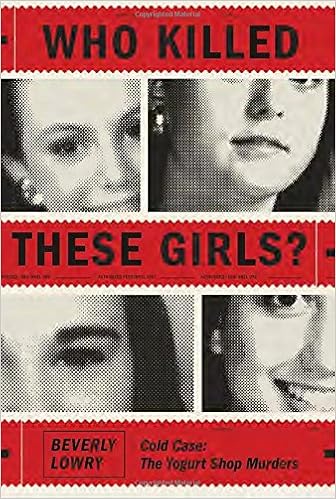
Who Killed These Girls?

Who Killed These Girls?  Cold Case: The Yogurt Shop Murders by Beverly Lowry, 373 pages

On December 6, 1991, firefighters in Austin, Texas responded to reports of a small fire at an "I Can't Believe Its Yogurt!" shop in a suburban strip mall.  Inside they discovered the raped, murdered, partially burned corpses of four teenage girls.  Two young men were subsequently convicted of participating in the crime, but after ten years in prison they were released and all charges against them dropped.  The real perpetrators have never been caught.  

Beverly Lowry is intimately familiar with Austin.  She knows its neighborhoods, knows its people, and she knows how deeply this horrific crime wounded the community.  Most of all, having herself lost a child to an unknown hit-and-run driver, she knows something of the pain of the families of the victims.  This perspective turns Who Killed These Girls? into something more than an ordinary true crime book - a fact-based meditation on the inexplicable nature of evil and the elusive nature of truth.

Wednesday, January 11, 2017

Filthy Rich

Filthy RichFilthy Rich by James Patterson and John Connolly with Tim Malloy, 287 pages

In June of 2008, Jeffrey Epstein plead guilty to a single charge of soliciting a minor for prostitution, and was sentenced to spend 18 months in jail, of which he served 13.  It is doubtful whether such a minor case would have garnered any attention beyond an article in the local newspaper, except that Jeffrey Epstein was a billionaire who counted among his friends both Bill Clinton and Donald Trump.  And Epstein had not been accused of having sex with a single teenage prostitute, but paying dozens of underage girls hundreds of dollars each for "massages" and similar sums for recruiting new girls into the network.  The generous plea deal, negotiated by a legal team that included Alan Dershowitz and Ken Starr, is a stark reminder of the extent to which great wealth and political connections can shield an individual from the full legal consequences of even the most appalling crimes.

Overall, Filthy Rich is about what you'd expect from the Patterson firm.  There is no real insight into Epstein - the authors all but admit that he remains a cipher to them.  Nor can the book get too close to his victims, who are, after all, minor victims of sex crimes.  Despite a considerable amount of innuendo, there are no grand revelations about sex parties in which underage girls mingled with American politicians and British royals.  The story of the actual investigation which resulted in Epstein's exposure, however, is somewhat compelling, and the narrative never drags or becomes dull.

Saturday, September 3, 2016

Devil in the White City

Cover image for The Devil in the White City: Murder, Magic, and Madness at the Fair that Changed America by Erik Larson, 390 pages

The Columbian Exposition of 1893 - the Chicago World's Fair - was a historical landmark, defining a nation and an era in the same manner as the 1851 London Great Exhibition and 1889 Paris Exposition Universalle.  Timed to commemorate the 400th anniversary of Columbus' discovery of the New World, the Fair looked towards the future as much as the past, its monumental neo-classical buildings painted stark white and illuminated at night by tens of thousands of electric lights, forming an ideal "White City", an attainable future of unimpeded progress.  As Erik Larson relates, however, the real contemporary city formed a contrasting "Black City" of stockyards, smokestacks, and slaughterhouses, shady figures and dark streets which swallowed people whole.  In the midst of this Chicago squatted the misshapen "castle" of Herman Mudgett, also known as HH Holmes or a galaxy of other aliases, a conman and serial murderer.

Larson divides his narrative largely between Holmes and Daniel Burnham, the architect who, more than anyone else, shaped the Fair.  Frederick Law Olmstead, who designed the landscaping, George Washington Ferris, who designed the famous Wheel, and Sol Bloom, who managed the Midway, all receive due attention as well, and Larson interweaves their threads skillfully to complement Burnham's story and fill in the broader tapestry of the Fair.  Less interesting are the chapters dedicated to Patrick Pendergast, a disappointed, delusional office seeker and assassin, who is either too prominent or not prominent enough, distracting from other narratives without yielding any real insight.  

The greatest difficulty Larson faces is Holmes.  An inveterate liar, conman, polygamist, and sociopath, much of Holmes' life remains mysterious, with even known facts colored by rumor and supposition.  A writer must be careful in separating reality from fantasy.  Disappointingly, Larson does not engender confidence in this regard, even reimagining a scene from Holmes' childhood to equip him with a Lecter-grade cold, intimidating stare.  Further undermining the reader's trust are some bald errors - Mary Kelly, last of the canonical victims of Jack the Ripper, was not pregnant at the time of her murder.  Thankfully, Larson regains some measure of skepticism before the end of the book, lest Holmes appear to be the only predator in 1893 Chicago.

There may be better books about the Columbian Exposition - Harold Schechter's Depraved is certainly a better book about Holmes.  What The Devil in the White City does so well is telling the stories in parallel, allowing similarities to emerge without ostentatiously drawing attention to them.  Burnham and Holmes were men of their time, like many others drawn to Chicago as a city on the move, where a man could be whoever he wanted to be.  Each struggled and strived to live that dream or nightmare.

Friday, May 6, 2016

One of Us

Cover image for One of Us: The Story of Anders Breivik and the Massacre in Norway by Asne Seierstad, translated by Sarah Death, 524 pages

On July 22, 2011, a car bomb exploded in downtown Oslo, killing eight people.  It was only the beginning of the horror.  The perpetrator, Anders Breivik, the founder, leader, and only member of a terrorist secret society dubbed "The Knights Templar", launched a heavily armed assault against a youth camp run by the progressive Labour Party, killing 69 people, mostly adolescents, before surrendering to police.

As Norwegian journalist Seierstad (The Bookseller of Kabul) recounts, Breivik had passed through a number of enthusiasms - graffiti tagger, right-wing activist, entrepreneur,  Freemason, World of Warcraft guild leader.  His commitment to each had less to do with its specific nature than his ambition to be recognized as someone extraordinary, to somehow distinguish himself as better than average, worthy of respect - a cool kid, a leader, rich, an elite.  His constant search for a new identity was clearly reflected in a series of pseudonyms - Morg, Anders Behring, andersnordic, Andrew Berwick.  In each environment, he repeated the same pattern - initially friendly and even sycophantic, totally invested and eager for recognition, until his ambition led him to overstep his bounds and offend the very people whose favor he had sought.  This pattern held true in his final obsession, fighting the Islamicization of Europe, but tragically that failure did not lead to depression followed by a new obsession, but mass murder.

Seierstad not only follows Breivik on his path to the massacre, but several of the victims as well, denying the killer the satisfaction of reducing them to mere props in his story and making clear to the reader the human cost of the massacre.  This accentuates the book's central theme - not only was Breivik "one of us", his victims were "us", too, and the evil and the loss belong to all of us.

Wednesday, February 17, 2016

American Terrorist

Cover image for American Terrorist: Timothy McVeigh and the Oklahoma City Bombing by Lou Michel and Dan Herbeck, 388 pages

On April 19, 1995, three tons of nitromethane explosives packed into the back of a Ryder truck were detonated outside the Murrah Federal Building in Oklahoma City, instantly demolishing over half the building and killing 168 people, wounding hundreds more.  The bomb was built, placed, and detonated by Timothy McVeigh, a decorated veteran of Desert Storm who had become convinced that the US government was preparing for a war against its own people.  April 19 was a double anniversary, of the battles of Lexington and Concord that began the American Revolution, and of the fiery end of the siege of the Branch Davidian compound in Waco, Texas two hundred years later, which McVeigh saw as emblematic of a new tyranny.  How an all-American kid from upstate New York grew into a soldier in a one man war against the federal government is the subject of American Terrorist, written by a pair of journalists from Buffalo with unequalled access to the McVeigh family.

Their account makes it clear that McVeigh was not, himself, the victim of injustice at the hands of the government.  To the contrary, American Terrorist reveals his remarkable attempts to provoke authorities - from flatly refusing to return extra money erroneously paid to him during his military service to speculating about whether he could shoot down a police helicopter with a flare gun in the presence of a man he knew was an undercover cop to trespassing at Groom Lake - without consequences.  Only with the bombing would he become, in his own eyes, the martyr he always wanted to be, sacrificing himself for The Cause.

One issue that the authors are unable to settle concerns McVeigh's attitudes on race.  McVeigh himself, while in prison, denied being a racist, and a number of witnesses support him on this.  Yet he did, at one point, join the Klan, he was cited while in the Army for using racial slurs, he associated with white supremacists such as those at Elohim City, and he was fixated on the virulently racist novel The Turner Diaries, to the point that he handed out copies like an evangelist might hand out Bibles.  Perhaps, as he claimed, the racial slurs were just locker room talk, his mail order KKK membership was a mistake, and the Elohim City and Turner Diaries connections were the result of a shared anger with the US government and not a shared racist ideology.

This reflects the major question surrounding this book - as reliant as it is on McVeigh's own account, to what extent can we trust McVeigh?  Surprisingly for a true crime book, in this case the subject comes across as quite candid - after all, McVeigh wanted people to know what he had done and why.  Michel and Herbeck communicate this effectively, and their tale of McVeigh's road to mass murder reveals more than about their subject than he intended.