Showing posts with label society. Show all posts

Saturday, January 3, 2026

Ancient City

The Ancient City by Numa Denis Fustel de Coulanges, translated by Willard Small, 323 pages

In The Ancient City, the 19th century historian Fustel de Coulanges explores the origins of the great city-states of the classical world, chief among them Sparta, Athens, and Rome.  All of these, he observes, were born out of a context of familial, tribal associations bound together by religious observance, in which the concept of property was centered on the ancestral tomb and law was "at the same time a code, a constitution, and a ritual."  The history of the ancient world then progresses or degenerates as a movement away from this hierarchical religious community towards a polity which is more egalitarian, secular, and dissolute.

In an age like our own when historiography generally treats religion as an accident, this landmark work indisputably establishes religion as the central reality of every ancient civilization.  The family, the tribe, and the city were all religious in their foundations.  Then, as now, those foundations are vulnerable to water and fire, to the slow drip of complacency and the burning flame of resentment.

Thursday, September 8, 2022

Li Chi

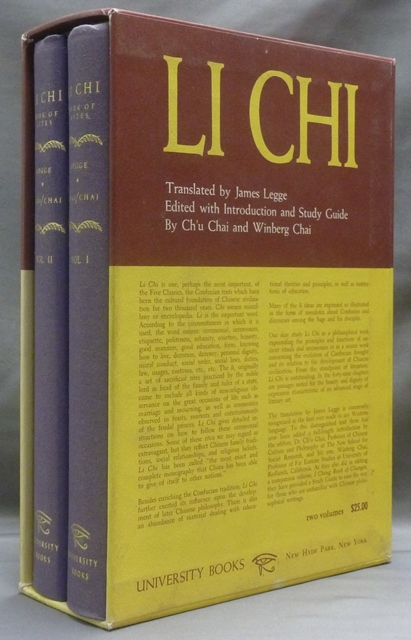
Li Chi: Book of Rites, translated by James Legge, 949 pages (2 vols)

The Li Chi (pinyin Liji) is a collection of Confucian texts compiled in the Han dynasty dealing with matters of classical Chinese ceremonial.  Much of it concerns the minutiae of proper observance, including difficult questions when unusual circumstances impose conflicting obligations.  Other texts consider the nature and value of ceremony against those who would reject it as mere outward show, maintaining that ritual is essential to the proper ordering of emotion, evoking the proper feelings in those who lack them and restraining the passions of those who cannot control themselves.

The Li Chi is one of the "Five Classics" of Confucian philosophy.  As such, it has been studied, interpreted, glossed, and debated by legions of scholars for thousands of years.  Legge attempts to condense some of this conversation into the footnotes, along with notes on difficult translations and the claims of textual critics, and he succeeds in doing so without burying the text in the commentary.  Most readers will find it to be primarily of antiquarian interest, which is hardly surprising given that the motives of the authors and compilers was itself antiquarian, a search into the past, not due to idle curiosity or academic ambition, but out of a love of wisdom and a deep need for models to be imitated.  

Friday, August 5, 2022

Natural Symbols

Natural Symbols: Explorations in Cosmology by Mary Douglas, 167 pages

In the conventional view, as history progresses men naturally turn away from rote ritual in favor of more personal and meaningful expressions of social life and worship.  Ritual is viewed as something imposed by the strong upon the weak in order to reinforce the existing power relationships.  As Mary Douglas explains in this revelatory work, this simple narrative fails to account for either the diversity of ritual intensity and development among "primitive" peoples and the passionate connection to ritual of certain marginalized groups in the developed world.  Instead, she concludes, ritual is a vital part of the language of peoples with a strong sense of community and well-defined social roles, while populations that are more undifferentiated and individualistic reject ritual and prioritize inward states and expressive gestures.  Moreover, she suggests, this latter attitude not only reflects and enhances the alienation of the individual from society, but encourages a conception of the spirit as radically independent of, and naturally in opposition to, the body.

Douglas is very clear that she is building upon the work of a number of others, and this can be a bit disorienting for those not familiar with some of the thinkers and theories involved.  This is a small price for a study that so lucidly explicates much that would otherwise remain inexplicable, not least of all the ingrained, and often unexamined, hostility to ritual, both civic and religious, on the part of modern Western elites, both secular and ecclesiastic.  

Thursday, July 7, 2022

Cry Wolf

Cry Wolf: A Political Fable by Paul Lake, 215 pages

After the farmer died, the animals of Green Pastures Farm managed to keep things going.  It wasn't always easy - they couldn't reach the fruit on the higher branches of the trees, and the mouths of lambs proved to be poor substitutes for hands when it comes to milking cows - but the community managed to come together under the Laws left by the farmer and not only survive, but thrive, even defeating an invading bear.  Until, that is, more sympathetic outsiders present themselves, and the clever owl uses the magic of words to bring down the laws and plunge the farm into a spiral of chaos from which it may not recover.

Cry Wolf is a straightforward reimagining of Animal Farm, not only updated for the 21st century - as if such a thing was necessary - but with a revised set of anthropological assumptions, so that it bears little more than a conceptual resemblance to Orwell's original.  Where it does more deeply echo Orwell is in Lake's awareness of the power of words, particularly as they are defined and redefined so that they become tools for confusion rather than communication, and in the ease with which slogans can evoke the power of sentiment to overthrow reason.  What Lake most memorably adds is his exposure of late modern decadence, particularly the unwarranted conviction that a very precarious situation is, in fact, the natural state of things, the unmerited confidence that any disruptions are merely manageable exceptions, and the baseless belief that there are no higher desires than comfort and peace.

Tuesday, December 14, 2021

Unsettling of America

The Unsettling of America: Culture and Agriculture by Wendell Berry, 223 pages

In this early work, Wendell Berry decries what he sees as the continuing colonization of the North American continent, concentrating on the colonization of the rural by the urban.  This colonization is carried out by technocratic elites who reduce everything to economics, ignoring the human, social, and environmental costs of their policies.  Although Berry's subject is agriculture, his theme is over-specialization and fragmentation, a feature of modern life that of itself tends to transform all human interaction - even "charity" - into forms of money-exchange.  The alternative, he insists, must be the invention (or recovery) of an economics, a politics, a philosophy, and even a theology of limits.

This was always intended as an argumentative work, a new salvo in an ongoing debate.  Now it is a mostly forgotten volley in a debate that has moved on, but its echoes can, perhaps, still be heard in the hills.  While it is explicitly tied to the particular time and place in which it was composed and published, with considerable space taken up by criticism of academic and political figures in power or in fashion in the late '70s, the underlying principles are hardly outdated, and what it has lost in ripped-from-the-headlines relevance is compensated for by what it has gained in historical value.

Monday, September 27, 2021

Essays

Essays on Catholicism, Liberalism, and Socialism Considered in Their Fundamental Principles by Juan Donoso Cortes, translated by Rev William McDonald, 347 pages

In his celebrated 1988 Gifford lectures, Alisdair MacIntyre exposed the failure of both the modernist "encyclopedic" and postmodernist "genealogical" approaches to ethics, a failure rooted in their incommensurability, their inability to meaningfully dialogue with and assimilate alien systems.  Now we stand in the ruins of those towers of human pride, with leaders who, whether from knavery or imbecility or some mixture of the two, leap uncomprehendingly from one to the other, asserting at one moment that "my truth" is something manufactured, and at the next that it issues from the Delphic prophetess Science, once her mad ravings have been suitably interpreted by her labcoated priests.  If reason is the slave rather than the master of the passions, every subjectivity is at war with every other, convenient lies contending with convenient lies, and so the heathen rage.

This was all warned against by Juan Donoso Cortes in the early nineteenth century.  The liberal superstition that truth will triumph in a free marketplace of ideas is belied by the fact that men do not seek the truth, to the contrary, even when the Truth appeared to them they mocked Him, spit on Him, and ultimately crucified Him.  The entire liberal project is founded on the mistaken belief that human freedom consists of the power to choose between good and evil rather than the ability to will the good.  The result is moral chaos, the war of all against all by other means, and sin, Cortes reminds us, is nothing more or less than disorder, the confusion of lesser goods for higher, ending in the disunion of soul and body which is death.  Life, then, is order, true order, the harmony which exists in the presence of the supreme mysteries in the light of which all apparent contradictions are resolved.   

Monday, September 13, 2021

True and Only Heaven

The True and Only Heaven: Progress and Its Critics by Christopher Lasch, 532 pages

Christopher Lasch's story of progress and its critics is, as the subtitle suggests, really two stories.  The first, counterintuitively, is the tale of the nineteenth century critics of industrialization and enlightenment and their warnings about atomisation, alienation, and decadence.  The second is that of twentieth century American progressives as they came to increasingly view the masses as the object rather than the protagonist of historical processes.   Uniting these narratives is Lasch's apocalyptic understanding that the end of progress is not a realized utopia, but an insatiable demand for more of everything, resulting in a fundamental rejection of all boundaries and limitations.

The True and Only Heaven is not merely a book that should be read by anyone seeking to understand the current century and the two which preceded it.  It is a book that no one can plausibly claim to understand the world in its present moment without having read.  Lasch even profoundly explicates matters only peripheral to his central concern - the transformation of the civil rights movement from moral suasion to black power, for instance.  Indeed his analysis is so brilliant that it illuminates even areas he does not directly touch - his treatment of syndicalism, for example, reveals a previously unexpected foundation beneath Nolte's theory of fascism.  Yet another mark of Lasch's genius are the uses to which his thoughts can be put that he did not foresee and would not have sympathised with.  This is entirely fitting for a narrative the great theme of which is hope, for hope, Lasch tells us, depends upon faith in an "underlying order of things [that] cannot be flouted with impunity."

Friday, September 3, 2021

Revolt of the Public

The Revolt of the Public and the Crisis of Authority in the New Millennium by Martin Gurri, 425 pages

In The Revolt of the Public, analyst Martin Gurri considers the possibilities and dangers that the information age presents to established institutions and ways of life.  The technological changes of the last few decades, he observes, have greatly facilitated the emergence of informal networks, energized by a passionate involvement with specific issues, out of a generally disinterested mass populace.  These have collided with technocratic institutions which have inherited their organization from the industrial age, their size and complexity justified by modernist utopian promises which are no longer rationally believed but are still emotionally expected.  It is precisely in this gap - between what we know to be the limits of expertise and what we believe we are owed - that the aroused public finds its angry home.  The negativity of postmodern protest, then - the inability of activist networks to advance positive solutions to the systemic problems they identify - is not just the result of their own lack of hierarchy, but an inescapable feature of the crisis of late modernity.  The danger, Gurri believes, is that the accelerating erosion of institutional authority is transforming the gap into a chasm, making the prospect of a wholesale rejection of democratic pluralism correspondingly more attractive to dissidents on both the left and the right.

Beyond Gurri's method and presentation, there is little here that would surprise anyone who has read, for example, MacIntyre, Postman, or Lasch.  That Gurri, deliberately or not, seems unaware of this is, on the whole, more a blessing than a defect, allowing him to approach the current crisis along his own path and therefore providing all that much more support when his conclusions overlap with those of deeper thinkers. It also gives him space to suggest his own solutions, as nebulous as those might be.  It helps, too, that his presentation is excellent, and will doubtless appeal to many reluctant to try older, more substantive works.

Tuesday, August 3, 2021

Christus Vincit

Christus Vincit: Christ's Triumph Over the Darkness of the Age by Bishop Athanasius Schneider and Diane Montagna, 421 pages

In the relatively new but vital tradition of book-length interviews of Catholic prelates, popularized by Cardinal Ratzinger and continued by Cardinal Sarah, Christus Vincit is an expansive, free-ranging conversation with the auxiliary bishop of Nur-Sultan, the capital of Kazakhstan.  It might understandably be asked what this man of the peripheries has to offer the Church and the world.  Quite a bit, as it turns out, and if little of it is new, most of it is excellent.

The heart of Bishop Schneider's message is that the naturalistic turn the Church took in the twentieth century has been a disaster pastorally, evangelically, and theologically.  To counter this, he calls for a renewed emphasis on the supernatural and the transcendent.  Again he reminds us that human beings are embodied creatures rather than pure spirits, that history is not Providence but has a providential aspect, and that while all earthly economic and political arrangements, debates, and crises are passing, there is a Kingdom which is eternal.  Unfortunately, there is also a certain amount of conspiratorial thinking, mostly involving the Freemasons, some of which may be true but which generally seems out of place and fantastical.

Tuesday, July 20, 2021

Unbroken Thread

The Unbroken Thread: Discovering the Wisdom of Tradition in an Age of Chaos by Sohrab Ahmari, 265 pages

In The Unbroken Thread, Sohrab Ahmari attempts to draw his readers' minds to a series of twelve questions, including "How Do You Justify Your Life?" and "What Do You Owe Your Body?"  He asks us to meditate on these questions in the light of the ideas and experiences of thinkers ranging from Confucius to Andrea Dworkin.  These are hard questions that defy simple answers, essential questions, yet questions that few seriously consider beyond the superficial responses that our superficial society provides.  In inviting us to consider such fundamental matters, Ahmari threatens to radically transform how we think about ourselves and the world.

The Unbroken Thread is not a self-help book.  It is not a quick survey of great books offering cheap self-satisfaction or conversation starters.  It isn't a diatribe against the ills of the modern world.  It isn't an especially challenging book, intellectually.  It is remarkably personal, seemingly for the author and certainly for those readers willing to engage with it.

Monday, May 3, 2021

Integralism

Integralism: A Manual of Political Philosophy by Thomas Crean and Alan Fimister, 279 pages

A spectre is haunting what was the West - it is the spectre of Integralism.  All the powers of the old liberalism have entered into an unholy alliance to exorcise this spectre: Democrat and Republican, libertarian and socialist, German and Brit, Dorsey and Zuckerberg, Bezos and Gates.  

This may seem a trifle overblown.  It is true, however, that as the liberal consensus crumbles, engaged Catholics, and especially younger Catholics, have begun looking for traditional alternatives to the naked emperor of modernity.  One of the most trenchant criticisms of the movement has been the lack of agreement as to what, precisely, is meant by "Integralism", particularly in a country founded on the rejection of throne and altar.  Is Integralism equivalent to Falangism, or is it a particular flavor of common-good conservatism, or is it a fundamentally unserious social-media phenomenon with no meaningful content whatsoever?

Although disagreements will no doubt continue, with the publication of Crean and Fimister's manual at least the last is no longer an entirely plausible answer.  Without being argumentative, they carefully build their argument for a rational society and a politics which respects the entire human person.  Although their conclusions are unlikely to convince anyone who does not agree with their premises, their political philosophy is at least coherent, which is more than can be said for any of the post-modern alternatives.  The result is a challenge to many, and an invitation to a few.

Thursday, April 29, 2021

The Day Is Now Far Spent

The Day Is Now Far Spent by Robert Cardinal Sarah and Nicolas Diat, translated by Michael J Miller, 343 pages

The hour is late indeed, says Cardinal Sarah in this book-length interview with his favorite interlocutor, Nicolas Diat.  The Church, he tells us, is riven by dissension, compromised by unbelief, and stained with sin.  Meanwhile, the decadent ruins of Christendom are in the grip of a "fundamentalist liberalism" that pursues wealth and power (often under the guise of "justice" and "liberation") while treating the sacred with indifference and contempt.  The irony is that, by attempting to place himself at the center of the world, modern man has created a world in which he is increasingly superfluous.  Not content in its iconoclasm with the destruction of its own past, the neo-colonialist West actively works to erase the cultures of Africa and Asia even as it plunders their lands of their natural resources.  

It is necessary, then, for faithful Catholics to resist the temptations of compromise and despair.  This demands the cultivation of virtue and excellence - "The Church does not have the right to be mediocre."  Fittingly for the author of The Power of Silence, while Sarah's message is urgent, it is not primarily a "call to action", but a call to prayer and contemplation.  "Your mission is not to save a dying world... Your mission is to live out with fidelity and without compromise the faith you received from Christ."

Tuesday, August 11, 2020

Road to Somewhere

The Road to SomewhereThe Road to Somewhere: The Populist Revolt and the Future of Politics by David Goodhart, 233 pages

In 2016, when despite the opposition of every major political party and the media establishment, the British people voted to leave the European Union, a commonly heard reaction from those who had smugly assumed Remain would win was that they didn't recognize the country anymore.  Several months later, on the other side of the Atlantic, after Donald Trump overcame the establishments of both parties to win the US presidential election, the same chorus was heard.  As David Goodhart reveals, however, both of these electoral earthquakes were the consequence of even more people feeling that their country had already been deformed beyond recognition.  For Goodhart, the major division of the early twenty-first century is between "Anywheres" and "Somewheres", the latter group finding their identity in their local community and culture, the former inventing identities out of their own will and desires.  While the Anywheres have been ascendant for the last few decades, the Somewheres have not disappeared nor even, according to polling, appreciably diminished in numbers.  Indeed, Goodhart maintains, the fundamental divide between a small Anywhere group and a somewhat larger Somewhere contingent is an enduring reality of modern societies, a reality made invisible and therefore dangerous by the Anywhere bubble of the elites.

It is worth noting that, if Goodhart is writing to call attention to the existence of the Somewheres, he is himself an Anywhere, and to some extent a prisoner of Anywhere cant and prejudice.  Thus, he uses "reason" as shorthand for the efficient pursuit of a purely material self-interest, so that the prioritization of family or faith over material gain is "irrational" even if it actually makes people happier, and when he struggles to come up with something the British people can be proud of having in common, the best he can offer is the welfare state.  Underlying it all is the belief that the meritocratic arrangements of liberal regimes function largely as advertised, efficiently filling positions with the people best suited for them, a naive faith that does not seem as if it could survive an encounter with the history of the past two decades.  Given that Anywheres are the target audience for the book, this may all be for the best.

Saturday, August 1, 2020

World Without Mind

World Without Mind
World Without Mind: The Existential Threat of Big Tech by Franklin Foer, 232 pages

In World Without Mind, journalist Franklin Foer identifies three distinct but overlapping threats posed by Silicon Valley.  The first, and most sensational, is the product of the utopian dreams of the tech gurus, who imagine that infallible algorithms can be used to replace fallible human judgments, ushering in a world where supposedly free choices have been eliminated in favor of mechanical, "scientific" decision-making.  The second, and most dear to the author, is the destruction of the old media by the new, particularly the near-death of quality journalism and the rise of click-bait which is tailored to attract the maximum number of views by gaming the algorithms which determine what people "want" to see.  The third is the bridge between the first two, the domination of our media and economic consumption by a few monopolistic corporations that attempt, as much as possible and more than we might like to imagine, to make our decisions for us.

It is easy to dismiss World Without Mind as the nostalgic whine of a loser in the tech race, a journalist who, like many before him, found that progress had rendered him irrelevant.  This is not helped by the fact that Foer is himself a prisoner of Whig history, freely bandying about cliched nonsense like "We consider conformism to be spiritually and morally deadening."  At one point he flatly asserts that "when writing was professionalized in the late nineteenth century, the culture deepened," without support or explanation and against the plain evidence of our senses.  It is ameliorated somewhat by his open admission that he has several axes to grind.  More importantly, his prescription that, in tandem with the use of antitrust laws to break up Big Tech, ordinary people begin to treat their independence from technology as a health issue even as they flaunt it as a status symbol, an approach consciously modelled after the remarkably successful healthy eating and organic food movements, is at least interesting.  It is, however, sadly reminiscent of similar attempts to wean Americans from their TVs, and cynics will be quick to suggest that it lacks the organic food craze's feature of being something big corporations can easily profit from indulging.

Thursday, July 2, 2020

Liberty, Equality, and Fraternity

Liberty, Equality, and Fraternity by Ven Fulton J Sheen, 170 pages

Written in 1938, as fascists and communists in Europe and America gathered their forces for their pending assault against the liberal order, Liberty, Equality, and Fraternity diagnoses the troubles of the time in terms of the internal contradictions of the slogans of the bloody revolution which established that order.  The liberals exalt freedom above all, the totalitarians demand equality, and as the values each proposes are seemingly incommensurable, their differences cannot be peacefully resolved absent a higher unifying principle.  Sheen finds this principle in fraternity, the principle which animates Catholic social teaching, which he advances as a cure for the world's ills.

Liberty, Equality, and Fraternity was written early in Sheen's public career, and suffers from a lack of focus.  After ably establishing his argument, Sheen proceeds to ramble on at length about the threat of communist subversion in the US - a timely warning, but one not directly connected to the main theme of the book or of much interest to a reader eighty years later.  Sheen's analysis of both liberalism and totalitarianism as sharing the same dehumanizing character despite their irreconcilable differences, however, remains powerful.

Tuesday, June 9, 2020

In Our Time

In Our TimeIn Our Time by Tom Wolfe, 119 pages

In Our Time collects a number of sketches written or drawn by Tom Wolfe in the years leading up to 1980, with most of the drawings having appeared in the "In Our Time" feature in Harper's magazine.  Together, they present a portrait of America, and especially New York, that is as amusing as it is incisive.

For Wolfe, the hidden significance of the '70s was that it was the decade when the counterculture of the '60s became the culture.  If the '60s witnessed the rise of the young barbarians, the '70s saw their triumph.  Just as importantly, it was when they began, despite their own best efforts, to grow old.

Tuesday, February 18, 2020

Cure for Consumerism

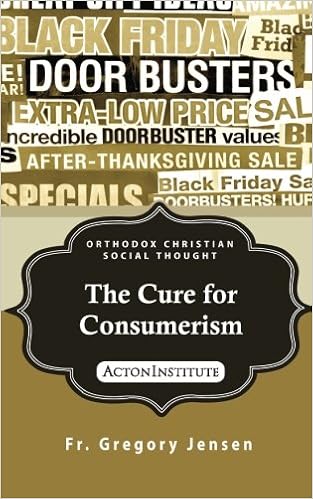
Image result for The Cure for Consumerism Jensen, GregoryThe Cure for Consumerism by Fr Gregory Jensen, 148 pages

Christianity has always had an ambivalent relationship with the world.  The world is, after all, simultaneously what the Lord overcame and what He died to save.  The world belongs to God, and yet His people are not of this world, and the world hates Him and them.  The goods of the world participate in the goodness of God, for otherwise they would not be goods, and they can serve as a ladder to Him, but divorced from their relationship with the Supreme Good who is their source and purpose, every ideal becomes an idol.

It is in light of this that Fr Jensen considers and reconsiders the Orthodox attitude towards capitalism.  He argues that the marketplace may be reimagined, not merely as an unfortunate necessity that must somehow be accommodated, but as a realm of genuine goods that ought to be nurtured.  The Christian can properly order the goods of the marketplace, and thus escape from the perils of idolatry, through a personal practice of asceticism.

Unfortunately, it is here that Fr Jensen's exposition seems naive, as he seems to fall into the peculiarly modernist delusion that a tool is a purely neutral object void of its own logic.  This causes him to neglect the reality of the free market as a social sphere which inevitably tends to totalize its own values.  While this may be resisted on the personal level, it can only be counterbalanced by a greater social force.

Saturday, June 8, 2019

Kingdom of Man

The Kingdom of ManThe Kingdom of Man: Genesis and Failure of the Modern Project by Remi Brague, translated by Paul Seaton, 216 pages

The third part of Remi Brague's grand history of ideas, following The Wisdom of the World, which was centered in the classical world, and The Law of God, which focused on the medieval world, The Kingdom of Man looks at the modern world, or, as the subtitle significantly puts it, the modern project.  For Brague, this is the distinctive characteristic of modernity - that it sees itself as a project. This was itself the result of a shift of attitudes towards work - where classically freedom from work was the privilege of nobility, in the Renaissance it became the expression of human dignity and power.  The valorization of "useful" work above "useless" contemplation, while it begins by promising worldly abundance, ultimately positions man as an object rather than a subject, like all nature an unsatisfactory thing that exists only to be mastered and overcome, and thus the project of modernist humanism ends in the sacrifice of humanity to the project.

Brague's approach is entirely descriptive.  He does not consider the views of critics of modernity, nor does he explore alternatives to it.  Instead, he follows the logical development of modernism from nominalism to posthumanism from within, carefully tracing the origins and consequences of each idea, and illuminating a great many things even outside of his focus.

Tuesday, January 15, 2019

Good and Mad

Good and Mad: The Revolutionary Power of Women's Anger by Rebecca Traister     320 pages

From Goodreads

From Rebecca Traister, the New York Times bestselling author of All the Single Ladies comes a vital, incisive exploration into the transformative power of female anger and its ability to transcend into a political movement. 

Review:

This is an exceptional look at gender inequality in the US, with focus on breaking down the politics of gender inequality, women of color, and other disadvantages faced by women. Traister leaves no stone unturned, covering several woman's rights movements, including the #metoo movement, and especially focuses on woman's rights/activism in the wake of the 2016 presidential election.

The main message is this: women, it is okay to be mad, in fact, it's good to be mad because a) no one should tell you what to feel, especially if it's justified, b) anger can be a tool that leads to change, and c) anger keeps us (women) from complacency and settling for less than equal rights.

I loved the coverage of this book, I loved Traister's inclusiveness, and I loved reading something that spoke to the anger I have felt and still feel after the 45 became president. This is a very important read and I would recommend it to all women, every woman, and then all men.

Thursday, November 8, 2018

Coddling of the American Mind

The Coddling of the American MindThe Coddling of the American Mind: How Good Intentions and Bad Ideas Are Setting Up a Generation for Failure by Greg Lukianoff and Jonathan Haidt, 269 pages

It is free-speech activist Greg Lukianoff and social psychologist Jonathan Haidt's contention that Western (and especially American) society has developed profound misunderstandings of human realities which are not only empirically false but positively harmful.  They condense these into three great untruths - that adversity is psychologically damaging, that feelings are the most reliable guide to what is right, and that people can be sorted into those who are fundamentally good-intentioned and their enemies.  As a consequence, young people are being encouraged to remain emotionally fragile, irrational adolescents who view anyone who disagrees with them as irredeemably evil.  Not only does this tend to reduce public discourse to grievance-fueled shouting matches, it also produces a mass of disconnected, immature, desperately unhappy individuals who lack even the basic resources necessary to understand the causes of their unhappiness.

The greatest risk for a book of this sort is that it will only contribute to, rather than ameliorate, the culture of outrage.  Thankfully, Lukianoff and Haidt are not partisan firebrands, and while readers of every political persuasion will likely find cause for anger in their analysis, they should also find reasons for self-reflection on their own complicity in our anti-cultural spiral into unreality, which extends far beyond the gloomy groves of academe.