Showing posts with label history. Show all posts

Friday, June 5, 2026

Venice

Venice: A New History by Thomas Madden, 427 pages

Beginning his landmark work, The Stones of Venice, John Ruskin tells his readers

Since first the dominion of men was asserted over the ocean, three thrones, of mark beyond all others, have been set upon its sands: the thrones of Tyre, Venice, and England.

Thomas Madden, a noted scholar of the Crusades, no doubt knows a great deal about Tyre, but it is no longer the household name it was in Ruskin's day, nor are "the most touching words ever uttered by the Prophets of Israel against the cities of the stranger" much remembered.  Likewise, England can no longer boast of its "prouder eminence," being well on its way to becoming the First Slum of Europe of which its poets spoke.  In a certain sense, America has succeeded England as England succeeded Venice.

This certainly seems to be Madden's perspective.  In his telling, Venice is a mirror of the United States as it was in its ascendancy, republican but not democratic, religious but not theocratic, conservative but not reactionary.  Whether this portrait is true to life or not, Madden's history is certainly a brisk, entertaining exposition of one of civilization's great cities and history's great riddles.

Monday, December 8, 2025

107 Days

107 Days by Kamala Harris, 300 pages

On July 21st, 2024, Vice President Kamala Harris got a call from her running mate, President Joe Biden.  He had decided, after weeks of pressure, to drop out of the campaign and back her as the Democratic nominee for the 2024 election.  It was up to Harris to step into the breach and save the Democrats from defeat by the deplorable Donald Trump.  She only had 107 days to do it, and 107 Days is her own day-by-day account of that momentous campaign and its immediate aftermath.

Of course, Harris failed, but the hidden comedy of 107 Days is that she still does not seem to have realized this.  The book is filled with stories about how her campaign succeeded and Trump's failed, most directly when discussing the Joe Rogan podcast, which she somehow manages to present as something that she was cheated out of and simultaneously something that hurt Trump.  Again and again, the former vice president is caught believing too many impossible things, that Biden was perfectly fit for a second term but should have quit the race sooner, that she was an inspiring success as vice president but unknown to the American people, that it was impossible to mount a successful campaign in 107 days but that on election night she believed there was no way she could lose.

Throughout, it is not entirely clear whether Harris is consciously trying to deceive or whether she is herself badly out of touch with reality, a distressing but by no means unusual trait in an American politician in the early 21st century.  Pointless agreements about combating climate change are touted as great foreign policy successes while wars rage around the globe.  The importance of job programs and affordable housing for American workers are touted as major priorities but legal and illegal immigration are treated as a minor concern.  She repeats Bernie Sanders' advice on the day Biden stepped aside not to concentrate on abortion as her defining issue, yet again and again that is what she does, secure in her complacency that no one who matters could possibly disagree with her.

This is the punchline of a very funny 300 page joke.  Harris claims to represent the future of democracy in the United States, but she repeatedly demonstrates that she neither understands nor particularly cares for the actual people of that country.  The comedy of her comeuppance is that much greater for not being hers alone, but shared by every institution that mocks the concerns of ordinary Americans because they do not conform to progressive ideological orthodoxy.

Friday, November 7, 2025

White Eagle, Red Star

White Eagle, Red Star: The Polish-Soviet War 1919-20 by Norman Davies, 278 pages

In the aftermath of the First World War, the Russian Empire fractured.  While the Bolsheviks consolidated their hold over the core territories, the Baltic States asserted their independence, and Poland became a sovereign nation again after a century of foreign domination.  As Norman Davies relates, this was not a simple, clean, or peaceful process.  With the Bolsheviks preoccupied with the Russian civil war, the Poles rushed forward to establish their eastern border near Minsk.  The Soviet response was conditioned not only by the border question, but by their dialectical fantasies of a general European revolution, which envisioned Poland as a stepping stone to Germany and the West.  In the end, the superior Soviet forces overextended themselves and were routed by a counterattack at the gates of Warsaw, and the whole episode concluded with a hasty peace which pleased neither government.

Writing in the early 1970s, Davies laments that the war is little known and poorly understood.  The Soviets were badly embarrassed by their defeat, and soothed their wounded pride by casting the bourgeois Allies as the actual belligerents.  However, as Davies chronicles, the British particularly gave the Poles little support, with David Lloyd George far more interested in building bridges with the Soviets than guaranteeing the future of the Polish state.  After the victory was won, the Western powers were glad to share in this view, with much of the credit accruing to the French general Maxime Weygand who was sent to Poland as an advisor and was credited as the architect of the Polish victory.  Yet Davies demonstrates that Weygand was treated with indifference and even contempt by the Poles and contributed little of value.  For the Poles those most responsible were Commander-in-Chief Pilsudski and God Almighty, and having dismissed the latter Davies gives the credit to the former.

As Davies demonstrates, despite the brief duration of the war and the compromise peace that ended it, the Polish-Soviet War had far-reaching consequences, especially in the area of Soviet foreign policy and the growing rivalry between Trotsky and Stalin.  For the Poles, of course, the war merely bought them a couple of decades before Nazi and Communist occupation.  For Davies, from his position in the early '70s, this seemed a small enough thing, but from a later perspective it is undoubtedly significant that Karol Wojtyla spent the first 19 years of his life in a free, Catholic Poland.

Wednesday, October 22, 2025

Brunelleschi's Dome

Brunelleschi's Dome: How a Renaissance Genius Reinvented Architecture by Ross King, 167 pages

At the end of the 13th century, the Florentines decided that they required a new cathedral, as much to celebrate the city's growing prosperity as to replace the crumbling Santa Reparata.  An ambitious plan was approved, but progress was slow, and it was not until the beginning of the 15th century that preparations began for the construction of what would be the largest masonry dome ever constructed.  Filippo Brunelleschi's innovative proposal for the dome construction was ultimately selected over several more conventional plans, including one by Lorenzo Ghiberti.  The dome was completed sixteen years later and remains an iconic symbol of one of the most beautiful cities in the world.

The story of this construction, through two decades of war, plague, and civil strife, is the subject of Ross King's book.  It is a promising subject indeed - a great construction project during one of the most colorful and fertile periods in human history, a contest of human ingenuity and the feuding wills of great artists and their patrons.  Unfortunately, King's book is deadly dull.  Working with incomplete historical and biographical records, he constructs his own account of events, asserting that a figure "must have" done this, or "seems to have" done that.  He plays equally fast and loose with history (at one point he flatly declares that the technique of perspective was "lost", then shortly thereafter says it was abandoned as "dishonest") and even basic facts (he asserts that other than Brunelleschi, the "only other person interred inside the cathedral was St Zenobius", which seems to be simply untrue).  Worse than all this, he seems to regard only the technical challenges of construction to be worth writing about, resulting in a book that contains nothing of beauty, nothing of poetry, and precious little of mind or spirit.

Saturday, October 18, 2025

Fascism in Spain

Fascism in Spain: 1923-1977 by Stanley G Payne, 479 pages

The rise of fascism in Europe in the 1920s and '30s had their impact on the political landscape of Spain.  Far-right activists, seeking a way forward in the crisis of the interwar years, naturally found attractive the path shown to them by Mussolini in Italy, a nation with a history and culture so intimately connected with that of Spain.  Various leaders alternately embraced and rejected the fascist label, incorporated elements of fascist ideology into their own thinking, sought assistance from the fascist powers, or adapted fascist symbols and slogans to a Spanish context.

However, as Stanley Payne demonstrates in his landmark history of Spanish fascism, fascism was never comprehensively adopted by the Spanish far right.  Even Jose Antonio Primo de Rivera, the founder of the Falange, was ambivalent about many aspects of fascism as it was practiced in Italy and especially in Germany.  Certainly Franco resisted identification with fascism, even in 1940-1 when the Axis seemed on the verge of total victory, effectively neutering the Falange by incorporating it into his new uniparty.  Efforts to strengthen the syndicalist movement within the Franco dictatorship were systematically thwarted.  Payne suggests a number of reasons for this, including the historical regionalism of the Spanish right and the strength of Catholic traditionalism as an alternative to fascism.  

The most important element of Payne's masterful study is not its thoroughness, but its fundamental refusal to treat the study of fascism as something akin to demonology.  Not that Payne is blind to the violent, revolutionary component that is essential to the ideology, but his goal is understanding rather than judgement, and he doesn't feel any need to restate every few pages that comprehension does not mean approval.  The result is a work that allows the reader to see the meaning that fascism had for mass man in the first half of the twentieth century, and therefore its appeal, growth, and failure.

Wednesday, October 1, 2025

Boyne Water

The Boyne Water: The Battle of the Boyne, 1690 by Peter Berresford Ellis, 152 pages

In 1690, the deposed Catholic King of England, Scotland, and Ireland, James II, backed by France's Louis XIV, seized control of Ireland and attempted to use it as a stepping stone to reclaim his throne from his Protestant son-in-law, William of Orange.  William landed his primarily English and Dutch troops in northern Ireland, and James resolved to use his largely Irish and French army to block William's advance on Dublin at the river Boyne.  The battle was brief, James' forces were routed, and James himself made the defeat seem decisive by returning to France rather than attempting to carry on the fight in Ireland, where his supporters would continue to resist until the Battle of Aughrim the following year.  By the 19th century, the anniversary of the Battle of the Boyne became the occasion for annual celebrations by Irish Protestants, and the Battle itself became understood as one of the turning points of Irish history.

According to Peter Berresford Ellis, this is all very exaggerated.  In the context of the Williamite Wars, he argues, it is Aughrim which was the final, decisive defeat, but even more importantly he sees the Jacobite cause as alien to Ireland itself.  Ellis contends that while James was able to rouse the Irish Catholics to his side, his restoration would have had little effect on the course of Irish history.  Indeed, insofar as the struggle was a personal one between rival claimants to the throne, Ellis' sympathy is entirely with William, who conducted his campaign in Ireland with dash and daring, in stark contrast to James, who proved timid and uncertain.

It is precisely in his portrayal of the individuals involved in the battle that Ellis is at his best, presenting an array of memorable characters, from William's grizzled, grumpy general the Duke of Schomberg to the bold cavalier, James' bastard son the Duke of Berwick.  As a result, the narrative of the battle proves highly interesting despite the author's claims that it was not tremendously historically significant.

Saturday, September 6, 2025

Field of Cloth of Gold

The Field of Cloth of Gold: Men and Manners in 1520 by Joycelyne Gledhill Russell, 190 pages

In 1520, the King of England, Henry VIII, met with the King of France, Francis I, upon a field in northern France not far from Calais.  On one level, the meeting was part of Cardinal Wolsey's triangulation strategy, positioning England as the difference maker in the struggle between France and Charles V, the Holy Roman Emperor and King of Spain.  On another, it was an opportunity for displays of royal magnificence by both princes, and feats of courage and skill during the days of tournaments that amused the two courts.  In the end, little of lasting value was accomplished, and the event serves in many ways as a brilliant coda to medieval Christendom before the horrors of the Reformation.

Russell's book is an exhaustive academic study of this legendary gathering.  As such, the casual reader is likely to find it exhausting.  Still, there is much of value and interest here, not only to the antiquarian, but also to those attempting to better understand a moment and period out of which the modern world was birthed.

Friday, August 29, 2025

Hell or Connaught!


Catholic Ireland revolted against the Protestant rule of Charles I in 1641.  By 1644 the Irish were supporting the King against Parliament, and after the execution of the King in 1649 the Roundhead army arrived in Ireland to end resistance by fire and sword and, most deadly of all, starvation.  Hundreds of thousands of Irish, perhaps as much as a quarter of the population, perished and thousands more were enslaved and transported to the New World.  In Ireland itself, the decision was made to isolate the native Catholic population in the province of Connaught, the northwestern quarter of the island, with the lands thus depopulated to be given as pay for the Commonwealth soldiery and the London investors who backed the campaign.

The story of this decision, the effort made trying to put it into effect, and the pain it engendered are the primary themes of Ellis' history of the period.  There are other important narratives here, too, including the impact of land speculation, the religious sectarian divides among the colonists, the internal politics of the Commonwealth, ultimately resulting in its end, and the disappointments of the Restoration.  Ellis tells these stories, and more, including the long running personal feud over the survey of Ireland, in a straightforward manner that nevertheless manages to incorporate primary sources and contemporary poetry to provide a complete picture of a crucial moment in Irish history.

Thursday, August 14, 2025

Emperor of Japan

Emperor of Japan: Meiji and His World, 1852-1912 by Donald Keene, 723 pages

When the 122nd Emperor of Japan ascended the Chrysanthemum throne in 1867 at the age of 14, no Japanese emperor had exercised real power for nearly seven centuries.  A year later, the last shogun resigned his position and the man who would be known as Meiji became the actual as well as symbolic ruler of Japan.  The country was dominated by a feudal aristocracy, educated according to Confucian principles, and threatened by the greed of the Western powers.  When Meiji died 45 years later, Japan had rapidly Westernized, adopted a parliamentary system, defeated China and Russia in successive wars, annexed Korea, and established itself as a major power on the global stage.  It had, however, lost something which is less tangible.

It is unclear how much influence the Meiji emperor actually exercised over the seismic changes that occurred in Japanese culture and politics during his reign.  Indeed, it is difficult to say much of anything about the personality of the emperor, given the reverential protectiveness of all those in a position to know him.  The few candid accounts of the man were provided by foreign dignitaries whose access was necessarily limited.  Understandably, then, Donald Keene's biography is as much a portrait of the era as of the emperor who gave the era its name, although discerning readers may sense the spirit of the man moving throughout.  Keene himself seems devoted to the fashionable cult of "progress", but his devotion does not become fanaticism, indeed, some of the most memorable passages concern Ulysses Grant's role in the preservation of No drama and the European derision of Western-style dance halls in Tokyo.  The result is a compelling, rich tale of an era of momentous change, both for better and for worse, told through the refracted image of the man who was its symbol.

Wednesday, August 2, 2023

Traveller's History of Oxford

A Traveller's History of Oxford by Richard Tames, 298 pages

There are a number of great universities in the world - at least two in England alone - but Oxford has a mystique all its own.  A great deal of this derives, of course, from its nine centuries of accumulated history, the people who studied and taught there and the traditions they fostered or defied.  This is the focus of A Traveller's History of Oxford, an introduction to both the university and the city presented as a journey through time a well as space.

The author, Richard Tames, is a proud graduate of the other university, which gives him an outsider's objectivity.  Unfortunately, while his snarky tone is amusing for a time, it sours and becomes tiresome long before the end.  This is aggravated by inconsistencies and basic errors - claiming, for example, that the putative author of The Screwtape Letters is Satan himself instead of Uncle Screwtape, or implying that Latin was a language unknown beyond the clergy before referring to it as "universally accessible" a few pages later.  Still, for those looking for an unconventional guidebook that focuses on the development of the place rather than whatever tourist spots happen to be hot at the moment, this book may be indispensable.

Monday, July 31, 2023

Winchester Cathedral Close

Winchester Cathedral Close: Its Historical and Literary Associations by John Vaughan, 275 pages

This is not a history of the cathedral itself, but of the monastic enclosure that surrounded it for centuries prior to the Reformation, elements of which survive to this day.  John Vaughan, a resident canon in the early years of the 20th century, follows these traces through to his own time, covering not only the buildings but also the flora and fauna of the cathedral precincts, as well as the scriptorium and the library collection.

Vaughan's intimate knowledge of his surroundings breathes a special vitality into what might otherwise be a very dry work, at times suggesting the sweet odour of contemplation that once incensed the air here.  Few, perhaps, will care about details of the alterations to the undercroft, but anyone looking for a testament of love of place will be enchanted.

Saturday, July 29, 2023

Story of Canterbury

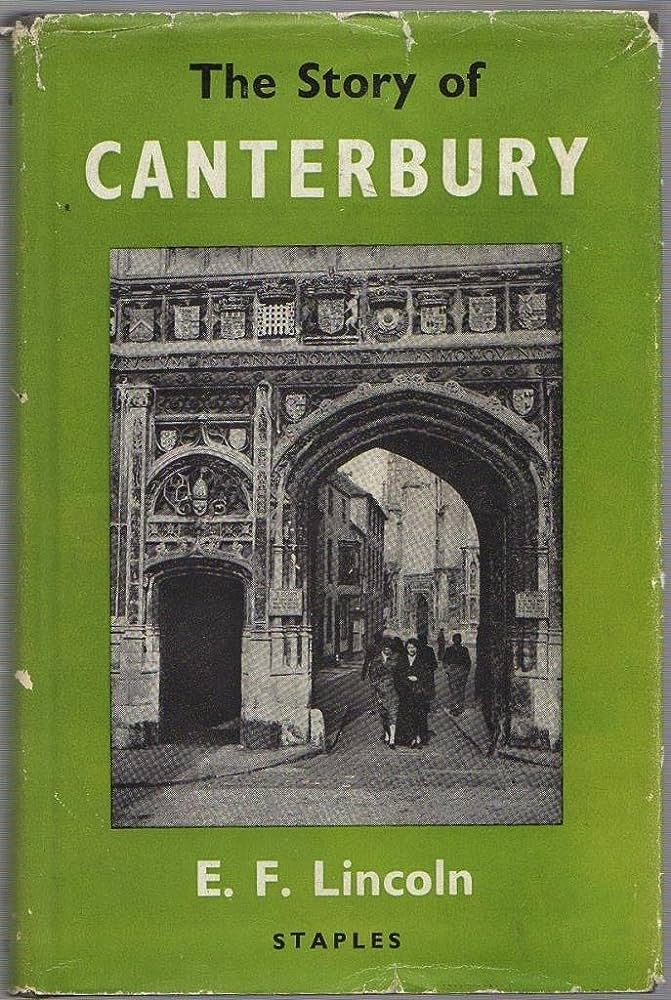
The Story of Canterbury by EF Lincoln, 156 pages

The Story of Canterbury is a brief history of the development of the city from the Cantii Gauls to the postwar years, through its time in the Roman province of Britain, the capital of the Kentish kingdom, the seat of the primate of England, a famed center of pilgrimage, a haven for Huguenot refugees, and a modest center of trade struggling to find a balance between past and future.  It is an interesting story simply and appealingly told, though with the inevitable Whiggish slant.

If the natural center of the story is the shrine of St Thomas, the focus of so much of the city's late medieval life, towards the end another shrine appears, that of the Invicta locomotive that first pulled a train from Canterbury to Whitstable, after a procession through the town center amid the pealing bells of the Cathedral and the cheers of great throngs of people.  Rarely has the unquiet ghost of Henry Adams been more invisibly and profoundly present.

Saturday, July 1, 2023

Early History of Glastonbury

The Early History of Glastonbury by William of Malmesbury, translated by John Scott, 83 pages

The Early History of Glastonbury is a translation of William of Malmesbury's 12th century history De Antiquitate Glastonie Ecclesie, accompanied by the Latin text as well as commentary and notes. William undertook this project at the behest of the monks of Glastonbury, at least partially as a supplement to four Lives of Glastonbury saints he had written (of which only the Life of Saint Dunstan survives), but the primary aim seems to have been a catalogue of the various charters and bequests associated with the monastery.  Indeed, the short book is generally more of a legal record than a conventional history, as rights and privileges awarded to the abbot and monks are thoroughly documented - in the uncertain period following the Norman conquest, this was a necessity.

For a modern reader this focus proves something of an obstacle, as it does not make for particularly entertaining reading.  To the kind of reader who is likely to even consider reading a 12th century monastic history, however, the rewards will almost certainly be worth the price.

Saturday, June 17, 2023

City of Bath

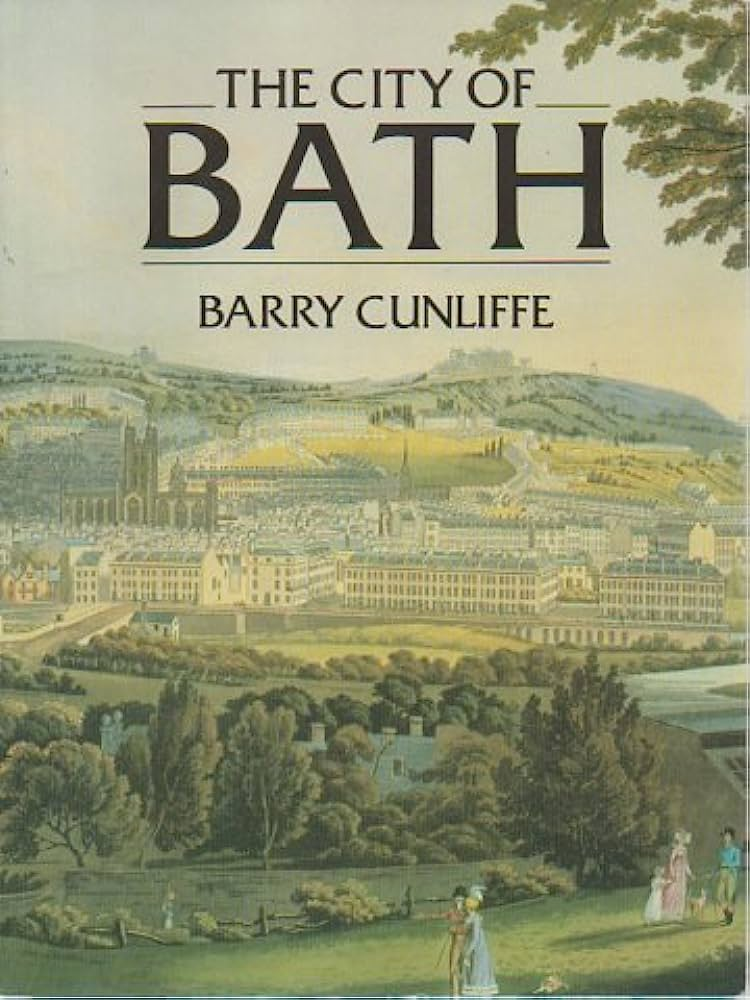
The City of Bath by Barry Cunliffe, 175 pages

Not to be confused with the seat of Steuben County, the city of Bath in Somerset has been occupied since the Romans built a public bath and temple over the hot springs in the first century AD.  Through the following millennia its fortunes rose and fell, becoming in turns home to a magnificent abbey, a site of royal coronations, a sleepy backwater, a fashionable (and later unfashionable) resort, a headquarters for the Royal Navy, and a tourist town.  It is its Georgian phase, as its 18th century magnificence turned increasingly shabby in the 19th, that it is best remembered today, largely through the novels of Jane Austen.

Barry Cunliffe surveys the material history of the city throughout its lifetime, charting the changing buildings and streets.  Those hoping for a history of the people are likely to be disappointed, for Cunliffe doesn't even waste much time with anecdotes about major figures.  Those who prefer unadorned facts, on the other hand, are likely to be pleased, although perhaps even they would appreciate a master map somewhere among the many fine illustrations.

Wednesday, September 14, 2022

Grant’s Last Battle: The Story Behind the Personal Memoir of Ulysses S. Grant

 Grant’s Last Battle: The Story Behind the Personal Memoir of Ulysses S. Grant by Chris Mackowski, PhD 192 pages

One of the books on my bucket list is “The Complete Personal Memoirs of Ulysses S. Grant.” I have put it off because the two-volume set is intimidating, especially to a reader who enjoys historical fiction than total history.

When I saw this small book on the shelf at the library, I thought I would try it. I’m glad I did. The reader/writer in me loved the first sentence: “Frederick Ward was a sociopath, but no one knew it at the time.” Doesn’t that make you want to read more? I was certainly hooked.

Most of us know Grant as the Union general who defeated General Robert E. Lee in the Civil War and who went on to become a tow-termed United States President. Two terms. But Grant had a full life off the battlefield and after his presidency. Author Mackowski does an excellent job in summing up the before the war made Grant a household name without getting in the way of this extremely personal story.

This succinct history takes place between May 4, 1884, and mid-July 1885. It is the story of Grant’s financial ruin, his tortured battle with throat cancer (from twenty cigars a day) and a drive, plus the urging of Samuel Clemens, which made him complete his memoirs before his illness killed him.

In the compulsively readable book, readers get to go behind the scenes in the life of a public man to learn about what drove him in this last stretch. And what drove him was Clemens’ assurance that the sales of his memoirs would provide financial security for his family. The memoirs were an instant hit when they were released in 1885 and remain one of the few books that has never gone out of print.

Mackowski has authored a book that is “Filled with personal intrigues and supported by a cast of colorful characters that included Mark Twain, William Vanderbilt, and P. T. Barnum, ‘Grant’s Last Battle’ recounts a deeply personal story as dramatic for Grant as any of his battlefield exploits.”

When I finished reading, I closed the book with a greater sense of respect and admiration for the “Hero of Appomattox.” 

“Grant’s Last Battle” receives 5 out of 5 stars in Julie’s world


Tuesday, March 8, 2022

Stalin's War

Stalin's War: A New History of World War II by Sean McMeekin, 666 pages

Sean McMeekin's provocative thesis in Stalin's War is that it is Stalin, not Hitler, who should be regarded as the central figure of World War II.  In proposing it, he is defying decades of Western historiography which has centered the war on Hitler's showdown with the French and British empires, as well as the Russian perspective in which the USSR is portrayed as the victim of Western perfidy and German aggression.  In McMeekin's persuasive retelling, neither the European nor the Pacific wars would have happened absent Stalin's active encouragement, and even Barbarossa was just as much a consequence of Stalin's ambitions in Central Europe as Hitler's.  Even more importantly, Stalin received from the war more than he could ever have hoped for, not only a mostly free hand in Central Europe and East Asia, but immense subsidies from US taxpayers to help build the Soviet military-industrial base.

The book is necessarily long and repetitive, yet McMeekin writes in a way that saves it from becoming ponderous.  Some may find the seemingly endless catalogues of lend-lease material supplied to an ungrateful mass murderer tiresome, but this is more than compensated for by the foregrounding of information which will be new even to those generally well-informed about the Second World War.

Tuesday, August 10, 2021

Borgias

The Borgias: The Hidden History by GJ Meyer, 431 pages

Everyone knows that after Rodrigo Borgia became Pope Alexander VI, he commenced an orgy of depravity the likes of which Rome had not seen since the days of Caligula and Nero.  Together with his bastard children, Cesare and Lucrezia, Alexander organized a criminal campaign of self-aggrandizement on a massive scale, while still finding time for some recreational murder and incest.

It's a wonderful story, featuring the darkest corruption in the holiest of places, playing upon popular prejudice and prurience, and as such it has been told and retold, most recently in hit TV shows and novels.  The only problem, according to GJ Meyer, is that very little of it is true.  Most of it is based on rumors spread by the rivals of the Borgias, given added currency by growing Italian nationalism and the Spanish origins of the family, their undisguised ambitions, and the almost complete collapse of their power after the death of Alexander, all of which was taken up and amplified by anti-Catholic polemicists in the centuries following the Reformation, eventually becoming engrained in conventional history alongside the Black Legend.  Going further than merely pointing out the obvious problems with the Borgia legend - the obviously invented operatic scenes, the supposed poisons whose effects are different from every poison known to modern medical science, the many positive accounts of Rodrigo's character before his election and Lucrezia's character after his death - Meyer challenges the most deeply ingrained myth of all, presenting strong circumstantial evidence suggesting that Cesare, Lucrezia, and their siblings were not, in fact, the illegitimate children of Rodrigo Borgia, but the legitimate children of his nephew.

The Borgias is not merely a debunking of myths.  Meyer turns the true story of the Borgias into a compelling story of ambition and intrigue, all while admirably informing the reader on the politics and culture of Renaissance Italy, a haphazard collection of independent and semi-independent states continually forming alliances and feuds with each other and the French and Spanish empires beyond the peninsula.

Thursday, May 6, 2021

King's Minion

The King's Minion: Richelieu, Louis XIII, and the Affair of Cinq-Mars by Philippe Erlanger, translated by Gilles and Heather Cremonesi, 240 pages

As the Thirty Years' War stumbled to its exhausted close, it became increasingly clear that the power of France would dominate the Continent, and that the director and architect of that power was the Red Eminence, Armand Jean de Plessis, Cardinal de Richelieu.  If to some he seemed nearly omnipotent, canny observers - and there were none more canny than the Cardinal himself - understood how precarious his position truly was, for he was deeply unpopular and served only at the pleasure of the king.  Louis XIII, for his part, personally loathed the man who had forced him to send his beloved mother into exile and thrown France into a murderous war for which he would have to answer before God, yet Louis also recognized his minister's genius and found him irreplaceable.  In an effort to ensure that this did not change, Richelieu went to great lengths to introduce Louis to the charming young Henri Coiffier de Ruze, Marquis de Cinq-Mars.  As Richelieu hoped, Cinq-Mars captivated the king, swiftly replacing his quarrelsome mistress Marie de Hautefort in his affections.  The proud, impetuous Cinq-Mars chafed under Richelieu's patronage, however, and soon found himself embroiled in a series of conspiracies against the Cardinal, eventually leading to a tragic end for the royal favorite.

Erlanger walks breezily through the backroom intrigues of the baroque court, following the interwoven plots with a clear narrative and such memorable sketches of the various personalities involved that even minor figures are easily distinguished.  If at times this leads him to go beyond the facts and to presume to know the hearts and minds of his subjects, it is easy enough to recognize this as the informed speculation it is.

Wednesday, March 31, 2021

Tales of the Early Franks

 Tales of the Early Franks: Episodes from Merovingian History by Augustin Thierry, translated by MFO Jenkins, 166 pages

It is no less a commonplace of our time than of Augustin Thierry's that the so-called "Dark Ages" are a confusing, dull, and unprofitable era to study - indeed, the sometimes-equivalent term "Middle Ages" seems to imply an unedifying interlude between the more significant Classical and more important Modern periods.  If scholars and ideologues are divided on when the "darkness" fell, in what, precisely, it consisted, and when and how it lifted, it seems certain that Gaul in the late 6th century was deep beneath it.  

It should be a pleasant surprise, then, to discover Thierry's tales of love, war, religion, politics, and intrigue in the Merovingian era.  Based largely on the histories and memoirs of St Gregory of Tours, Thierry's work is divided into seven interrelated narrative episodes covering events ranging from the tragic life of Queen Galswinth to the rigged trial of Bishop Praetextatus to the happy friendship of Radegund and Venantius Fortunatus.  Thierry delightfully combines a contagious love for the period with a deep awareness of the importance of personalities and character.

Saturday, December 19, 2020

Anabasis

 The Anabasis by Xenophon, from Xenophon (vols 2 and 3), translated by Carleton L Brownson, 316 pages

As the year 400 BC approached, a Persian prince named Cyrus hired ten thousand Greek mercenaries to help him seize the throne from his brother, Artaxerxes.  Recruited under false pretenses from across Greece, the decisive battle of the campaign ended with the Greeks holding the field but Cyrus dead and their Persian allies inclined to appease the king. Isolated in the midst of a hostile empire, the Ten Thousand managed to fight their way back to Greece. How they did so is the subject of Xenophon's Anabasis, which is not only a historical record but also an eyewitness account, Xenophon himself having been caught up in the Persian adventure and playing a significant role after the death of Cyrus.

Not that long ago, Xenophon's classic was a standard school text.  It is not difficult to understand why.  The book provides an immersion into the lives and culture (and, if one chooses to read it in the original, the language) of the ancient Greeks, packaged within a story of military adventure, manly virtue, and heroic speeches.