Showing posts with label religion. Show all posts

Thursday, September 8, 2022

Li Chi

Li Chi: Book of Rites, translated by James Legge, 949 pages (2 vols)
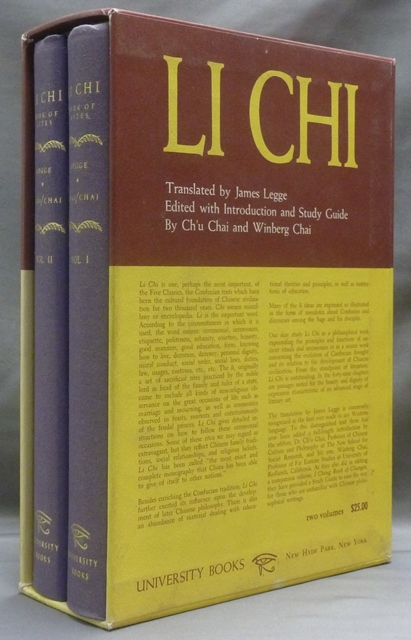
The Li Chi (pinyin Liji) is a collection of Confucian texts compiled in the Han dynasty dealing with matters of classical Chinese ceremonial.  Much of it concerns the minutiae of proper observance, including difficult questions when unusual circumstances impose conflicting obligations.  Other texts consider the nature and value of ceremony against those who would reject it as mere outward show, maintaining that ritual is essential to the proper ordering of emotion, evoking the proper feelings in those who lack them and restraining the passions of those who cannot control themselves.

The Li Chi is one of the "Five Classics" of Confucian philosophy.  As such, it has been studied, interpreted, glossed, and debated by legions of scholars for thousands of years.  Legge attempts to condense some of this conversation into the footnotes, along with notes on difficult translations and the claims of textual critics, and he succeeds in doing so without burying the text in the commentary.  Most readers will find it to be primarily of antiquarian interest, which is hardly surprising given that the motives of the authors and compilers was itself antiquarian, a search into the past, not due to idle curiosity or academic ambition, but out of a love of wisdom and a deep need for models to be imitated.  

Friday, August 5, 2022

Natural Symbols

Natural Symbols: Explorations in Cosmology by Mary Douglas, 167 pages

In the conventional view, as history progresses men naturally turn away from rote ritual in favor of more personal and meaningful expressions of social life and worship.  Ritual is viewed as something imposed by the strong upon the weak in order to reinforce the existing power relationships.  As Mary Douglas explains in this revelatory work, this simple narrative fails to account for either the diversity of ritual intensity and development among "primitive" peoples and the passionate connection to ritual of certain marginalized groups in the developed world.  Instead, she concludes, ritual is a vital part of the language of peoples with a strong sense of community and well-defined social roles, while populations that are more undifferentiated and individualistic reject ritual and prioritize inward states and expressive gestures.  Moreover, she suggests, this latter attitude not only reflects and enhances the alienation of the individual from society, but encourages a conception of the spirit as radically independent of, and naturally in opposition to, the body.

Douglas is very clear that she is building upon the work of a number of others, and this can be a bit disorienting for those not familiar with some of the thinkers and theories involved.  This is a small price for a study that so lucidly explicates much that would otherwise remain inexplicable, not least of all the ingrained, and often unexamined, hostility to ritual, both civic and religious, on the part of modern Western elites, both secular and ecclesiastic.  

Wednesday, May 11, 2022

Birgitta of Sweden

Birgitta of Sweden: Life and Selected Revelations by St Birgitta of Sweden and others, translated by Albert Ryle Kezel, 235 pages

St Birgitta (often referred to as St Bridget but here given the more Teutonic variant in order to distinguish her from her more popular Irish namesake) was born in Sweden around 1303 and died in Rome in 1373.  Such was her reputation that she was canonized less than two decades later.  Beginning in early girlhood, she experienced a series of mystical visions of varying nature and subject matter, all drawing her into an ever more passionate love for God, a consuming flame that demanded to be spread to others. 

The core of St Birgitta's visions, as they are presented here, are of a dissolute monk (unnamed but known to the visionary) who interrogates God as to His nature and the nature of His creation.  This runs through an impressive catalogue of objections to God's existence, not only general questions about the existence of evil but also more specific inquiries into the cruelty of beasts, the economy of salvation, and the purpose of pleasure, all resolved with holy clarity and simplicity.  The collection of texts is rounded off with the rather dry Life prepared for her canonization and a selection of moving prayers to Christ and His Mother.

Tuesday, March 1, 2022

Nostos

Nostos by John Moriarty, 698 pages

"Nostos", I am told, means "homecoming", in particular referring to the homecomings of the heroes of the Trojan War.  In John Moriarty's poetic memoir, his particular home is an impoverished farm in the Irish countryside, a shadowy place of earth and blood, far from the seemingly well-ordered certainties of modernity.  He is exiled from this place by Darwin and his companions, whose arrival was as fatal to the old European mythos as that of Cortes was to the Aztecs.  His restless wanderings take him first to England, then to Greece, and finally to the New World, through myths both ancient and modern, before he is allowed to return at last to that still point he left in his beginning.

It is natural to compare Nostos to Finnegan's Wake, not only because the authors are both Irish, or because both delight in wordplay and allusion and repetition, or because the Liffey features in both works, or even because Moriarty explicitly references Joyce repeatedly.  Both attempt to describe something that eludes description, to discover or recover something mysterious yet fundamental, although Moriarty's commodius vicus of recirculation begins and ends upriver of Howth Castle and environs, and even beyond Eve and Adam.  Nostos is a unique and unforgettable work, full of beauty and wonder and (best of all) hope.

Thursday, October 21, 2021

Crime and Punishment

 Crime and Punishment by Fyodor Dostoevsky, translated by Constance Garnett, 484 pages

"...a fantastic, gloomy business, a modern case, an incident of to-day when the heart of man is troubled, when the phrase is quoted that 'blood renews,' when comfort is preached as the aim of life.  Here we have bookish dreams, a heart unhinged by theories.  Here we see resolution in the first stage, but resolution of a special kind: he resolved to do it like jumping over a precipice or from a bell tower and his legs shook as he went to the crime."

It is difficult to imagine a better description of Crime and Punishment than that which Dostoevsky offers through the voice of one of his own characters, especially as the form - a prolonged monologue - is how much of the novel's action unfolds.  Raskolnikov is a failed student languishing in late nineteenth century St Petersburg, possessed by the notion that he can, by a single decisive act, break totally with the past and enter a realm of absolute freedom.  What he slowly and painfully discovers is that that realm is found in an entirely different direction, at the end of a radically different path, than he imagined.

It is difficult to say anything new about Crime and Punishment.  Obviously, it is not for everyone.  It is dreary and disorienting and merciless towards the reader.  Just as obviously, it is a work of genius, an incredible artistic achievement as well as an antidote to much of the existentialist sophistry that followed in its wake.

Friday, October 15, 2021

Three Ages of the Interior Life

The Three Ages of the Interior Life: Prelude of Eternal Life (Volume One) by Rev Reginald Garrigou-Lagrange OP, translated by Sister M Timothea Doyle OP, 470 pages

This book is an adaptation of a course Father Garrigou-Lagrange taught for over twenty years at the Pontifical College of St Thomas Aquinas (the Angelicum) in Rome.  The subject is mystical and ascetic theology, subjects which are sometimes treated as distinct but which the author demonstrates form a unity.  More importantly, he explains that these are not the concern merely of great saints and spiritual athletes, but are the heart of the universal call to holiness.  The interior life in which the soul ascends to God is both a foretaste of and a necessary preparation for that heaven which is true life in His presence.

The first volume treats of some foundational matters as well as the first of the three stages described by the great mystical writers, the purgative way.  Given the origin of the book, Garrigou-Lagrange's intended audience is current and future priests and spiritual directors, but despite occasional digressions into theological complexities, the work itself is imbued with a deep love of God and a concern for the souls of the faithful, so that it is pastoral in the best sense of the word.  A lay reader is likely to find himself both enlightened and inspired, though there is danger in reading beyond one's level.

Monday, September 27, 2021

Essays

Essays on Catholicism, Liberalism, and Socialism Considered in Their Fundamental Principles by Juan Donoso Cortes, translated by Rev William McDonald, 347 pages

In his celebrated 1988 Gifford lectures, Alisdair MacIntyre exposed the failure of both the modernist "encyclopedic" and postmodernist "genealogical" approaches to ethics, a failure rooted in their incommensurability, their inability to meaningfully dialogue with and assimilate alien systems.  Now we stand in the ruins of those towers of human pride, with leaders who, whether from knavery or imbecility or some mixture of the two, leap uncomprehendingly from one to the other, asserting at one moment that "my truth" is something manufactured, and at the next that it issues from the Delphic prophetess Science, once her mad ravings have been suitably interpreted by her labcoated priests.  If reason is the slave rather than the master of the passions, every subjectivity is at war with every other, convenient lies contending with convenient lies, and so the heathen rage.

This was all warned against by Juan Donoso Cortes in the early nineteenth century.  The liberal superstition that truth will triumph in a free marketplace of ideas is belied by the fact that men do not seek the truth, to the contrary, even when the Truth appeared to them they mocked Him, spit on Him, and ultimately crucified Him.  The entire liberal project is founded on the mistaken belief that human freedom consists of the power to choose between good and evil rather than the ability to will the good.  The result is moral chaos, the war of all against all by other means, and sin, Cortes reminds us, is nothing more or less than disorder, the confusion of lesser goods for higher, ending in the disunion of soul and body which is death.  Life, then, is order, true order, the harmony which exists in the presence of the supreme mysteries in the light of which all apparent contradictions are resolved.   

Friday, August 6, 2021

Real Music

Real Music: A Guide to the Timeless Hymns of the Church by Anthony Esolen, 274 pages

It is a truth rarely acknowledged that the Christian liturgy is at the center of the Western artistic tradition.  Both the fine and the practical arts developed as the handmaids of the Mass.  It can be argued that the seemingly undeniable decline of art over the course of the past few centuries is directly connected to the divorce of aesthetics from the sacred, and it is inarguable that this same divorce has impoverished the Church and resulted in much of what is seen, said, and sung being banal and second-rate.  It is under these conditions that Anthony Esolen invites us to consider the great hymns of the past, from the Protestant as well as Catholic tradition, and to appreciate their continuing power.

Esolen is a professor of English and not of music, which is reflected here in his concentration on poetry rather than melody.  Balancing this somewhat, the physical book includes a CD with performances of some relevant hymns by the St Cecilia Choir of Chicago's St John Cantius Church.  Despite the connection to St John Cantius, the book is not primarily a liturgical prescription, and Esolen is generally too preoccupied by the beauty of the hymns he is discussing to spend much time denigrating more recent compositions.  Instead, the book has the character of a devotional, exploring in a surprisingly moving way what these songs tell us about the Divine and our relationship with Him.

Tuesday, August 3, 2021

Christus Vincit

Christus Vincit: Christ's Triumph Over the Darkness of the Age by Bishop Athanasius Schneider and Diane Montagna, 421 pages

In the relatively new but vital tradition of book-length interviews of Catholic prelates, popularized by Cardinal Ratzinger and continued by Cardinal Sarah, Christus Vincit is an expansive, free-ranging conversation with the auxiliary bishop of Nur-Sultan, the capital of Kazakhstan.  It might understandably be asked what this man of the peripheries has to offer the Church and the world.  Quite a bit, as it turns out, and if little of it is new, most of it is excellent.

The heart of Bishop Schneider's message is that the naturalistic turn the Church took in the twentieth century has been a disaster pastorally, evangelically, and theologically.  To counter this, he calls for a renewed emphasis on the supernatural and the transcendent.  Again he reminds us that human beings are embodied creatures rather than pure spirits, that history is not Providence but has a providential aspect, and that while all earthly economic and political arrangements, debates, and crises are passing, there is a Kingdom which is eternal.  Unfortunately, there is also a certain amount of conspiratorial thinking, mostly involving the Freemasons, some of which may be true but which generally seems out of place and fantastical.

Tuesday, July 27, 2021

Word and Image

Word and Image: An Introduction to Early Medieval Art by William J Diebold, 148 pages

In Word and Image, William Diebold describes the development of early medieval art in the context of the interplay of the appeal of the visual arts and the Christian fear that such appeal might lead to idolatry.  Beginning with St Gregory the Great's famous defense of images as "the book of the illiterate", Diebold demonstrates how the language of images essentially differs from that of words, and how the Christian West made peace with those differences.

Diebold's argument is interesting and his writing clear.  The book is full of excellent (though inevitably mostly monochrome) illustrations.  Unfortunately, the text seems to present medieval Christianity as primarily a matter of certain intellectual propositions only incidentally reflected in practices, and likewise to consider writing as primarily a vehicle for rational argument rather than affective narrative.  Perhaps these deficiencies could have been eliminated had the book been a bit longer and deeper.

Tuesday, July 20, 2021

Unbroken Thread

The Unbroken Thread: Discovering the Wisdom of Tradition in an Age of Chaos by Sohrab Ahmari, 265 pages

In The Unbroken Thread, Sohrab Ahmari attempts to draw his readers' minds to a series of twelve questions, including "How Do You Justify Your Life?" and "What Do You Owe Your Body?"  He asks us to meditate on these questions in the light of the ideas and experiences of thinkers ranging from Confucius to Andrea Dworkin.  These are hard questions that defy simple answers, essential questions, yet questions that few seriously consider beyond the superficial responses that our superficial society provides.  In inviting us to consider such fundamental matters, Ahmari threatens to radically transform how we think about ourselves and the world.

The Unbroken Thread is not a self-help book.  It is not a quick survey of great books offering cheap self-satisfaction or conversation starters.  It isn't a diatribe against the ills of the modern world.  It isn't an especially challenging book, intellectually.  It is remarkably personal, seemingly for the author and certainly for those readers willing to engage with it.

Thursday, April 29, 2021

The Day Is Now Far Spent

The Day Is Now Far Spent by Robert Cardinal Sarah and Nicolas Diat, translated by Michael J Miller, 343 pages

The hour is late indeed, says Cardinal Sarah in this book-length interview with his favorite interlocutor, Nicolas Diat.  The Church, he tells us, is riven by dissension, compromised by unbelief, and stained with sin.  Meanwhile, the decadent ruins of Christendom are in the grip of a "fundamentalist liberalism" that pursues wealth and power (often under the guise of "justice" and "liberation") while treating the sacred with indifference and contempt.  The irony is that, by attempting to place himself at the center of the world, modern man has created a world in which he is increasingly superfluous.  Not content in its iconoclasm with the destruction of its own past, the neo-colonialist West actively works to erase the cultures of Africa and Asia even as it plunders their lands of their natural resources.  

It is necessary, then, for faithful Catholics to resist the temptations of compromise and despair.  This demands the cultivation of virtue and excellence - "The Church does not have the right to be mediocre."  Fittingly for the author of The Power of Silence, while Sarah's message is urgent, it is not primarily a "call to action", but a call to prayer and contemplation.  "Your mission is not to save a dying world... Your mission is to live out with fidelity and without compromise the faith you received from Christ."

Wednesday, March 17, 2021

Nine Songs

 The Nine Songs: A Study of Shamanism in Ancient China by Yuan Qu, translated by Arthur Waley, 61 pages

The "Nine Songs" were probably written down in the 3rd or 4th century BC, although the songs themselves are clearly older than that.  The eleven short poems are ritual hymns intended to aid a shaman in summoning a spirit or god.  Interestingly, they are love songs, with the god often described as a fickle lover and the shaman as the longing, forsaken partner.  As Waley suggests in his introduction, the closest Western equivalent is likely the Song of Songs, and similarly to that work the Nine Songs have been given a variety of allegorical interpretations down through the centuries, including many which literal-minded moderns will no doubt find impossibly tendentious.

Tracing the influence of the Nine Songs in Chinese cultural history is not Waley's aim, however.  Rather, he is interested in presenting them in something resembling their original context.  To this end, not only has he supplied an excellent introduction to the series as a whole, but each poem also gets its own brief but informative commentary.

Thursday, November 19, 2020

Zoroastrian Faith

 The Zoroastrian Faith: Tradition and Modern Research by SA Nigosian, 118 pages

Zoroastrianism is an outlier within the elastic category of Great World Religions.  For centuries it was practiced throughout successive and expansive Persian and Parthian empires, ordering the lives of millions of devotees.  It survives today only among tiny populations in Iran and India and their scattered emigre communities.  Often inaccurately labeled "fire-worship" or misunderstood as Manichaean dualism, not entirely monotheistic but not exactly polytheistic either, with strong similarities to Hinduism but also deep resonances with Judaism, Christianity, and Islam, the Zoroastrian faith is unique and more than a mere curiosity.

Thankfully, SA Nigosian's survey of Zoroastrian faith and practice is true to its subtitle: "Tradition and Modern Research."  Nigosian does not approach the former uncritically, but neither does he elevate the claims of the latter to indisputable truth.  Above all, he is willing to admit when something is simply not known.  Best of all, he writes almost purely descriptively, generally avoiding the pseudo-apologetical mode common in these kinds of books.  

Tuesday, July 14, 2020

Scholia to an Implicit Text

Scholia to an Implicit Text, Nicolas Gomez-Davila, Bilingual ...Scholia to an Implicit Text by Nicolas Gomez-Davila, translated by Roberto Pinzon, 195 pages

Nicolas Gomez-Davila was born in Colombia, but spent much of his childhood in Paris, including two years in which he was bedridden with pneumonia.  Recovering and returning to his homeland, he set about assembling one of the largest private libraries in the country, which served him as a kind of secluded smithy in which he refined and shaped his volumes of aphorisms.  Scholia to an Implicit Text is thus far the only work of his to be published in an English translation.

A "defeated unbeliever" who turns modern skepticism back on itself, fishing "with a net of doubts", a careful crafter of sentences who insists on the importance of the sensuous and the liturgical, a romantic reactionary who knows that the past is irrecoverable but not unrepeatable, Gomez-Davila is profound and provocative and never, ever boring.  He is also not an ideologue - central to his worldview is the rejection of the distinctly modern belief that problems require solutions rather than understanding.  The values that Gomez-Davila treasures do not require defence because they are eternal and indestructible, whereas every sin is its own worst punishment, and therefore the twentieth century "will bequeath nothing but the traces of its hustle and bustle at the service of our filthiest desires."

It could be worse, of course, and will be, if Gomez-Davila is correct in his assessment that totalitarianism is the natural end of modernity, "the technification of politics."  "A totalitarian state is the structure into which societies crystallize under demographic pressures," when solitude and the inner life have been made impossible.  "The 'rational', the 'natural', the 'legitimate' are only that which is customary.  To live in compliance with an enduring political constitution, behaving according to enduring customs, surrounded by enduring objects, is the only way to believe in the legitimacy of the ruler, in the rationality of habitudes, and in the naturalness of things."  All that being rejected, the world is waiting, not for Pericles, but for another, doubtlessly very different, Pol Pot.

Tuesday, June 16, 2020

Introduction to Christianity

Introduction to ChristianityIntroduction to Christianity by Joseph Ratzinger, translated by JR Foster, 359 pages

Introduction to Christianity is an adaptation of a series of lectures given by Joseph Ratzinger in 1967 and first published in written form in the momentous year of 1968.  Although he would go on to become bishop of Munich, then a cardinal and the head of the Congregation of the Doctrine of the Faith, and finally ascend the throne of St Peter as Benedict XVI, at the time this book was written he was still the dashing young peritus of the Second Vatican Council, and the book itself is very much a response to the theological winds that had begun to blow through the windows the Council opened.  Indeed, in Introduction to Christianity Ratzinger outlines the theological project that would fill his remaining life.

This begins with the recognition that Christianity is unavoidably a historical religion, founded in a real past and not a mythic long ago, unfolding in the lives of the prophets and the saints with the Incarnation at the center.  One consequence of this is that the progressive attempt to inaugurate a revolutionary new Christianity freed from its actual historical development is inevitably futile.  Ratzinger argues instead for the providential role of Hellenistic philosophy in early Christianity, just as he argues that modern Christianity can be enriched rather than impoverished by the real contributions of modern scholarship.  His ultimate aim is to demonstrate the unity of the living "God of Abraham, Isaac, and Jacob" with the "God of the philosophers and scholars", the God of faith with the God of reason, and how the work of reason is vitally - indispensably - involved in establishing a personal relationship with this transcendent God.

Friday, June 5, 2020

Spiritual Life

St. Theophan the Recluse - WritingsThe Spiritual Life and How To Be Attuned To It by St Theophan the Recluse, translated by Alexandra Dockham, 320 pages

In the middle of the nineteenth century, a young Russian woman in the grips of a profound spiritual crisis approached a holy monk for advice.  The resulting correspondence was preserved and collected in this book, which quickly became a Russian Orthodox classic.  St Theophan's balance of holy zeal and humane sympathy fully justifies this judgement of posterity.

For Latins, the obvious comparison is with St Francis de Sales, and indeed The Spiritual Life closely resembles the Introduction to the Devout Life in its attempt to chart a path to God for those living in the secular world.  If the Frenchman's work is more developed, the Russian's is more accessible, at least partially due to having been written two centuries closer to our own time.

Tuesday, January 7, 2020

Painted Glories

Painted GloriesPainted Glories: The Brancacci Chapel in Renaissance Florence by Nicholas A Eckstein, 208 pages

The frescoes painted by Masolino and Masaccio in the Brancacci chapel of Florence's Santa Maria del Carmine have been drawing admirers since they were painted in the early fifteenth century, although, as Nicholas Eckstein relates, their intended influence was not merely aesthetic, but simultaneously devotional, memorial, and didactic, shaped in both their conception and reception by a continually changing social and religious context.  Most notably, Eckstein contends, the chapel was transformed after Florence's defeat of a Milanese army in 1440, a victory that was attributed to the intercession of Sts Peter and Paul and the Florentine Carmelite Bl Andrea Corsini.

Little documentation of the creation of the Brancacci chapel has survived down to the present, leaving a number of intriguing mysteries which Eckstein attempts to solve with a combination of careful deduction and informed speculation.  The result is a vibrant portrait of Florence in the midst of the Renaissance.  If there is a major flaw to the book, it is that the focus sometimes seems lost, so that the art begins to disappear behind the history.

Monday, December 23, 2019

Household Gods

Household GodsHousehold Gods: The Religious Lives of the Adams Family by Sara Georgini, 204 pages

Gore Vidal memorably remarked, "As far as we know, it never occurred to any Adams of the Four Generations that there might be no such thing as eternal justice."  As Vidal went on to note, "eternal justice" took many forms in their imaginations.  Sara Georgini prefers to refer to it as "Providence", and the changes it underwent through the successive generations of America's first First Family, from the Puritan Henry Adams who first settled in Massachusetts to the historian Henry Adams who died mere blocks from the White House that had been occupied by his grandfather and great-grandfather, is the subject of her short book.

This tale obviously particularizes, and thus highlights, much larger movements within American religiosity and New England Protestantism.  For Georgini, who seems to equate Unitarianism with reason and progress, this may be viewed as a positive development.  For those who regard the transition from dogmatic principle to moral sentiment as rather a dissipation than an evolution, it will appear very different, but no less important.

Tuesday, November 19, 2019

Auden and Christianity

Auden and ChristianityAuden and Christianity by Arthur Kirsch, 179 pages

In Auden and Christianity Arthur Kirsch explores the impact of the faith of WH Auden primarily through an analysis of For the Time Being and the "Horae Canonicae".  In the process Kirsch reveals the extent to which Christianity served as a unifying principle in Auden's life and work, bringing together matter and spirit, the present and the past, the individual and society.

This is the kind of literary criticism that is expansive rather than reductive, illuminating one facet of an author's work without denying the existence or value of others.  Although Kirsch's remarkable combination of sensitivity and candor is unlikely to inspire readers to a greater love of God, it is very likely to lead to a greater love of Auden.