Showing posts with label Christianity. Show all posts

Friday, December 5, 2025

Life of St Dionysius

The Life of St Dionysius the Areopagite by Michael Syncellus, Anthony Pavoni, and Evangelos Nikitopoulos, 267 pages

The book of Acts records that St Paul, on his visit to Athens, converted one "Dionysius, a member of the Areopagus."  Tradition relates that this Dionysius, venerated as St Dionysius the Areopagite, would become the first bishop of the city, and was eventually martyred.  Halfway across the Roman Empire, the first bishop of what would become Paris, St Dionysius or Denis, was beheaded, his remains buried at the place where the church and abbey dedicated to him were eventually built, and it was sometimes claimed that this Dionysius was the Areopagite in exile from his native Greece.  In the early centuries of Christianity multiple works appeared which claimed to have been written by the Athenian bishop, among them foundational works on Christian mysticism and angelology, most of which seem to have been written by a single author.

Modern historians discount most of this, beyond the existence of two Dionysii, one in Athens and another, later one in Paris.  The writings are ascribed to a hypothetical pseudonymous author who is thought to have lived around 500 AD.  The Life of St Dionysius the Areopagite is a panegyric composed in the 9th century by the Greek scholar monk Michael Syncellus, a translation of which takes up about fifty pages of the present book.  Most of the rest is a scholarly attack on the historical consensus, arguing that the Dionysian corpus is actually the work of the Areopagite.  The authors argue that apparent seeming anachronisms are explicable in a 1st century context, and, more exhaustively, that what are assumed to be Pseudo-Dionysian borrowings from Proclus actually represent Proclean borrowings from Dionysius.  This last point is convincingly buttressed by what appear to be references to the corpus present in pre-fifth century writings.  

If the textual analysis is quite dense and sometimes baffling to a layman, it clearly deserves to be taken seriously and not dismissed with stale references to 19th century skepticism.

Friday, August 6, 2021

Real Music

Real Music: A Guide to the Timeless Hymns of the Church by Anthony Esolen, 274 pages

It is a truth rarely acknowledged that the Christian liturgy is at the center of the Western artistic tradition.  Both the fine and the practical arts developed as the handmaids of the Mass.  It can be argued that the seemingly undeniable decline of art over the course of the past few centuries is directly connected to the divorce of aesthetics from the sacred, and it is inarguable that this same divorce has impoverished the Church and resulted in much of what is seen, said, and sung being banal and second-rate.  It is under these conditions that Anthony Esolen invites us to consider the great hymns of the past, from the Protestant as well as Catholic tradition, and to appreciate their continuing power.

Esolen is a professor of English and not of music, which is reflected here in his concentration on poetry rather than melody.  Balancing this somewhat, the physical book includes a CD with performances of some relevant hymns by the St Cecilia Choir of Chicago's St John Cantius Church.  Despite the connection to St John Cantius, the book is not primarily a liturgical prescription, and Esolen is generally too preoccupied by the beauty of the hymns he is discussing to spend much time denigrating more recent compositions.  Instead, the book has the character of a devotional, exploring in a surprisingly moving way what these songs tell us about the Divine and our relationship with Him.

Friday, July 26, 2019

A Book Forged in Hell

A Book Forged in Hell: Spinoza's Scandalous Treatise and the Birth of the Secular Age by Steven Nadler, 279 pages


Summary courtesy of Goodreads: "When it appeared in 1670, Baruch Spinoza's Theological-Political Treatise was denounced as the most dangerous book ever published--"godless," "full of abominations," "a book forged in hell . . . by the devil himself." Religious and secular authorities saw it as a threat to faith, social and political harmony, and everyday morality, and its author was almost universally regarded as a religious subversive and political radical who sought to spread atheism throughout Europe. Yet Spinoza's book has contributed as much as the Declaration of Independence or Thomas Paine's Common Sense to modern liberal, secular, and democratic thinking. In A Book Forged in Hell, Steven Nadler tells the fascinating story of this extraordinary book: its radical claims and their background in the philosophical, religious, and political tensions of the Dutch Golden Age, as well as the vitriolic reaction these ideas inspired.

It is not hard to see why Spinoza's Treatise was so important or so controversial, or why the uproar it caused is one of the most significant events in European intellectual history. In the book, Spinoza became the first to argue that the Bible is not literally the word of God but rather a work of human literature; that true religion has nothing to do with theology, liturgical ceremonies, or sectarian dogma; and that religious authorities should have no role in governing a modern state. He also denied the reality of miracles and divine providence, reinterpreted the nature of prophecy, and made an eloquent plea for toleration and democracy.

A vivid story of incendiary ideas and vicious backlash, A Book Forged in Hell will interest anyone who is curious about the origin of some of our most cherished modern beliefs."


Nadler sheds light on Spinoza. He isn't a philosopher that is discussed a lot by philosophers and his ideas aren't well known. He also touches on Spinoza's ethics. Spinoza was Jewish but gave up Judaism. Despite what some believe he didn't become atheist or convert to Christianity. He had a different conception of God and religion. I appreciated the context that Nadler provided for Spinoza's book and philosophy. I would recommend this book to people that like reading history, religion or philosophy.

Tuesday, May 21, 2019

Anti-Mary Exposed

The Anti-Mary ExposedThe Anti-Mary Exposed: Rescuing the Culture from Toxic Femininity by Carrie Gress, 196 pages

For Carrie Gress, the feminism which rose to prominence in the '60s and '70s and quickly became cultural orthodoxy only pretended to offer women liberation, instead promoting a distorted perversion of femininity.  In her telling, the vanguard of the women's movement consisted of its most dysfunctional members, and they have used the power of the media to shape a concept of the modern woman after their own image - vulgar, shallow, petulant, self-absorbed, and, above all, hostile to the Marian ideals of virginity and motherhood.  More than an ideological struggle, Gress presents this as nothing less than a diabolical plot to replace the Marian "fiat" with the Luciferian "non serviam".

This is definitely a book written for the choir, and a women's choir at that.  Anyone who does not accept Gress' premises will not be swayed by demonic testimony reported by exorcists.  For believers, there is another danger, in that Gress' sensationalism sometimes lends to her subjects a glamour that covers the tired banality of yesterday's transgressions.  That the book is aimed almost exclusively at women is both inevitable and fitting, given Gress' contention that women's identities have always been influenced, for better or worse, far more by other women than by men.  Thus it is that she advances the icon of "not only a well-behaved woman who made history but the best-behaved woman around whom all of history turns" to oppose that of a high-heel stomping on a human face, forever.

Thursday, May 16, 2019

Philosophers Without Gods

Philosophers Without Gods: Meditations on Atheism and the Secular Life edited by Louise M. Antony, 315 pages


This collection of essays is divided into two parts. The first part is Journeys and the second part is Reflections. The essays are relatively short as they are about 10-20 pages.

The essays in Journeys are autobiographical. They describe how the essay writer grew up with religion and how he or she became an atheist. It includes perspectives from Jewish people and Christian people. It was noteworthy that a lot of the stories were similar. I almost thought I had just read some of them. It also stood out to me that a lot of the people were heavily religious before they became atheist.

The essays in Reflections cover a range of ideas related to atheism. One considers whether there can be transcendence without God. A couple consider how we can have ethics and morality without God. Others of them tackle belief and the nature of God. They cover some of the same ground but have different perspectives and opinions on the same questions.

I would recommend this to those interested in atheism or philosophy.


Tuesday, April 16, 2019

Way of a Pilgrim

Image result for The Way of A Pilgrim And The Pilgrim Continues His WayThe Way of a Pilgrim and The Pilgrim Continues His Way by Anonymous, translated by RM French, 224 pages

Sometime in the 1850s, an anonymous Russian peasant attending Divine Liturgy heard St Paul's injunction to "pray without ceasing" and went in quest of a method to put it into practice.  In time, he found this in hesychasm - the practice of praying, with every breath, the Jesus Prayer: "Lord Jesus Christ have mercy on me."  The purported record of his journeys, both physical and spiritual, was supposedly discovered some time later in a monastic library, and circulated widely among Russian monks before being discovered by the outside world.

In the opening passages of this memoir, the author rejects the sound advice of a variety of holy men on growth in the spiritual life, as none of them are able to offer him a concrete technique to accomplish his specific goal of living in a state of perpetual prayer.  This is the danger of the book - it is easy to ignore the repeated insistence on the necessity of spiritual direction and seize upon hesychasm as a shortcut or "simple trick to grow closer to God".  This danger is heightened by the apparent speed of this pilgrim's progress, but will be avoided by the careful reader.  Such a reader is also likely to notice that the sequel is very different in style and tone from the original, lending credence to the claim that one or both is a pious fable rather than a genuine memoir.  This in no wise detracts from a genuinely moving story of faith and growth in holiness.

Monday, October 29, 2018

The Year of Our Lord 1943

The Year of Our Lord 1943The Year of Our Lord 1943: Christian Humanism in an Age of Crisis by Alan Jacobs, 206 pages

Samuel Johnson famously quipped that when a man knows he is to be hanged, it "concentrates his mind wonderfully."  For Christian thinkers in Europe and America, the catastrophe of the Second World War wonderfully concentrated their minds on the problem that liberal democracy could not, on its own, provide a convincing account of human nature to rival those proposed by fascist and socialist ideologies.  In The Year of Our Lord 1943 Alan Jacobs explores the disparate ways a number of disparate philosophers and poets, including Jacques and Raissa Maritain, TS Eliot and Simone Weil, CS Lewis and WH Auden, sought to rectify that deficiency.  Despite substantial differences, their thoughts all focused on culture and education, not only their necessity but also their limitations - indeed, all were insistent that any education which sought to contribute to the building up of the human person must preeminently be an education in limits and ends.

Jacobs perceptively highlights both the sympathies and antipathies among his subjects.  He is clear about his own biases, or is possibly simply unable to resist the occasional editorial comment, and those biases do not prevent him from being fair to those with whom he disagrees.  It is from this attitude that he is able to conclude with the observation that, at a point in history when the technical appears to have vanquished the human, Christians can find comfort and inspiration in their faith that history is itself ruled, not by a process, but by a Person.

Saturday, October 13, 2018

Waking the Dead

Waking the Dead: The Glory of a Heart Fully Alive, by John Eldredge             Hardcover: 244 pgs.         

     From the title, you might think this book is about the zombie apocalypse, but this is no horror story!  There is, however, a sense in which most Christians are zombies, according to Eldredge (though he doesn’t use that analogy).  After all, Jesus promised His people abundant life (John 10:10), but the lives of most believers fall far short of this amazing promise.  The question is, why?  Eldredge argues that most Christian teaching, emphasizing “sin management” or mere intellectual knowledge of doctrine, doesn’t help us find this life in part because it doesn’t emphasize the importance of our hearts.  We usually think of the heart as the seat merely of our emotions, but the author shows that the Bible speaks of it as far more than that: as the source of our motives, deep thoughts, creativity and courage.  Citing Romans 10:9 & 10, he even shows that it is part of the means by which people come to faith in Christ.  Perhaps the most controversial thing Eldredge writes is that the Christian’s heart is good— that the oft-quoted verse about the heart being deceitful above all things (Jeremiah 17:9) does not apply to believers.  Christ gives us the abundant life when we engage our hearts through what the author calls the “Four Streams”: walking with God, receiving His intimate counsel, deep restoration and spiritual warfare.  Eldredge especially emphasizes spiritual warfare; he often brings it in even when talking about the other streams.  This resonated greatly with me, as spiritual opposition well explains why things are often so difficult in my life, especially in my spiritual life.  Eldredge doesn’t blame demons for everything, though; their activity doesn’t absolve Christians of sin and unwise choices.  I found most of the author’s arguments very convincing, though there are a few things I didn’t agree with or wasn’t sure about.  I also found his interpretation of a few Scriptures to be questionable.  Nevertheless, I still would highly recommend this book.  It gives hope that, in spite of great opposition from the Enemy, Christians can find, more and more, the life Christ promised us.

Tuesday, October 9, 2018

Ecclesiastical History

Eusebius' Ecclesiastical HistoryEcclesiastical History by Eusebius of Caesarea, translated by CF Cruse, 428 pages

Eusebius' Ecclesiastical History, written in the early fourth century, is the most complete early record of the first centuries of Christianity.  As the author's purpose was apologetic as much as historical, the interlinked central themes are the Holy Spirit's protection of the Church from heresy through the guidance of the apostolic succession of bishops, the divinely-inspired resilience of the faithful in the face of centuries of intermittent persecution, and the antiquity of the Church as the legitimate heir of the promises once made to Israel.  Eusebius is primarily concerned with personalities and events in his native Palestine, secondarily neighboring Egypt and Syria, beginning with the life of Christ and climaxing in the martyrs of the Diocletian persecution, many of whom were men and women personally known to the author.

The edition put out by Hendrickson Publishers, while set in an easily readable, large font, suffers from a number of minor editorial problems, primarily the misplacement of quotation marks.  The editors also chose to append a modern essay on the Council of Nicaea, presumably as the capstone of the early Church, although this seems to properly belong to the following era of Church history.

Thursday, July 5, 2018

The Love Dare


The Love Dare by Stephen Kendrick, 235 pages
“Unconditional love is eagerly promised at weddings, but rarely practiced in real life. As a result, romantic hopes are often replaced with disappointment in the home. But it doesn't have to stay that way. The Love Dare , the New York Times No. 1 best seller that has sold five million copies and was major plot device in the popular movie Fireproof , is a 40-day challenge for husbands and wives to understand and practice unconditional love. Whether your marriage is hanging by a thread or healthy and strong, The Love Dare is a journey you need to take. It's time to learn the keys to finding true intimacy and developing a dynamic marriage. This second edition also features a special link to a free online marriage evaluation, a new preface by Stephen and Alex Kendrick, minor text updates, and select testimonials from The Love Dare readers. Take the dare!” This book is definitely not for anyone who isn’t Christian, however, this has a lot of good advice for anyone who is having any problems in their relationship.  It gives specific tasks, so anyone who isn’t sure what to do to fix the problems has very specific things to focus on. 

Sunday, July 1, 2018

Philosophy in the Islamic World

Philosophy in the Islamic World: A Very Short Introduction by Peter Adamson, 133 pages

Adamson notes in his introduction that the reason for his title is that Christian, Jewish and Islamic thinker contributed to philosophy in the Islamic world which has at times included Spain.

Per the name of the book, this book isn't very deep and while it is supposed to cover up to current time it is mostly focused on ancient times. Islamic philosophy began around the 8th century AD and was heavily influenced by Greek philosophy and science.

Adamson starts by talking about the most important period. He gives an overview of significant philosophers along with the year they died and important ideas. Further chapters focus on specific subjects that were debated.

It is notable that Islamic philosophy, in contrast with Latin Christendom, doesn't distinguish between theology and philosophy. Some Islamic philosophers saw limits to reason while others didn't.

Some Islamic philosophers believed that God created the world and then ceded control while others think that God still controls the world and sometimes chooses to change it. As with some Christian philosophers, some Islamic philosophers attempted to use logic to prove there is a God (a creator).

Other notable subjects Islamic philosophers focused on include eternity, knowledge, ethics and politics.

Even though this book isn't long there is a lot crammed into the pages. I felt it was a good overview and would like to read about some of the subjects further at some point in the future.

Saturday, June 9, 2018

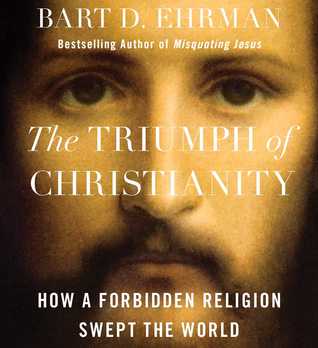
The Triumph of Christianity

The Triumph of Christianity: How A Forbidden Religion Swept the World by Bart D. Ehrman          Audio Book: 10 hours, 18 min      Hardback Book:  352 pages         

There is a feeling of cynicism to this book.    At times the author comes from a I like the ideas Jesus brought to the world similar to a Ghandi was a pretty cool guy, interpretation.   Other times, the author is very adamant that he doesn’t believe many of the Christian precepts that Jesus and his disciples did not heal the sick, resurrect the dead nor drive demons out of people.   It is a fact that if you ask a crowd of people what they just saw you will get as many different answers as there are people in the crowd you just asked.    There may be some overlapping – the person had on a yellow shirt for instance but each person interprets what they see based on their own background experience.    “He was tall,”  “he was athletically built,”  “he had amazing green eyes,”   “he spoke with a speech impediment,”  “I don’t know, the guy talked funny like he was nervous.”   All equally true or embellished as the case may go, but, everyone saw the same thing, but, in their own way and their description will be based on their own experience or experiences and background.   “He might have been Italian,”  “He was probably Greek, maybe a Gypsy,”  “I believe he was from the Middle East, his accent sounded Arabic.”    We all see things our own way and in describing our perceptions may sound like our stories match within the group, or we or others may come off as being totally contradictory to one another, making one wonder, did we even see the same thing at all?    It is the same with varying accounts down through history from those who were there to those who got the story through hearsay and have come to believe even though they were not necessarily there to witness first-hand.    Ehrman’s writing dismisses people’s belief in many cases throughout the book, though, he gives a thoroughly researched account of the historical background on how Christianity spread throughout Europe and Africa.    He notes little known points along the way – like that early Christians would often meet in cemeteries so they could talk freely about Jesus and His teachings and that the Roman Empire didn’t particularly persecute early Christians.   Ehrman says the Romans didn’t particularly care who someone worshipped, as there were many different gods being offered sacrifices and being prayed to for intervention.    The problem came in, he says, when the Jews or the newly formed Christian groups wouldn’t pay homage by bowing to whoever was in power politically, Caligula comes to mind first, – so- to be particularly violent in driving the point home that Roman emperors demanded to be worshipped as deities themselves, punishment was bitter, cruel and the accused were subject to local ridicule and used to frighten and entertain– ie. Circus Maximus.    Amazing when you think of all the early endured to get to where it is today and how the teachings spread throughout the world, it boggles the mind.   The Roman Emperor Constantine became known as the first Christian ruler over the Roman Empire, building churches, etc.   though he was not baptized until on his deathbed – easier to keep from sinning that way he reasoned.   Lots of good information both pro and con on Christianity here though the author’s bent is definetly agnostic toward atheism all-together.   He holds up the historical records and dismisses tales of the Holy Spirit manifesting tongues of fire over the apostles heads on Pentecost.   There is a lot of good information on how the Church spread out across the land from Jerusalem across the continents, I will be very interested to see if he has a sequel going further into history beginning with how the WORD was spread in the beginning up to current day.    It was a little choppy not knowing if he was a believer just questioning everything or if he is leaning toward atheism with a total skeptic’s attitude.    There are things to learn here though so I will praise the author for the compelling way he brings history to life even if a little unsettling in his assertion that lies were told.    For those with a theological bent I would say this book is for you as it debates every issue giving you differing viewpoints on the bible and the history of the early evangelizers.   I liked learning the facts this book taught but I think the author instead of presenting the information for the reader to make his or her own mind up about tends to poo poo belief and pushes really hard for the reader to come to Ehrman’s way of thinking.   It’s like well believe what you want to but only his position is right.   Yeah, we’ve heard that before, thank God they stopped serving the open minded and believers up to the lions for sport and entertainment.