Showing posts with label Inklings. Show all posts

Tuesday, September 24, 2019

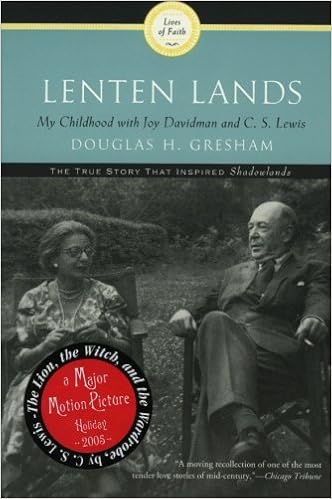
Lenten Lands

Image result for lenten lands douglas greshamLenten Lands: My Life with Joy Davidman and CS Lewis by Douglas H Gresham, 213 pages

Douglas Gresham is the younger son of the authors WL Gresham and Joy Davidman.  After his parents' divorce, his mother took him to England, where she had become close friends with the brothers CS (Jack to his friends) and WH (Warnie) Lewis.  In time, Jack and Joy would wed, and Lewis legally adopted the Gresham boys.  Lenten Lands is Gresham's memoir of his time at the Kilns, as the Lewis' home was called, from the earliest days when it seemed an enchanted place, to later years when it became for him an emblem of loss and grief.

This is a personal book.  Lewis' writings are barely mentioned, and anyone seeking insight into them (other than A Grief Observed) is sure to be disappointed.  It is also Gresham's book, giving his perspective and not anyone else's, and it is focused on his life rather than being "CS Lewis As I Knew Him."  It has to be said that it is all the more charming for that, and it would be an enjoyable read even if Lewis had never written a word.

Monday, October 29, 2018

The Year of Our Lord 1943

The Year of Our Lord 1943The Year of Our Lord 1943: Christian Humanism in an Age of Crisis by Alan Jacobs, 206 pages

Samuel Johnson famously quipped that when a man knows he is to be hanged, it "concentrates his mind wonderfully."  For Christian thinkers in Europe and America, the catastrophe of the Second World War wonderfully concentrated their minds on the problem that liberal democracy could not, on its own, provide a convincing account of human nature to rival those proposed by fascist and socialist ideologies.  In The Year of Our Lord 1943 Alan Jacobs explores the disparate ways a number of disparate philosophers and poets, including Jacques and Raissa Maritain, TS Eliot and Simone Weil, CS Lewis and WH Auden, sought to rectify that deficiency.  Despite substantial differences, their thoughts all focused on culture and education, not only their necessity but also their limitations - indeed, all were insistent that any education which sought to contribute to the building up of the human person must preeminently be an education in limits and ends.

Jacobs perceptively highlights both the sympathies and antipathies among his subjects.  He is clear about his own biases, or is possibly simply unable to resist the occasional editorial comment, and those biases do not prevent him from being fair to those with whom he disagrees.  It is from this attitude that he is able to conclude with the observation that, at a point in history when the technical appears to have vanquished the human, Christians can find comfort and inspiration in their faith that history is itself ruled, not by a process, but by a Person.

Monday, September 3, 2018

Tolkien and the Great War

Tolkien and the Great WarTolkien and the Great War: The Emergence of Middle Earth by John Garth, 313 pages

On November 8th of 1916, after almost 6 months of service at the front, Second Lieutenant John Ronald Reuel Tolkien, a signals officer with the 11th Lancashire Fusiliers, was invalided home to England with a severe case of trench fever.  It was during his long recovery, first in hospital and later in the Royal Defence Force, that Tolkien would begin to tie together his scattered fantasies into a coherent mythology, the foundation of the legendarium that served as the basis for his later masterpieces.

Tolkien and the Great War, beyond presenting the bare facts of Tolkien's service in the War and the fate of his closest friends, is concerned with the impact of the War on Tolkien's imagination.  For Garth, Tolkien developed his legendarium not to escape from the brutal material reality of the War, but as an attempt to place his ordeals in a moral and spiritual context.  This was not expressed, as one might expect, by simply aligning the warring nations on the sides of good and evil - to the contrary, Tolkien was only too aware of the orcishness present on all sides.  Rather, the War confirmed for Tolkien the need for a recovery of memory and renewal of language, while his explorations of the meaning of suffering led to a deeper understanding of the paradoxes of evil, eucatastrophe, and the value of the meek and lowly, themes which would become the hallmarks of his future work.

Friday, March 9, 2018

Tolkien's Sanctifying Myth

J.R.R. Tolkien's Sanctifying MythJRR Tolkien's Sanctifying Myth: Understanding Middle-Earth by Bradley J Birzer, 138 pages

JRR Tolkien famously disapproved of allegory, indeed, it was a major source of disagreement between him and CS Lewis.  Nearly as famously, he referred to The Lord of the Rings as "a fundamentally religious and Catholic work, unconsciously so at first, but consciously in the revision".  Many commentators have chosen, despite the former, to read some allegorical significance into elements of the legendarium, others have dismissed the latter claim as a pious pose.  Bradley Birzer explains the religious basis of Tolkien's work, which is not allegorical but results from his understanding of the artist as subcreator, dependent on and responsible to creation and its Creator.  In this reading, Tolkien's understanding of the cosmic order of reality is reproduced in his mythic work.

Birzer's book focuses less on Tolkien's most famous works than on some of his less well-known writings and personal correspondence.  Although this may be a weakness for those primarily interested in a discussion of the specifics of The Hobbit and its somewhat longer sequel, it allows Birzer to fruitfully connect Tolkien with his sympathetic contemporaries, including not only the expected Inklings but also TS Eliot and Christopher Dawson.

Wednesday, January 25, 2017

That Hideous Strength

That Hideous StrengthThat Hideous Strength by CS Lewis, 382 pages

The conclusion to CS Lewis' Space Trilogy brings the series back to Thulcandra, the Silent Planet, home of the Bent One, known to its inhabitants as Earth.  For the first time, Elwin Ransom is not the main character, though he is still a vital part of the story, his time in Perelandra has made him more than ever an image of Christ, the Fisher-King, the wounded but undying leader of Logres, keeper of the wisdom that came out of the West from the Numinor that was.  The focus now passes to a young married couple.  Jane Studdock is struggling, as newlyweds do, to come to terms with the changes marriage brings, trying to be a good wife without surrendering her independence while coping with a husband who is now less attentive (and who seems more ordinary) than he was when he was a suitor - she is also experiencing increasingly vivid and terrifying dreams that may be more than dreams.  Her husband, Mark, is working hard to do what, he believes, good husbands do - get ahead in the world.  He has already secured a spot among the progressive clique guiding the future of Bracton College, and he is even being considered for membership in the National Institute for Coordinated Experiments.  The N.I.C.E. is where the future of the world is being built, to join is to become one of the directors of human destiny, and the price for entry is merely his soul.

That Hideous Strength is a fictional exploration of Lewis' observations from The Abolition of Man with an overlay of Charles Williams' neo-Platonic mysticism.  The result resembles an urban fantasy equivalent of Brave New World.  Unlike Huxley, however, Lewis' talent for memorable characters fills his world with colorful figures including the sadistic policewoman Miss Hardcastle, a friendly bear named Mr Bultitude, and the reawakened wizard Merlin.  Combined with Lewis' customary intelligence and insight into human nature, this makes That Hideous Strength a very good book indeed.

Friday, January 13, 2017

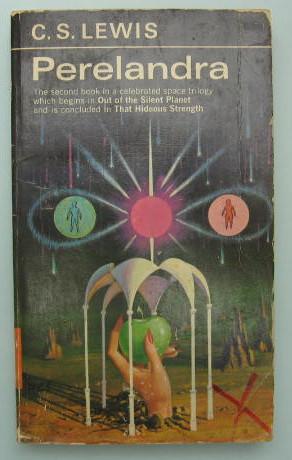
Perelandra

Perelandra by CS Lewis, 238 pages

In Perelandra, the second book in CS Lewis' Space Trilogy, Elwin Ransom is summoned by the eldils to travel to Perelandra, the world men call Venus, for unknown reasons.  Where Malacandra (Mars) boasted a civilization older than that of Thulcandra (Earth), Perelandra is younger - indeed, intelligent life is just beginning.  Ransom recognizes his purpose after he meets the Lady - the Venusian Eve - and the pair are joined by his old enemy Weston, there to play the role of the Tempter.  Or, at least, to be the host for the true Tempter.

Perelandra is less interesting as science fiction than Out of the Silent Planet.  There are some memorable creations - Venus' floating islands of vegetation primary among them - but the focus is now on the philosophical and religious elements of the story.  Lewis' real triumph is in the character of the Tempter.  There is none of the operatic grandeur of Milton's Satan in the thing possessing Weston, but only petty baseness and senseless - worse, passionless - cruelty.  Its arguments are the arguments its kind have made throughout human history, distilled into a few days of subversion, while the final battle between Ransom and not-Weston is one of the most epic fights in all of literature.

Wednesday, December 28, 2016

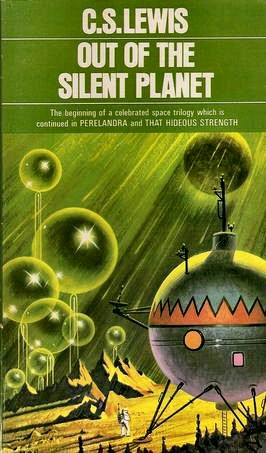
Out of the Silent Planet

Out of the Silent Planet by CS Lewis, 174 pages

The first book in Lewis' Space Trilogy introduces Elwin Ransom, Cambridge philologist and avid walker, who finds himself kidnapped and taken to Mars as a human sacrifice for the alien gods.  His captors are Weston and Devine, the former a genius who has invented interplanetary travel, a tool which he intends to use to ensure the future of the human race no matter what - or who - gets in his way, the latter an investor who sees Weston's quest as a means to accumulate unimaginable personal wealth.  Luckily for Ransom, the universe is a far different place from what either imagines.

Out of the Silent Planet is the most conventional science fiction book in the trilogy, a planetary romance obviously inspired by Burroughs and Wells, the latter of whom is directly referenced by Ransom.  The depiction of Martian life is unique and, especially in terms of language, somewhat better developed than in most other such works.  But it is the climax, in which Ransom struggles to explain the "bent" thinking of Devine and Weston to the uncomprehending Martians, which makes the book truly unforgettable and presages the rest of the series.

Wednesday, December 14, 2016

Lord of the Elves and Eldils

Lord of the Elves and Eldils: Fantasy and Philosophy in CS Lewis and JRR Tolkien by Richard Purtill, 211 pages

In this essay on the philosophical dimensions of the fiction of CS Lewis and JRR Tolkien, Purtill busies himself contradicting certain common misconceptions about the works of both authors - foremost among them that Lewis' fiction consists primarily of arguments for Christianity while Tolkien's saga is essentially non-Christian.  He accomplishes this by exploring the underappreciated subtlety of Lewis and the overarching presuppositions of Tolkien.

Lord of the Elves and Eldils was written while Tolkien was still alive, but not only does the author not seem to fear (outside of a few explicitly speculative sections) that Tolkien will contradict him, but some of his arguments are confirmed by the then-unpublished material collected in The Silmarillion, as well as biographical research carried out in subsequent decades.  If this consistency with facts then unknown is testament to the perspicuity of Purtill's observations, the greatest compliment the book can be paid is that it considerably deepens the understanding, and correspondingly heightens the appreciation, of the works of its subjects.

Wednesday, January 13, 2016

Return of Christian Humanism

Cover image for The Return of Christian Humanism: Chesterton, Eliot, Tolkien, and the Romance of History by Lee Oser, 165 pages

One of the three seems not to fit - Chesterton, the English fabulist who converted from Anglicanism to Catholicism, Tolkien, the English fantasist and all-but-cradle Catholic, and Eliot, the American Modernist poet who converted from Unitarianism to Anglicanism.  Of course, put another way, Eliot was only four years older than Tolkien, but Chesterton was fourteen years older than him.  Or it could be pointed out that while Chesterton flourished a short time before, during, and after the First World War and Eliot did his best work between the wars, The Lord of the Rings wasn't published until the '50s.  Yet none of them seem as out of place as Oser's untitled fourth subject, 19th century Deist critic Matthew Arnold.  Oser describes Arnold as having recognized a central problem for an agnostic humanism - an inability to balance the anarchic tendencies of romantic progressivism with the rigidity of neo-classicism.

According to Oser, the proof of that inability can be found in the exhaustion of the humanist tradition with Beckett and the anti-humanism that has subsequently ascended to power within the academy, with the collapse of the humanities as a consequence.  To rebuild it is necessary to embrace the "romance of history", which means meaningfully engaging with religion generally and Christianity particularly, especially the more-than-mere Christianity of the romantic reactionaries Chesterton, Eliot, and Tolkien.

Monday, November 30, 2015

History in English Words

History in English Words by Owen Barfield, 218 pages

A living language is not something manufactured, it is grown gradually over the course of centuries, with layer upon layer of accretion.  By digging back into those linguistic strata of the past, Barfield tells us, we can recover some sense of how the people of previous ages lived and thought.  Likewise, this linguistic archaeology can reveal the full significance of the words we use today.

History in English Words is nothing more or less than a journey through The Oxford English Dictionary with a particularly erudite guide.  Doubtless, more recent scholarship has invalidated some of Barfield's work, first published in 1926, but the main structure has enough redundant supports that losing a few here or there barely constitute a weakening of the whole.

Saturday, October 17, 2015

The Hobbit

Cover image for The Hobbit, or, There and Back Again by JRR Tolkien, 317 pages

"In a hole in the ground there lived a hobbit..." named Bilbo Baggins, and he had a magical adventure in which he traveled with dwarves and a wizard, eluded trolls and goblins, riddled with Gollum and Smaug, found a magic ring, dined with elves and a bear-man, and persevered through sheer heroic decency.

Rereading The Hobbit, two things are remembered: the writing is approachable, plain, and unpretentious, and the book is very funny.  Neither of these qualities are possessed by The Lord of the Rings, although the trilogy has other, greater virtues.

Saturday, September 19, 2015

The Fellowship

Cover image for The Fellowship: The Literary Lives of the Inklings: JRR Tolkien, CS Lewis, Owen Barfield, Charles Williams by Philip Zaleski and Carol Zaleski, 512 pages

For two decades a group of writers known as the Inklings gathered regularly in Oxford for conversation and criticism, brought together, according to CS Lewis, by a love of literature, Christian faith, and "a shared set of enemies, including atheists, totalitarians, modernists, and anyone with a shallow imagination."  The most famous members included Lewis, JRR Tolkien, anthroposophist Owen Barfield, and esoteric fantasist Charles Williams.  The Fellowship is the story of these men, their friendships, and how they formed perhaps the most influential literary clique of the twentieth century.

The Zaleskis are more interested in the work of the Inklings than their personal lives, not that they entirely neglect the latter, but the focus is on "literary lives".  Beginning with the title, the authors give Tolkien a central place in their account, equal to that of Lewis.  If this undervalues the importance of Lewis' personality within the group, it is justified by Tolkien's importance as an author.  The lives of Barfield and, especially, Williams are revealed as more troubled than is generally understood.  The book also draws in a galaxy of other Inklings beyond the canonical four, including David Cecil, Hugo Dyson, Lewis' brother Warren, and Tolkien's son Christopher.  The Inklings' meetings were not restricted to fiction, but included historical and even medical works.

While not the definitive critical account of the Inklings' influence, nor the best biography of the individual members of the group, The Fellowship ties the lives and works of the Inklings together in an extraordinarily satisfying - and revealing - way.

Tuesday, June 9, 2015

The Silmarillion

Cover image for The Silmarillion: The Myths and Legends of Middle-Earth by JRR Tolkien, edited by Christopher Tolkien, 304 pages

This the book that JRR Tolkien spent most of his life trying to write and never quite finished.  Begun during the First World War, the stories were written and rewritten over and over again until the author's death in 1973, layers building upon layers like a Monet lily-pond.  The story of the composition of the material included in The Silmarillion takes up the better part of the 12 volume History of Middle Earth.  It is doubtful it ever would have been published had Tolkien not half-heartedly decided to use some of the names in a children's book he wrote called The Hobbit and its somewhat larger sequel.  As it is, it was cobbled together by his son Christopher for posthumous publication.

The Silmarillion begins with the creation of the world and an enumeration of the powerful spiritual beings who shape and guide it, for good or ill.  This is the section most likely to cause readers to simply give up on the book.  It continues with the tale of the Silmarils, their creation by the elf-lord Feanor, their theft by Morgoth the Enemy, the awful oath of the sons of Feanor, and the long war between the elves and Morgoth.  This section includes some of the most beloved tales of the Tolkien legendarium - the romance of Beren and Luthien, the tragedy of Turin Turambar, and the adventure of Earendil.  The book continues with the tale of the rise and fall of the island kingdom of Numenor, and concludes with an account of the forging of the Rings of Power.

Poetically digressive, light on character, and lacking a central plot, this is not for everyone, certainly.  Casual fans of Tolkien will undoubtedly struggle, fans of the movies should definitely start with the books the movies were based on, and chronological order be damned.  The Silmarillion should be recognized as what it is, however - not merely fantastic but truly magical, deeply humane, the greatest work by perhaps the greatest author of the twentieth century.

Saturday, September 20, 2014

Pilgrim's Regress

 
http://d.gr-assets.com/books/1327952574l/989775.jpgThis is the tale of John, a native of Puritania, raised in terror of the judgement of the Landlord of that country.  Leaving home to escape from the shadow of that tyrant, John journeys through the city of the Clevers and the land of Mammon, into the home of old Mr Halfways and his daughter Media as well as into the home shared by the bachelors Mr Angular, Mr Classical, and Mr Humanist, accompanied at times by the warrior maiden Reason and at times by the adventurer Vertue, chasing an Island he has seen only in dreams and visions.  His quest takes him to the ends of the earth, which turn out to be rather closer to home than he had imagined.
 
This is a remarkable book, full of Lewis' customary insight and wit, which always seems to cut through layers of obfuscation to the heart of the matter.  It is intimated at times that this is the landscape of The Pilgrim's Progress, transformed by the passage of years, but John's regress involves more progress than Christian's pilgrimage.  Unfortunately neglected, it will surely be appreciated by any fans of Lewis' theological fantasies (The Screwtape Letters, The Great Divorce) or the novels of Chesterton.

Monday, July 21, 2014

The Place of the Lion

The Place of the Lion by Charles Williams, 236 pages
 
https://blogger.googleusercontent.com/img/b/R29vZ2xl/AVvXsEi9iAPREAVotV27jqLaXyCdDT0DspT-6Vs6KwLIML8HrixVWPlkHPfS4UkBhlbjYO6brLZuzqM4gqkaetubwYxgcOm5eRcUmxOvUkYhL9_jJR6o49pnm065IwfDn-kCgm9ZWDfzi__zpoZE/s1600/949011.jpgIn a small town in England lives Damaris, a graduate student who dissects philosophers instead of understanding them.  She has a suitor, Anthony, who shares her antiquarian interests but whom she views as an instrument rather than a love interest.  Her father, who has few interests beyond catching butterflies, she sees as a bore.  Their comfortable world shatters when the numinous begins to intrude upon the mundane, at first subtly and then more and more forcefully.  Dangerous beasts, the avatars of abstract concepts like strength (a lion), subtlety (a snake), and beauty (a butterfly), are appearing - at least to those with eyes to see - and affecting the people of the town, transforming them, accentuating those aspects of their personalities that share an affinity with the concepts.
 
Charles Williams is the least well-known of the Inkling trinity.  This novel shows why.  Although set on Earth in the present (or, at least, the 1930s), unlike Tolkien's legendarium or any of Lewis' fiction with the sole exception of That Hideous Strength (and assorted framing stories), it is nonetheless stranger than their writing.  That is not, however, necessarily a bad thing, nor are the alien elements the center of the novel.  Indeed, behind the intimations of a Platonic world that underlies the world of appearances, the real subject is the relationship between Damaris, Anthony, and Anthony's best friend Quentin, the theme that of love and salvation.
 
A fascinating novel, with genuine insight into the nature of things, especially human things.

Saturday, May 31, 2014

Romantic Religion

http://cache2.bdcdn.net/assets/images/book/large/9781/5842/9781584200475.jpg

This is an analysis of the works of Owen Barfield, CS Lewis, Charles Williams, and JRR Tolkien, all of whom knew and were influenced by each other, being the core members of the literary discussion group called the Inklings.  Although the formal religious beliefs of the four varied considerably - Barfield was an Anthroposophist, Lewis and Williams were Anglicans, and Tolkien was Catholic - it is Reilly's contention that the four shared a common, romantic approach to religion.  He defines "romantic religion" as cataphatic theology, the "Affirmative Way" which affirms what is good in things and regards all things, therefore, as in some ways reflective of, and thus revelatory of, their Creator.  In this way, Lewis' admiration for the truths to be found in pagan mythologies, Williams' belief that "theologized" romantic love (best represented in the love of Dante for Beatrice) is a valid path to God, and Tolkien's notion of "secondary creation" are all presented as variations on the theme of the reception - and communication - by the human imagination of glimmers of divine Truth.

Barfield receives as much space as the other three combined, which the author attempts to justify on the grounds that Barfield is the most obscure of the four, and therefore the most in need of introduction, but seems to be more a result of the author's own preference for Barfield's theological views.  The section on Lewis centers on his books for adults (especially the Space Trilogy and Till We Have Faces), excluding the Narnia books.  Since the book was published in 1971, Tolkien is considered an "obscure scholar" who has had some "recent success", and receives the least amount of attention.

An intriguing and enlightening study, even if, in my opinion, Reilly puts the least first and the first last.