Showing posts with label Farm Life. Show all posts

Tuesday, December 14, 2021

Unsettling of America

The Unsettling of America: Culture and Agriculture by Wendell Berry, 223 pages

In this early work, Wendell Berry decries what he sees as the continuing colonization of the North American continent, concentrating on the colonization of the rural by the urban.  This colonization is carried out by technocratic elites who reduce everything to economics, ignoring the human, social, and environmental costs of their policies.  Although Berry's subject is agriculture, his theme is over-specialization and fragmentation, a feature of modern life that of itself tends to transform all human interaction - even "charity" - into forms of money-exchange.  The alternative, he insists, must be the invention (or recovery) of an economics, a politics, a philosophy, and even a theology of limits.

This was always intended as an argumentative work, a new salvo in an ongoing debate.  Now it is a mostly forgotten volley in a debate that has moved on, but its echoes can, perhaps, still be heard in the hills.  While it is explicitly tied to the particular time and place in which it was composed and published, with considerable space taken up by criticism of academic and political figures in power or in fashion in the late '70s, the underlying principles are hardly outdated, and what it has lost in ripped-from-the-headlines relevance is compensated for by what it has gained in historical value.

Tuesday, May 12, 2020

Threads: A Depression Era Tale


Threads: A Depression Era Tale by Charlotte Whitney 327 pages

I was excited when I won this book in the giveaway section of the Shelf Awareness newsletter. I was dismayed when the book opened with “A Note on Mid-Michigan Farm Dialect.”  Ninety-five percent of the books I read with dialogue aren’t very good—the dialect gets in the way. Not so with this intriguing tale of three sisters over the course of 1934. It sort of got in my way in the beginning, but it soon evened out. 

To tell a story with three different narrators is challenging, even for a seasoned writer, which Whitney is not.  But she does it superbly!  And to keep the voices clear and recognizable to each sister is quite the feat!  I never had a problem knowing which sister was talking at any given time.

This is the story of three sisters:  Nellie, seven; Irene, eleven, and Flora, 17.  Remember the old adage that there are three sides to every story?  Two who tell the story and the truth.  Here we get three sides of each story, as each sister gives her account of what is happening.

And there is a lot happening.  The girls live on a farm in mid-Michigan, and reads are treated to what life is like in this hardscrabble time. 

Nellie is still too young to really know how the Depression is affecting the family.  She visits the farm animals every day, especially the cows that stand under the cherry blossom trees. She even has an imaginary friend, ZeeZee, who is an alien.  But one day, Nellie finds a shallow grave of a dead baby.  Whose it is and how the discovery affects the little girl runs through the entire novel.

The middle sister, Irene, seems to have more faults than good qualities. She finds faults with the world in general and especially with her sisters.

The oldest sister, Flora, wants to get go on dates and get married.  She eyes a schoolmate and fellow church member, Henry, as her savior from spinsterhood.  But when rumors start to fly that the dead baby Nellie found is Flora’s, well her chances to wed seem to disappear.

There are a lot of other interesting characters that the readers meet in the small farming community. By the end I felt as if I had been part of the lives of these people.  I thoroughly enjoyed this novel, always looking forward to my reading time every evening. 

As I read,  wondered how on earth could Whitney without leaving the readers hanging. Easy-peasy---an epilogue that thakes place forty years later.

 “Threads: A Depression Era Tale” receives 5 out of 5 stars in Julie’s world.

Tuesday, September 24, 2019

Lenten Lands

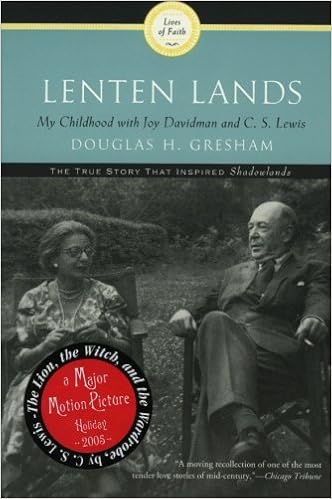
Image result for lenten lands douglas greshamLenten Lands: My Life with Joy Davidman and CS Lewis by Douglas H Gresham, 213 pages

Douglas Gresham is the younger son of the authors WL Gresham and Joy Davidman.  After his parents' divorce, his mother took him to England, where she had become close friends with the brothers CS (Jack to his friends) and WH (Warnie) Lewis.  In time, Jack and Joy would wed, and Lewis legally adopted the Gresham boys.  Lenten Lands is Gresham's memoir of his time at the Kilns, as the Lewis' home was called, from the earliest days when it seemed an enchanted place, to later years when it became for him an emblem of loss and grief.

This is a personal book.  Lewis' writings are barely mentioned, and anyone seeking insight into them (other than A Grief Observed) is sure to be disappointed.  It is also Gresham's book, giving his perspective and not anyone else's, and it is focused on his life rather than being "CS Lewis As I Knew Him."  It has to be said that it is all the more charming for that, and it would be an enjoyable read even if Lewis had never written a word.

Saturday, September 12, 2015

Unusual Chickens for the Exceptional Poultry Farmer,

Unusual Chickens for the Exceptional Poultry Farmer, written by Kelly Jones, illustrated by Katie Kath, 216 pages

Sophie and her parents have recently inherited her great-uncle's farm in rural California.  The timing couldn't have been better, what with her father having just lost his job -- so the family picks up and moves from Los Angeles to Blackbird Farm.  Neither Sophie nor her father know much about farming, and her mom's too busy with her freelance writing gig to teach them.  Just as her great-uncle's chickens begin wandering home, Sophie stumbles across a mysterious mail correspondence course in poultry farming.  She's going to need all the help she can get, because these chickens are HIGHLY unusual (semi-spoiler: they have superpowers!) and it appears that there's a poultry thief out to get them.

This story is told entirely through letters that Sophie writes to local (and mysterious) poultry-expert Agnes as well as her deceased abuelita and great-uncle, and is sure to appeal to fans of Roald Dahl (though Jones' writing lacks Dahl's typical disdain for adults).  The black and white illustrations go a long way to helping readers picture Sophie and the myriad breeds of chickens she encounters while the epistolary format should appeal to kids who love reading diary-style novels like Wimpy Kid and Dork Diaries.

Friday, January 2, 2015

Georgics and Eclogues

The Georgics and Eclogues of Virgil by Publius Virgilius Maro, translated by Theodore Chickering Williams, 166 pages

This is a translation of some of the lesser pastoral poetry by the master of The Aeneid, praising the beauties of nature and the simplicity of country life, in the tradition of Hesiod rather than Homer.  The Eclogues were written in Virgil's youth, the Georgics in his maturity, and most readers are likely to admire the latter more than the former.  Most of the Eclogues are presented in the form of dialogues and exchanges of poetry (the famous Fourth is somewhat of an exception), which makes them irritatingly disjunct.  The problems might be eased in Latin or with more familiarity with the poetic template.  The Georgics are much more readable, although some readers may be bored by the long sections of agricultural advice (and I have my doubts as to the extent of Virgil's practical farming expertise), which is a shame, because the passages, whether discussing horse breeding or beekeeping or where and when to plant grape vines, all contribute beautifully to the greater themes of the work.

Williams' verse translation is excellent.

Thursday, November 20, 2014

Some Luck

Some Luck by Jane Smiley, 395 pages

Jane Smiley is an excellent writer and this slice of Midwestern American life story is no exception.  Walter Langdon is a farmer in Iowa who marries Rosanna.  They have five children who survive childhood and the book covers the lives of the family from 1920 to 1953.  We get to see the births of all six children, Frank, Joe, Mary Elizabeth, who dies young, Lillian, Henry and Claire.  We get to see their good years and bad, the births and deaths, the Great Depression and World War II.  There is no big action in the book, but Smiley has a way of making characters seem real and their troubles and triumphs important which makes her books really nice to read.  And even though there is no bog conflict and resolution, she always brings the stories to a satisfactory conclusion.  I would recommend this to anyone who likes slice-of-life, historical America stories.

Thursday, October 2, 2014

A Girl Called Problem

 A Girl Called Problem by Katie Quirk                       242 pages


Shida means problem in Swahili.  She was given this name because bad luck surrounded her birth.  Because mothers are called by their first born children’s names, Shida’s mother is called Mama Shida and most of the bad luck seems centered around her, especially as Shida has gotten older.  She is almost the right age to get married but she doesn’t want that yet.  She wants to continue to learn about healing and help the people in her village.  Her grandfather has decided to move their village and merge with another, larger, nearby village so that both villages will benefit from schools and a clinic, as the president of Tanzania has asked people to do.  Even girls will go to the school so maybe Shida can have her dream.  But her mother is reluctant to move and many people are upset that girls will be allowed at the school.  They think that only boys should be educated and that their village may be cursed if the allow all of these changes.  Will Shida be able to follow her dreams?  A fairly easy read for young teens, this is a pretty good story about life in Tanzania and kids who are interested in other cultures will probably like it.