Showing posts with label anti-culture. Show all posts

Tuesday, December 14, 2021

Unsettling of America

The Unsettling of America: Culture and Agriculture by Wendell Berry, 223 pages

In this early work, Wendell Berry decries what he sees as the continuing colonization of the North American continent, concentrating on the colonization of the rural by the urban.  This colonization is carried out by technocratic elites who reduce everything to economics, ignoring the human, social, and environmental costs of their policies.  Although Berry's subject is agriculture, his theme is over-specialization and fragmentation, a feature of modern life that of itself tends to transform all human interaction - even "charity" - into forms of money-exchange.  The alternative, he insists, must be the invention (or recovery) of an economics, a politics, a philosophy, and even a theology of limits.

This was always intended as an argumentative work, a new salvo in an ongoing debate.  Now it is a mostly forgotten volley in a debate that has moved on, but its echoes can, perhaps, still be heard in the hills.  While it is explicitly tied to the particular time and place in which it was composed and published, with considerable space taken up by criticism of academic and political figures in power or in fashion in the late '70s, the underlying principles are hardly outdated, and what it has lost in ripped-from-the-headlines relevance is compensated for by what it has gained in historical value.

Friday, September 17, 2021

Culture and Anarchy

Culture and Anarchy by Matthew Arnold, 212 pages

In the seminal essays that make up Culture and Anarchy, originally published serially in 1869, Matthew Arnold attempted to convince his hardheaded English countrymen, who prided themselves on practicality and efficiency, of the value of culture.  For Arnold, the cult of efficiency amounts to an idolatry of machinery, a confusion of ends and means, and a worldview closed to the "sweetness and light" that make life worth living.  In the process, Arnold famously distinguishes two rival tendencies in Western civilization, which he dubs the Hebraic and the Hellenic - the former demanding faithful action, the latter rational thought.  Both pursue the same goal of human perfection, but that goal is unattainable by either alone.

It is easy to criticize Arnold's scheme as overly simplistic and reductive, although the notion of a rivalry between Athens and Jerusalem can be traced back at least as far as Tertullian.  It is equally easy to point out its weaknesses - to ask, for example, whether Hellenism is not just as likely to lead to the kind of radical individualism Arnold deplores as Hebraism, or whether other forms of Hebraism beyond Puritanism might not admit sweetness and light as readily as Hellenism.  To do so, however, would be to fundamentally misunderstand what Arnold means by Hebraism and Hellenism, to imagine the former as simply religious and the latter as purely secular.  Arnold wants contemplative philosophers, not scientific administrators, true intellectuals, not chattering policy wonks.  Indeed, the latter are the vanguard of the mechanical anti-culture he abominates.

Tuesday, August 17, 2021

Fiery Angel

The Fiery Angel: Art, Culture, Sex, Politics, and the Struggle for the Soul of the West by Michael Walsh, 224 pages

On one level, The Fiery Angel is Michael Walsh's celebration of the power of art and storytelling, of how they shape us and our future.  On another, it is an argument for the heroic ideal he believes is central to Western culture and civilization.  Walsh is well aware that the heroic tends to shade into the luciferian, indeed he sees this as a positive - Western man is never comfortable with the status quo and acknowledges no limits except those which he places on himself.  This is a vision that Walsh believes is threatened by the rising forces of leftism and Islam, each of which finds the concept of the heroic threatening for ideological and theological reasons.

Walsh leaps quickly from topic to topic and idea to idea in a way that is equal parts thrilling and disorienting.  It isn't clear whether this is deliberate - a little reflection reveals how thin is his distinction between the idea of progress he advances and the progressive definition he deplores, as well as how consistently his archetypal superman served as a cautionary tale rather than a model to be imitated in the premodern West, and especially how it is precisely the rejection of limits that has led us to our present crisis.  If his overall vision seems lacking, however, the passages where he discusses music are notable for their depth of thought and feeling.

Thursday, April 29, 2021

The Day Is Now Far Spent

The Day Is Now Far Spent by Robert Cardinal Sarah and Nicolas Diat, translated by Michael J Miller, 343 pages

The hour is late indeed, says Cardinal Sarah in this book-length interview with his favorite interlocutor, Nicolas Diat.  The Church, he tells us, is riven by dissension, compromised by unbelief, and stained with sin.  Meanwhile, the decadent ruins of Christendom are in the grip of a "fundamentalist liberalism" that pursues wealth and power (often under the guise of "justice" and "liberation") while treating the sacred with indifference and contempt.  The irony is that, by attempting to place himself at the center of the world, modern man has created a world in which he is increasingly superfluous.  Not content in its iconoclasm with the destruction of its own past, the neo-colonialist West actively works to erase the cultures of Africa and Asia even as it plunders their lands of their natural resources.  

It is necessary, then, for faithful Catholics to resist the temptations of compromise and despair.  This demands the cultivation of virtue and excellence - "The Church does not have the right to be mediocre."  Fittingly for the author of The Power of Silence, while Sarah's message is urgent, it is not primarily a "call to action", but a call to prayer and contemplation.  "Your mission is not to save a dying world... Your mission is to live out with fidelity and without compromise the faith you received from Christ."

Tuesday, July 28, 2020

Decline and Fall of Western Art

The Decline and Fall of Western Art by Brendan MP Heard, 319 pages

It is not particularly hard to say that the emperor has no clothes.  It is easy enough to notice when he flaunts his nakedness with the same assertiveness with which the modern art world flaunts its ugliness.  It is more difficult to explain why this deranged naked man is dancing his way through our museums and public spaces.  It is even more difficult to imagine how we can get him to stop.

To his credit, it is the difficult things that Brendan Heard attempts in The Decline and Fall of Western Art.  The extent to which he succeeds is another matter.  His account of the historical breakdown of Western art is tentative and somewhat superficial, with Picasso, Duchamp, and Kandinsky as the expected villains.  However, Heard is canny enough to understand that our cultural ruin has its roots in political and theological disorders, and his analysis of the impact of materialism and feminism on art is better developed, although more vituperative.  Heard's solutions hinge on a metaphysical revival, to which end he proposes a kind of mere neo-Platonism compatible with a wide variety of religious commitments.

Heard sets his ambitions high, but his scanty one-page bibliography is one sign that his reach exceeds his grasp.  He writes with passion and wit, but certain errors suggest that he is parroting second-hand (and possibly second-rate) sources rather than speaking from personal experience - although St Thomas Aquinas was doubtless more of a Platonist than is commonly supposed, he was certainly not a believer in a "universe-as-God Neoplatonic philosophy".  As this is Heard's first book, it can be hoped that there will be sequels, and that he and his writing will grow deeper and broader with time.

Tuesday, May 21, 2019

Anti-Mary Exposed

The Anti-Mary ExposedThe Anti-Mary Exposed: Rescuing the Culture from Toxic Femininity by Carrie Gress, 196 pages

For Carrie Gress, the feminism which rose to prominence in the '60s and '70s and quickly became cultural orthodoxy only pretended to offer women liberation, instead promoting a distorted perversion of femininity.  In her telling, the vanguard of the women's movement consisted of its most dysfunctional members, and they have used the power of the media to shape a concept of the modern woman after their own image - vulgar, shallow, petulant, self-absorbed, and, above all, hostile to the Marian ideals of virginity and motherhood.  More than an ideological struggle, Gress presents this as nothing less than a diabolical plot to replace the Marian "fiat" with the Luciferian "non serviam".

This is definitely a book written for the choir, and a women's choir at that.  Anyone who does not accept Gress' premises will not be swayed by demonic testimony reported by exorcists.  For believers, there is another danger, in that Gress' sensationalism sometimes lends to her subjects a glamour that covers the tired banality of yesterday's transgressions.  That the book is aimed almost exclusively at women is both inevitable and fitting, given Gress' contention that women's identities have always been influenced, for better or worse, far more by other women than by men.  Thus it is that she advances the icon of "not only a well-behaved woman who made history but the best-behaved woman around whom all of history turns" to oppose that of a high-heel stomping on a human face, forever.

Friday, May 17, 2019

New Philistines

The New PhilistinesThe New Philistines: How Identity Politics Disfigure the Arts by Sohrab Ahmari, 104 pages

The New Philistines is Sohrab Ahmari's lament for the current state of the arts - a genre he is well aware is already well-established.  Yet he is convinced that something has gone uniquely wrong in the past few decades, a period during which Western cultural elites have had their worldviews narrowed by their embrace of identity politics.  The result has been the wholesale abandonment of aesthetic standards in favor of a propagandistic political statements, which has not only further impoverished the art of today and led to a triumph of spectacle and cliche, but has deprived many of the ability to appreciate the great works of the past.

Ahmari is a journalist, and The New Philistines is journalism in the formerly archaic but once again popular sense, a journal of personal encounters and experiences, in this case disappointing ones with the elite art world.  As such, it is accessible but not particularly deep, though keenly observed.

Tuesday, April 2, 2019

Making Dystopia

Making DystopiaMaking Dystopia: The Strange Rise and Survival of Architectural Barbarism by James Stevens Curl, 388 pages

In Making Dystopia, James Curl attempts to debunk the myth that Modernist architecture evolved organically in continuity with earlier styles and therefore represents the only acceptable style for the present era.  Curl provides a detailed explanation in words and (more importantly) pictures of how Modernism represented a revolutionary rupture with the moralistic, traditionalist, humanistic architectural philosophies of Pugin, Ruskin, and Morris, and the establishment of a new aesthetic ideology that is Puritanical, anti-tradition, anti-history, anti-culture, and therefore ultimately totalitarian and thoroughly anti-human.

The pictures are vitally important because it is not enough for Curl that the reader should concede that he is right, he wants us to see why he is correct.  More than either an argument in architectural theory or a history of modern architecture, the book is an education in how to understand architecture.  Yet Curl does not neglect the social, political, or commercial factors that contributed to the triumph of Modernism despite its unpopularity, either.  In his account of the process by which theoretical abstraction gave momentum to the development of artistic abstraction, there are many similarities to Wolfe's The Painted Word, but despite this (and the overt allusions to Pugin's Contrasts) the book it most resembles may be The Stones of Venice.  This comparison may displease the author, but it is devoutly hoped that his book has the kind of impact in our time as Ruskin's had in his.

Monday, July 30, 2018

Death of Christian Culture

The Death of Christian CultureThe Death of Christian Culture by John Senior, 178 pages

According to John Senior, modernity's inward turn resulted in a solipsistic closed circle, and subsequent attempts to escape have only accelerated the death spiral into nihilistic madness.  Senior's argument is not that this is wicked, but that it is delusional, and it is destructive and wicked because it is delusional.  In this, the long demise of Christian Realism is both cause and effect, her resurrection a faint but not impossible hope.

Senior throws out ideas and references with machine gun rapidity.  For some readers this will be hopelessly confusing, while others will constantly find themselves asking him to expand upon an argument or observation.  Certainly he is never boring.

Monday, July 16, 2018

The Truth of Things

The Truth of ThingsThe Truth of Things: Liberal Arts and the Recovery of Reality by Marion Montgomery, 295 pages

In this book, collecting essays spanning four decades, Marion Montgomery argues that the modern world's rejection of transcendence has resulted in a wholesale flight from the Real into unreal abstraction.  In his view, the effects of this amputation of the spirit, brought about by an unholy alliance of pragmatism and narcissism, have been exacerbated by the decline of the academy as the result of its alienation from the community, brought about by the growth of specialization and a rootless cosmopolitanism all the more provincial because it is blind to its own provincialism.  This has led in turn to a "justice" divorced from truth and thereby distorted into injustice, with all human interaction reduced to postmodern power politics, the natural particularity of gifts denounced in favor of a artificial consumerist egalitarianism, the existing person displaced by the abstract individual, the actual community by the fictitious society.

Without proposing a definite program for reform, Montgomery does offer some hope for those who continue to see the value of ordered thought in relation to truth, and who therefore feel keenly the modern spiritual disease as a source of unease.  At the heart of his proposed recovery of reality is a cultivation of personhood through a reconnection with the human experience as distilled in the thought, literature, and art of the past, but ultimately predicated on a reverence for Being.  To carry out this vital task, Montgomery insists that the postmodern multiversity, shattered by specialization, ought to be reunited by a commitment to higher education - "higher" not because more difficult but because more profound, taught by teachers rather than technicians.

Wednesday, May 30, 2018

Generation Abandoned

A Generation AbandonedA Generation Abandoned: Why 'Whatever' Is Not Enough by Peter D Beaulieu, 261 pages

In the opinion of Peter Beaulieu, the contemporary world faces a crisis of acedia - of restless boredom, of dissatisfied complacency.  He sees this as the natural consequence of widespread moral indifference, incarnated in a shrug of the shoulders and the word, "whatever".  This, in turn, is a result of what he calls the "Big Lie" of "mandatory amnesia", the total rejection of the past and, with it, any kind of standards beyond the political fashions of the moment, leading inexorably to the conclusion that nothing really matters.  The alternative he presents is that of the Catholic Church, which asserts that everything matters.

Beaulieu's thoughts pour out onto the page in a rhetorical flood, and, like a literal flood, the result is a muddied mess.  Counter-intuitively but convincingly, given our mass media obsession with vacuous fantasy, Beaulieu indicts our contemporary anti-culture of a lack of imagination, and it is clear that imagination is something he possesses in abundance, but organization does not seem to be among his gifts.  There are some startlingly brilliant diamonds in this rough - who else would directly contrast the lives of CS Lewis and Michael Edwards (Priscilla Presley's second husband)? - but the rough is deep and extensive.  Beaulieu amuses himself (and occasionally his readers) with frequent digressions, but oftentimes the digressions overpower his point.  Anecdotes are repeated without acknowledgement of the repetition.  Unfortunately for a book condemning indifference, the author is somewhat sloppy when it comes to facts (the Marquis de Sade was not in the Bastille when it was stormed in 1789, Descartes was not a priest).  Sad as it is to say, however, the book's greatest shortcoming is its author's laudable defense of the lives of the unborn - Beaulieu writes so passionately on the subject of abortion and returns to it so frequently that it is difficult to believe that anyone who disagrees with him at all on this key issue will find his book palatable.  In the end, its incoherence makes A Generation Abandoned ineffective as either a summons for the unchurched or a sermon for the faithful.

Saturday, April 28, 2018

Freedom from Reality

Freedom From RealityFreedom from Reality: The Diabolical Character of Modern Liberty by DC Schindler, 363 pages

In the modern (Western) world, freedom has long been regarded as a good in itself, rather than a means by which what is good can be chosen.  Paradoxically, this elevation of freedom to the position of the highest good requires the denial of all other goods, and even goodness itself.  According to Schindler, the problem begins with metaphysics, as modern political philosophers, typified by Locke, have inverted the classical relationship between potency and act.  Rather than seeing power and possibility as always preceded by and rooted in an already existent reality, freedom has been understood to exist before, above, and independent of actuality.  It is in this inversion that he uncovers the origins of the superficially contradictory modern propensities for atomistic individualism and totalitarian government.  By rejecting the given in favor of the manufactured and valuing appearance over substance, modernity promises that each individual will be the god of his own private world, but that world is entirely solitary and, in the end, vanishingly small.

If the modern concept of freedom is, as Schindler argues, inherently diabolical, that is, predicated on division, the path to replace alienation with integration leads through a rediscovery of the symbolical, which is predicated upon unity.  He begins to explore this path in the final chapters of the present book, but a fuller discovery and recovery must wait for a promised sequel, which should be eagerly anticipated.  Freedom from Reality is as dense as it is deep, and no short summary can do justice to the scope and subtlety of its analysis.  Schindler himself is at great pains not to oversimplify the complexities of the thinkers whose thoughts he explores.  It is a rigorous, philosophical work and not a manifesto, but all the more explosive for it.

Wednesday, December 27, 2017

Heresy of Formlessness

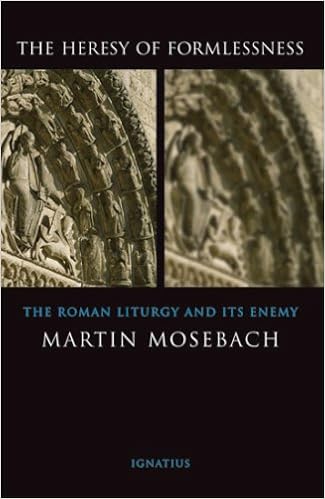
The Heresy of Formlessness: The Roman Liturgy and Its Enemy by Martin Mosebach, translated by Graham Harrison, 209 pages

Martin Mosebach freely confesses that progress has passed him by.  He has not learned that words are meaningless, that truth is nothing but a bigoted opinion, or that beauty is entirely in the eye of the beholder.  He still clings to antiquated prejudices - that religion ought to connect man to a higher reality, that the best of what has been thought and done in past ages can never be irrelevant, that no one can consume trash and expect to remain healthy.  Most indicative of his backwardness is his belief that human beings are both soul and body, and that therefore what we believe and what we do are interconnected.

In the wake of the Second Vatican Council, a new wave of iconoclasm swept through the Catholic Church.  Great artworks which had stood the test of time were replaced with up-to-date substitutes which were obsolete the day after they appeared.  Even kitschy works that, though undeniably second rate, were popular with the average Catholic were replaced, when they were replaced at all, with pieces that allegedly spoke to modern sensibilities, but which pleased few beyond the artists who were paid to produce them and their clerical patrons who paid dearly for the pleasure of believing they were with-it.  Simultaneously, an elaborate language of ritual and gesture which had developed over the course of millennia was simply abandoned.  The iconoclasts claimed that all of this was distracting and unnecessary, modern man having outgrown the need for symbols, beauty, and supernatural hope.

In The Heresy of Formlessness Mosebach makes the case that the iconoclasts were wrong.  The nature of man, he contends, has not changed since the Stone Age.  We still live and die by symbols, still crave beauty, are still bound together - to the extent we are bound together at all - by rituals both civic and religious.  As a novelist by trade, his arguments are affective rather than logical, his investigations personal rather than philosophical or theological.  Ironically, this makes his book somewhat formless - the final essay, tacked on in the third edition, while cromulent in itself, greatly diminishes the power of the conclusion by its placement.

Wednesday, December 20, 2017

Decline of Wisdom

The Decline of Wisdom by Gabriel Marcel, 56 pages

The Decline of Wisdom is a short analysis of the nature of modern industrial civilization, beginning with the disappearance of a spiritual heritage, which he explains cannot be described as property (and is certainly not a manufactured product), but is rather a voice - or, better, voices - calling down through the centuries.  What is required to hear those calls are ears willing to hear, or hearts open to gift.  Only in a spiritual heritage can wisdom take root - wisdom, which involves hierarchy and discipline, which are anathema to egalitarianism and its politics of envy and resentment.  Only wisdom can give direction to a technical mastery of the world, only wisdom can offer common ground to seemingly incommensurable worldviews.

Writing in the years following the Second World War, it is natural for Marcel to view the totalitarian states of the twentieth century as the exemplars of modernity, and understandable that he then conceives modernity as reducing modern man to units of production.  From a twenty-first century vantage point, consumption seems to have replaced production, with effects he could hardly have foreseen.  Particularly interesting is his awareness that in a pragmatic era art was endangered, hardly suspecting that once art was subordinated to fashion it would be easily commodified, resulting in the triumph of the trivial.  Yet his diagnosis of the fragmentation of modern society remains trenchant, and his belief that cultural renewal must begin with the humble and the personal remains the only sane prescription.

Wednesday, August 16, 2017

Elementary Particles

The Elementary Particles by Michel Houellebecq, translated by Frank Wynne, 264 pages

The Elementary Particles
Michel Houellebecq's novel of the twilight of Western civilization is the story of the nearly parallel lives of a pair of half-brothers, one focused on seemingly abstract scientific theories and phenomena, the other preoccupied with fantasies of sexual conquests, the former oddly detached, the latter pathetically desperate.  Each is, in related ways, less than fully human.

The Elementary Particles is a portrait of a dying world that has abandoned the intellectual and moral to pursue the physical to the exclusion of all else.  Houellebecq writes with a clinical objectivity, analyzing his characters rather than sympathizing - or inviting the reader to sympathize - with them.  Unfortunately, like Chuck Palahniuk, his attempts to shock his readers sometimes seem desperate.  The novel might be called pornographic in that it is explicit without being erotic, simultaneously obsessed with sex and pervaded by a sense of futility.  From this bleak vision, Houellebecq offers no hope of renewal or escape.

Friday, June 30, 2017

The Dehumanization of Art

Velazquez, Goya, The Dehumanization of Art, and Other Essays by Jose Ortega y Gasset, 136 pages

This volume collects Jose Ortega y Gasset's writings on art, consisting of six essays written over the course of forty years, including an unfinished work on Goya.  Thematically, the essays center on his understanding of the development of art over the course of the modern era away from the Real and towards abstraction, defacing the human, inverting (but not abolishing) all hierarchies, and negating history and tradition.  Ortega is not concerned here to praise or condemn, but to comprehend, and he freely admits that his conclusions may be wrong, yet such is the power of Ortega's writing that at times even simple sentences seem to imply a fascinating galaxy of meaning.

Saturday, June 24, 2017

Captive Mind

The Captive Mind by Czeslaw Milosz, translated by Jane Zielonko, 251 pages

In his 1953 book The Captive Mind, Polish poet Czeslaw Milosz describes the place of an intellectual under socialism, a situation he compares to that of a violinist in a concentration camp.  Through a series of essays he analyzes the seductiveness of the System, especially in the East, where the world wars had thoroughly wiped away the past and the Soviet way seemed the only path to the future.  He vividly exposes the tragedy of thought under an ideology which not only prohibits opposition but demands approval, necessitating a thoroughgoing dissimulation which approaches schizophrenia.

Naturally, a book like The Captive Mind could never have been written under communism, and indeed Milosz wrote it following his defection to the United States in 1951.  He evocatively describes the tragedy of a poet living in isolation from his linguistic community, so that the book serves simultaneously as a justification for his own decision to leave and an explanation for the decisions of others to stay.  At the heart of the book are Milosz's biographies of four typical writers - a Catholic, a cynic, a Communist, and a nationalist - and the self-mutilation they must perform to survive under Stalinism.

Monday, May 15, 2017

Out of the Ashes

Out of the AshesOut of the Ashes: Rebuilding American Culture by Anthony Esolen, 193 pages

Anthony Esolen's examination of our current cultural collapse casts it as the consequence of a wholesale flight from reality - a preoccupation with what we can make of things which blinds us to the nature of things as they are.  The only cure, then, is a renewed commitment to truth - truth about good and evil, beauty and ugliness, human nature and the nature of the world around us.  That means confronting what he calls the "higher cant", the slogans, propagated with unprecedented power by the modern media and educational establishments, which serve to replace thinking.

As is frequently the case with Esolen, his contagious enthusiasm and far-ranging interests are accompanied by a lack of organization and focus, a combination which is alternately thrilling and frustrating.  It is easy to dismiss much of what he writes as tendentious - an unrealistically bucolic vision of the past contrasted with a rhetorically denigrated present.  Yet it is only possible to do so consistently from within the same narcotic cloud of unreality he seeks to disperse - his central argument is as reflexively simple as asserting that children ought to have childhoods, educators ought to educate, art ought to be beautiful, and that we should be defined more by the homes we build than by the work we do.

Wednesday, January 18, 2017

Ideas Have Consequences

Ideas Have ConsequencesIdeas Have Consequences by Richard M Weaver, 192 pages

Written and published in the wake of the Second World War, Ideas Have Consequences takes as its first premise, admirably summarized by the title forced upon Richard Weaver by his publisher, the claim that ideas have an existence independent of those who think them, and events will follow the logic of ideas whether their proponents will it or not.  Weaver traces the origins of modernity to medieval Aristotelianism, which meliorated the early medieval and patristic rigorous ascetism of Christianity, to the nominalism of William of Ockham, which denied the independent existence of universals, and to eighteenth century Whiggism, which represents the negation of history, memory, and tradition.  

Of these, Weaver finds the second to be the most significant, as the denial of universals is tantamount to a denial of form and therefore a rejection of any kind of definition, limitation, or discrimination.  This leads to a shift from a belief that learning ought to be humbling to one in which knowledge is empowering, and a social system under which "manipulation is a greater source of reward than is production".  In Weaver's view, man did not discard the concept of essences because it was disproven, but because it was an obstacle to his own ambitions.  For Weaver, the flight to the city which characterizes the modern age is a flight from nature, and therefore also a flight from reality.  In the new, artificial order, enlightened self-interest dissolves the spiritual basis of true community, while the parallel cult of sincerity gives rise to a never-ending quest for sensation which actively attacks personal and historical memory.  This produces a population of spoiled children who believe happiness to be their natural right but lack the resources to attain to true happiness.  Incapable of understanding this, they become resentful and prone to blaming any scapegoat, whether the one percent or illegal immigrants, for their unhappiness.  Inevitably, treating men as mere bundles of egotism leads to statism and an obsession with "privilege".

Ideas Have Consequences is a cri de coeur, not a systematic work.  Weaver never resolves the question of whether metaphysics reveals deeper truths or covers reality with necessary illusions.  Meanwhile, his critique of Romanticism is a simplification of a complex movement and neglects the restorative aims of some of its leading figures.  Yet if Ideas Have Consequences does not present a fully developed analysis of modernity, what "it offers is a challenge.  And the challenge is to save the human spirit by re-creating a non-materialist society.  Only this can rescue us from a future of nihilism, urged on by the demoniacal force of technology and by our own moral defeatism."

Friday, December 30, 2016

Demon in Democracy

The Demon in Democracy
The Demon in Democracy: Totalitarian Temptations in Free Societies by Ryszard Legutko, translated by Teresa Adelson, 182 pages

A prominent intellectual in the Solidarity movement during the '80s, Ryszard Legutko has served in various positions in both the Polish government and the European Union since Solidarity's triumph.  This has not been an altogether positive experience.  Even before the fall of communism, Legutko noticed the affinity between Western elites and their Warsaw Pact counterparts - a sympathetic understanding which did not extend to anti-communist dissidents.  According to Legutko, he and his fellow members of Solidarity, in common with their dissident counterparts in other countries, did not seek a primarily individual freedom, but freedom for their religion and their nation.  After 1989, however, they were instructed that religions and nations were both obsolete and must be abandoned in the name of modernity.  The functionaries in Brussels are just as hostile to tradition as the functionaries in Moscow had been, and nearly as intolerant, though far less violent.

It is Legutko's argument that, when liberal democracy ceased to view tolerance, equality, and pluralism as goods alongside other goods and began to exalt them as supreme goods, then the proponents of liberal democracy came to see dissenters as hopelessly wicked, and their repression as justified.   Liberal democracy being identified with tolerance and equality, dissenters are by definition racists, sexists, homophobes, Islamophobes, and so on.  Anything that partakes of hierarchy or absolute truth claims - patriotism, art, religion, the family - must be abolished according to the logic of this intolerant anticulturalism.  As a result of its ideological rejection of the best of the past in favor of modern mediocrity, Legutko warns, the West is marching towards the dystopia of the hollow men.