Showing posts with label Modernism. Show all posts

Friday, August 9, 2019

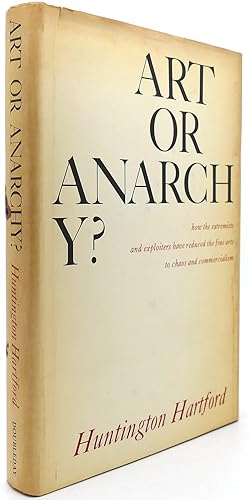
Art or Anarchy?

Image result for Art of Anarchy? huntington hartfordArt or Anarchy?  How the Extremists and Exploiters Have Reduced the Fine Arts to Chaos and Commercialism by Huntington Hartford, 196 pages

This 1964 book by the playboy founder of New York's Huntington Hartford Gallery of Modern Art presents a bleak view of an art world that has slid deep into solipsism and meaninglessness, a collapse Hartford attributes primarily to the abandonment of the subject.  As he saw it, this was enabled and exacerbated by the increasing commercialization of fine art in the first half of the twentieth century.  Although the result may be an art reflective of its time, it signally fails to transcend its time.

Hartford's book is a free-ranging polemic which includes extensive discussions of the peccadilloes of great artists and the subversive influence of the KGB in the Western art scene.  This has its advantages - Hartford is unafraid of making enemies - but these are far outweighed by the lack of focus and gossipy malodor.

Tuesday, July 9, 2019

Meditations on Quixote

Image result for Meditations on QuixoteMeditations on Quixote by Jose Ortega y Gasset, translated by Evelyn Rugg and Diego Marin, 165 pages

Meditations on Quixote was Ortega's first published work, an exploration of the Spanish character as distilled in its literary exemplar.  Musing in the shadow of the Escorial, Ortega finds in the Don the intersection between modernity and antiquity, matter and spirit, body and mind, the particular and the universal, science and myth, the Germanic and the Mediterranean, the novel and poetry, comedy and tragedy, disillusionment and hallucination.  As the former supplant the latter, however, he discovers that the latter are not annihilated, but secrete themselves within the former.

Saturday, June 8, 2019

Kingdom of Man

The Kingdom of ManThe Kingdom of Man: Genesis and Failure of the Modern Project by Remi Brague, translated by Paul Seaton, 216 pages

The third part of Remi Brague's grand history of ideas, following The Wisdom of the World, which was centered in the classical world, and The Law of God, which focused on the medieval world, The Kingdom of Man looks at the modern world, or, as the subtitle significantly puts it, the modern project.  For Brague, this is the distinctive characteristic of modernity - that it sees itself as a project. This was itself the result of a shift of attitudes towards work - where classically freedom from work was the privilege of nobility, in the Renaissance it became the expression of human dignity and power.  The valorization of "useful" work above "useless" contemplation, while it begins by promising worldly abundance, ultimately positions man as an object rather than a subject, like all nature an unsatisfactory thing that exists only to be mastered and overcome, and thus the project of modernist humanism ends in the sacrifice of humanity to the project.

Brague's approach is entirely descriptive.  He does not consider the views of critics of modernity, nor does he explore alternatives to it.  Instead, he follows the logical development of modernism from nominalism to posthumanism from within, carefully tracing the origins and consequences of each idea, and illuminating a great many things even outside of his focus.

Saturday, May 11, 2019

Idol of Our Age


In The Idol of Our Age, Daniel Mahoney uses the thought of Orestes Brownson, Vladimir Soloviev, and Aleksandr Solzhenitsyn to critique what he calls, following Aurel Kolnai, the religion of humanitarianism, itself the product of the replacement of a traditional understanding of reason as the faculty by which men could apprehend the underlying order and harmony of Creation with a truncated this-worldly view of reason as a tool of manipulation and conquest.  The Enlightenment rationalists naively imagined that they could organize a world where a soulless humanity could live in peace and plenty, but Mahoney argues that their immanentist project, by substituting the idol of the mere man for the icon of the God-man and putting the love of an abstract humanity above the love of God, ends by elevating sentimentality over reason and the easy appearance of virtue over the hard work of becoming virtuous.  The hubris of humanitarianism, which vastly overestimates the power of the human mind and therefore fails to recognize the seriousness of evil, is nevertheless powerfully seductive to Christians, being in fact a fragment of a disintegrated Christianity, and, as the subtitle implies, exposing this specific temptation is the primary purpose of Mahoney's book.

The Idol of Our Age began as a series a separate essays, and these have been not very artfully welded together, the whole functioning primarily as a commentary on the appended 1944 essay by Kolnai.  The whole work might be stronger if that essay had been placed at the beginning, or if the reader skips to the end to read it first and then returns to Pierre Manent's introduction.  Yet even if all he did was draw attention to such a powerful essay, Mahoney's work would be worthwhile.  He does more, using his sources to elaborate on Kolnai's insights, and to demonstrate their continuing significance for the world and Church of today.

Tuesday, April 2, 2019

Making Dystopia

Making DystopiaMaking Dystopia: The Strange Rise and Survival of Architectural Barbarism by James Stevens Curl, 388 pages

In Making Dystopia, James Curl attempts to debunk the myth that Modernist architecture evolved organically in continuity with earlier styles and therefore represents the only acceptable style for the present era.  Curl provides a detailed explanation in words and (more importantly) pictures of how Modernism represented a revolutionary rupture with the moralistic, traditionalist, humanistic architectural philosophies of Pugin, Ruskin, and Morris, and the establishment of a new aesthetic ideology that is Puritanical, anti-tradition, anti-history, anti-culture, and therefore ultimately totalitarian and thoroughly anti-human.

The pictures are vitally important because it is not enough for Curl that the reader should concede that he is right, he wants us to see why he is correct.  More than either an argument in architectural theory or a history of modern architecture, the book is an education in how to understand architecture.  Yet Curl does not neglect the social, political, or commercial factors that contributed to the triumph of Modernism despite its unpopularity, either.  In his account of the process by which theoretical abstraction gave momentum to the development of artistic abstraction, there are many similarities to Wolfe's The Painted Word, but despite this (and the overt allusions to Pugin's Contrasts) the book it most resembles may be The Stones of Venice.  This comparison may displease the author, but it is devoutly hoped that his book has the kind of impact in our time as Ruskin's had in his.

Wednesday, November 29, 2017

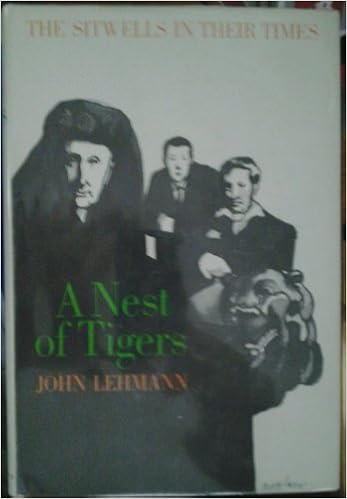
Nest of Tigers

A Nest of Tigers: The Sitwells in Their Times by John Lehmann, 275 pages

"We are as cosy as a nest of tigers on the Ganges," was how Dame Edith Sitwell described her relationship with her brothers, Sir Osbert and Sacheverell, to her friend John Lehmann.  This provided the title for Lehmann's admiring portrait of the Sitwell family, their literary works in all their variety, their roles in the English Modernist avant-garde, and their relations with their contemporaries both famous and obscure.

Although the book concentrates as much on their works as on their lives, Lehmann writes more as a friend rather than as a critic, and his obvious sympathy with the Sitwells is perfectly mirrored by his antipathy towards their detractors.  The result is not, perhaps, as fine as a more objective evaluation might have been.  It is, however, undoubtedly more charming.

Wednesday, August 30, 2017

Duino Elegies

Duino Elegies by Rainer Maria Rilke, translated by JB Leishman and Stephen Spender, 102 pages

Undoubtedly Rilke's masterpiece, the ten poems which constitute the Duino Elegies form the field on which the poet, like Jacob, wrestles with the Angel.  Rilke's struggle, conducted in words, is existential - he seeks to uphold the worth of human things in the light of eternity, in spite of the pain and grief with which they are entangled.  In his elegies Rilke celebrates love and youth and expresses sorrow at their loss, but on a higher level he grapples with the meaning of, and ultimately affirms the value of, the reality of death and suffering.  In the process he manages to magnificently fulfill the vocation of the poet, translating the visible into the invisible, the temporal into the imperishable.

Wednesday, August 23, 2017

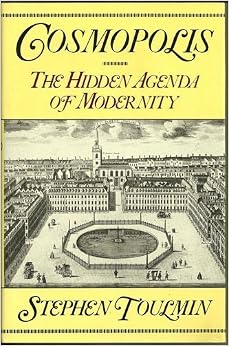
Cosmopolis

Cosmopolis: The Hidden Agenda of Modernity by Stephen Toulmin, 209 pages

In Stephen Toulmin's exhilarating history of ideas, "cosmopolis" is defined as a worldview that unifies the vision of the social world of humanity with the world of nature.  The medieval cosmopolis, which combined a Ptolemaic astronomy that understood the earth as lying at the bottom of the cosmos with a theological social orientation dominated by the Church, faded into an urbane skepticism during the Renaissance.  This was replaced, in turn, by a new cosmopolitical vision, joining together Cartesian philosophy and Newtonian physics.  Toulmin identifies this union as the wellspring of modernity, noting that, contrary to the standard account, it represented a narrowing rather than a broadening of mind.  The late twentieth century, in this view, represents the dawn of another skeptical age, wherein the embryo of the next cosmopolis will form.

Toulmin's argument is marred by some questionable judgments (that Baroque art was "histrionic and grotesque", for example) and exaggerations (while not as oppressive as often imagined, the Middle Ages were hardly as open-minded as he implies).  More incredible is his too-easy identification of postmodern nihilism with Renaissance humanism.  Yet the greatest difficulties are raised by his enthusiasm for the adoption of ecology as the new model for social order, in which he is seemingly oblivious to the obvious problems of invoking biology as a political principle.  Nonetheless, these problems are ultimately forgivable, if only because his book is so rich in audacity and explanatory power.

Friday, May 5, 2017

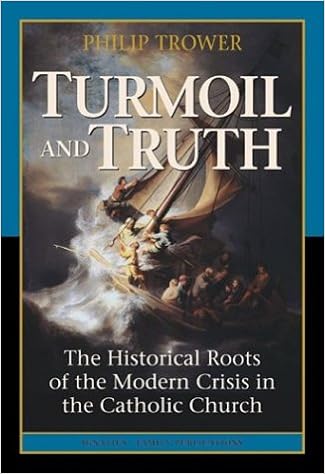
Turmoil and Truth

Turmoil and Truth: The Historical Roots of the Modern Crisis in the Catholic Church by Philip Trower, 199 pages

"Ecclesia semper reformanda est," St Augustine declared in the 4th century, "The Church is always in need of reform."  This was as true in the middle of the twentieth century as in Augustine's time, and historically the most powerful impetus to reform has been the ecumenical councils.  With the Second Vatican Council, however, the worst abuses seemed to follow rather than precede the Council, so that it seemed to many to be the cause rather than the cure.  The mission of aggiornamento entrusted to the Council by St John XXIII necessarily involved the sifting of the fruits of the modern world, keeping the wheat and disposing of the chaff.  According to Philip Trower, it was precisely this task that Church authorities and theologians proved unable - or unwilling - to perform in the wake of the Council.  

In Trower's view, the Church not only had the opportunity but also the moral responsibility to assimilate the goods of modernity, but not at the cost of the goods already entrusted to her.  The faith does not evolve, with the present replacing the past, rather it develops, with yesterday being refined and expanded upon today.  As such, modernity needs to be evaluated critically, but as Trower demonstrates, many of the reformers' reforms were outdated before they were even implemented - the idea of an immanentist Church which downplayed irrational elements of mystery and the supernatural was advanced even as the youth of the West embraced exotic mysticism and inchoate spirituality.  The modernists triumphed just as post-modernity began.

There are some problems with the book, the first being that it is really half a book - the sequel, The Catholic Church and the Counter-Faith, being the second half.  Trower concentrates on the ideas themselves rather than how they were propagated - he particularly seems to underestimate the extent to which dissenting Catholic intellectuals were bolstered by Western cultural elites, allowing them to make their case directly to the public instead of the bishops.  Still, it is precisely Trower's faith in the power of ideas that makes his history of the sowing of the wheat and tares reaped in the wake of the Council so worthwhile.

Wednesday, December 16, 2015

Modernism


Modernism is an amorphous category with many definitions.  It is reasonable to argue that it should not be used as a label at all, having too little meaning.  Peter Gay argues that it does have a meaning, and that the cultural movement by that name has a coherent past, and possibly a future.

Unfortunately, he fails to establish this convincingly.  The subject is too large and the book too small.  Gay never explicitly defines modernism, vaguely describing it as a set of attitudes involving the search for total independence of artistic expression, the resulting rejection of history and tradition, the quest for inwardness, and an unwavering hostility towards the bourgeois masses.  Understandably, he chooses to break the subject down into subsets - painting, literature, music, architecture, film - and discuss each individually, but in practice this lack of a unitary narrative produces repetition and confusion, as when the story of the birth of Dada is told twice, once under painting and once under drama.  Not that this is avoided within the chapters, either - Waiting for Godot is summarized in the discussion of the Theater of the Absurd and again in the very next paragraph when introducing Beckett as an author.

Nor is Gay consistent in his definitions.  Repeatedly the reader is told that Modernism transcends politics and morality, but views that violate certain norms - Strindberg's virulent misogyny, for example - are nonetheless presented as definitely outside the Modernist pale.  Worse, despite the obvious ways in which modernism, with its rejection of real history, tradition, and morality, its cult of novelty, obsession with progress, and hatred of the unenlightened masses, prepared the way for totalitarianism, and the fact that many of the modernists who, in Gay's own words, "were proclaiming an overwhelming need for, and prophesied the coming of, a New Man in a culture that seemed naked without ideals", found that New Man in Nazi Germany, Fascist Italy, and especially in the Soviet Union, the modernist celebrations of those regimes are treated as secondary to the dictatorships' hostility to modernist art.  True, Knut Hamsun's support of Hitler is thoroughly discussed and justly condemned, but Picasso's enthusiasm for Stalin and Kim Il Sung is not mentioned at all.

There are a few positives.  Gay's account of the importance of artistic middlemen - dealers and brokers, publishers and directors - in the development of art that, by its very nature, had to fight for an audience, could be the seed of a good book, but it is not this book.  Near the end, when criticizing Pop Art and celebrating Gehry's Bilbao Guggenheim, Modernism becomes more interesting, but it is too little, too late.

Overall, the treatment of individual figures is superficial, and the treatment of great themes hopelessly muddled.  Modernism does not succeed in compellingly describing either small details or the big picture.
Sunday, December 29, 2013

Robert Rauschenberg

Robert Rauschenberg by Catherine Craft, 145 pages 2013

      One of the things I love about being a floater on the second floor is that I get to spend a lot of time in the fine arts room, and get to check out new art books as they come in.  This slim new book on Rauschenberg is an elegant introduction to an important American modern artist.  The writing is clear, and to the point; Craft does not complicate the text by littering it with art jargon.  The page where she describes Rauschenberg's famous piece Erased de Kooning  is one the best examples of writing I have ever seen concerning that specific project. She follows the different phases of his prolific career, summarizing each phase with relative ease.   The photographic reproductions of his work rivals that of more expensive, expansive fine art monographs. Usually when the book is cheaper and shorter, the reader is offered a mediocre viewing experience, here, Phaidon does not disappoint.