Showing posts with label philosophy of science. Show all posts

Wednesday, April 11, 2018

Tyranny of Science

Tyranny of ScienceThe Tyranny of Science by Paul Feyerabend, 134 pages

The Tyranny of Science is an adaptation of a series of lectures delivered by Feyerabend, themselves the distillations of decades of class lectures and extracurricular talks.  These form a critique of what Feyerabend sees as the unjustified hegemonic dominance of Scientism in Western culture.  Far from conceding that a scientific worldview justifies itself by its successes, he questions the very concepts of success and progress.  More fundamentally, he insists that reality exists prior to theory, and valid interpretations of that reality include not only the mathematical but also the poetic, not only the universal but also the particular, not only the abstract but also the concrete.   He drives home this analysis through an extensive use of Plato, the pre-Socratics, and the Greek dramatists, less as a source for arguments than as a source of illustrations for his arguments.

Each chapter closes with the transcript of a question and answer session, and it is obvious that Feyerabend takes great pleasure in the give and take.  The author's playfulness certainly makes the text more lively, but it also seems to be the author's primary motivation.  Feyerabend does not attack Scientism because he disdains science, but because he rejects any claim to final, incontrovertible Truth.  For Feyerabend, absolute Truth is an unintelligible concept, and philosophy is found in the interplay of truths.  Clearly, he finds dancing on the edge of the abyss of nihilism exhilarating, but to an outside observer it also appears unsustainable.

Wednesday, August 23, 2017

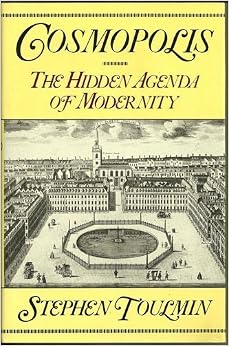
Cosmopolis

Cosmopolis: The Hidden Agenda of Modernity by Stephen Toulmin, 209 pages

In Stephen Toulmin's exhilarating history of ideas, "cosmopolis" is defined as a worldview that unifies the vision of the social world of humanity with the world of nature.  The medieval cosmopolis, which combined a Ptolemaic astronomy that understood the earth as lying at the bottom of the cosmos with a theological social orientation dominated by the Church, faded into an urbane skepticism during the Renaissance.  This was replaced, in turn, by a new cosmopolitical vision, joining together Cartesian philosophy and Newtonian physics.  Toulmin identifies this union as the wellspring of modernity, noting that, contrary to the standard account, it represented a narrowing rather than a broadening of mind.  The late twentieth century, in this view, represents the dawn of another skeptical age, wherein the embryo of the next cosmopolis will form.

Toulmin's argument is marred by some questionable judgments (that Baroque art was "histrionic and grotesque", for example) and exaggerations (while not as oppressive as often imagined, the Middle Ages were hardly as open-minded as he implies).  More incredible is his too-easy identification of postmodern nihilism with Renaissance humanism.  Yet the greatest difficulties are raised by his enthusiasm for the adoption of ecology as the new model for social order, in which he is seemingly oblivious to the obvious problems of invoking biology as a political principle.  Nonetheless, these problems are ultimately forgivable, if only because his book is so rich in audacity and explanatory power.

Friday, June 2, 2017

The Island of Knowledge

The Island of Knowledge: The Limits of Science and the Search for Meaning by Marcelo Gleiser, 335 pages


Marcelo Gleiser is Appleton Professor of Natural Philosophy and Professor of physics and astronomy at Dartmouth College. Gleiser proposes a new metaphor to use when thinking about knowledge in general and science specifically.


Human knowledge is an island that grows as our knowledge grows (and sometimes shrinks some when we find out our knowledge is not true). The island grows but is always surrounded by water and never reaches a boundary. We can continue to learn more but never learn everything. Some would find despair in this but Gleiser doesn't.


There are three sections in the book. In the first, Gleiser talks about the evolution of humanity's knowledge about the origin of the Earth and the Universe. The second is titled From Alchemy to the Quantum: the Elusive Nature of Reality. He talks about atoms, heat, light and quantum physics. He describes the limits of what we can know. The third and shortest part is titled Mind and Meaning. This section is devoted to whether mathematics is an invention or a discovery, consciousness and a conclusion.


Gleiser sees science as a way to search for meaning. It is an open ended search that will never end. He does not see science as the only way of finding meaning. Not all scientists would agree with him that there is a limit to how much we can know.


I found the metaphor of knowledge as an island an apt one. Sure, all islands don't grow but they can. This book provided great food for thought. While some of the science may be a review I would recommend this to people who are interested in science or philosophy.