Showing posts with label loss. Show all posts

Saturday, July 13, 2024

The Museum of Ordinary People

The Museum of Ordinary People by Mike Gayle 336 pages


What do you do with your mom’s stuff after she is gone? It’s a predicament that many find themselves in these days. Or maybe I feel that way because my own mom cannot live at home anymore. But what the heck am I going to do with all that stuff! Sixty years worth of life!


That’s the issue Jess is facing.  Her mother dies suddenly. Jess is an only child so the entire burden passes to her.


From the book’s back cover:

“Still reeling from the sudden death of her mother, Jess is about to do the hardest thing she's ever done: empty her childhood home so that it can be sold.  As she sorts through a lifetime of memories, everything comes to a halt when she comes across something she just can’t part with: an old set of encyclopedias.  To the world, the books are outdated and ready to be recycled.  To Jess, they represent love and the future that her mother always wanted her to have. 

In the process of finding the books a new home, Jess discovers an unusual archive of letters, photographs, and curious housed in a warehouse and known as the Museum of Ordinary People.  Irresistibly drawn, she becomes the museum's unofficial custodian, along with the warehouse’s mysterious owner.  As they delve into the history of objects in their care, they not only unravel heart-stirring stories that span generations and continents, but also unearth long-buried secrets that lie closer to home.

Inspired by an abandoned box of mementos, 
The Museum of Ordinary People is a poignant novel about memory and loss, the things we leave behind, and the future we create for ourselves.  

I really enjoyed this book and was intrigued by it. It takes place in a London suburb, but it could have taken place anywhere. I found the story rather sad and heartbreaking, but there are shining moments. This is a tough book to review as it is hard, for me, to articulate my feelings. Still, I encourage everyone to read it and give this challenge: Think about your home. What would donate to The Museum of Ordinary People and why. The Museum of Ordinary People receives 4 out of 5 stars in Julie’s world.


Tuesday, January 11, 2022

A World Lost

A World Lost by Wendell Berry, 151 pages

Andy Catlett was nine years old when his favorite uncle and namesake was shot and killed.  The murder left a void in little Andy's life, family, and community, a powerful absence strongly felt but unspoken.  As the decades pass and Andy becomes a man, he explores this loss in many dimensions, even as he gradually comes to recognize that he will never really know why his uncle died.

A World Lost is short, powerful, and mysterious.  Mysterious not because it is a whodunnit - the identity of Uncle Andrew's killer is never in doubt - but because it touches on deeper mysteries, mysteries involving the human person and the nature of sin.  Berry does not try to solve these mysteries, he tries to understand them, and that begins with accepting that they cannot be solved.  Who Uncle Andrew was is ultimately a question just as unanswerable - and infinitely more wonderful - as the questions surrounding his murder.

Tuesday, September 24, 2019

Lenten Lands

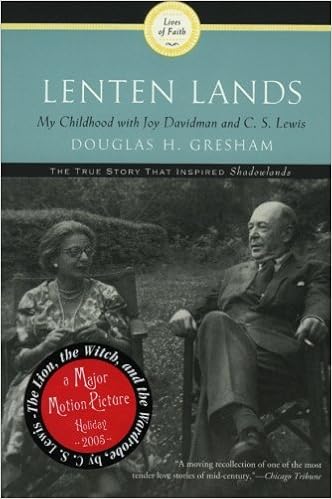
Image result for lenten lands douglas greshamLenten Lands: My Life with Joy Davidman and CS Lewis by Douglas H Gresham, 213 pages

Douglas Gresham is the younger son of the authors WL Gresham and Joy Davidman.  After his parents' divorce, his mother took him to England, where she had become close friends with the brothers CS (Jack to his friends) and WH (Warnie) Lewis.  In time, Jack and Joy would wed, and Lewis legally adopted the Gresham boys.  Lenten Lands is Gresham's memoir of his time at the Kilns, as the Lewis' home was called, from the earliest days when it seemed an enchanted place, to later years when it became for him an emblem of loss and grief.

This is a personal book.  Lewis' writings are barely mentioned, and anyone seeking insight into them (other than A Grief Observed) is sure to be disappointed.  It is also Gresham's book, giving his perspective and not anyone else's, and it is focused on his life rather than being "CS Lewis As I Knew Him."  It has to be said that it is all the more charming for that, and it would be an enjoyable read even if Lewis had never written a word.

Tuesday, June 13, 2017

Trumpet

Trumpet by Jackie Kay, 278 pages


The novel starts soon after Joss Moody's funeral. It is mostly set in London in 1997. We find out that Joss was a legendary British jazz trumpet player. His wife Millie is mourning him. We find out that Joss was biologically a woman and the only person who knew before he died was Millie. The novel is told from the perspective of his wife and people who didn't know such as a doctor, a registrar, the funeral director, fellow jazz musicians, their adopted son Colman, a reporter, etc. Their reactions are all different.


The doctor, registrar and funeral director have to find a way to digest what they have never come across before.  The fellow jazz musicians don't care and indicate that the music was the important part. Colman didn't know until he was told by the funeral director and feels betrayed that he was never told. His father has left him a letter that he refuses to open. This leads him to accept a tabloid reporter's offer to write a book about his father. As time goes on, Colman begins to doubt the motivations (the reporter's and his) behind the book. In seeking answers about his father's life, he finds out that Joss's mother is still alive and goes to visit her. Will he come to peace with who his father was and open the letter?


This novel won the 1998 Guardian Fiction prize and was inspired by the real life of jazz musician Billy Tipton.


I thought this novel was good but I was also unsatisfied. On one hand, I realize it was meant to be mostly told from the perspectives of others but the lack of Joss's perspective left me with too many unanswered questions. Maybe that was the point.

Wednesday, November 30, 2016

The Poet's Dog

The Poet's Dog by Patricia MacLachlan, 88 pages

This is a short, sweet story about a dog, Teddy, who was rescued by a poet, Sylvan.  Sylvan tells Teddy that only poets and children can understand dogs, which turns out to be true, at least once Teddy begins to understand human words.  Teddy, in turn, rescues two human children, Nickel and Flora, from a bad storm.  He leads them back to Sylvan's cabin so they will be warm and safe but Sylvan is not there.  Through the book, the story of Sylvan and Teddy is revealed.  This story is definitely predictable, especially for adults, but even children will be able to guess what happened to Sylvan and few will be surprised by the bittersweet ending of the book.  This is a good early chapter book for beginning readers, especially kids who like animal stories.

Thursday, September 29, 2016

Still Here

Still Here by Lara Vapnyar   320 pages

In her seventh novel, author Lara Vapynyar deals with the immigrant experience and identity, specifically a person’s online identity after his or her demise.

The novel centers around four Russian immigrants, friends since their school days. Now in their mid-40s, the four have come to the crossroads that often plague the lives of the middle-aged. The friends---Vica, Vadik, Sergey and Regina---all live in New York City.

Sergey and Vica are married and have a son, Eric. Sergey is constantly being laid off from his job as a financial analyst. Vica works as a medical technician at a local cancer treatment center. Just after the story opens, the couple split. Sergey goes to stay with Vadik and decides to devote all his time to developing an app that he calls “Virtual Grave.” The idea is that the app will peruse a person’s emails, text, voice mails, etc. to continue to recreate his or her online presence after death.

Vadik  is a programmer and is single. He lives the bachelor life, dating woman after woman. I thought he was the lesser drawn of the characters. He had been in love with Rachel, but there were two Rachel’s in Vadik’s life, referred to as Rachel 1 and Rachel 2. I found that utterly confusing.

Then there is Regina. A famous literary translator back in Russia, she spends her days grieving over her lost career and her mother. She’s marred to Bob, a wealthy American. Readers never get to see Bob except in passing and when he shows up, it is sometimes confusing because I always had trouble remembering who he was.

The book seems less to do with app and how it would than it does the four trying to navigate the daily struggle of life. I also had trouble in remembering who Vica and Vadik were…I kept getting them confused.

The story didn’t grab me. I plodded along with, much like the characters do in their lives. The book was okay, but I’ve read better books that deal with the same subject (virtual life after death) that were much better. I did like all the literary references. I give Still Here 3 out of 5 stars.

I received this book from Blogging for Books in exchange for this review.


Thursday, July 21, 2016

The Year of Fog

The Year of Fog by Michelle Richmond     432 pages

When I go on vacation, I like to read books that place in that locale. This year my destination was San Francisco, and I happened upon this wonderful novel about memory, obsession, and one woman’s search for a missing child.

I don’t know about you, but when I hear about a child who has gone missing without a single trace, I shake my head, say a quick prayer, and tell others that I cannot imagine what the parents are feeling. Michelle Richmond did an amazing job in keep the character in one place yet moving forward at the same time, all the while letting readers be voyeurs of this horrific happening.

Freelance photographer Abby Mason is the step-mother-to-be to six-year-old Emma. Abby loves her new role as fiancée and as friend and mom. Abby and Emma go to the foggy Ocean Beach almost every day. Today it may be summer, but it’s almost always cold and foggy at this remote beach. Emma twists her tiny hand from Abby’s and runs ahead. Momentarily distracted by a dead seal pup, when Abby turns back to Emma, she has disappeared in the fog. Literally, she is gone.

Readers will get a behind-the-scenes look at a search for a missing child. The police and volunteers who comb the area, the flyers, the reward posting, the sleepless nights, the inability to choke down more than a few morsels of food, the fear that grips Abby and Jake, Emma’s father.

Police at first believe she has drowned. Then they look at the Jake and Abby as possible suspects. Jake goes on national television to plead with anyone who may have seen Emma, especially her mother, Lisbeth, who abandoned Jake and Emma three years earlier.

As the minutes turn to hours to days to weeks to months, the police give up as new, more solvable cases capture their attention. After months, Jake wants to hold a memorial service and move on with life. But not Abby, she refuses to believe that Emma cannot be found.

Readers go with her on her travels through the Bay area, shoving flyers into strangers’ hands, practically begging for help. Readers go with Abby on her quest to locate any memory of their surroundings on the beach that day.

I don’t often have a need to peek at a novel’s ending, but the tension is so great that it was all I could do not to peep at the ending.


I give The Year of Fog 6 out of 5 stars.

Friday, April 15, 2016

The Lost

Cover image for The Lost by Sarah Beth Durst, 350 pages

For a great plot synopsis, see Krista's review: here.

The Lost has three fairly distinct acts, with (sadly) each one being slightly worse than the last. It starts out very strongly, with a legitimately creepy tone and an interesting setting. It's hard to pull off creepy - especially for extended lengths of time - and The Lost does the best job of it that I've seen recently. It changes pretty quickly to a survival story - well written, and bringing more complexity to the characters - but the transition is a bit jarring. It would have been amazing to maintain the creepy atmosphere while moving into survival territory, but it... doesn't. Eventually the narrative changes again (though when and how is spoiler-y). While it's categorized as an adult novel, the author's YA roots show through pretty plainly - there's only three male characters with any real story relevance, and two of them are over-the-top handsome men with (inexplicable?) crushes on the main character.

I should emphasize that I really did like the book, even in the final act. It just lost (pun intended) a lot of its impact as it went on.

Friday, September 25, 2015

Buried Giant

Buried Giant by Kazuo Ishiguro
317 Pages

"The Romans have long since departed and Britain is steadily declining into ruin. But, at least, the wars that once ravaged the country have ceased. Axl and Beatrice, a couple of elderly Britons, decide that now is the time, finally, for them to set off across this troubled land of mist and rain to find the son they have not seen for years, the son they can scarcely remember. They know they will face many hazards--some strange and otherworldly--but they cannot foresee how their journey will reveal to them the dark and forgotten corners of their love for each other. Nor can they foresee that they will be joined on their journey by a Saxon warrior, his orphan charge, and a knight--each of them, like Axl and Beatrice, lost in some way to his own past, but drawn inexorably toward the comfort, and the burden, of the fullness of a life's memories. "


Not character driven  and somewhat rambling the book was a near miss for me.  While the concepts Ishiguro explored were interesting I didn't really enjoy the journey, both figuratively and literally.  

Thursday, September 24, 2015

Not on Fire but Burning

Not on Fire but Burning by Greg Hrbek
275 Pages

"Twenty-year-old Skyler saw the incident out her window: Some sort of metallic object hovering over the Golden Gate Bridge just before it collapsed and a mushroom cloud lifted above the city. Like everyone, she ran, but she couldn't outrun the radiation, with her last thoughts being of her beloved baby brother, Dorian, safe in her distant family home.

Flash forward to a post-incident America, where the country has been broken up into territories and Muslims have been herded onto the old Indian reservations in the west, even though no one has determined who set off the explosion that destroyed San Francisco. Twelve-year old Dorian dreams about killing Muslims and about his sister—even though Dorian's parents insist Skyler never existed. Are they still shell-shocked, trying to put the past behind them . . . or is something more sinister going on?

Meanwhile, across the street, Dorian's neighbor adopts a Muslim orphan from the territories. It will set off a series of increasingly terrifying incidents that will lead to either tragedy or redemption for Dorian, as he struggles to prove that his sister existed—and was killed by a terrorist attack."


This is a difficult book to classify and it will leave the reader thinking about the fabric of reality and life. Parts of the book are confusing and weak but overall the language is beautiful and the plot evolves into a climatic ending.

Friday, July 17, 2015

Losing Mum and Pup

Cover image for Losing Mum and Pup: A Memoir by Christopher Buckley, 251 pages

In twelve months, Christopher Buckley (author of Thank You for Smoking and Boomsday) lost first  his mother Patricia Buckley (famed socialite and member of the International Best-Dressed Hall of Fame) and then his father, William F Buckley, Jr (founder and editor of National Review, host of Firing Line for 33 years, author of over 50 books).  Both died after long illnesses, with William's condition deteriorating rapidly after his wife's death.  As their only child, much of the burden of care fell upon Christopher.  Losing Mum and Pup is the story of that year, and, seen through it, all the years before, three remarkable lives entangled together, not always happily.

Author Buckley is well aware that losing parents is not a unique event, and that a successful author from a wealthy, distinguished family is not generally a suitable object of pity (pity and sympathy are, of course, different things).  Some of the passages, taken by themselves, would seem horribly egocentric - if it was possible to make such a judgement of a man as he told you of his last words to his dying mother.  Buckley is primarily a satirist, and he is deftly able to defuse the pathos with humor before it becomes overwhelming.

A touching book about life, love, and loss that also happens to be really funny.

Saturday, April 18, 2015

Sinners Welcome

Cover image for Sinners Welcome by Mary Karr, 93 pages

An admirable collection of poems that manages to wed the sublime to the grotesque.  Karr finds faith, hope, and love - in short, the sacred - in the unlikeliest places and things, conveying meaning and feeling with a light touch that never becomes sentimental or preachy.  The best of the poems surprise with a flicker of light in what seemed dead dimness.

Included is an essay Karr wrote for Poetry magazine about her slow, grudging conversion to Catholicism, out of long struggles with alcoholism but also a sense of the sacredness of words.

Friday, January 23, 2015

Blue Lily, Lily Blue

Cover image for Blue Lily, Lily Blue by Maggie Stiefvater, 391 pages

Yep, this series is great. (series recap: magic happens, charming characters seek out magic, things get bad)

The 3rd book has a less traditional arc than the previous two, and I think it might be better for it. While you can pretty easily say that Blue is the main character of The Raven Boys, and Ronan is at least the focus of The Dream Thieves (if not the main character), by this point, the whole cast of characters take center stage.

You could argue that this is a bit of a transitional book. While some new conflicts do present themselves in this entry, for the most part, the focus here is on further exploring problems that began in the previous entries, with none truly "concluded." Even the new problems introduced here remain a "looming threat" for most of the book, until things come crashing down (sometimes literally) at the end. Some people might be disappointed, but when he plotlines are this interesting, and the characters this engrossing, it becomes a selling point.

I can't heap much more praise on this series than I already have in prior reviews (wait, did I even post those here? Imagine two super-cool, incredibly eloquent reviews, heaping praise via shovel). The characters are (still) great, and (still) develop in mostly believable ways (though as the plot becomes more and more magical, the characters change with it). There's a series of scenes in particular with such real, imperfect emotion, that I'd believe if it was adapted autobiography. Everything from the dialogue to the setting is pretty darn fantastic.

I don't think this series would work if you started on book two or three, and by this point, it doesn't even try to acclimate new readers. But really, you're doing yourself a great disservice if you start anywhere but the beginning.

Saturday, September 27, 2014

If He Had Been With Me

Cover image for If he had been with me : a novel / Laura Nowlin.If He Had Been With Me by Laura Nowlin, 330 pages

Have you ever just... gone into the bathroom and punched yourself in the chest 330 times? No? Well... me either, but I'm pretty sure I know what that feels like now. But this is a positive review! And I promise I'm not a masochist!

Almost from the title alone, you can tell where this book is headed. I feel like I can only diminish it by going into too much detail. Instead, I'll say this: while the story is simple, the writing is superb. Being able to sneak incredible insight (almost unnoticed) into scenes that feel perfectly real is a rare skill, and Nowlin does it flawlessly on many occasions here.

There's a four-page chapter almost squarely in the middle of the book that perfectly encapsulates not only what the book is about, but also why it's great. As much as I'd like to block quote all four pages, I'll just say "sometimes sad things are beautiful." This story is an experience that is often difficult to push through - for the most part, I read it in small pieces - but is worth the struggle.

It should be stated that this book fails the Bechdel test about as badly as it is possible to fail. But in a story about obsessive unrequited introvert love, it's understandable.

This would never be a novel I could recommend to everyone. But if you're wearing a breastplate, then you might be okay.

Monday, July 21, 2014

Wild: From Lost to Found on the Pacific Crest Trail

Wild: From Lost to Found on the Pacific Crest Trail
by Cheryl Strayed, 311 pages

Another female author with a memoir-ish book about a journey they have embarked upon. Is is just me, or do all these women have the same whiny voice? Would I sound the same if I wrote one of these books? I hope not.
Cheryl loses her mom, gets divorced as a result of her own infidelity, and decides to hike the Pacific Crest Trail for 3 months, totalling about 1100 miles. She's not really a hiker or a camper, so she mostly relies on the kind staff at REI to advise her on this trip. She meets all sorts of interesting people, encounters many rattlesnakes, a few bears, and even a pretty little red fox. She makes a lot of bad decisions.
I don't know how legit I can even consider her trip, since she mailed herself things at various stops along her route, such as money and food. I guess I'm okay with it since her trip WAS 3 months long and it would be hard to carry 3 months worth of food on your back (her backpack was ridiculous as it was).
Reading about the nature and wilderness she got to experience was the only really good part of this book. It did make me start thinking about a trip such as this myself. Well, actually nothing like this. But I do enjoy nature.

Wednesday, May 14, 2014

Prodigy: a Legend Novel

Cover image for Prodigy / Marie Lu.Prodigy: a Legend Novel by Marie Lu, 373 pages

Feels very similar to the first book in the series, Legend, in that there are parts that are very good, and parts that are very bad. The overall plot arc is quite good, and while it won't absolutely stun you with any of its plot twists, it also doesn't follow the exact trajectory that you'd expect. The characters are relatively well fleshed-out, and some of the plot points that at first seem a little head-scratching, end up making more sense as the story progresses.

But it's not without its blemishes. First off, I'm fine with makeout sessions, but... maybe when one of the characters is bleeding out from a leg wound is not the optimal time to be swapping saliva? That these scenes are here is not the problem. The problem is where they're placed. If you've got a sense of tension and immediacy that you've been building for the past few chapters, maybe don't put in a blatant red "Stop" sign and take a detour for sloppy makeouts. It ruins both.

Also... the big bad boss we meet early in the book is named... Razor? Honestly... Razor? You couldn't think up anything better than... Razor? It sounds like something a 10-year-old boy would name a supervillain. I listened to this as an audiobook, and when they first mentioned his name, I laughed out loud. Unless you're trying to make this book an awkward commentary on a gaming peripherals company, the name Razor is just... not good. And you're not fooling anyone (nor making your universe more interesting) calling the princess-like position a "princeps."

There are times in the book that the tension will grab you, where the plot will take a turn you weren't entirely expecting, and you'll be invested. And it will be immediately followed by a passage so cheesy and out of place that you'll facepalm. Overall, this is a solid series (and I'll certainly read the final book), but there's just so much room for improvement - and often in ways that could have been easily fixed. Alternately engaging and disappointing.

Friday, January 31, 2014

More Than Thiss

More Than This by Patrick Ness, 472 pages

Seth wakes up after drowning in a strange world. In fact, he wakes up outside of his old house in England, even though he has lived in America for the past several years. He doesn’t remember exactly what happened or everything about his life right away either and even though he recognizes his house, there is no one around and everything looks as though it has been deserted for years. He finally meets two other people, Regine and Tomasz. Maybe with their help, he can figure out what is going on, if they can avoid the Driver, a figure all in black, who may or may not be human, but seems bent on killing them. This was an excellent story and any teen who enjoys fantasy/science fiction would love it.

Wednesday, December 11, 2013

The Dog Stars by Peter Heller

The Dog Stars by Peter Heller, 320 pages

My best friend recommended this book a year ago, and I finally got around to reading it. Actually, I listened to the first part of it, then read the rest. It is written in a way that is a little hard to follow: choppy, stream of consciousness sentence fragments throughout and no clear "he said she said" dialogue. Listening to the first part made it easier to follow since the person narrating it distinguished separate voices for the characters.
The book is set sometime in the future, 9 years after the flu and blood disease began to ravage humankind. Most everyone that's left is sick. Not Hig and Bangley. They've set up a camp near the mountains in Colorado. They have secured the perimeter. Hig flies his Cessna and patrols. Bangley mans the watchtower and is a good shot. A really good shot. Hig has a more sensitive side. He won't shoot unless it's absolutely necessary. Hig's wife was taken by the disease but not his faithful canine companion named Jasper. Dog really is Hig's copilot.
One day while Hig is out patrolling well outside the perimeter, he gets a communication from an airport. It sticks in his mind for years. Someone else might be out there that's still untouched. He has to find out. So he goes. Then the story really begins. And it's worth the confusing dialogue to read.

Wednesday, November 27, 2013

More Than This

More Than This - Patrick Ness
472 pages

In the opening pages of More Than This, Seth dies. Then he wakes up. Not in his small Pacific Northwest town, but in England where he grew up. However, things are… different. He is alone, every house and store he comes across is abandoned; even the birds have disappeared. The weather patterns are unusual. There is an unearthly black coffin in his childhood home’s attic. Is he in hell? Somewhere else?

This isn’t Patrick Ness’s first foray into dystopian landscapes; his Chaos Walking trilogy is one of the true stand-outs in the overcrowded YA dystopian fic genre. More Than This is more slowly paced and contemplative than Chaos Walking, but the philosophical meanderings are dotted with enough action and suspense to keep it moving at a steady clip. Ness’s writing is superb as always, but an unexpected (and somewhat irksome) plot twist toward the middle of the book threw me for a loop. I found the Cormac McCarthy-ish bleakness of the first 200 pages and the absolutely stellar cover design (that door is actually a cutout to the title page) to be the highlights of the book.

Monday, November 25, 2013

Winger

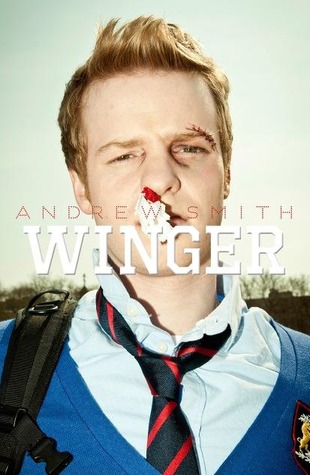
Winger by Andrew Smith, 439 pages

This book is an interesting study. It's an interesting study in narrative, and how we often root for the protagonist of a story simply because he's the protagonist (and in this case, because the book's written in first person), and not necessarily because they're worth rooting for. Let's be honest: for 2/3 of the book, Winger, the main character here, is a largely unrepentant turd who typically thinks, feels, and acts more with his libido than his brain. It's easy to jump to the argument, "sure he makes some mistakes, but at heart, Winger's a good guy!" But is he? Annie is touted as his best friend, but apart from her laughing at his usually-crude jokes, the relationship seems rather one-sided. She seems to legitimately care about him and his well-being, but 9 times out of 10, his mind is more occupied with how hot she is and how jealous he gets at her talking with other guys than it is with anything remotely friend-like. He's routinely a hypocrite, acknowledges he's a hypocrite, and ignores that knowledge so he can keep being a hypocrite. He lashes out at his friends, plays horrible pranks on his enemies, and for the most part, shows no remorse for any of it.

The study goes further though. The story itself is largely about his need to grow out of that mindset - about how, while Winger thinks of "growing up" as getting a few inches taller and having to shave off his first chin hair, it's really about realizing that love needs to go beyond physical attraction, that education needs to go beyond just mindlessly vomiting back what your teacher tells you, and that friendship needs to go beyond surface-level screwing around.

The question becomes: does the book sell that? And that's a question I have difficulty answering. I'd tend towards "yes," but at the same time, the book sometimes feels manipulative. If this book was written from JP's perspective (one of Winger's friends), it could probably be titled "Bad things happen to a relatively decent guy." I just don't know. I'm not sure if I'm rooting for Winger because I believe he's a good person and I want him to learn and grow and win in the end, or if I root for him because I'm as messed up as he is and I associate with some of his worst elements. I don't know if this books an indictment of juvenile thinking or a celebration of it.

I do know this much: Winger is not the most likable character in the story, and the character who is the most likable makes this novel what it is - powerful. Despite my confusion about much of the book, by the end it's hard to argue that. It is powerful.