Showing posts with label devotional. Show all posts

Tuesday, April 23, 2019

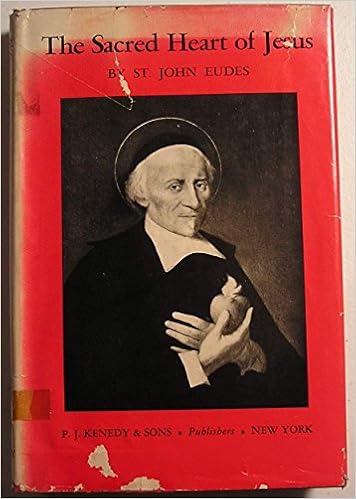
Sacred Heart of Jesus

Image result for The Sacred Heart of Jesus Eudes richard flowerThe Sacred Heart of Jesus by St John Eudes, translated by Dom Richard Flower, OSB, 180 pages

Undoubtedly one of the most popular Catholic devotions, the devotion to the Sacred Heart of Jesus, while rooted in Scripture and Tradition, only became formalized in the 17th century with the work of St John Eudes and the revelation to St Margaret Mary Alacoque.  To celebrate the 300th anniversary of their founding, the Congregation of Jesus and Mary commissioned a new translation of some of the works of their founder into English, centering on this devotion.  The result is this book, which compiles many different kinds of writing, from theological treatises to spiritual exercises and the text of the Mass and Office of the feast.  In this, it is somewhat reminiscent of Scripture itself, and as with Scripture the diversity of forms is bound together by a thematic unity, where every line speaks of Christ and His Sacred Heart, the burning furnace of charity in which sinners are refined into saints.

Thursday, April 18, 2019

Devotional Writings

The Tower WorksThe Tower Works: Devotional Writings by St Thomas More, 309 pages

This book collects a number of devotional works written by St Thomas while imprisoned in the Tower of London awaiting his trial and execution.  Not surprisingly given the author's circumstances, two of the three main treatises focus on the suffering Christ.  The first, the unfinished Treatise Upon the Passion, ends with the Last Supper, while another, The Sadness of Christ, meditates on Gethsemane.  Linking the two thematically as well as physically is the middle work, A Treatise to Receive the Blessed Body of Our Lord, on the Blessed Sacrament.  

St Thomas lives up to his reputation as a scholar, a lawyer, and a Christian, combining a breadth of learning with keen argumentation, all in the service of an ever-deepening love of God.  Although he does not refer to his personal situation, awareness of it makes the texts more poignant, particularly his warnings against the treachery of flatterers, the fragility of worldly esteem, and the Lord's human fear on the eve of His Passion.

Thursday, July 5, 2018

The Love Dare


The Love Dare by Stephen Kendrick, 235 pages
“Unconditional love is eagerly promised at weddings, but rarely practiced in real life. As a result, romantic hopes are often replaced with disappointment in the home. But it doesn't have to stay that way. The Love Dare , the New York Times No. 1 best seller that has sold five million copies and was major plot device in the popular movie Fireproof , is a 40-day challenge for husbands and wives to understand and practice unconditional love. Whether your marriage is hanging by a thread or healthy and strong, The Love Dare is a journey you need to take. It's time to learn the keys to finding true intimacy and developing a dynamic marriage. This second edition also features a special link to a free online marriage evaluation, a new preface by Stephen and Alex Kendrick, minor text updates, and select testimonials from The Love Dare readers. Take the dare!” This book is definitely not for anyone who isn’t Christian, however, this has a lot of good advice for anyone who is having any problems in their relationship.  It gives specific tasks, so anyone who isn’t sure what to do to fix the problems has very specific things to focus on. 

Friday, May 18, 2018

Private Devotions of Lancelot Andrewes

Image result for The Private Devotions of Lancelot Andrewes MaclennanThe Private Devotions of Lancelot Andrewes by Lancelot Andrewes, translated by Blessed John Henry Newman, edited by David A MacLennan, 62 pages

Famed for his piety, learning, and eloquence, Lancelot Andrewes served as chaplain to Elizabeth I and James I.  Disdaining the claims of Rome to supremacy but also rejecting the Puritan revolution, Andrewes became, at least in retrospect, a landmark along the Anglican via media.  Since its publication in the nineteenth century, his personal prayer book has been adapted, referenced, and most of all prayed by generations of pious Anglicans.

It is easy to see why.  Andrewes' prayers, here translated into English from Latin and Greek, are pure artifacts of crystallized devotion, their poetic power only enhanced by their extensive borrowings from Scripture and Tradition.  From an analytical perspective, there are a number of interesting elements, including Andrewes' vivid sense of the unity of Christendom, his abundant gratitude and continual desire to grow in humility, his concern for the poor, sick, and imprisoned, and his fundamental awareness of the social dimension of religion as summarized in his adage, "He who prays for others, labors for himself."

Saturday, March 31, 2018

Kinships

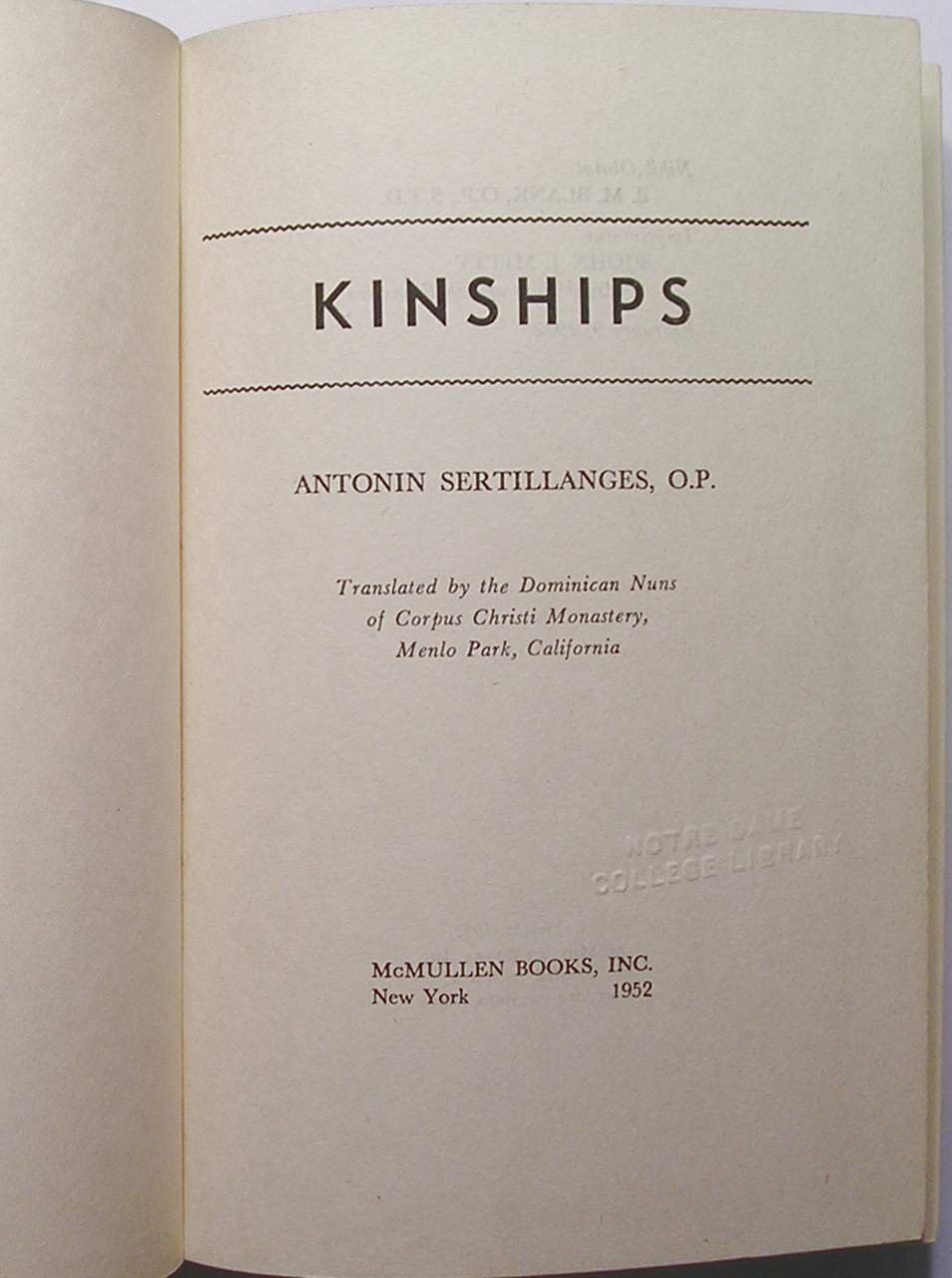
Image result for Kinships SertillangesKinships by Antonin Sertillanges, OP, translated by the Dominican Nuns of Corpus Christi Monastery, Menlo Park, California, 234 pages

In considering the nature of the world and the moral order, Fr Sertillanges never forgets that it is a natural order animated by love.  Kinships reflects on that love and the response it demands, for it is nothing less than the charity of Christ, a love of "renunciation and generosity", not self-indulgence.  It is in this light that he reflects on the bonds of religion and society, not as chains that enslave, but as our means of escape from selfishness.

Whether read on its own or in conjunction with Recollection and RectitudeKinships is involving, if a bit uneven.

Wednesday, March 28, 2018

Rectitude

Image result for Rectitude SertillangesRectitude by Antonin Sertillanges, OP, translated by the Dominican Nuns of Corpus Christi Monastery, Menlo Park, California, 244 pages

If "recollection" is the awakening of the mind to the order of the world, "rectitude" is the orientation of the will into harmony with that order.  The word Fr Sertillanges returns to again and again in these reflections is "integrity", by which he means, not merely "uprightness", but the disposition of every part of the whole human person according to the hierarchy of values.  This right order of the soul is built on a foundation of humility - humility, which is strong where pride is weak.  Sin disorders the soul and disintegrates the personality.

The meditations in Rectitude seem generally stronger than those in Recollection, although this is probably primarily the result of a tighter thematic focus.

Monday, March 26, 2018

Recollection

Image result for Recollection SertillangesRecollection by Antonin Sertillanges, OP, translated by the Dominican Nuns of Corpus Christi Monastery, Menlo Park, California, 235 pages

In this collection of reflections Fr Sertillanges seeks to summon the reader to recognition of the reality of the world and his own place in it, to the human condition in all its high dignity and abject wretchedness.  To do so, he calls upon his own wide learning, including quotes and allusions from sources from Aquinas to the Zend-Avesta.  Life, he tells us, must be understood and lived in the light of eternity.  The recognition of a reality by which we are produced and which we cannot reproduce demands a response.

Recollection is often excellent but becomes thin in places, despite the book's high purpose and the author's considerable erudition.

Friday, June 16, 2017

Meditations on the Life of Christ

Meditations on the Life of Christ attributed to St Bonaventure, translated by Sister Mary Emmanuel, OSB, 441 pages

This book presents 100 meditations on events in the life of Christ, either as reported in the Gospels or inferred by the pious imagination of the author.  Traditionally, this book was paired with St Bonaventure's Meditations on the Passion of Christ and was therefore often mistakenly attributed to him, however it was actually composed by an unknown Franciscan friar early in the 14th century.  The early date is itself somewhat surprising, since we have been told over and over that the harnessing of the imagination in the service of piety was an innovation of the devotio moderna of the 15th century Rhineland.

The meditations themselves are both succinct and rich.  Most of the commentary comes, not from the anonymous author, but from the writings of St Bernard of Clairvaux, particularly his sermons on the Song of Songs.  The arrangement of the material demonstrates a deep sensibility well-formed by practice - but although the placement of short treatises on the active and contemplative life in the center of the book is organically necessary, the decision to place a reflection on the use of the Sacred Humanity as a window into Divinity at the end rather than at the beginning is questionable. 

Wednesday, May 24, 2017

Life of Jesus

Life of Jesus by Francois Mauriac, 257 pages

This is Mauriac's treatment of what he describes as "the only subject that really matters, and also the only one of which it is impossible to treat successfully."  Despite his hedging, his Life of Jesus is a vivid portrait of the God-man, a portrayal that balances the man who is God and the God who became man.  Although the text itself is superficially objective, this masks the deeply personal nature of Mauriac's use of his renowned psychological imagination to discover the Beloved - "Here is the Man who is (and this is sure) the One I love the most in this world - and who for this reason is the One I have most betrayed."

Thoroughly compelling, oftentimes surprising, and resolutely orthodox, Mauriac's Life of Jesus deserves to be recognized as the modern classic it is, worthy of a place beside Guardini's The Lord.  Such profound works of the mind and heart may go out of fashion but can never become obsolete, for, as Mauriac himself observes, "Everything changes, except the need of the man without God for God, of the Christian who has forgotten Christ for Christ."

Monday, May 22, 2017

Way to Happiness

Way to Happiness by Fulton J Sheen, 192 pages

In 59 short essays - none more than a few pages long - Fulton Sheen lays out the Way to Happiness with his customary wit and erudition.  In the simplest terms, his "way" - which is, of course, not really his - is to have less but to be more, to know the difference between the highest things and the lowest and to act accordingly.

A man of remarkable intelligence and education, Sheen believed, in classic American fashion now sadly out of fashion, in the ability of the average man or woman to grasp, and grapple with, the insights of the great thinkers of the past.  As such, his book is studded with references and allusions to figures from Plato to Freud, all presented and integrated in his usual accessible style.  In the same tradition, he is uncompromising in his insistence that, to find happiness, "we must go out beyond the limits of this shadowed world - to a Truth not mingled with its shadow, error - to a Life not mingled with its shadow, death - to a Love not mingled with its shadow, hate."

Sunday, December 25, 2016

Fruits of the Spirit

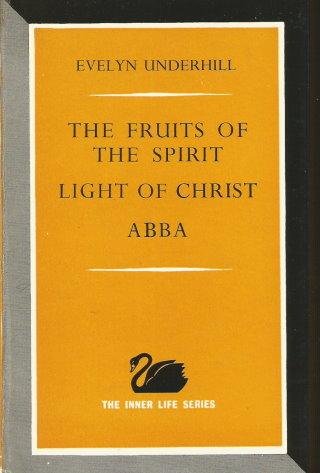
The Fruits of the Spirit, Light of Christ, Abba by Evelyn Underhill, 266 pages

This is a collection of transcriptions of three conferences hosted by Underhill, along with some supplemental material.  In The Fruits of the Spirit she guides the reader along a Jacob's Ladder to holiness through the development of Joy and Peace, Long-Suffering and Gentleness, Goodness and Faithfulness, Meekness and Temperance.  Throughout she stresses patience - these fruits are the gifts of the Holy Spirit in the same way earthly fruits are the product of the Sun - they cannot be forced or hurried.  In Light of Christ she expounds on the imitation of Christ as the foundation of the Christian life, especially focusing on His roles as Teacher, Healer, and Rescuer.  In Abba she uses the seven clauses of the Lord's Prayer as a framework for her reflections

Throughout these retreats, Underhill's focus is on transformation in Christ.  Her principal aim is to draw her retreatants deeper into communion with God in the only way that can be accomplished, through complete abandonment to His Will.  Although she draws extensively on the treasures of monastic spirituality, however, her retreats are all intended for those who, like her, live in the world.  This is Underhill's greatest gift - in her reflections, the challenges of ordinary life are revealed as luminous portals of grace.

Monday, November 21, 2016

Spiritual Conferences

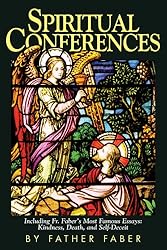
Spiritual Conferences by Frederick William Faber, 472 pages

Spiritual Conferences collects a dozen conferences delivered by Fr Faber in the middle of the nineteenth century, designed to guide the reader on his quest for holiness, a holiness which Faber states "consists simply of two things, two endeavors - the endeavor to know God's will, and the endeavor to do it when we know it."  The conferences focus on topics ranging from self-deceit, wounded feelings, and the value of reading in the spiritual life to the four last things - death, judgement, heaven, and hell.

Both hard-headed and soft-hearted, Fr Faber brings to his talks a wealth of experience as a spiritual director.  Nowhere is he more timely than in his condemnation of the craze for novelty that can infect the spiritual life as easily as it has the culture, which embraces every fad, charitable as well as devotional.  The continued vitality of his own work reinforces his claim that "each century makes too much of itself, and is mistaken both in thinking itself so very peculiar and in considering its peculiarities to be of much consequence... while times change very much, souls change very little, and God not at all."

Wednesday, July 20, 2016

Dialogues with Silence

Cover image for Dialogues with Silence: Prayers and Drawings by Thomas Merton, 183 pages

This collection pairs prayers drawn from Merton's journal with drawings now held by Bellarmine College.  Most of the prayers have a poetic quality, and while Merton's drawings - quick black and white sketches of monks and saints and landscapes - are not by any means great art, they evoke the same quiet stillness that is sought in the prayers.  Merton again and again struggles with the Benedictine charism of stability.  Unlike his rebel cousins Dean Moriarty and Sal Paradise who perpetually "gotta go", Merton seeks his fulfillment in the inky silence of the Kentucky night, confident that the One he seeks is also seeking him.

Friday, February 26, 2016

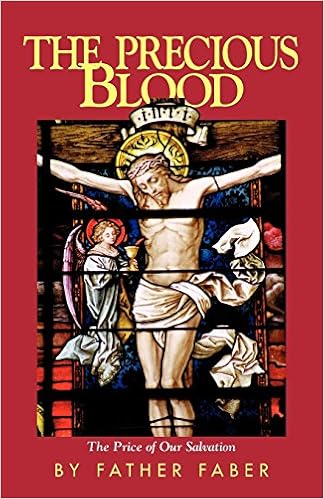
Precious Blood

The Precious Blood, or, The Price of Our Salvation by Frederick William Faber, 362 pages

Fr Faber, best known as the author of the hymn "Faith of Our Fathers", wrote this devotional work on the subject of the Precious Blood of Jesus in 1860.  A poet as well as a theologian, a parish priest as well as a hymnist, a friend of both Wordsworth and Bl John Henry Newman, Faber combines intelligence, eloquence, and empathy in his writing.

Faber finds in his exalted subject the principle of creation, incarnation, and redemption, and the binding unity of the three.  This brings him into contact with the vast mystery of eternity, God's foreknowledge, and His suffering.  His meditation ends where it began, with the reality of the total self-giving love of God as it is revealed in the shedding of His Most Precious Blood.

Wednesday, December 31, 2014

Imitation of Christ

The Imitation of Christ by Thomas a Kempis, translated by William Bentham, 167 pages

The Imitation of Christ has been attributed to many authors, but the most likely source was the 15th century Rhineland monk Thomas of Kempen, an eager practitioner of the devotio moderna, a school of spirituality which placed an emphasis on the individual pursuit of holiness.  One of the great successes of the early years of printing, it is solidly established among the classics of Western spirituality.

The book is a devotional, encouraging reflection upon the relationship between God and man.  The reader is urged to recognize the transient nature of worldly desire and cling to the eternal joys of the spirit.  The only goal is increased intimacy with God through formation of the virtues, particularly humility.

Monday, April 21, 2014

Christian Perfection

Christian Perfection by Francois de Salignac de La Mothe Fenelon, edited with an introduction by Charles F Whiston, translated by Mildred Whitney Stillman, 208 pages

http://ecx.images-amazon.com/images/I/51fO5OaKdHL._SY300_.jpgFenelon was archbishop of Cambrai in France at the beginning of the eighteenth century, having previously served in the court of Louis XIV as the protege of the great orator Bossuet, the bishop of Meaux.  Bossuet and Fenelon had a falling out in later years, due in large part to the former's Gallicanism and the latter's Quietism.  Since Bossuet seems to be enjoying a minor revival of late, Fenelon might likewise be worth revisiting.

Christian Perfection is a devotional work, having been distilled primarily from letters and lectures given by Fenelon to those under his spiritual direction.  It is, perhaps, a bit too Quietist for strict orthodoxy, emphasizing the need for surrender, or even annihilation, of one's own will, but given modernity's Pelagian tendencies, this may be less a flaw than a useful over-corrective.  Certainly, it is well-written (and well-edited and well-translated), moving in places, thought-provoking in others, and never insincere.