Showing posts with label Dante. Show all posts

Monday, July 23, 2018

Purgatorio

PurgatorioPurgatorio by Dante Alighieri, translated by Jean Hollander and Robert Hollander, 759 pages

In the second part of the Divine Comedy, the pilgrim Dante ascends the Mount of Purgatory in the company of his guide, Virgil, encountering the souls of the blessed dead being purified of their sins while being purified himself, made ready for Beatrice and Heaven.

The Hollanders' translation is serviceable if unspectacular, but where this edition really shines is in the notes, surpassing the expected biographical, historical, and theological explanations by drawing upon the centuries of interpretation and commentary that Dante has inspired.

Wednesday, July 29, 2015

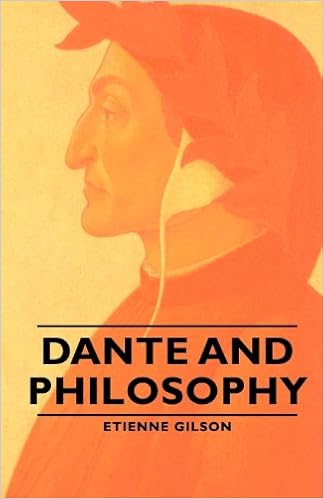
Dante and Philosophy

Dante and Philosophy by Etienne Gilson, 327 pages

From one of the most distinguished scholastic philosophers of the twentieth century comes an analysis of Dante's work and his concept of philosophy.  Gilson is not primarily interested in identifying the features of Dante's philosophy, rather, he is determined to establish that Dante conceived of philosophy as sovereign in its own sphere, complementary but separate from theology and politics.  In the process, he presents a Dante influenced by, but not a slave to, the outstanding philosophers of his time, bringing him out from under the shadow of Aquinas.

Gilson spends much of the book refuting Mandonnet's curious interpretation of Dante - this is mostly wasted for readers to whom Mandonnet and his elaborate symbolism are unknown.  Even so, Gilson's insight, intellect, and wit make the book worth reading for any admirer of Dante.

Monday, July 6, 2015

La Vita Nuova

Cover image for La Vita Nuova by Dante Alighieri, translated by David R Slavitt, 144 pages

La Vita Nuova ("The New Life") is a collection of 31 sonnets written by Dante between the ages of 18 and 30, with prose introductions and explications by the poet.  The result is the story of how, at the age of 9, Dante's life began anew with his first sight of Beatrice, and how that love lasted throughout her life, and even stretched beyond death, into the eternal.

Slavitt translates the whole in a plain style, taking considerable liberties with the text.  The danger of a translation that aims to be "relatable", especially of a work distant in time and place, is that it will destroy what makes the work worth reading in the first place.  Slavitt clips Dante's wings and brings him down to earth.  The mutilated poet is easier to approach, but less interesting when reached.

Wednesday, July 9, 2014

The Divine Comedy

The Divine Comedy by Dante Alighieri, translated by Clive James, 526 pages

Cover image for The divine comedy / Dante ; a new verse translation by Clive James.The Divine Comedy is undoubtedly one of the literary masterworks of Western Civilization.  It has been translated by Henry Wadsworth Longfellow and by Dorothy Sayers, illustrated by Gustave Dore and William Blake.  It has been adapted into blank verse, prose, a video game, and the origin for the X-Men villain Belasco.  So why do we need yet another version?

James' intent in this translation is to do something different - to produce a Divine Comedy which is not an object for study, but a poem to be read.  For this reason, the book contains no footnotes.  Some of the material that would normally be included in footnotes is incorporated into the text, while other information is simply left out, on the quite sensible grounds that the reader of Dante's time wouldn't have caught every allusion, either.  While the intent is surely sound, it does diminish the appreciation of the depth of Dante's work.  The translation likewise paves over Dante's archaisms, without being distractingly anachronistic.  The rhyme and meter are adapted from terza rima to schemes more natural to the English language. 

A good introduction to Dante for anyone intimidated by page after page of commentary, but also an interesting refresher for those already familiar with the poem.