Showing posts with label Language. Show all posts

Tuesday, September 24, 2019

How to Speak Brit


How to Speak Brit: The Quintessential Guide to the King's English, Cockney Slang, and Other Flummoxing British Phrases
How to Speak Brit:  The Quintessential Guide to the King's English, Cockney Slang, and Other Flummoxing British Phrases by Christiopher J. Moore       Hardback Book:  128 pages

A fun read.   I was surprised by a few things:

 1.)   It was only 128 pages long - surely there are loads more British      colloquialsms than that

 2.)   The words/phrases included seemed to be of another age, not contemporary.

 3.)   Many of the words/phrases I grew up hearing in my family's speech and found them not
        to be uniquely British, maybe they originated there, but, were well known to me
.
Things I particularly enjoyed about this book.   The author explains the phrase, "Bob''s Your Uncle." He explains the origin of the phrase, who Bob actually is and why Brits still say it to this day.  He also explained that Cockneys love to reinvent words and phrases to make them rhyme and have a fun lilt to them for a laugh.   Makes a lot of sense and I have come to appreciate a local friend's sense of humor who has always done the same thing with people's names, Bruce became Spruce, Richie became Bitchy and so forth as maybe being in his genes as his background is largely British though he has never set foot in "Old Blighty" nor met any of his Brit kin.    The book reads like a dictionary just a lot more explicit with the occaisional minimally derogatory embelishment.  A fun read, wish it had went further and offered additional current phrases, though, I guess current is a relative term and is so subject to change as to not be worth trying to keep up with.   Fun book, yes, I recommend it to all who love British flavor in their speech and anyone else's.  Getting the answer to "Bob's Your Uncle," was worth the read but wordsmith's worldwide will enjoy this read.  Fun one
.

Wednesday, April 17, 2019

The Origin of Consciousness in the Breakdown of the Bicameral Mind

The Origin of Consciousness in the Breakdown of the Bicameral Mind by Julian Jaynes, 491 pages

The title of this book is confusing. The most basic way to explain it is that Jaynes believed the right hemisphere gave orders to the left hemisphere and that system (bicameral mind) broke down when consciousness emerged. People described it as taking orders from god(s). Part of his argument lies in the similarities of ancient religions including ones that are halfway around the world. It includes the way they depict their gods and where holy sites are located in towns or settlements.

Jaynes believed this happened much later in human history than we think. He puts the time somewhere in the time of the Greeks. Part of his evidence lies in analyzing the language in the Iliad and the Odyssey. His analysis indicates that while humans had bicameral minds people didn't think they were in control. The Odyssey's language contains evidence of people believing they are in charge of their own actions.

Jaynes believes that schizophrenia is a situation where the brain has partially reverted to the bicameral mind and makes the argument that evidence proves his idea.

While I don't buy Jaynes's theory I am glad that I read this book because it is a classic and now I am going to have to re-watch the first season of Westworld with the theories from the book in mind. I did find it noteworthy that when Jaynes was defining what consciousness isn't the ways mirrored what Koch mentioned in Consciousness: Confessions of a Romantic Reductionist.

Tuesday, October 2, 2018

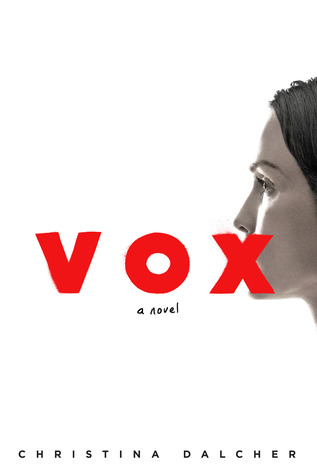
Vox

Vox by Christina Dalcher     326 pages

"Set in an America where half the population has been silenced, VOX is the harrowing, unforgettable story of what one woman will do to protect herself and her daughter.

On the day the government decrees that women are no longer allowed more than 100 words daily, Dr. Jean McClellan is in denial—this can't happen here. Not in America. Not to her.

This is just the beginning.

Soon women can no longer hold jobs. Girls are no longer taught to read or write. Females no longer have a voice. Before, the average person spoke sixteen thousand words a day, but now women only have one hundred to make themselves heard.

But this is not the end.

For herself, her daughter, and every woman silenced, Jean will reclaim her voice."

My overall thoughts are that this book, whose premise was so intriguing to me, didn’t go far enough to match my expectations. I wanted it to be so much more than it was. In some ways, it felt like Dalcher was trying to write a “Handmaid’s Tale” read-alike, but Jean just cannot live up to the standard of Offred. The story is too short and doesn’t really explore the world too much. Like with “Handmaid’s Tale,” Jean has little interaction with the resistance, in fact she didn’t even realize there could be one, and so much of the story is focused on Jean’s own reception of and reaction to the Pure Movement. Since I didn’t care for Jean, I cared little for her comments or feelings on the whole situation and so the book was really just me trying to figure out how this movement would be brought down, or if it even would be. So, would I recommend it? Yes, to those who like reading dystopias or are interested in feminist literature. But otherwise, I’d say people could pass on it and they wouldn’t be missing much.

Wednesday, November 30, 2016

Talking Leaves

Talking Leaves by Joseph Bruchac, 235 pages

Everyone thinks that Uwohali's father is crazy.  Even Uwohali is afraid that it is true.  His father has been gone for many years and since he has returned Uwohali has been afraid to go see him in case that everyone in the village is right.  When Uwohali finally gathers the courage to see his father he finds that his father is not crazy but is trying to create a system of writing for their own language.  The biggest problem is that many people think that he may be involved in witchcraft, which is punishable by death in their village.  Since Uwohali is talking to his father, some people believe that he may also be involved in witchcraft.  If he and his father aren't careful, they could both be hurt or killed.  This was a good book based on a the real life Sequoyah, who did create a writing system for the Cherokee people.  I have already recommended this book to a group of third through sixth graders.