Showing posts with label Metaphysical poets. Show all posts

Friday, September 25, 2015

George Herbert

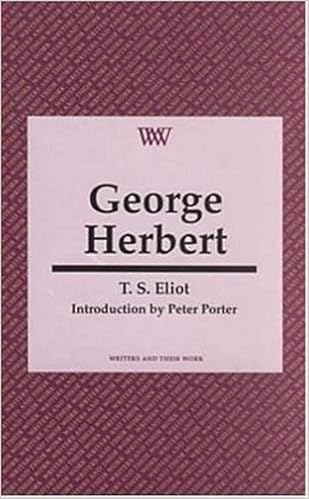
George Herbert by TS Eliot, 34 pages

This short essay by Eliot on Herbert emphasizes the significance of the planned structure of Herbert's primary work, The Temple.  Eliot also traces the influence of Donne and the Anglican liturgy on Herbert's poetry, and discusses the question of whether one must accept Herbert's religion to appreciate his poetry (Eliot's answer, predictably, is "No.").

Friday, September 11, 2015

Herbert's Poetical Works

Poetical Works by George Herbert, 256 pages

George Herbert was perhaps the greatest of the Metaphysical poets - only Donne disputes the title.  Herbert lacks Donne's sophistication in both a positive and a negative sense - never as dazzling, but also never as contrived.  The Temple, the body of poems that comprises the vast majority of his surviving work (241 out of 256 pages in this volume), was not published in his lifetime, but was publicized by his executor, Nicholas Ferrar of Little Gidding.  Overall, they chart the personal journey of the author as a man of faith, through struggles with sin and doubt and misfortune to peace and a deeper love.

The 1857 R & R Clark edition of Herbert's works is charmingly illustrated by foliage borders and woodcuts.

Wednesday, July 1, 2015

Metaphysical Poets

The Metaphysical Poets: A Study in Religious Experience by Helen C White, 411 pages

They are a diverse group: the intellectually omnivorous John Donne, the saintly rural vicar George Herbert, the questing exile Richard Crashaw, the country doctor Henry Vaughan, and the very nearly forgotten Thomas Traherne.  Their lives stretched from 1572 to 1695.  At the same time, they were clearly linked - young Herbert knew old Donne, Crashaw was a disciple of Herbert's literary executor Nicholas Ferrar, and Vaughan credited his conversion to his reading of Herbert.  All were rooted in the Anglican Church of Andrewes, Hooker, and Laud, although pulled in various ways by Catholicism (Donne, Crashaw), Puritanism (Traherne), and Hermeticism (Vaughan).  All were suspicious of enthusiasm, all sought a way to express their religious experiences in poetic form, and all succeeded to some degree.

White conducts a reasoned, careful examination of these authors and their works, with each getting a biographical chapter followed by a critical chapter, along with introductory chapters on the historical period.  There aren't extensive selections from the poets, however, so readers not already somewhat familiar with at least some of their works are unlikely to profit much - this is a study, not an introduction.

Friday, June 19, 2015

Felicities

Felicities by Thomas Traherne, edited by Sir Arthur Quiller-Couch, 114 pages

Thomas Traherne was one of the 17th century Metaphysical poets.  An Anglican priest, he lived and died in obscurity, but his unpublished works were discovered in manuscript form in the late 19th century.  Upon publication, they established their author's reputation as a remarkable poet and mystic, a 17th century forerunner of figures like Blake and Hopkins.

Felicities is an amalgamation of selections from Traherne's works, primarily Poems of Felicity and Centuries of Meditations, chosen and organized by Quiller-Couch into loose thematic groups.  It is a tribute to the sensibility of the editor that this succeeds, giving good tastes of Traherne's poetry and spirituality.  While Traherne is not the equal of Donne or Herbert either aesthetically or intellectually, he certainly deserves better than to be forgotten.

Wednesday, May 20, 2015

Silex Scintillans

Silex Scintillans, or Sacred Poems and Private Ejaculations by Henry Vaughan, from Poetry and Selected Prose of Henry Vaughan, 164 pages

One of the greatest of the Metaphysical poets of 17th century Britain, Vaughan was little known during his lifetime.  The first volume of Silex Scintillans - "The Sparkling Flint" - was followed years later by a second after a nearly fatal illness led to a renewed interest in life and religion.  This shows - while the first volume is fine poetry, the second has an added energy and depth that elevates it to the rank of classic.

Both volumes are solidly grounded in Scripture, with Vaughan making more use of explicit Biblical subjects and models than his Metaphysical peers.  The second volume is also deeply personal, with an interesting combination of reflectiveness and urgency.

Monday, March 23, 2015

Crashaw's Poetical Works

Steps to the Temple and The Delights of the Muses by Richard Crashaw, from The Poems: English, Latin and Greek, edited by LC Martin, 123 pages

One of the greatest of the poets of the 17th century Metaphysical school, Crashaw wrote verse in English, Latin, and Greek.  The English Civil War forced him to flee Cambridge, where he taught and served as an Anglican priest.  In exile in France and Italy, he wrote his most celebrated works, collected and published in a single volume as Steps to the Temple and The Delights of the Muses, with the religious poetry found under the former title and the secular poetry under the latter.

These poems are rougher and less mannered than those of Donne, but this lends them a certain spontaneous feel which may be better appreciated today.  The opening poem of The Delights of the Muses, "Musicks Duell", which tells the story of a battle between a musician and a nightingale, is particularly memorable.

Wednesday, February 11, 2015

Poems

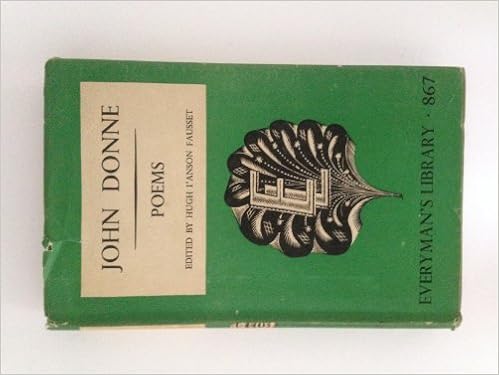
Poems by John Donne, edited by Hugh I'Anson Fausset, 288 pages

John Donne is certainly remembered as one of the England's finest poets and essayists, but his era is sometimes regarded as a literary lull between the heights of Shakespeare and Milton.  Donne's early poems are primarily concerned with love, with a heavy emphasis on the changeable nature of human affections.  Later poems begin to circle around the royal court, with a heavy emphasis on the dishonesty of courtiers - and a substantial amount of flattery directed towards potential patrons.  Finally, the latest poems tend to be religious, with a certain confidence in divine grace.

Donne's language is often cryptic and sly, and this Everyman's Library edition of his poems contains no notes to help explicate the material.  His obseqiousness can be off-putting - even the tremendous "An Anatomy of the World" seems diminished by its identification of the death of a fourteen year old girl (albeit one with a very wealthy father) as the cause of universal dissolution.

Donne's poetry requires time and quiet to appreciate.  Even then many of them are undistinguished.  When the poet finds a worthy subject, however, his promise is fulfilled.