Showing posts with label de Rougemont. Show all posts

Saturday, December 8, 2018

Devil's Share

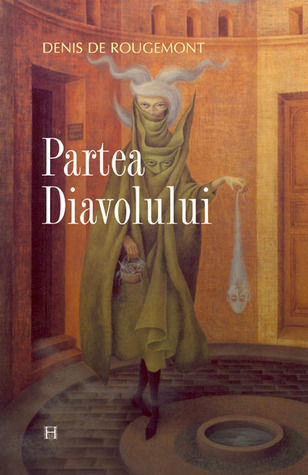
Related imageThe Devil's Share by Denis de Rougemont, translated by Haakon Chevalier, 189 pages

"Over dessert we agreed: what democracies in general, and America in particular, most lack is belief in the Devil."  This is, according to Denis de Rougemont, a serious problem, since the Devil is the Prince of Lies and therefore Lord of Unreality, and he begins his seduction by making himself seem unreal.  De Rougemont observes that in the modern West sin, like everything else, is mass-produced.  The gigantism of modern society allows for the efficient escape of the individual from responsibility.  Thus, by careful gradualism, Satan reduces persons to damned things.

As the book was written in France in the 1940s, it is not surprising that Hitler features prominently - it is more surprising that de Rougemont recognizes the peril in using Hitler's evil to deny our own.  Indeed, it is precisely in his recognition of the connection between the Germans' "necessary" desire for Lebensraum and the romantic's surrender to the "vital" demands of his own passions that he has proven most prescient.

Monday, May 21, 2018

Love in the Western World

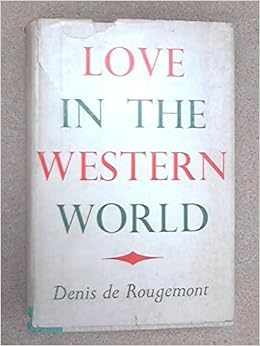
Image result for Love in the Western World Rougemont, Denis deLove in the Western World by Denis de Rougemont, translated by Montgomery Belgion, 323 pages

In Love and the Western World begins with an analysis of the genre of chivalric romance as typified by the story of Tristan and Isolde.  For de Rougemont, the protagonists are not in love with each other, but are rather in love with Love itself, in such a way that the fulfillment of their desires would be the end of the romance.  Their love, then, is real only insofar as it is frustrated - it is a passionate love, which is to say a suffering love, ultimately consummated only in the final negation of death.  He connects these themes to a stream of mysticism with its sources in the Greek, Celtic, Hindu, and Arab worlds, a stream which in the High Middle Ages fed the pool of Catharism.  In de Rougemont's view, this heretical mysticism, which seeks the total absorption of the individual into the Godhead, has fundamentally perverted the Western view of love, transforming the Christian ideal of a communion of persons into a paradoxically selfish quest for self-destruction.  The former is a humble religion of incarnation, the latter a prideful spirituality of disincarnation.

De Rougemont's historical claims have been strongly criticized, and doubtless the author somewhat exaggerates the influence of the Cathars.  Yet it is part of his argument that Catharism was itself part of a much larger, largely underground heterodox tradition.  Such criticism cannot touch his startling contention that, contrary to the reductive belief that all mysticism has its origins in repressed eroticism, much of our romantic language - and dysfunction - is the product of sublimated mysticism.