Showing posts with label drug abuse. Show all posts

Monday, December 31, 2018

High


High by David & Nic Sheff, 260 pages
“Just Say Know!  With drug education for children more important than ever, this nonfiction book draws on the experiences of the NY Times bestselling father/son team of David and Nic Sheff to provide all the information teens and tweens need to know about drugs, alcohol, and addiction. From David Sheff, author of Beautiful Boy (2008), and Nic Sheff, author of Tweak: Growing Up on Methamphetamines (2008), comes the ultimate resource for learning about the realities of drugs and alcohol for middle grade readers. This book tells it as it is, with testimonials from peers who have been there and families who have lived through the addiction of a loved one, along with the cold, hard facts about what drugs and alcohol do to our bodies. From how to navigate peer pressure to outlets for stress to the potential consequences for experimenting, Nic and David Sheff lay out the facts so that middle grade readers can educate themselves.”  I thought that this was a decent account of how drug addiction can negatively impact lives. It was a little dry in places but I still felt like it was worthwhile and something that some teens might pick up on their own.

Monday, April 30, 2018

A Hero Ain’t Nothin’ But A Sandwich


A Hero Ain’t Nothin’ But A Sandwich by Alice Childress, 126 pages
“The life of a thirteen-year-old Harlem youth on his way to becoming a confirmed heroin addict is seen from his viewpoint and from that of several people around him.” This book is kind of tough to read but hopeful.  Teens who like realistic fiction about issues will want to read it.

Saturday, May 13, 2017

Hillbilly Elegy

Hillbilly ElegyHillbilly Elegy: A Memoir of a Family and a Culture in Crisis by JD Vance, 257 pages

Hillbilly Elegy is a tour through the childhood of its author, JD Vance, a childhood set in a world of crime, poverty, violence, substance abuse, mental illness, and shattered families.  From the revolving door of father figures to the preoccupation with respect to the outspoken religiosity to the feeling of being an outsider to mainstream American society, much of Vance's upbringing would not be out of place in a memoir of growing up in the inner city, except that his home was in a "holler" in the backwoods of Kentucky.  Not that Vance is interested in comparing narratives of victimhood or arguing about privilege - his goal is to describe the function and dysfunction of hillbilly America at the dawn of the 21st century through the lens of his own experience.  

It is this experience that is the heart of the book - Vance is wise enough to understand that the problems involved are as complex as life.  His observations do not fit into sociological boxes and do not result in a 6-point public policy proposal.  In his estimation, the crisis faced by his family and culture is not so much an economic crisis as a crisis of values, itself sparked by alienation and a loss of dignity in a society where poverty is considered a personal failing.  At one point, Vance recalls attending one of his mother's court hearings and noticing that the judge and lawyers all spoke with "newscaster accents" quite unlike those of his family and friends.  The sense that "people like us" don't hold positions of influence and authority, don't attend Ivy League schools or start successful businesses, dogged him for much of his life, and although he did eventually graduate from Yale and settle into a stable marriage, one of the major themes of the book is that he couldn't have done so without a great deal of help - beginning with his grandparents and sister and including sympathetic high school teachers, college professors, and the United States Marine Corps.  The lesson is that the only cure for a vicious culture is a virtuous culture, and the first virtue (Peguy's "little one who leads them all") is theological - hope.

Thursday, July 9, 2015

The Bodies We Wear

The Bodies We Wear by Jeyn Roberts, 353 pages


Faye was only eleven years old when some dealers forced her to take Heam, a drug that most people say allows them to see Heaven.  Faye nearly overdosed but survived, and she didn’t see Heaven, but Hell.  However, people like her are outcasts.  She is forced to hide her secret every day and has had to fight the craving for more for six years.  Her one plan is to kill the people who did this to her, for revenge, both for her, and for her friend, Christian, who died that night.  Recently, Faye has met a boy who seems to like her.  He looks a lot like Christian would have, if he had lived, and he knows things about Faye that he shouldn’t, including her plan for revenge.  This was a really good book.  It was pretty strange, but I think a lot of teens that like magical reality will want to read it.

Friday, March 13, 2015

What Lisa Knew


Everyone knew her as Lisa Steinberg, and she herself had never known any other name, but her birth certificate read "Baby Girl Launders" and her death certificate, issued six years later, would read "Baby Girl Launders, also known as Lisa".  The day she was born, her mother handed her over to attorney Joel Steinberg, who claimed to know a wealthy family eager to adopt the girl and give her every advantage in life.  Instead, he and his girlfriend Hedda Nussbaum kept her and raised her in their own hell of sadism and drug abuse, until the day when Joel beat the six year old so badly that she died slowly and painfully while Hedda watched, not calling an ambulance until hours later, by which time it was far too late.

Nussbaum is the real mystery.  Steinberg was a sadistic control freak, while Lisa (and Mitchell, another child Steinberg illegally acquired, only 16 months old at the time of Lisa's death) was a helpless child.  At the time she met Steinberg, Nussbaum had a successful career as an editor at Random House, was a published author herself, and had multiple serious relationships with men behind her without a hint of abuse.  Yet by the time of Lisa's death, Steinberg's beatings had left Nussbaum a hollow shell of her former self, with prematurely gray hair and the face of a veteran boxer.  Her defense attorneys presented her as a case of battered woman syndrome, but Steinberg maintained that most of Nussbaum's injuries resulted from consensual sado-masochist activities, fueled by their mutual abuse of crack cocaine.

Johnson gives a plausible account of the psychodrama between the two principals, though whether it is an accurate account can never be known - indeed, the author admits explicitly "What Lisa knew will never be known."  Some of her confidence in certain witnesses is questionable, as are her negative insinuations about other people involved.  Overall, it does have an interesting account of how a woman with so many advantages could proceed one step at a time down a spiral with murder and madness at the bottom, though like most true crime (especially when it's well-written), it also disappoints - the madness turns out to be more pathetic than fantastic, and the cruelty merely depressing.

Saturday, February 21, 2015

Love Is The Drug

Love Is The Drug by Alaya Dawn Johnson, 335 pages


There is a superflu that is threatening the world but Bird isn’t really worried about it.  She’s got other things to worry about that are more immediate, like getting out from under her mother’s control.  Bird has always done what her mother expected: gone to the right schools, had the right friends, dated the right boy.  Now, all of that seems to have caused her nothing but grief.  After a party, Bird woke up in the hospital.  She doesn’t remember exactly what happened, but she knows it isn’t exactly what she’s been told, and suspects that a man named Roosevelt, a government agent, and someone who supposedly worked with her parents, is responsible.  With the help of a boy from school, Coffee, who she might be falling in love with, Bird attempts to uncover what happened to her and what is the big secret about it before Roosevelt can destroy her.  This was a good suspense, mystery, romance for teens.

Tuesday, October 14, 2014

Megahex


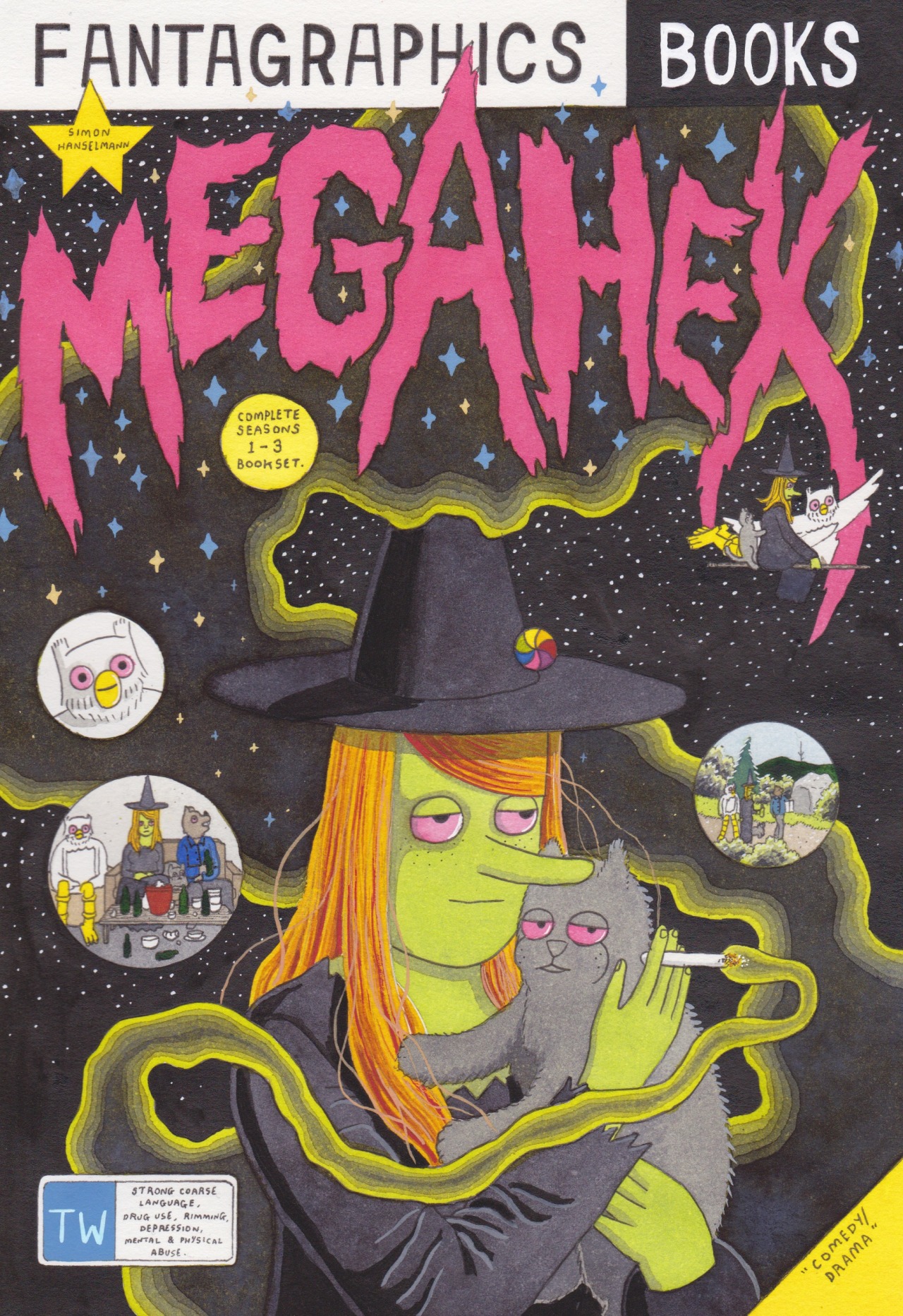
 Megahex by Simon Hanselmann, 207 pages

A witch and a black cat that are sometimes lovers. A werewolf who's known for his outrageous antics at parties. An owl who just wants to find love. A warlock thrown in the mix. This is Megahex! All these lovable characters are also hardcore drug users, fyi. How can an owl have a muffin top when he's not even wearing pants? How does a cat get naked for some skinny dipping? How does a witch fight depression? Who will win the horrible feet contest? Find out in Megahex!
This is a highly entertaining, but definitely meant for grown-ups graphic novel. (Warning on the cover: "strong coarse language, drug use, rimming, depression, mental & physical abuse"). It's set up in grids and was originally done in watercolor.
For an extra laugh, look this Tasmanian-born author up on the Internet. There are many photos of him in drag. Awesome.

Sunday, October 5, 2014

Party Monster: a Fabulous But True Tale of Murder in Clubland

Party Monster: A Fabulous But True Tale of Murder in ClublandParty Monster: a Fabulous But True Tale of Murder in Clubland , by James St. James, 287 pages

With the recent release of Michael Alig from prison, I found myself saying, "Who?"  I had no knowledge about the Club Kids culture of New York City in the '90s, so I read this true-crime tale written by James St. James.  (Note: if interested in drag queen makeup tutorials, google James St James transformations on Youtube).  James St. James writes of an incredibly decadent, superficial, drug-fueled nightlife, where the cast of characters is simultaneously sympathetic and repulsive, all at once.  He describes at length the rise of Michael Alig, from shunned party-goer to the organizer of must-attend, blow-out bashes, where wild events would take place, all in a frenzy of tons of drugs.  Alig, who comes across as someone who just desperately wanted to be loved, soon becomes addicted- both to drugs and notoriety, which soon spirals out of control, culminating in a night of murder and months of denial.  The writing is very scattered and conversational, which I found engaging, but others might not.  There are many funny events in this book, but those, combined with the shadow of addiction and murder, made me feel a little uncomfortable laughing.  This was later turned into a movie with Macaulay Culkin.

Tuesday, August 19, 2014

Buzzed

Buzzed by Cynthia Kuhn, 385 pages
Cover image for Buzzed : the straight facts about the most used and abused drugs from alcohol to ecstasy / Cynthia Kuhn, PhD, Scott Swartzwelder, PhD, Wilkie Wilson, PhD, Duke University and Duke University School of Medicine ; with Leigh Heather Wilson and Jeremy Foster.
Buzzed is a nonfiction book that details the effects and history of various types of drugs. These range from caffeine to nicotine to heroine to inhalants. Buzzed not only tells you what they are and what effects they cause but goes into the science behind why people abuse them and how they effect the brain. All the information is presented in a mostly unbiased way that is sorted into useful chapters. However, they also use a lot of chemical names that as they put it "look like alphabet soup". These near unpronounceable names popping up and being referred to frequently can make it difficult to read at times.

Overall it was a very informative and for a nonfiction, scientific book was not too painful to get through.

Wednesday, May 21, 2014

Kara Was Here

Kara Was Here by William Conescu, 302 pages

Kara Tinsley is dead. Let's not beat around the bush about that. The book opens with her ex-boyfriend Brad driving to her funeral, having left his pregnant wife at home. We also have Margot, Kara's longtime friend, who has moved away from the fast-paced life of her 20s to become a baker with golden delivery van and a long-distance boyfriend. And then there's Gwen, Kara's artsy little sister who has just graduated from high school and looks just like Kara did 15 years earlier. Kara Was Here observes these three as they deal with Kara's death, and the other issues they have going on in their life.

Confession: I picked this book up solely because my name was in the title. Let's face it, there aren't many Karas in books, at least not that I've read. I'm pleased to report that this Kara is absolutely nothing like me (druggie alcoholic wannabe actress moving from one friend's couch to another; also, dead, from an overdose). And while she's dead, she certainly plays a central role in this book, as Brad, Margot, and Gwen try to figure out what Kara may have been thinking and experiencing in her last days. The plot moved a bit slowly for me at times, but I think Conescu put together a good examination of grief and how it manifests in ways that we don't expect. This won't be at the top of my list of books to recommend, but it wasn't bad.

Friday, March 28, 2014

27


Cover image for 27 : a history of the 27 club through the lives of Brian Jones, Jimi Hendrix, Janis Joplin, Jim Morrison, Kurt Cobain, and Amy Winehouse / Howard Sounes. This is a history of famous musicians who have died at the age of 27, particularly the most famous six - Jones, Hendrix, Joplin, Morrison, Cobain, and Winehouse.  Sounes admits at the outset that the whole notion of 27 being a particularly dangerous age for rock stars is not statistically accurate, but the conceit allows for a Plutarchan approach that proves revelatory in examining the similarities and differences in this series of parallel lives.
 
Indeed, there are many similarities.  They all wound up on a rarefied stratum of fame and fortune where the world seemed to revolve around themselves, but none of them seems to have liked themselves.  All were estranged from their families to some degree - interestingly it is Hendrix, who by all accounts had the most difficult upbringing, who may have had the best relationship with his father.  Drinking and drug abuse plays a predictable role in all the stories, alongside sexual promiscuity and occasional violence.

An interesting element is the change in public attitudes over time - none of the sixties stars were spectacles of self-destruction (although Morrison did have a reputation for outrageous, unpredictable behavior), but with Cobain there was an ongoing deterioration marked by a well-reported series of overdoses and marital difficulties, and with Winehouse her descent almost became a spectator sport.  This seems to have been the result of a combination of media saturation and tabloid journalism, a world-weary cynicism on the part of the public towards rock stars and the price of fame, and also the need of the celebrities themselves to continue to be transgressive as a form of attention-seeking.  It is notable that Joplin, Morrison, and Cobain all lied quite spectacularly about the material and emotional deprivations of their unhappy pre-fame lives.  Winehouse. meanwhile, regularly faked falling down as part of her performances.

The weakest part of this book is Sounes' sympathy towards this narcissistic attitude.  He seems to agree with the maxim - quoted by Cobain in his suicide note - that it's "better to burn out than fade away".  One of Sounes' previous efforts was a biography of Bukowski, and the notion that being down-and-out equals authenticity that attracts many people to Bukowski seems to run through this work.  Early on he muses:
 
"They might still be alive, but who would have heard of the optometrist Brian Jones, assuming he had followed the career his parents envisaged?  Who would have known Jimi Hendrix, landscape gardener, or care about Janis Joplin, Port Arthur housewife, who would read the sociologist Jim Morrison, or given a damn about school janitor Kurt Cobain?" 
 
This recalls the following exchange in Robert Bolt's A Man For All Seasons:

More: "You'd be a good teacher."
Rich: "And if I were, who would know it?"
More: "Yourself, your friends, your pupils, God--pretty good public, that!" 
 
A somewhat interesting and easy to read book that pulls the reader along, but ultimately superficial.