Thursday, August 15, 2019

If You Leave Me: A Novel

If You Leave Me: A Novel  by Crystal Hana Kim            Audio Book:  12 hours, 4 minutes       Paperback Book:   448 pages   
               
Very well told story.   This is the second book about the hardships in Korea during WWII and after that I have read recently and I have enjoyed both very much.   A case of doing the wrong thing for the right reason.   Sometimes these selfless acts can be tolerable and turn out well, sometimes they leave one wishing they had made other choices but one can never know ahead of time which way things will turn out.   Weighing the good that comes of our decisions can keep one positive, but, if ever once we look back and see what we gave up and dream of what could have been if not careful life becomes resentful and ugly when we feel weighed down by a burden when in our illusions we see across the miles and starry skies dreams of an unattainable happiness we think we might want.      Be careful what you wish for sometimes the answer comes in unusual ways and sometimes in our musings, we only consider our own wants and not how they will affect others that we love.    A beautiful bittersweet story of longing.  Haunting.   I would recommend this book to highschoolers on up.   Some horrific tragedies but a story you won't soon forget.

 - Shirley J

Bare Bones: I'm Not Lonely If You're Reading This Book

Bare Bones: I'm Not Lonely If You're Reading This Book by Bobby bones      Audio book: 6 hours, 24 minutes   Hardback Book:  224 pages              

A fun very down-to-earth biographical telling of the life and times of Bobby Estell a.k.a. Radio Personality, Bobby Bones.   From his rough beginnings being born to a Mom that was a just turned sixteen year old drug addict and their life in Mountain Pine, Arkansas, population 750.  Thank God for his grandmother who taught him right from wrong as his mother wasn't a present enough only part time mother when she wasn't nodding on some chemical induced high.   His Dad left them when Bobby was 5 years old and though Bobby knew he was "around" the area, he never made an effort to come by and see his kids nor provide for them in any way.   Bobby's Mom's welfare and his Grandmother's social security along with his Mom's on again off again part-time jobs got them through along with a few five finger discounts here and there.   Bobby has a sense of comedy about what he went through, not that it didn't piss him off or cause him anxiety but he learned how to be the funny guy at school so he wouldn't get beat up since he was also a little guy and he learned to see the humor in most things in life.   He brings that easy country charm and humor to his radio show that is broadcast in many markets nationwide and it has made him one of the most popular radio talk shows on the air.   After several starts and stops he finally found his niche and the owners of the broadcast moved the show to Nashville where he has interviewed and become good friends with many country music greats, Keith Urban, Brad Paisley, Garth Brooks, Taylor Swift etc. who live in the Nashville area and hangout together as time allows.   In his self-deprecating manner the reader feels ultimately sorry for the guy, glad for the guy, glad that he can find the funny in the most embarrassing and/or harsh circumstances  and glad for him that he has turned life's lemons into an amazing lemonade.  He talks about wanting a family, wife, kids the whole nine-yards, but, he has trust issues and cannot commit to a long term realitionship.    He says though there have been a couple of especially great ladies in his life that he should not have let get away, seems like the closer a female gets to him the less likely he will ever tell her that he loves her and will go so far as to pick fights and sabotage his relationships once they get to the commitment category.  He just can't do it, and, yet, he thinks he wants to.   Maybe in his next book he will find a lady that is as gun-shy about commitment as he is and who will never ask any more of him than he is able to commit to and they can both be o.k. with that.   Good luck, Bobby Bones.  I would recommend this book to anyone from Middle School on up - his early years could be beneficial to middle schoolers going through the same things as an example and even if the reader hasn't heard of him, I hadn't, it is an enjoyable tale with lots of tattling on his own screw-ups and what he learned from the experiences.   Well told, Bobby Bones.

 - Shirley J

White Chrysanthemum

White Chrysanthemum by Mary Lynn Bracht          Audio Book:  10 hrs,, 39 mins    Hardback Book   320 pages                   

Excellent Book set during WWII and the Japanese invasion and capture of Korean women held as prisoners and forced into prostitution even as children.   The author  researched  the topic thoroughly and created a magnificent story of fortitude, courage and strength under extreme duress of Korean women, young girls and children captured and brutalized by Japanese soldiers.during WWII.   It starts off innocent and lovely as a mother and her two daughters who were or became in the youngest sister's case, haenyeo - female divers of the sea who could hold their breath for long periods of time in order to make deep dives in order to collect fish, octupus, crabs, clams, oysters, conch shells and whatever looked appealing that they found on the sea floor to sell to provide food for their families.    The mother always told the older daughter to protect her younger sister and when the older girl saw Japanese soldiers coming down the beach she told her sister to stay quiet and hide all the time praying her mother would continue diving and not come out of the water.   She went to meet the soldiers to avoid their seeing her sister or mother and when forced to go with them, she did so knowing she was saving her family from such a fate.   The story is a sad and brutal one as the poor girl, Hana, is raped and forced into prostitiution though she was a young teenager.   Known as "comfort women,"  the Japanese soldiers used the women to satisfy themselves not caring the pain, shame and cruelty they committed.   Some of the children were raped to death.   It is a gripping, haunting novel that the reader will carry images away from that can't be unseen even if they are the creation of the writer's words.   These atrocities did happen and these women are vindicated today as the story later tells of Hana' s younger sister going to protests against the Japanese and asking for apologies, and charges to be brought against the Japanese regime in honor of these women who suffered unmercifully at the hands of Japanese soldiers who treated them less than human as things to be used then discarded or dealt sharply with to appease their own stress, anxiety and hatred of peoples other than themselves.    An excellent story, I highly recommend it.

Shirley J

Tuesday, August 13, 2019


A Strangeness in My Mind

A Strangeness in My Mind


A Strangeness in My Mind by Orhan Pamuk
599 pages

Long time since I've read a novel this good! Love the connections between marriage and vocation, religion and family, the struggle to make ends meet and happiness, city and village. These themes are wonderfully connected in the life and loves of a boza seller who moved to Istanbul at age 10 and came to a keen awareness of the meaning of love in his mid 50s. Marvelous!

Dying for Ideas

Dying for Ideas: The Dangerous Lives of the Philosophers by Costica Bradatan, 238 pages


Summary from Goodreads: What do Socrates, Hypatia, Giordano Bruno, Thomas More, and Jan Patocka have in common? First, they were all faced one day with the most difficult of choices: stay faithful to your ideas and die or renounce them and stay alive. Second, they all chose to die. Their spectacular deaths have become not only an integral part of their biographies, but are also inseparable from their work. A "death for ideas" is a piece of philosophical work in its own right; Socrates may have never written a line, but his death is one of the greatest philosophical best-sellers of all time.

Dying for Ideas explores the limit-situation in which philosophers find themselves when the only means of persuasion they can use is their own dying bodies and the public spectacle of their death. The book tells the story of the philosopher's encounter with death as seen from several angles: the tradition of philosophy as an art of living; the body as the site of self-transcending; death as a classical philosophical topic; taming death and self-fashioning; finally, the philosophers' scapegoating and their live performance of a martyr's death, followed by apotheosis and disappearance into myth.

While rooted in the history of philosophy, Dying for Ideas is an exercise in breaking disciplinary boundaries. This is a book about Socrates and Heidegger, but also about Gandhi's "fasting unto death" and self-immolation; about Girard and Passolini, and self-fashioning and the art of the essay.


Bottom line: I wouldn't recommend this book to anyone. I learned some things I didn't know before but the book falls short for what it is supposed to be. It seems as if Bradatan is trying to provide an argument about philosophers who end up dying for ideas. It is more of a chronicle of instances where they have. While Bradatan does use sources from other disciplines I am not sure how much he is breaking boundaries.

Simone Weil

Simone Weil, Attention to the RealSimone Weil: Attention to the Real by Robert Chenavier, translated by Bernard E Doering, 81 pages

For Chenavier, Weil's whole approach can be summarized as an "attention to the real."  This provided the motivation for her lifelong search for a "spirituality of work" that would celebrate the interaction between the freedom of the spirit and material necessity.  Likewise, it drove her quest for a transcendent Truth which reoriented her life around the love of the Good.  This abandonment of self itself presents a higher form of the collision between freedom and necessity.  The higher values do not, however, replace the lower, to the contrary, they illumine and fulfill them.

In her thought as in her life, Weil was a consummate outsider, yet she was also very much a typical twentieth century figure in that her biography and her philosophy are each unintelligible without the other.  In only a few pages, Chenavier demonstrates the significance and coherence of the whole, for her time and for all time.

Monday, August 12, 2019

The Community Land Trust Reader

The Community Land Trust Reader
by John Emmeus Davis
600 pages

This reader is an excellent introduction to Community Land Trusts (CLTs), with history, case studies, technical references and anticipated hybrids. CLTs are shown to be the best way to preserve affordable housing over time and across generations, and to mitigate urban gentrification. The sweep of thought, geography and history shows the broad application of the model: from Henry George's thoughts on taxation, India's Gramadan movement, Koinonia Farms in Georgia, Dudley Neighbors in Boston, and the Woodland CLT in Appalachia, readers see the broad principles and common benefits of viewing land primarily as a trust rather than primarily viewing it as a means of speculation and profiteering.
Work Optional

Work Optional Retire Early the Non-Penny-Pinching Way
by Tanja Hester
288 pages

This book is the best of a few that I've read about retirement and finances because its start, center and focus is not on earning enough to retire but on defining what kind of a life you want before and after retirement. Finances are clearly a part of any retirement (or work-change plan) but money should be in the service of life goals not the other way around. The book was practical and focused with enough detail to offer guidance in defining goals, outlining a process to work with life partner these, making a financial plan to accomplish those goals, reviewing the plan and putting the plan into practice through retirement, semi-retirement or a gap year -- through savings, lowering expenses, increasing income for a time, or finding new streams of income. In prioritizing life-goals the book does not assume keeping present house, location, cars, expenses, health insurance, meals out, lifestyle, etc. but identifies financial options in these areas to review so that bigger goals can be accomplished.


Rescuing the Gospel from the Cowboys
Rescuing the Gospel from the Cowboys: A Native American Expression of the Jesus Way

Rescuing the Gospel from the Cowboys: A Native American Expression of the Jesus Way   by Richard Twiss
272 pages.

Richard Twiss reviews the grim story of Christian missions among Native Americans in United States missions as an attempt at cultural annihilation which was accompanied by national genocide, segregated resettlement and apartheid. The story includes the author's own stories along with his desire to claim his Native cultural and ritual roots but also to synchronize First Nation ways with a Jesus who honors rather than destroys his people's life-giving traditions.

The Crucifixion

The Crucifixion: Understanding the Death of Jesus Christ

The Crucifixion: Understanding the Death of Jesus Christ
by Fleming Rutledge
669 pages.

A significant theological help & a step toward Black Lives Matter: 

This is a powerful and thorough book. Not having grown up with animal sacrifice as the first (Jewish) Christians, I often have difficulty understanding the language and meaning of sacrifice as an explanation of Jesus' crucifixion. This book helps. It also makes a good effort to connect Christ with historic suffering of oppressed people in the world and United States. The books cover is photo of a stain-glass window in Birmingham's Sixteenth Street Baptist Church. The window was given by people of Wales to commemorate the bombing of the church where four girls were murdered and fourteen others injured. In the photo one hand of Jesus is stretched out to put off Satan's oppressive powers, the other is open to embrace the victims of oppression. This is one of the stretched which killed Jesus and the book marvelously explores this tension and other significant biblical and historic discussions of the crucifixion of Jesus. With the late James Cone's book, The Cross and the Lynching Tree, this books makes progress to understand and connect the meaning of the crucifixion with the history of black people in the United States. More work is needed to connect crucifixion with the death of Michael Brown and the Black Lives Matter movement.

Friday, August 9, 2019

Art or Anarchy?

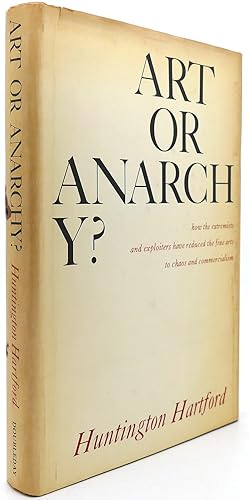
Image result for Art of Anarchy? huntington hartfordArt or Anarchy?  How the Extremists and Exploiters Have Reduced the Fine Arts to Chaos and Commercialism by Huntington Hartford, 196 pages

This 1964 book by the playboy founder of New York's Huntington Hartford Gallery of Modern Art presents a bleak view of an art world that has slid deep into solipsism and meaninglessness, a collapse Hartford attributes primarily to the abandonment of the subject.  As he saw it, this was enabled and exacerbated by the increasing commercialization of fine art in the first half of the twentieth century.  Although the result may be an art reflective of its time, it signally fails to transcend its time.

Hartford's book is a free-ranging polemic which includes extensive discussions of the peccadilloes of great artists and the subversive influence of the KGB in the Western art scene.  This has its advantages - Hartford is unafraid of making enemies - but these are far outweighed by the lack of focus and gossipy malodor.

Thursday, August 8, 2019

An Unorthodox Match


An Unorthodx Match by Naomi Ragen   336 pages
 I admit that I’m not well educated in the different sects of Judaism. I depend on great authors like Naomi Ragen to help me understand that extremely complex world. Usually, she does a great job.

Lola is looking for a sense of purpose and roots. She has known the world and all it’s twenty-first century trappings and tragedies. Yet she longs for a simpler life. That is why she has decided to join a Jewish Orthodox community in Brooklyn, New York. She has even changed her name to Leah.

Yaakov has recently lost his wife. He is struggling to raise his five children and continue his studies of the Torah. He has gotten a lot of support from family and friensds, but he know she needs more; he needs a wife.

As Leah and Yaakov navigate the idea of an arranged marriage, the attraction the feel for each other creates problem after problem.

 I had an extremelu difficult time with this book. At times, as in the first 40 pages, there was too much information on the various forms of Judiasm, which I had to read at least three times. I was never clear if some of the words were Yiddish or Hebrew. And if it was explained, I missed it.  I’m sure that this is why I didn’t care about the characters for the rest of the story.

The story seems well-written, the plot seems strong. But this just wasn’t my cup of tea. It’s the reader, not the writer in this instance. I feel bad about my ranking, but it’s an honest opinion.  “An Unorthodx Match” receives 1 out of 5 stars in Julie’s world.


Now What? A Math Tale


Now What? A Math Tale by Robie H. Harris, Illustrations by Chris Chatterton   32 pages
Puppy want to take a nap. Unfortuantely, he doesn’t have a bed. All he has is a bag of blocks.  As he looks at their different shapes, he begins to understand their names: rectangle, square, etc. He decides that he can build a bed, but soon realizes that there aren’t enough of each shape to make a bed for napping. As he begins to maneuver the blocks, he soon deduces that he can make a bed using the shapes he has. 

Althouth he has Bear by his side, Bear isn’t very helpful and there is no real need for him in the story.

A gentle way to introduce early math concepts to little ones.  “Now What? A Math Tale” receives 4 out of 5 stars in Julie’s world.

The Winemaker's Wife


The Winemaker’s Wife  by Kristen Harmel   400 pages
Part of this story takes place in the Champagne Region of France. It’s set in 1940 and begins just before the Nazis invade France. Then the timeline and the location shifts to 2019 and New York. Dualing timelimes…one of my favorite plot structures!

In the 1940s sections, the Maison Chauveau is one of, if not the, best Champagne houses in all of France. The house is owned and operated by Michel Chauveau and his new wife, Ines. Also heavily featured in these sections are the chef de cave, Theo, and his wife, Celine. No matter the danger they are in from the aiding enemy army, there is a bigger threat to the house’s stability. Celine is half-Jewish. Word of the real purposes of the “work camps” is just beginning to be discussed. Michel puts them all in danger, but especially Celine, when he begins running munitions for the French Resistance. Michel is so worried, and so preoccupied,  that he begins to ignore Ines, hoping her ignorance of his activities will keep her safe. Then there is the attraction Michel feels for Celine that puts a monkey wrench in the whole situation.

In New York, Liv has lost everything. Right before she and her husband, Eric, had started their third round of in vitro fertilization, he convinced Liv to quit her job, to stay home and focus on getting pregnant. Little did Liz know that it got her out of the way while he had an affair. Now divorced, Liv is depressed. There’s a knock at her door

Her 99-year-old grandmother has arrived from France to get her. Liv isn’t interested in returning to Paris. But Grandma Edith is a tough cookie, still, and won’t take no for an answer. Plus she has an agenda that will shock Liv, and give her the purpose she needs to move on with her life.

I enjoyed “The Winemaker’s Wife.” Author Kristen Harmel does an excellent job in keeping the characters’s secrets until the end. There was one question that I had that wasn’t answered and that is, “Did the Nazis find the hidden room in the underground cave system where Michel and Theo his their best champagnes?” Otherwise, the story is a fascinating look at the cave system where Maison Chauveau hid their products, the small things that were done as part of the Resistance, and family secrets. 

The Author’s Notes provided insight into the book’s creation, which was also fascinating.  “The Winemaker’s Wife ” receives 6 out of 5 stars in Julie’s world.

Tuesday, August 6, 2019

Unpublished Memoirs of the Revolution

Unpublished Memoirs of the Internuncio at Paris During the Revolution, 1790-1801Unpublished Memoirs of the Internuncio at Paris During the Revolution 1790-1801 by Louis-Siffren-Joseph de Salamon, 291 pages

In 1790 the revolutionary government of France enacted the Civil Constitution of the Clergy, requiring all priests to swear an oath attributing to the State supreme authority in all religious matters.  In response, Pius VI recalled his nuncio in Paris, appointing Louis-Siffren-Joseph de Salamon, a former member of both the Roman Rota and the Parliament of Paris, as internuncio until such time as friendly relations were restored.  That would take over a decade, during which time the Pope's representative in France would be hunted, imprisoned repeatedly, and tried, narrowly escaping with his life during the September Massacres.

Some sixty years after his death, the personal memoirs of de Salamon were discovered in Rome.  Written as a gift for an aristocratic benefactress, if they are not entirely candid, they are highly personable.  Msgr de Salamon nearly became a martyr, but he was far from being a saint, and he agreeably portrays himself as a typically worldly prelate of the ancien regime, more concerned with courtesy than piety.  He is well aware, with the power of hindsight, that the former did not serve him as well as the latter might have.

Saturday, August 3, 2019

Tradition and Sanity

Tradition and SanityTradition and Sanity: Conversations and Dialogues of a Postconciliar Exile by Peter A Kwasniewski, 211 pages

CS Lewis famously remarked that the value of studying history lies not in the delusion that previous eras had all the answers, but in the realization that their mistakes were different from ours.  Similarly, for Dr Kwasniewski the fact that the traditional liturgy was not specially made for our time enables it to offer the modern world precisely what the modern world desperately needs but is incapable of producing, a form of worship which is oriented to the transcendent and therefore not dependent on, or manipulable by, us.  In Tradition and Sanity this theme runs through the collected conversations, some real interviews, some invented dialogues.

Of course, invented dialogues often become polemics, but those collected here are characterized by their gentleness.  The author defies the stereotype of the narrow-minded traditionalist by refusing to play the angry activist and writing instead as a thoughtful contemplative.  Whether discussing the role of sacred music or the shortcomings of the current pontificate, he speaks not as an outraged partisan but as a joyful discoverer eager to share the treasures he has found.

Friday, August 2, 2019

The Women

The Women by T. C. Boyle, 451 pages

The narrator to this book is a fictional Japanese man who is written as one of Frank Lloyd Wright's apprentices. I think Boyle chose him as a narrator because he could provide an 'inside' perspective but also provide some objectivity. The book is about three of Wright's mistresses. Two of them later became wives. Some of the what Wright did would still be considered scandalous today but to truly understand you have to consider the mores of the time.

It starts with the story of Frank and the last woman and goes backwards. Once I came to the end I saw why Boyle started with the last woman and went backwards. The events at the end are mentioned earlier but it doesn't prevent them from being a fitting climax to the novel.

Before reading this I was only aware of Frank Lloyd Wright as an architect. I didn't know about the mistresses, some significant events in his life or him as a person. It seems that he wasn't good about paying his bills on time. Overall, I would rate this book somewhere between good and very good.

July monthly stats

This month was a little quieter for the SLPL team:
5 people
read 32 books
for a total of 8806 pages

Shirley J. blew past everyone, logging audiobooks and books for a whopping total of 5360 pages!  The push is now on for our last month of logging in August!!

Thursday, August 1, 2019

The Spies of Shilling Lane


The Spies of Shilling Lane by Jennifer Ryan   368 pages
When I sat down to start this novel, I expected a fast-paced ride with menancing undertones. What I got instread was a rather comical cozy-mystery vibe. Not that that’s bad, it was out of left field for me.

Mrs. Braithwaite is having a rough year. Her husband has divorced her, creating quite the scandal. Couple that with her demotion as head of the local Women’s Volunteer Service in Ashcombe Village, England, well, she’s feeling kinda low and sorry for herself.

She doesn’t have a close relationship with her daughter, Betty, who left for London as soon as WWII broke out.  Although she has sent five letters, Mrs. B. has not received a single reply. So Mrs. B. decides to go visit.  During the Blitz.

When she finally arrives, Betty isn’t home and Mr. Norris, who owns the home where Betty rents a room, hasn’t seen her in quite a while. He has no idea when she could be coming back or even if she has survived the nightly Nazi air raids. Author Ryan does a great job in taking readers to the tunnels during the air raids and how Londoners coped. When Mrs. B. and Mr. N. spend one night in a church’s catacombs, it’s quite creepy

Eventually, Mrs. B., accompanied by Mr. Norris, locates Betty, tied to a chair in the basement of a garage. Then it becomes good-guys versus bad-guys. The story that follows is rather humorous, but stereotypical.  Like sluggin the bad-guys with her purse, taking turns with Betty getting captured by the bad-guys, and ultimately saving the day.

 “The Spies of Shilling Lane” was okay, and that is why it receives 3 out of 5 stars in Julie’s world.

Wednesday, July 31, 2019

The Future of Another Timeline

The Future of Another Timeline by Annalee Newitz   Due out September 2019 - I read a galley  350 pages

Timetravel + feminism + social justice = an unforgettable story.

In 1992, 17 year-old Beth is navigating life with a difficult father, as well as a friend who seems to be going down a dangerous path. Immersed in the punk scene, Beth gets involved in acts of escalating violence, especially when she and her friends realize other girls and women need protection from the harm that threatens them.

In 2022, Tess is determined to help her present by going back and rewriting the timeline. However, it's not as simple as changing one person or event, especially when it comes to the Comstockers, men determined to make sure women have no reproductive rights.  When Tess discovers a way to make an edit in the timeline that will make a huge difference, she encounters a group of dangerous timetravelers who are determined to stop her.

As Tess' time traveling intersects with Beth's timeline, we start to understand how the two women are linked and how their futures depend on each other. With the two perspectives of both characters, it isn't clear right away how they are connected but as the story progresses, things become much clearer. An additional bonus to this story (to me, at least) was the backdrop in Tess' story of the World's Columbian Exposition in Chicago in 1893. The historical details in that timeline and part of her story made the book even more interesting --- and I was already finding it to be a fascinating read.  Definitely a unique take on the time-travel story, and the inclusion in real-life women's issues made it thought-provoking, as well.  Great read!