Showing posts with label Jews. Show all posts

Monday, January 20, 2020

Paris Never Leaves You


Paris Never Leaves You by Ellen Feldman  368 pages


Ages ago, I read author Ellen Feldman’s “Lucy,” and it was a wonderful read.  I’m sorry to say tht I haven’t read any of her five books since then, but I plan to rectify that soon. In this, her sixth, novel, Feldman deals with a form of PTSD as invoked by the title.  Charlotte can never forget what happened in Paris during the Nazi Occupation. Her daughter, Vivi, was barely a toddler, but the events of those extraordinary times also seem to prey on her.

The novel opens in Paris, in 1944. Charlotte and other Jews are ripping the stars from their clothing.  Paris had been liberated and with it the camps. But the opening scene turns frightful when an angry mob attacks a woman known as a collaborator.

The scene then shifts to New York, 1954 (I love dueling timeline!). Charlotte is a book editor at the prestigious  publishing house of Gibbon & Field. The “Field” is none other than Horace Field, one of Charlotte and Vivi’s sponsors, which allowed them to come to America.

A letter, not the first, has arrived at Charlotte’s desk. She’s on her way to a meeting and slips it into the trash. Readers don’t know who it is from and Charlotte’s apprehension regarding opening it foreshadows the fear she feels that her past is about to come for its revenge.

One of the things that I admired most about this novel was the seemless transition between Charlotte’s life as a bookseller in Occupied Paris to her contemporary circumstances without using chapter breaks.

In Paris, Charlotte is managing a bookstore with ther friend and the store owner, Simeone. Many think they are sisters, but they are not. One afternoon a Nazi officer comes into the bookstore, just browsing. Fear races through Charlotte’s veins, but she manages to stay calm.  That officer’s arrival will have implications in her life forever.

I don’t want to give too much away, and I was surpised that there was no synopsis on the book’s cover. But as Feldman weaves her story, she drops little bombshells ar just the right time to make this reader sit up straighter and stay up way past her bedtime. Even when I thought the book was going to plateau, another little bomb oes off, and I’m up even later. Therefore, “Paris Never Leaves You” receives 6 out of 5 stars in Julie’s world.

Monday, December 31, 2018

The War I Finally Won


The War I Finally Wonby Kimberly Brubaker Bradley, 385 pages
As the frightening impact of World War II creeps closer and closer to her door, eleven-year-old Ada learns to manage life on the home front. This is an amazing work of historical fiction about England in World War II.  This is a sequel, although the books could be read as stand alone stories and I think I liked this one better than the first.  This story has as much action as the first and really hits all of the emotion that anyone could possibly want in a story.  I would highly recommend it to kids who like historical fiction.

Friday, May 25, 2018

The Inquisitor’s Tale or The Three Magical Children And Their Holy Dog


“Crossing paths at an inn, thirteenth-century travelers impart the tales of a monastery oblate, a Jewish refugee, and a psychic peasant girl with a loyal greyhound, the three of whom join forces on a chase through France to escape persecution.” This book is pretty amazing.  Any child who likes historical fiction needs to read it.

Monday, January 8, 2018

Rome and Jerusalem

Rome and JerusalemRome and Jerusalem: The Clash of Ancient Civilizations by Martin Goodman, 557 pages

In 66 AD, Jewish rebels seized control of the city of Jerusalem and declared the foundation of a new state of Israel free from Roman control.  Four years later, the armies of Rome recaptured Jerusalem.  Hundreds of thousands of men, women, and children died by violence or starvation, tens of thousands more were enslaved, while thousands of real or suspected rebels were crucified, sometimes as many as five hundred at a time.  The Temple, the center of Jewish life and worship, was completely destroyed, never to be rebuilt, its treasures carted off to adorn the triumph of the victorious general, Titus, son and heir of Emperor Vespasian.

This "Jewish War", described in detail by Josephus, is the centerpiece but not the subject of Martin Goodman's Rome and Jerusalem.  His focus is not the conflict itself, but its causes and consequences.  Through a detailed analysis of the societies and cultures of the Jews and Romans, he dissents from the conventional view that the bloody showdown was inevitable, while contending that it was responsible for a seismic shift in Roman attitudes towards Jews that would resonate for millennia.   Unfortunately, in order to reach these conclusions, Goodman is forced to stretch the evidence to the breaking point.  He often writes as if people are only allowed a single motivation for any action, so that attacks by poor Jews against their wealthier coreligionists can be dismissed as class warfare without any component of opposition to Roman power or influence, despite the obvious parallels with the Maccabean revolt, which was as much a struggle of poorer rural Jews against the Hellenizing urban elite as with the Syrian king.  Another problem is his tendency to selectively generalize from the acknowledged diversity of social groups - for example, since many Jews were comfortable with certain aspects of Hellenism, Goodman concludes that first century Hellenism and Judaism were essentially compatible, effectively papering over the existence of large numbers of Jews and Gentiles who passionately believed that they were fundamentally incompatible.  This reaches absurd levels in his treatment of the early Church, when he dishonestly elides the early Jewish persecutions of Christians in order to mystify the break between the two communities, then imagines that those same Christians would voluntarily disassociate themselves from Jews in order to escape from Roman antisemitism despite themselves being under an imperial death sentence.  Then, too, he sometimes slides into the error of evaluating a period with the full benefit of hindsight, so that he imagines the inhabitants of Herodian Jerusalem, not as chafing under a corrupt alien dynasty with the knowledge that the security of their holy place was dependent upon the unpredictable whims of distant pagan emperors and their functionaries, but as enjoying a golden age of peace and prosperity which was cut tragically short by war precisely because that is how it appears in retrospect. 

This overreach is a considerable and unnecessary flaw.  Goodman's exploration of the Roman and Jewish cultures of antiquity is excellent, not in spite of but precisely because of his recognition of the heterogeneity of each and his awareness of their broad similarities as well as their particular differences.  Likewise, he generally avoids the trap of imagining that even the most authoritarian of ancient societies much resembled modern totalitarianism.  It would be a far stronger book if it was not driven by the author's overriding determination to discover a single source for all of European antisemitism.  Goodman succeeds as a historian of fact but ultimately fails in his analysis.

Monday, November 30, 2015

The Muralist

The Muralist by B.A. Shapiro
337 Pages

 "When AlizĂ©e Benoit, a young American painter working for the Works Progress Administration (WPA), vanishes in New York City in 1940, no one knows what happened to her. Not her Jewish family living in German-occupied France. Not her arts patron and political compatriot, Eleanor Roosevelt. Not her close-knit group of friends and fellow WPA painters, including Mark Rothko, Jackson Pollock, and Lee Krasner. And, some seventy years later, not her great-niece, Danielle Abrams, who, while working at Christie's auction house, uncovers enigmatic paintings hidden behind works by those now famous Abstract Expressionist artists. Do they hold answers to the questions surrounding her missing aunt?

Entwining the lives of both historical and fictional characters, and moving between the past and the present, The Muralist plunges readers into the divisiveness of prewar politics and the largely forgotten plight of European refugees refused entrance to the United States. It captures both the inner workings of New York's art scene and the beginnings of the vibrant and quintessentially American school of Abstract Expressionism. "


I enjoyed this book and it's portrayal of the abstract art movement in the United States.  I think the book would have been stronger had the author concentrated on just one aspect instead of including the struggle of the Jews coming to America at the outbreak of war in the plot. 

Thursday, October 30, 2014

The Butterfly and the Violin


The Butterfly and the Violin by Kristy Cambron   330 pages

Present day Manhattan: Art dealer Sera James saw a beautiful painting as a young girl. She has made it her life’s work to find that painting, which has been missing for decades. The painting’s subject is that of a young female violinist with a shaved head and a number tattooed on her forearm. In my mind’s eye, I see a black-and-white painting with the girl’s eyes in color. Her assistant, Penny, gets a lead on the painting. It’s owned by a wealthy San Francisco family, and Sera rushes to try to obtain the painting. 

That’s one story in the complex novel.

1942-1945 Europe.  First in Vienna. Adele is Vienna’s Sweetheart. At sixteen, the young woman is a violin prodigy. She plays the most beautiful music Austrians have ever heard. It doesn’t hurt that Adele is also a beautiful young woman. Her father is a high-ranking Nazi, and Adele is often called upon to play for the upper echelons of the Third Reich. She has fallen in love with one of her colleagues, Vladimir Nicolai, and has embraced his mission to help a Jewish family flee the city. Once it’s know that she’s been involved with Nicolai, she is arrested at her family’s home and sent to Auschwitz. Second, Auschwitz. Adele struggles to survive the harsh realities of the concentration camp, but she is housed in a special musical group. 

That’s the other main story line.

The Butterfly and the Violin is one of those stories that weaves back and forth, which I like. The thing that struck me the most is how Adele was forced to play a violin, not only to stay alive, but as the concentration camp inmates were marched in and out of the camp, some to work, some to die.

The story lacked an overall tension, and wrapped up much too quickly. I give The Butterfly and the Violin 4 out of 5 stars

Sunday, October 12, 2014

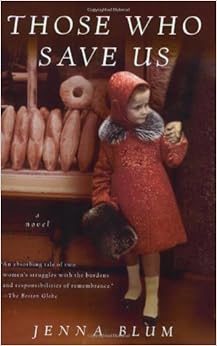
Those Who Save Us

Those Who Save Us by Jenna Blum, 482 pages

I have a fascination with anything pertaining to World War II and this was some of the best historical fiction about it I have read. Those Who Save Us tells the story of Trudy, a middle aged German history professor, herself born in Germany during the war, and her mother Anna, who has come to live with her after a fire destroys the farmhouse of Trudy's childhood, where Anna was still living. Trudy has always had a strained relationship with her mother and she has never been told the story of what led up to herself and her mother coming to live in America with an American soldier.
The book alternates between present day, which is the late 90s, and the late 30s early 40s, when Anna was around the age of 20, living in Nazi Germany.
Trudy embarks on a project for work in which she interviews Germans about their experiences during the war. Her goal in the project is to see if any Germans feel any remorse or responsibility for the tragedies of the Jews.
Trudy learns much in these interviews, including things about herself and eventually, the details from when she was young.

*One of the fun details of this story was that Anna worked in a bakery in Germany when she was young. Many delicious sounding German cakes and breads are mentioned, and the mouth waters just reading about them.