Showing posts with label Native Americans. Show all posts

Wednesday, January 31, 2024

The Angel of Indian Lake


 The Angel of Indian Lake

Stephen Graham Jones

343 pp


The Angel of Indian Lake  by Stephen Graham Jones is the third entry into his trilogy starting with My Heart Is a Chainsaw.  In this series, Jade Daniels (real name Jennifer), is a horror movie fan with almost encyclopedic knowledge of the films in this genre.  As in the other books, the chapter titles are those of horror movies.  Jade uses the plots of movies she has seen to compare what is happening to her in real life to what happens to characters in these movies.  She also uses the behavior of the “final girl” to inform the way she reacts to situations, although she does not believe herself to be worthy of that title.


Jade is back after a stint in prison and is teaching history at the high school like her former teacher Mr. Holmes.  Instead of writing papers on the assigned topics, Jade always wrote about the horror movie.  She has given her class the assignment to do a report on the history of Proofrock and Indian Lake.  Unlike when she was a kid, the reports of today are high tech.  One of the reports even is filmed by drone.  During one of these reports, a missing Bronco is  shown with the bodies of two former Proofrock residents in it.  Then the drone shows teens from their school who have been brutally murdered.  Meanwhile, the local game warden sets a forest fire and the sheriff’s office must find him before things get worse.  The sheriff (Jade’s best friend’s husband) enlists Jade to watch over their daughter since he knows he will be busy.  Things get even busier for him when a parent waiting for their child in the pick up lane is beheaded.


Even though Jade has vowed not to get involved in figuring out any of the crimes, she just can’t help herself.  After she finds out more people in town have been killed she goes after the sheriff so she can tell him what is going on.  Once dropped off in that area, she does not have a lot of mobility since all of the boats have been tampered with.  Eventually, Letha (the sheriff’s wife and her best friend) comes to the rescue.  There’s even more after this, but I won’t spoil it.


To read this book effectively, you must have read the first two books.  There is too much that refers back to the first two “massacres” to comprehend the story otherwise.  I loved this book and am sorry to see the trilogy end.  I will be sure to recommend this to other horror lovers.  

Thanks to Simon & Schuster for giving me an advance reading copy.


Thursday, April 25, 2019

The Orchid Thief

The Orchid Thief: A True Story of Beauty and Obsession by Susan Orlean, 284 pages


Susan Orlean is a journalist. She came across a story about man who was arrested for stealing endangered orchids from a Florida swamp. Orlean goes to Florida to follow the case and ends up meeting the man. John Laroche had been hired by the Seminoles to set up a nursery and he came up with a scheme to obtain the rare orchids, clone them and sell them to make a lot of money.

Laroche is the central character in the narrative but Orlean also profiles several other people and investigates related subjects. Laroche is a fascinating man who begins exploring a subject and then becomes engrossed in it. He may spend years collecting items but then decides he is done with it and stops, never to do it again. She delves into the world of obsessive orchid collectors and producers. She also explores the history of orchid collecting, the history of Florida and the history of the Seminoles.

It does get a little slow in the middle but it is worth it to go through to the end. This was a re-read for me and I found it as compelling as I did the first time. I would recommend this to people who like narrative nonfiction.

Saturday, December 22, 2018

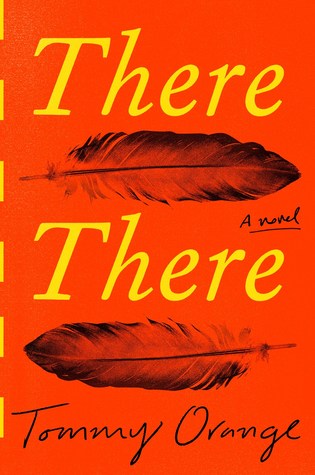
There There

There There by Tommy Orange     294 pages

From Goodreads:

There There is a relentlessly paced multigenerational story about violence and recovery, memory and identity, and the beauty and despair woven into the history of a nation and its people. It tells the story of twelve characters, each of whom have private reasons for traveling to the Big Oakland Powwow. Jacquie Red Feather is newly sober and trying to make it back to the family she left behind in shame. Dene Oxendene is pulling his life back together after his uncle’s death and has come to work at the powwow to honor his uncle’s memory. Opal Viola Victoria Bear Shield has come to watch her nephew Orvil, who has taught himself traditional Indian dance through YouTube videos and has come to the powwow to dance in public for the very first time. There will be glorious communion, and a spectacle of sacred tradition and pageantry. And there will be sacrifice, and heroism, and unspeakable loss.

My Review:

I didn't really know what I was getting into when I started this book, but wow it sure took me places.

Things I liked: the dichotomy that Orange explores about being Native, being mixed race, of having ancestors who owned this land and some who took that land away. I loved the different ways he explored this topic through the lens of so many people with such different backgrounds. I also loved how all these characters struggled with the feeling of "acting Indian" because it feels like a trope now, just one more thing that White culture has taken away. This struggle is then met with Orange's discussions on how Indians have evolved, that they can be Urban and still Native.

Things I didn't like: the multiple view points. I know I said I liked seeing all the different perspectives, but I also don't like reading so many perspectives. It's hard for me to keep them all straight, and since only a small amount of time is given to each person, it made it harder for me to remember the intricacies of each character. I also had a hard time getting into the way the story organically grew out of nothing and then ended right at the climax. It was a strange build to a story, one that I could see the outline of, but it also didn't really help keep me invested. I didn't like how sudden the ending was and I'm still trying to wrap my head around what it all meant, which in a way is a good thing, because that means the story has stuck with me, but in a way it's bad because I don't feel I'm likely to get any answers.

I would recommend this story because it's a hard-hitting one from a Native voice and it demands to be heard. It's sad and it's hopeful and it'll make you sit up and pay attention. Orange has a commanding voice in this book and I think it really reached me. So dig into it if you can.

Saturday, March 17, 2018

Heart Berries

Heart Berries by Terese Marie Mailhot     142 pages

Heart Berries is a powerful, poetic memoir of a woman's coming of age on the Seabird Island Indian Reservation in the Pacific Northwest. Having survived a profoundly dysfunctional upbringing only to find herself hospitalized and facing a dual diagnosis of post traumatic stress disorder and bipolar II disorder; Terese Marie Mailhot is given a notebook and begins to write her way out of trauma. The triumphant result is Heart Berries , a memorial for Mailhot's mother, a social worker and activist who had a thing for prisoners; a story of reconciliation with her father--an abusive drunk and a brilliant artist--who was murdered under mysterious circumstances; and an elegy on how difficult it is to love someone while dragging the long shadows of shame.

I believe this genre of writing is not my cup of tea. Mailhot's writing style reminded me a lot of Maggie Nelson's book, The Argonauts, where everything is related out of time, in a stream-of-consciousness style, and addressing a specific person ("you") throughout. The book is deeply personal, but at the same time, it is meant to be shared with everyone, her story finally being told on her terms and in the way she believes it should be shared.

I don't like reading books that are sad or depressing - and Mailhot's memoir is both. She jumps from one bleak moment of her life to the next, which in itself does not warrant me rating this book two out of five stars, but only relates to my personal feelings about reading such material. It's not something I enjoyed, I felt a lot of it went beyond my understanding - so much of it was metaphorical that I could find no anchor to ground myself with. Everything was symbolic or told in a poetic style that made it difficult to find the reality of it. I was mostly left shrugging my shoulders and thinking maybe if I read this in a classroom setting and was prompted to discuss it further, then maybe I'd get something more out of it.

I read this as a book club selection, otherwise I'm not sure I ever would have picked it up for myself as a personal interest. I am counting this book as my one-sitting book for Book Riot's Read Harder challenge. I don't know that I'd recommend this book, unless I was sure there'd be an interest in the memoir genre or I knew the person enjoyed reading from diverse authors.

Thursday, August 31, 2017

You Don’t Have To Say You Love Me

You Don’t Have To Say You Love Me: A Memoir  by Sherman Alexie         Audio Book: 12 hours        Hardback Book: 464 pages               

I knew that life on the reservation was hard and harsh and many of the Native Americans who live there have such a hard time that many turn to other measures to make life a little less depressing, drink, drugs, but what had never entered into my thoughts was the abuse mental, physical and most horrible sexual abuse of children.    Sherman Alexie discusses in detail horrific terrors that happened to him and others in the tribe from family, friends of family who are tribal members also the despicable things that occurred through the people coming onto the reservation who were supposed to be offering hope and help, priests, teachers, local people who pretend to be kind only to turn on them (he describes an older boy who pretended to befriend him and his cousins once only to turn around and start shooting them.    No wonder there is so little trust and so much hate and anger in the people who live there.    What began with the breaking of treaties by the government and abuse by soldiers and rogues forcing those who were the original inhabitants of the land to move from the rich parcels of land they farmed to tracts of land so harsh they were all but wastelands homes of rattlesnakes, coyotes, bears too harsh for the overbearing interlopers who hoped the Native Sons and Daughters would die from the lack of resources available to them in the hell holes they were imprisoned on.    But these were proud and noble folk who did the best with the lot that was thrust upon them and in the circumstances they found themselves.  Not every human being is mentally strong enough to deal with the harshness.   Sherman Alexie’s parents chose to color their world with alcohol and drugs.    This helped to numb them to life for a while.   Of course, this left their children vulnerable to the others who were always over to party and fight, drinking, doing drugs and molesting the children, the Alexie children, their cousins and friends.    Parties were a cover to rape children, to beat up and rape the older kids and abuse young women and young men as they saw fit because no one was clear headed enough to protect them.   Sherman Alexie talks about being bi-polar and in this memoir he deals with so much grief over his life and what he and his family have been through.   The bigotry of the town people toward the tribal peoples.   It is an often shocking book a look deep within the ugliness of what can happen to a soul.   Alexie pours his emotion into his poetry and there is such a feeling of release when you read his poems  which are so full of the hurt and contempt he feels at everyone who did dastardly things to him throughout his life and he rails at God in such ugly ways when he still to this day is so full of venom over the death of his mother.   While his father never tried to quit drinking and drugging his mother finally did and took the kids and ran away from the reservation once only to find she didn’t have anywhere to go and dejectedly returned.   A sad story that will remain in your memory but not without light moments.   Even the most put upon can find something to laugh about even in the most dismal of conditions and Sherman Alexie does that throughout offering light laughter his way of making it through.   It will keep you interested but his rants can get pretty blasphemous.   

Friday, August 11, 2017

LaRose

LaRose by Louise Erdrich.  372 pages

Late one summer, Landreaux Iron is out hunting deer along the edge of the property that borders his own. He's confident in his shot, but then realizes he's hit something else: his neighbor's five year-old son, Dusty. Landreaux's own son, LaRose, has been close friends with Dusty and horrified at what he has done, Landreaux and his wife, Emmeline, turn to an Ojibwe tradition for guidance. They decide they will give LaRose to Dusty's parents, Peter and Nola.  LaRose is quickly absorbed into his new family, even as he is gradually allowed visits with his own family. As years pass, this shared relationship begins to link the two families. However, another man in the community, one with a longstanding grudge against Landreaux, is determined to raise trouble and threaten the tenuous peace between the two families.

My summary of this book feels lacking, partly because there is way more going on in this book than just the story of the boy being shared between two families.  I found this to be a complex story, and while I appreciated what the author was doing, and her writing style, the story just didn't resonate with me.  I may try reading The Round House by Erdrich and see if I like that story any better.

Friday, February 10, 2017

Atala and Rene

Atala and Rene by Francois-Rene de Chateaubriand, 96 pages

This book collects two famous short stories by Chateaubriand.  Atala is a tale told to the young Frenchman Rene by the elderly Natchez Chactas, relating how as a young man he was captured by the Muscogees and condemned to death by torture, but was saved by the love of the virtuous maiden Atala.  Rene is told by Rene to Chactas, explaining why he left behind the sister he loved to find a new home in the American wilderness.

Together, these two stories established Chateaubriand's reputation as France's answer to Goethe, but just as The Sorrows of Young Werther seems cliche after two centuries, so too Atala and, to a lesser extent, Rene.  Unlike Young Werther, however, Chateaubriand's stories appeal to a timeless standard to judge their protagonists.

Tuesday, May 26, 2015

No Name

No Name by Tim Tingle, 160 pages


Bobby’s dad is really hard to live with.  He drinks too much and when he drinks he gets mean.  He beats Bobby and sometimes he really hurts him.  When Bobby’s mom leaves on a vacation from work, she doesn’t come back for a long time.  Bobby decides to dig a hole in his backyard and live in it.  He covers it with a door that he hides with leaves and stays there for a week, coming back to the house for food and things while his dad is out.  Bobby loves his dad but he doesn’t feel safe and he doesn’t know if his dad can change.  This was a good book for reluctant teen readers.  It was pretty simplistic and the resolution came about too easily but it was a decent story and an easy read.