Saturday, June 14, 2014

March Book One


March Book One by John Lewis, Andrew Aydin & Nate Powell     
121 pages

This is a graphic novel biography of Congressman John Lewis, who was one of the “Big Six” leaders of the civil rights movement.  This book tells both about his years as a young boy growing up on a farm in Alabama and talks about his civil rights years.  As a college student in Nashville he organized non-violent sit-ins at the lunch counters in department stores.  The book is written as though he is speaking today to two young boys in his office about his younger days.  It’s very well done and I could see a lot of teens that may not usually like to read about history having an interest in this book because of the format.

Spirit's Chosen


Spirit’s Chosen by Esther Friesner 
484 pages

This is the sequel to Spirit’s Princess but could be read alone.  Himiko is the daughter of the chief of the Matsu tribe.  She has returned from a journey fully trained as a shaman, only to find that her people have been attacked by the Ookami clan.  Several of her people, including her father, have been killed and others enslaved.  Her mother is in poor health, mentally, because one of those enslaved is her younger brother.  Himiko swears that she will rescue her brother and restore her mother’s mind.  She undertakes the journey but ends up enslaved herself.  However, not all of the Ookami are as warlike as their leader, Ryu.  She may find allies and help within the clan and she finds that the spirits are still with her, even in her captivity.  This is a good story and an interesting look into Japan’s past.  Teens that like historical fiction, fantasy, or books with strong female characters may like this book.

Sea of Shadows

Sea of Shadows by Kelley Armstrong
 406 Pages


Moria and Ashyn are twin sisters who at birth are marked to be the Keeper and the Seeker of Edgewood in this new series by Armstrong.  Each year they are tasked with quieting the souls of the damned, but this year things go terribly wrong and the twins and their animal companions find themselves fighting to remain alive.

This wasn't a great book, the pace was slow and the characters one-dimensional.  I would judge the book to be a miss by Armstrong.

Worst Person Ever

Worst Person Ever by Douglas Coupland
100 read
of 301 Pages

Worst. Book Ever... well not ever but this month.   I was really disappointed by Coupland's latest because I had liked some of this past works and this sounded interesting.  Raymond Gunt is a cameraman that hasn't worked for awhile but gets a job on a Survivor Like show.  A series of events tries his limited (non-existent)  patience.   

I understand that Gunt is supposed to be unpleasant and the novel a satire of the shallowness of modern society.  However, Gunt goes beyond unpleasant, he is one-dimensional nastiness and the satire rarely escalates above that of a 12 year old boy.

Society and Sanity

http://d.gr-assets.com/books/1304873607l/3993566.jpg
Society and Sanity by Francis J Sheed, 274 pages

Sanity - according to Frank Sheed - is, quite simply, a state in which one's ideas accord with reality - in which what I believe is true.

In observing the dialogue between Americans and Soviets, Sheed saw what has since become obvious - that although the Americans could say how a man ought and ought not to be treated, they could not explain why, because they could not agree on what a man is.  The result is to reduce the entire set of human rights to irrational preferences, or, viewed from another perspective, prejudices.  A strong defense of human rights, then, must be based upon a sane account of human nature.

Sheed's thesis is that the Western, which is to say the Christian, idea of human nature, although predicated upon divine revelation, is also empirically verifiable in terms of lived human experience.  Included as an extension of human nature are the natures of the family and of society, without either of which it is impossible to be fully human.  The element which harmonizes all this is reverence - of children for parents, parents for children, spouses for each other, the individual for society, and the State for the individual.  It is the concept of man as made in the image and likeness of God which grants the proper perspective - the proper piety - to allow for the existence of a healthy society.

Some books are dated a decade after their publication, others are still relevant at sixty years old.  This is one of the latter.

Thursday, June 12, 2014

The Bees

The Bees by Laline Paull
340 Pages


 Flora 717 is a bee born at the lowest level of the hive.  Since she has some small difference from her brethren, Flora finds herself moving among all the castes, from the nursery to the gatherers. But it is proving to be a hard winter and the survival of the hive is in question.


At first I was a little dubious about a book about a bee, would it be some sort of insectile Watership Downs?  It is actually pretty good, and even though the bees are anthropomorphized there is enough of a scientific framework  that you can believe how the hive operates.

Race With The Devil

Cover image for Race with the Devil : my journey from racial hatred to rational love / Joseph Pearce.

Joseph Pearce has garnered some attention in the last decade and a half for his biographical work on literary figures as varied as Solzhenitsyn, Belloc, Chesterton, and Wilde.  Most notably he, along with Clare Asquith, can claim credit for having reopened the question of Shakespeare's religious views.   In addition, he has produced TV specials on Shakespeare and Tolkien (the latter featuring St Louis' own Kevin O'Brien).  What is not known to most of his admirers, at least not on this side of the Atlantic, is that Pearce had attained notoriety in his native England for a rather different set of writings, when he served as the editor of a series of far-right newspapers with titles like Bulldog and Nationalism Today.  His first book-length biography had as its subject the racist skinhead band Skrewdriver.   As the result of articles he authored, he was twice imprisoned on charges of inciting racial hatred.

This book is Pearce's own story of his life leading up to, and beyond, his conversion to Catholicism in 1987.  The weak moral relativism of his schooling proved no barrier to an irrational hatred that fed off of the jingoistic pride he was taught at home.  Through his reading of Schumacher and Solzhenitsyn, Lewis and Tolkien, Belloc and Chesterton, Pearce gradually came to recognize the existence of an underlying moral and spiritual order, catalyzing his transformation from militant, imperialistic "Great Britisher" to contemplative, agrarian "Little Englander".
 
The book has a number of appealing personal touches, as when Pearce interrupts an account of the negative impact his father had on him to reassure the reader that this makes his father seem much worse than he actually was.  Likewise, the stories of his riotous exploits as a street brawler are spiced with a kind of guilty pride.  Throughout, Pearce is generous to friends and enemies alike, and, at least in retrospect, acutely conscious of the small moments of grace which marked his journey.

If judged by the standard of St Augustine's Confessions, which it deliberately evokes, this work falls short.  By almost any other standard, it is a considerable success.  With wit and charm, Pearce illustrates that his faith is not the rejection of what is good in the world, but its purification and transcendence.

Wednesday, June 11, 2014

Where'd You Go, Bernadette

Where'd You Go, Bernadette by Maria Semple, 330 pages

Told from the perspective of the 15-year-old daughter but consisting mostly of correspondence between various characters, this story focuses on Bernadette Fox and her antisocial behavior, extreme agoraphobia and utter disgust with Seattle, the city she lives in.
The daughter, Bee, has requested a trip to Antarctica as a reward for getting all A's in 8th grade (couldn't figure out the 15-year-old 8th grader part). The idea of planning and taking this trip makes Bernadette panic beyond any panic she's ever felt. To help with the trip planning and life in general, she utilizes a remote assistant named Manjula located in India, who takes care of all her scheduling and purchasing needs.
You slowly learn more about Bernadette and her back story,  and her reasons for her odd behavior.
The turning point in this story is when Bernadette suddenly goes missing without a trace. Bee is determined to find out what's happened to her mother, no matter what it takes.

Snow Queen

The Snow Queen by Michael Cunningham
258 Pages


This is a story of two brothers, Barrett and Tyler Meeks set between the years 2004 and 2008.  Barrett has just been dumped via text and is examining his history of failed relationships when he sees a strange light and has an almost religious moment.  Meanwhile Tyler is trying to write a wedding song for Beth who is dying of cancer.  Both Tyler and Barrett are dissatisfied with their lives and are struggling to find a place and purpose for themselves.

Cunningham has written several well received books in the past including The Hours and A Home at the End of the World (which I really liked) which is why I choose to read this novel.  However, like many authors, I think Cunningham sacrificed story for artifice.  The language and metaphors are well written and somewhat engaging but the story never really picks up speed or reaches a grand denouement.

Storm Front

Storm Front by Jim Butcher, 322 pages

Harry Dresden is a wizard, but not the Harry Potter type or the Gandalf type. Rather, he's a wizard-for-hire (but not for parties) more akin to a private detective. Just like any good noir detective novel, Dresden is a couple months behind on rent when hard-nosed police officer Karrin Murphy calls on him to help solve a gruesome double murder, almost certainly done by magical means. And just like any good noir novel, Dresden's poking around in Chicago's seedy underbelly (this time with vampires!) pulls the murderer's focus onto Dresden, making for some tough and dangerous situations.

This is the first book in Butcher's Dresden Files series (of which there are supposed to be, when all is finished, something like 30), and it serves as a decent introduction. I wouldn't call this the end-all, be-all of either fantasy or noir, but it's fun and I can tell that Butcher has a lot of room to work with and a lot of stories to tell in the world he's created. That said, the world of Harry Dresden is remarkably similar to that of Angel, the Buffy spin-off show about an L.A.-based private detective office run by a vampire with a soul. As I've been watching Angel recently, it's a bit unnerving to me, though as I've had plenty of people sing the praises of the Dresden Files, I hope that feeling fades as I read more of the series.

Mary Poppins & Mary Poppins Comes Back

Mary Poppins & Mary Poppins Comes Back by P.L. Travers
357 Pages


While I was on vacation I saw the movie Mr Banks which was about the making of Mary Poppins by Disney and the author of the stories.  Stories?  I never knew it was a book first although I should have known better.  This prompted me to check out and read the first 2 books of the series.

The movie is pretty true to the stories themselves although there are 2-3 extra children and Mary isn't quite so nice as Julie Andrews.  Would kids today like the stories?  Probably not since they've become a little dated and some of the playfulness wouldn't be understood.  Has anyone else ever read these stories?  What did you think? 

Tuesday, June 10, 2014

I Can't Complain

I Can't Complain: (All Too) Personal Essays by Elinor Lipman, 161 pages

Well, the title just about says it all. In this volume, Lipman presents a selection of essays previously published in various magazines. The topics run the gamut from the finale of Sex and the City to her mother's lifelong aversion to condiments, from watching golf after the death of her husband to Lipman's experience watching one of her novels become adapted into a movie. Throughout it all, Lipman maintains a genial disposition, a trait magnified in the audiobook, which Lipman narrates and I listened to.  I think what I most enjoyed was realizing that Lipman is approximately the same age as my mom, and I'm the same age as Lipman's son, so I found it interesting to get a glimpse into what was going on for someone else whose life somewhat paralleled my mom's. This was most apparent in her discussion of becoming pregnant with her son, and in her essay about the soap opera "stories" she watched throughout life (though my mom was a diehard As the World Turns girl, not an All My Children fan like Lipman).

I enjoyed this collection, though not as much as I've liked essays by writers with a bit more snark and sarcasm (such as David Sedaris, or even Rick Reilly). This would probably be better for a fan of Anna Quindlen or Nora Ephron, or someone who has read one of Lipman's novels, which I haven't.

Monday, June 9, 2014

Dreams of Gods & Monsters

Dreams of Gods & Monsters by Laini Taylor, 613 pages

The third book in the series has Karou leading the chimera rebellion against the angels. Both the world of the Kirin and the human world are at stake if Karou, Akiva, and the rebellion do not succeed. This book introduces us to Eliza, who, unbeknownst to her, is a vital part of the upcoming war. Karou’s many friends, human, chimera, and angel, will also prove to be indispensable in many ways, but will their help be enough to win the war? And if Karou and Akiva can even survive, will their love be able to withstand the upcoming trials? A really good finale to the series, I definitely would recommend reading them in order. Teen fantasy fans should like this series.

The Assassin's Apprentice

The Assassin’s Apprentice by Robin Hobb, 435 pages

Fitz is the bastard son of Prince Chivalry, the former heir to the throne. Fitz has never met his father, but is being raised in the King’s household. Chivalry, when he finds out about Fitz, removes himself from the line of succession and retires to a quiet country life. Fitz, meanwhile, is being taught many things. His lessons include being taught by Chade, the King’s assassin. As Fitz grows, so do his abilities and responsibilities. He has been trying to hide one of his abilities, called the Wit, which allows him to talk to and understand animals. In the end, this ability may just save his life. Fantasy lovers will enjoy this story, which is the first in a series.

Sunday, June 8, 2014

Catholic Church In China


The Catholic Church in China: 1978 to the Present by Cindy Yik-Yi Chu, 134 pages

Cover image for The Catholic Church in China : 1978 to the present / Cindy Yik-yi Chu.In 1552, St Francis Xavier died on the island of Shangchuan, on the doorstep of China.  By the middle of the twentieth century there were over three million Chinese Catholics.  Today, estimates begin with the six million acknowledged members of the government-approved "open" church, and add six to eleven million Catholics who are members of the persecuted "underground" church or otherwise uncounted.  Most of this expansion has occurred in the last three decades, since the death of Mao.

Although the subject seems interesting, the book is not.  It is written in an academic style which serves to make even interesting material seem boring, and it uses Chinese designations ("June 4th Incident" for what is generally referred to in the West as the "Tiananmen Square protest/crackdown/massacre") which serve to make clear points more obscure.  Of course, this is an academic book, so these handicaps are to be expected.  The major problem is, likewise, seemingly unavoidable - the book is very repetitious, because the story is very repetitious - initially cool relations warm between China and the Holy See until a breakthrough seems possible, then Beijing feels the need to reassert its control, and everyone goes back to square one.

Nonetheless, there are interesting insights.  Chu favors "official" and "unofficial" over "open and "underground", as the former better captures a situation where most of the state-appointed bishops are recognized by the Pope, while the "underground" church is not illegal as such.  There is also some interesting material surrounding modernization - virtually every Mass celebrated in mainland China was Tridentine until well into the '90s, and it was the unofficial church which began liturgical reforms through its connections with the churches in Hong Kong and Taiwan.

As short as it is, this book has enough good content to make reading it worthwhile for anyone interested in Sino-Vatican relations specifically, or modern China more generally.

Friday, June 6, 2014

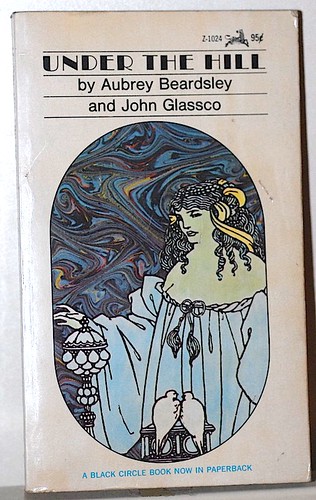
Under the Hill


Aubrey Beardsley is better known as an artist than as an author.  This is understandable - while his illustrations provoked comparisons with Durer and Dore, Under the Hill, his only attempt at a novel, only had three non-sequential chapters published during his lifetime, and was only halfway finished at the time of his death at age twenty-six.  Glassco wrote the second half himself over fifty years after Beardsley's death, attempting to mimic Beardsley's style.
 
This book is, frankly, disgusting, full of aimless erotic tableaux presented with an air of nonchalance reminiscent of parts of Moorcock's Dancers at the End of TimeWhatever the limits of each individual reader's taste may be, Beardsley was clearly determined to exceed them.  Indeed, it may be that the only interest this book holds is as an experiment in excess and transgression.  The second half of the novel, written by Glassco, tones down the transgression but also loses the hallucinatory, fever-dream quality of Beardsley's work, with the result that over-the-top perversion is replaced by the merely prurient and tawdry.  A plot appears briefly near the end, but while Beardsley might have been able to use it to tie the work together, Glassco was not.
 
Someone, somewhere will like this book.  I do not want to meet them.

Thursday, June 5, 2014

Stuart Little

Stuart Little by E.B. White, 131 pages

Stuart is the second son of the Little family of New York City. They're human, he has a rather mouse-like appearance, down to his three-inch height and long tail. While they're a bit surprised by this development, they seem to accept him as-is, and do everything they can to create a good life for him. This rather short book takes Stuart on adventures down the bathtub drain (to retrieve a lost ring), on a garbage barge, and in a terrifying sailboat race in Central Park.

It's been a long while since I read this book, and while I remember loving it as a kid, today I'm a bit perplexed. Yes, the unconditional love Mr. and Mrs. Little show their son is great, and a great thing for kids to read, and yes, those adventures are fantastic. But the fact that all the animals talk, and the fact that a small dapper-dressed mouse with human parents seems to be completely normal to all the people of New York City and beyond, not to mention the fact that, as much as they love him and worry about him, the Littles don't seem to notice or care when Stuart takes off on a road trip at the ripe old age of seven... well, those make this book a little hard for adult me to swallow. I plan on reading this one to my son someday in the not-too-distant future, so perhaps sharing it with a little kid might help bring some of the magic back. Because sadly, I seem to have lost it.

Good for kids, not so much for adults.

Tiger, Meet My Sister...

Tiger, Meet My Sister...: And Other Things I Probably Shouldn't Have Said by Rick Reilly, 342 pages

I'm going to hazard a guess and say that most of the people who blog here, and most of the people who read this blog, are not die hard sports fanatics or hard-core athletes. I could be wrong, and if I am, I retract the previous statement. But working under that assumption, I probably need to explain that Reilly is a longtime sports columnist, first for Sports Illustrated and now for ESPN. The man has even been inducted into the National Sportswriters and Sportscasters Hall of Fame (though so has Mitch Albom; make of that what you will).

Anywho, Tiger, Meet My Sister... is a collection of Reilly's favorite ESPN columns, and often those that have gotten him in hot water or left him with egg on his face. In this collection, Reilly reprints the column where he admits that he feels like a world class chump for believing Lance Armstrong all those years; the column where he argues against retiring the name "Redskins" from the NFL team; even the column where he skewers the double standard of blocking PED-using players from the Baseball Hall of Fame while rolling out the carpet for their managers, who must have known what was going on. (Incidentally, his targeting of Tony LaRussa in that third column has made it so he "can't eat lasagna in downtown St. Louis anymore," according to a post-script.) But with all of those controversial or embarrassing columns, Reilly has also chosen to share some truly fascinating, even emotionally charged, columns, including an interview with Archie, Peyton, and Eli Manning; a story about a blind woman making a long commute to Yankees games from her home in New Jersey; and a fun one about commuting to the Staples Center on game day with Kobe Bryant.

These columns are all, no matter what they cover, entertaining and enthralling, and laced with Reilly's trademark humor. Many times while reading this, I found myself both chuckling out loud and then reading short passages to my husband (who was probably annoyed beyond all belief, since I was interrupting his own reading time). A great collection for even casual sports fans.

Wednesday, June 4, 2014

Johannes Cabal the Detective

Johannes Cabal the Detective by Jonathan Howard, 288 pages

This book is the second in a series, the first of which I read a few years back. The main character, Johannes Cabal, is a darkly humored necromancer and in the first book, he has been without his soul in order to learn necromancy. However, he wants it back and must earn it back by getting others to give up theirs, while running a carnival.
This installment in the series was a little steampunk, which was a change of pace from the first book.  The second book is set mostly on a zeppelin onto which Cabal has fled, to attempt to escape a crime. He ends up having to participate in the solving of several murders and is almost murdered himself. Along to help him is Leonie Barrow, a woman he met in the first book.
The author tried to throw in some poor attempts at romance for Cabal in this one, which I found unnecessary, as it breaks from Cabal's character. It is attributed to him having his soul back, but still, unnecessary.
The best part about the Cabal books are the humor. Cabal is extremely sarcastic and he's not only a necromancer, but also an un-apologetic killer when necessary. I suppose he's somewhat sociopathic. I've discovered I really do enjoy books about sociopaths.

The Long Nineteenth Century

Cover image for The long nineteenth century : a history of Germany, 1780-1918 / David Blackbourn.

This book covers the history of Germany during the period from the outbreak of the French Revolution to the end of the First World War.  From "Germany" the author deliberately excludes Austria after the Austro-Prussian War, a decision which is entirely defensible, but still disappointing.  The book does presume a certain minimal knowledge on the part of the reader (that 1848 was a year of revolutions throughout Europe, for example).  Blackbourn is far less interested in politics than in economics, which, while entirely justified by the importance of urbanization and industrialization in this era, does make for some dull reading.
 
Much of the book consists of qualifications - the bourgeoisie may have taken on certain habits of the old aristocracy, but this was more often an assertion of their pride as bourgeois than an attempt to escape their class, likewise even as the socialists struggled to overturn the existing order they still saw themselves as patriotic Germans, and the artistic glories of German romanticism were balanced by widespread crass materialism and the celebration of wealth and power.  This adds considerable nuance to an era that is often oversimplified by terms like "Industrial Revolution", "Prussianism", and "Blood and Iron".  In turn, these poorly understood contradictory aspects would continue to shape German history through the Great War and beyond.

Excellent history, and well worth reading, even if a little dull at times.

Tuesday, June 3, 2014

May Totals!

Congrats to Ed W, Krista R and Kara K!!  Ed read 7,664 pages in May, but Krista once again won the race for points with 27.  Kara K is the winner of our random drawing. We'll contact you within the next few days so you can claim your prize.  Full results are as follows:
BloggerBooks Pages Points
Ed W 207,66421
Krista R206,23027
Jason S125,53215
Kara K133,99519
Dennis M133,29513
Terra S51,0286
Steve J28612
TOTALS8528,605103

Monday, June 2, 2014

No Logo


Cover image for No logo : no space, no choice, no jobs, no logo : taking aim at the brand bullies / Naomi Klein.No Logo is an anti-consumerist tract railing against the impact of brands on our public space and consciousness.  Klein clearly describes the increasing ubiquity of advertising, the consumerist values it tacitly advances, and the manner in which multinational corporations have become increasingly "brand-centered" and distanced from the actual manufacturing of their products, as well as the negative consequences this shift has had on individuals and communities in both developed and underdeveloped countries.  Further, she shows how the very power of the brand can be used to force corporate accountability in environmental and labor practices.  Visibility, it seems, also means vulnerability.
 
Klein is a journalist by profession, and this book carries the endemic sin of journalism - by exceeding the author's competence it undercuts itself.  So Klein calls Macy Gray "Mary Gray", imagines cross-country skiers being dropped off at the top of a mountain, and claims Disney's Mulan "flopped at the box office".  Such mistakes, while perhaps minor in themselves, contribute to a lack of confidence as to whether she understands that the Internet is not, in fact, public property, or whether she knows that Brave New World is not about the dangers of shopping malls.  Despite this, Klein is clearly no fool.  She appreciates the dangers of brandless invisibility in a world of brand-name protests, and of a protest against one brand benefiting its equally reprobate competition.  She recognizes the possibility of the appropriation by the brands themselves of a responsible image without actually implementing the reality.  Nor is she afraid to criticize fashionable alternative brands like Diesel alongside obvious targets like Walmart. 
 
Unfortunately, although the book is only fifteen years old, it already feels outdated, not only in the description of invincible mega-brands like AOL, Borders, and Blockbuster as tools of creeping fascism, but also because so much has changed in the world of mass media in general in the last decade.  Still, many of the problems Klein calls attention to have only gotten worse in the interim.  The book does not present a clear alternative, however.  Klein's anti-brand coalition includes anarchists and labor unions, Filipino Marxists and Canadian Catholic schoolkids, a big tent too fragile to bear much in the way of positive prescriptions.  Her underlying preference seems to be for maximization of available choices, but that just leads back to consumerism.

Overall, a mediocre work that would have been much better if it was half as long and twice as radical.