Showing posts with label Decadent. Show all posts

Monday, September 14, 2020

Poems

Algernon Charles SWINBURNE / Poems 1925 | eBay

 Poems by Algernon Charles Swinburne, 231 pages

He offers his tithe.

     The sea gives her shells to the shingle,
          The earth gives her streams to the sea;
     They are many, but my gift is single,
          My verses, the first fruits of me.

Swinburne has been called the "last of the giants", and indeed he stands tall at the end of Romanticism and the beginning of Decadence, willing to be damned for love's spite or sake.

     But you would have felt my soul in a kiss,
          And known that once if I loved you so well;
     And I would have given my soul for this
          To burn forever in burning hell.

Death has closed the circle on Swinburne's world of flesh, but delight has not yet yielded wholly to disgust, nor heartache to horror.

     Is it worth a tear, is it worth an hour,
          To think on things that are well outworn?
     Of fruitless husk and fugitive flower,
          The dream foregone and the deed forborne?

Saturday, February 1, 2020

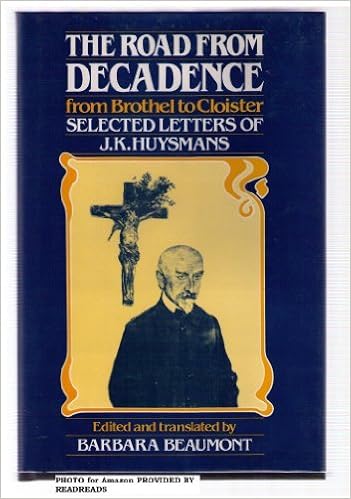
Road From Decadence

Image result for road from decadence"The Road from Decadence: From Brothel to Cloister: Selected Letters of JK Huysmans by JK Huysmans, edited and translated by Barbara Beaumont, 235 pages

This collection of letters spans four decades and includes the author's correspondence with such literary luminaries as Emile Zola, Guy de Maupassant, Stephane Mallarme, Paul Verlaine, and Leon Bloy, as well as less famous figures with whom he was involved financially, socially, or spiritually.  Through the chronological arrangement it is easy to trace Huysmans' journey from Realism to Decadence to conversion, and to witness how through these transitions he remains stubbornly consistent in his dissatisfaction with the world and rejection of every form of sentimentality and superficiality.  Although his devoted admirers will doubtlessly enjoy this collection, there is admittedly little here to interest a wider audience.

Tuesday, April 9, 2019

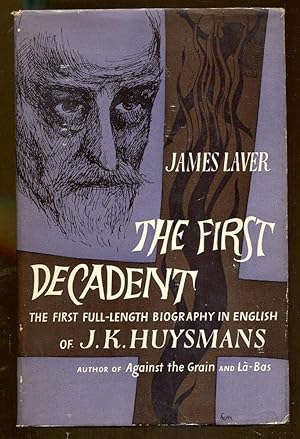
First Decadent


Nabokov insisted quite rightly that Proust was a novelist rather than a memoirist, and warned that the reader should therefore guard against conflating Marcel the character with Marcel the author.  The same could be said of other authors as well - Dante being the obvious example.  Despite this, when dealing with a novelist as assertively autobiographical as Huysmans a solid biography can be an invaluable aid.  Thankfully, that is exactly what James Laver delivers.

There are two great temptations when dealing with the life of a man like JK Huysmans.  The purely aesthetic literary admirer is unlikely to be sympathetic to Huysmans' spiritual journey, and is likely to imagine that it impoverishes rather than enriches his work.  The pious biographer, on the other hand, is likely to want to sanitize Huysmans' life and work for fear of alienating his intended audience, thus ironically minimizing the importance of the same journey.  Laver somehow manages to avoid both traps, capturing the erotic charge the young Huysmans derived from the scent of a cluster of streetwalkers whose services he was unable to afford as well as the transcendent shock he found in the sound of perfect plainchant.  The result is, however, likely to be disturbing to the sensitive (there are passages here that are as black as any in La Bas), a quality it fittingly shares with its subject.

Wednesday, June 6, 2018

Against the Grain

Image result for Against the Grain huysmansA Rebours (Against the Grain) by JK Huysmans, 339 pages

Against the Grain is not the story as much as the description of the retreat of the misanthrope Jean des Esseintes into aesthetic seclusion, to live in a world entirely of his own imagination.  The exquisite taste of des Esseintes scorns the vulgarity of fin-de-siecle Paris, "the Caliphate of the counting-house", demanding that everything be custom-tailored to his exacting specifications, his rooms decorated in carefully selected shades of blue and yellow so as to appear their best in candlelight, mechanisms installed with which he is able to precisely reproduce any taste or scent he desires, books collected combining the late antique Latin authors with the best poets and novelists of his own era, the detritus of a lost world spiced with a hint of degeneracy and decay.  Ultimately, inevitably, his self-indulgent solitude collapses into illness and madness. 

A Rebours is the greatest Decadent novel, although it is not Huysman's best - En Route and even La Bas are superior.  It stands at the limits of nineteenth century French realism, and at the threshold of something ever ancient, ever new.

Friday, December 29, 2017

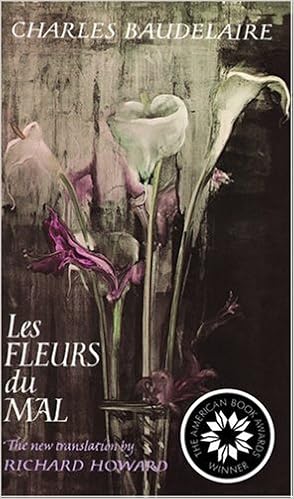
Les Fleurs du Mal

Les Fleurs du Mal by Charles Baudelaire, translated by Richard Howard, 176 pages

     Here with grisly appetite
     I grill and devour my heart.

In these six collections (with some additional poems appended), Baudelaire indulges in the ultimate descent into romantic degradation, treasuring each horror.

     the final bag of coins in a gambler's fist;
     the cavernous kisses you get from Adeline;
     the maddening tune that will not let you go,
     as if it echoed faintly all of human pain...

Turning the moral universe upside down, the poet composes hymns to Satan and hurls curses against God, while those made in His image and likeness are considered simultaneously pitiable and disgusting.

     Woman a slave and yet vainglorious,
     stupid and unashamed in her self-love;
     Man a greedy tyrant, slave of his slaves,
     swelling the sewer to a stinking flood...

Baudelaire casts his celebration of corruption as a bold adventure, the ultimate existential revolt.

     Pour us your poison, let us be comforted!
     Once we have burned our brains out, we can plunge
     to Hell or Heaven - any abyss will do -
     deep in the Unknown to find the new!

He manages to create beauty out of his longing for Beauty, for escape from this world and its oppressive boredom and disgust.

     Who cares if you come from paradise or hell,
     appalling Beauty, artless and monstrous scourge,
     if only your eyes, your smile or your foot reveal
     the Infinite I love and have never known?

The greatest work of the greatest of the Decadents, The Flowers of Evil is the field of an almost invisible struggle to find coherence in the "heap of broken images" where

     Satan Trismegistus subtly rocks
     our ravished spirits on his wicked bed
     until the precious metal of our will
     is leached out by this cunning alchemist:

     the Devil's hand directs our every move -
     the things we loathed become the things we love;
     day by day we drop through stinking shades
     quite undeterred on our descent to Hell.
Monday, October 31, 2016

Picture of Dorian Gray

The Picture of Dorian GrayThe Picture of Dorian Gray by Oscar Wilde, 254 pages

The story is familiar.  As the result of a rash prayer, a young dandy is cursed - physically he will never change, but his portrait will.  Seduced willingly into a life of debauchery, outwardly he remains the beautiful young man, but his portrait becomes increasingly hideous, reflecting the degeneration of his soul.

The Picture of Dorian Gray is, at its heart, a fairy tale, a fable exploring the connection between goodness and beauty which Wilde, along with the rest of Victorian England, learned from Ruskin.  The novel is far from perfect.  The early romance between Gray and an actress never rises above melodramatic cliche.  The cascade of witticisms that emerges from the mouths of Gray and Lord Henry now suffers from a combination of antiquity and familiarity.  Yet although the central message - that all sin is a form of self-mutilation, however the sinner may have been self-anaesthetized - is at least as old as Plato, Wilde's dramatization is memorable enough to make the old truth young again.

Wednesday, September 23, 2015

Disagreeable Tales

Cover image for Disagreeable Tales by Leon Bloy, translated by Erik Butler, 177 pages

Disagreeable Tales consists of thirty dark vignettes by the "ungrateful beggar" Leon Bloy, author of The Woman Who Was Poor.  With each story being only a few pages long, there is very little plot, only a peek into an individual well of sin, exposing shameful vices, base depravity, and cruel injustice, but most of all Bloy's favorite target, respectable hypocrisy. 

At the heart of the collection is the tale of a priest who relates the horrible crime of an anonymous penitent, a man who while walking in the country out of sheer maliciousness and desire to destroy burned down a random cottage, killing the old woman who lived there.  Upon hearing the story several men begin sobbing - each identifying himself as the penitent.  Bloy's work, at its best, has the same effect - an accusatory mirror held up to our souls.

Saturday, January 10, 2015

Unmasking of Oscar Wilde

Cover image for The Unmasking of Oscar Wilde by Joseph Pearce, 398 pages

Oscar Wilde was, undoubtedly, one of the most elusive literary figures in history.  Few writers have so reveled in artifice, in being serious about frivolity, in the wearing and discarding of masks.  Yet, to believe Joseph Pearce, this artificiality was a feature of Wilde's public persona, and although his private life was full of sordid deception, it was earnestly so, while in his art he was consistent, honest, and above all moral.

Pearce's book functions mainly as a corrective to Richard Ellmann's magisterial biography of Wilde, and more generally to what he describes as over a century of misinterpretations by "the prurient and the puritan", both of whom reduce the man to his vices, whether celebrated or deplored.  Pearce situates Wilde in the context of the wider Decadent movement, illuminating his path by the lights of Huysmans and Verlaine, Thompson and Dowson and Beardsley.  Like them, his life would end either "at the point of a gun or at the foot of the Cross."  Only by grasping this can the man behind the masks be uncovered.

Wednesday, August 20, 2014

Poetical Works of Lionel Johnson

http://www.forgottenbooks.com/bookcover/0240/Poetical_Works_of_Lionel_Johnson_1000316841.jpgPoetical Works of Lionel Johnson by Lionel Pigot Johnson, 307 pages
 
Lionel Johnson was a poet in the last decades of the nineteenth century.  He was a member of the circle of English Decadent poets that also included Ernest Dowson and Oscar Wilde.  His long battle with alchoholism ended when he died from head injuries suffered in a fall off a barstool.
 
Although primarily a religious poet, he is also capable of evoking a profound "sense of place" especially pronounced in his poems celebrating his love of Ireland, Wales, and Cornwall.  A sly sense of humor and a genuine sense of delight lend life to his encounters with nature and nature's God.

Monday, July 7, 2014

Selected Poems

Cover image for Selected poems / Paul Verlaine ; translated by C.F. MacIntyre.
Selected Poems by Paul Verlaine, translated by CF MacIntyre, 100 pages
 
Verlaine was a French poet in the latter half of the nineteenth century.  His poems are often short and atmospheric, hinting more than stating:
 
     Never the Color, always the Shade,
     always the nuance is supreme!
 
He makes extensive use of hallucinatory imagery, seeking to craft poems: 
 
     like dreams when one wakes up to see
     what's doing, then falls asleep, dreaming once more
     of the same old enchantment, the same old decor...
 
This collection left me cold, probably more due to my own shortcomings than any of the author or translator.  I appreciated his later poems more than the earlier ones - indeed, the last poem, "Droll Advice", is my favorite in the collection.  The book includes the original French text on the facing pages, which helps even those of us who know no French get some idea of how the original sounds.

Friday, June 6, 2014

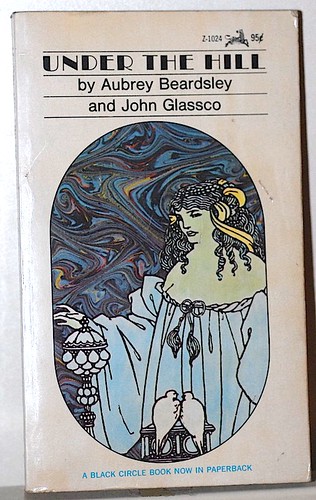
Under the Hill


Aubrey Beardsley is better known as an artist than as an author.  This is understandable - while his illustrations provoked comparisons with Durer and Dore, Under the Hill, his only attempt at a novel, only had three non-sequential chapters published during his lifetime, and was only halfway finished at the time of his death at age twenty-six.  Glassco wrote the second half himself over fifty years after Beardsley's death, attempting to mimic Beardsley's style.
 
This book is, frankly, disgusting, full of aimless erotic tableaux presented with an air of nonchalance reminiscent of parts of Moorcock's Dancers at the End of TimeWhatever the limits of each individual reader's taste may be, Beardsley was clearly determined to exceed them.  Indeed, it may be that the only interest this book holds is as an experiment in excess and transgression.  The second half of the novel, written by Glassco, tones down the transgression but also loses the hallucinatory, fever-dream quality of Beardsley's work, with the result that over-the-top perversion is replaced by the merely prurient and tawdry.  A plot appears briefly near the end, but while Beardsley might have been able to use it to tie the work together, Glassco was not.
 
Someone, somewhere will like this book.  I do not want to meet them.

Tuesday, May 27, 2014

Poems of Ernest Dowson

http://thumbs1.ebaystatic.com/d/l225/m/m-EZByVWxB1WPOZbbBpIYMA.jpgThe Poems of Ernest Dowson by Ernest Dowson, 123 pages

A Decadent poet of the nineteenth century, Dowson is primarily remembered for his skill at turning a phrase, particularly "the days of wine and roses" and "gone with the wind".  This is a short collection of his poetry (and a short verse play, Pierrot of the Minute), mostly dealing with love disdained, refused, regretted, and remembered.  At its best, his poetry continues the old romantic rejection of the mundane, disdaining the "men who sow and reap, / all their days, vanity", in favor of the monastery or the madhouse.

An short, enjoyable book, well-crafted but not particularly challenging.

Wednesday, May 21, 2014

The Oblate

http://d.gr-assets.com/books/1386749028l/315296.jpg
The Oblate of St Benedict by Joris-Karl Huysmans, translated by Edward Perceval, 403 pages 
 
The Oblate is the final book in the Durtal series that began with La Bas and continued with En Route and The Cathedral.  Durtal's friend and mentor, Abbe Gevresin, having died, the author-surrogate makes the decision to leave Chartres, where he spent the bulk of The Cathedral.  He attaches himself to the Abbey of Val-des-Saints, in Burgundy, as an oblate, that is, as a person living in the world but sharing in the work and, especially, the liturgical life of the monastery.  Although much of the novel is taken up by dialogues on subjects including art, history, and the liturgy, there are a couple of subplots in this novel which provide some narrative movement (unlike The Cathedral, which had virtually no plot at all).   One involves the mediocre new parish priest, who plays his part in the age-old struggle between the secular and religious clergy.  The other involves the looming threat of government persecution in the aftermath of the Dreyfus Affair.

Huysmans' novels are very much an acquired taste.  He does seem to have gained a sense of humor at some point, which tempers the fierce dogmatism of his aestheticism somewhat.  On the other hand, the conclusion is highly unsatisfying, especially given that it is also the conclusion of the four-book cycle.  Perhaps the open-endedness is intentional, a call for the reader to continue the story in his own life.  In any event, The Oblate is simultaneously easier to read and less interesting than either En Route or The Cathedral.

Friday, April 18, 2014

En Route


En Route by Joris-Karl Huysmans, translated by C Kegan Paul, 463 pages

This is Huysman's sequel to La Bas, continuing the story of the semi-autobiographical protagonist Durtal.  Horrified by the events which formed the climax of La Bas, Durtal turns to the Church for spiritual succor, only to find himself repelled both by the mediocrity of the faithful and his own base appetites.  He drifts through an exploration of the churches of Paris, but it is only during a retreat at a Trappist monastery that he is forced to wrestle with his demons.

This is not an ordinary novel - there are no external conflicts or dramatic events (even La Bas had the affair between Durtal and Madame Chantelouve).  The conflict is entirely internal, within Durtal's mind and soul.  The author's Puginesque aestheticism and obsession with the "pure spirit of the Middle Ages" is also sometimes off-putting.  En Route is, however, for those who appreciate its subtleties, an arresting story of grace and redemption.