Showing posts with label Huysmans. Show all posts

Saturday, February 1, 2020

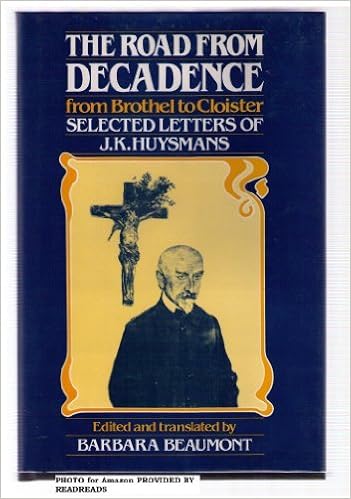
Road From Decadence

Image result for road from decadence"The Road from Decadence: From Brothel to Cloister: Selected Letters of JK Huysmans by JK Huysmans, edited and translated by Barbara Beaumont, 235 pages

This collection of letters spans four decades and includes the author's correspondence with such literary luminaries as Emile Zola, Guy de Maupassant, Stephane Mallarme, Paul Verlaine, and Leon Bloy, as well as less famous figures with whom he was involved financially, socially, or spiritually.  Through the chronological arrangement it is easy to trace Huysmans' journey from Realism to Decadence to conversion, and to witness how through these transitions he remains stubbornly consistent in his dissatisfaction with the world and rejection of every form of sentimentality and superficiality.  Although his devoted admirers will doubtlessly enjoy this collection, there is admittedly little here to interest a wider audience.

Tuesday, April 9, 2019

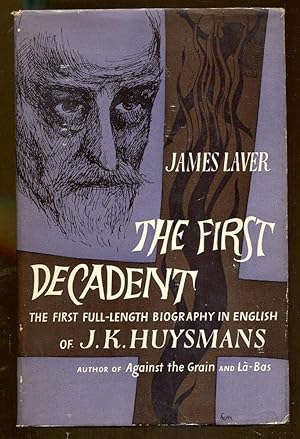
First Decadent


Nabokov insisted quite rightly that Proust was a novelist rather than a memoirist, and warned that the reader should therefore guard against conflating Marcel the character with Marcel the author.  The same could be said of other authors as well - Dante being the obvious example.  Despite this, when dealing with a novelist as assertively autobiographical as Huysmans a solid biography can be an invaluable aid.  Thankfully, that is exactly what James Laver delivers.

There are two great temptations when dealing with the life of a man like JK Huysmans.  The purely aesthetic literary admirer is unlikely to be sympathetic to Huysmans' spiritual journey, and is likely to imagine that it impoverishes rather than enriches his work.  The pious biographer, on the other hand, is likely to want to sanitize Huysmans' life and work for fear of alienating his intended audience, thus ironically minimizing the importance of the same journey.  Laver somehow manages to avoid both traps, capturing the erotic charge the young Huysmans derived from the scent of a cluster of streetwalkers whose services he was unable to afford as well as the transcendent shock he found in the sound of perfect plainchant.  The result is, however, likely to be disturbing to the sensitive (there are passages here that are as black as any in La Bas), a quality it fittingly shares with its subject.

Wednesday, June 6, 2018

Against the Grain

Image result for Against the Grain huysmansA Rebours (Against the Grain) by JK Huysmans, 339 pages

Against the Grain is not the story as much as the description of the retreat of the misanthrope Jean des Esseintes into aesthetic seclusion, to live in a world entirely of his own imagination.  The exquisite taste of des Esseintes scorns the vulgarity of fin-de-siecle Paris, "the Caliphate of the counting-house", demanding that everything be custom-tailored to his exacting specifications, his rooms decorated in carefully selected shades of blue and yellow so as to appear their best in candlelight, mechanisms installed with which he is able to precisely reproduce any taste or scent he desires, books collected combining the late antique Latin authors with the best poets and novelists of his own era, the detritus of a lost world spiced with a hint of degeneracy and decay.  Ultimately, inevitably, his self-indulgent solitude collapses into illness and madness. 

A Rebours is the greatest Decadent novel, although it is not Huysman's best - En Route and even La Bas are superior.  It stands at the limits of nineteenth century French realism, and at the threshold of something ever ancient, ever new.

Wednesday, May 21, 2014

The Oblate

http://d.gr-assets.com/books/1386749028l/315296.jpg
The Oblate of St Benedict by Joris-Karl Huysmans, translated by Edward Perceval, 403 pages 
 
The Oblate is the final book in the Durtal series that began with La Bas and continued with En Route and The Cathedral.  Durtal's friend and mentor, Abbe Gevresin, having died, the author-surrogate makes the decision to leave Chartres, where he spent the bulk of The Cathedral.  He attaches himself to the Abbey of Val-des-Saints, in Burgundy, as an oblate, that is, as a person living in the world but sharing in the work and, especially, the liturgical life of the monastery.  Although much of the novel is taken up by dialogues on subjects including art, history, and the liturgy, there are a couple of subplots in this novel which provide some narrative movement (unlike The Cathedral, which had virtually no plot at all).   One involves the mediocre new parish priest, who plays his part in the age-old struggle between the secular and religious clergy.  The other involves the looming threat of government persecution in the aftermath of the Dreyfus Affair.

Huysmans' novels are very much an acquired taste.  He does seem to have gained a sense of humor at some point, which tempers the fierce dogmatism of his aestheticism somewhat.  On the other hand, the conclusion is highly unsatisfying, especially given that it is also the conclusion of the four-book cycle.  Perhaps the open-endedness is intentional, a call for the reader to continue the story in his own life.  In any event, The Oblate is simultaneously easier to read and less interesting than either En Route or The Cathedral.

Monday, April 28, 2014

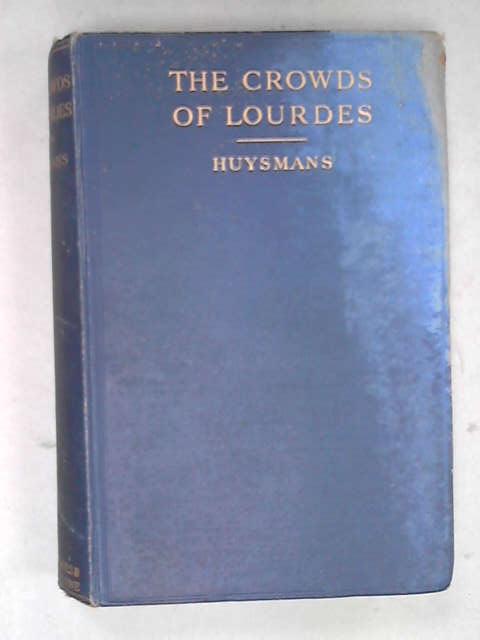
Crowds of Lourdes

http://images.worldofrarebooks.co.uk/1386611978RLG_1.jpg
The Crowds of Lourdes by Joris-Karl Huysmans, translated by William Henry Mitchell, 260 pages

This is Huysmans' account of an extended visit to the great Marian shrine at Lourdes, intended, no doubt, as a counterpoint to Zola's work on the same subject.  In contrast to Zola, who famously declared that even if he saw a miracle firsthand, he would not believe it, Huysmans multiplies accounts of miraculous healings even while frowning upon hysteria and popular fervor.  Utilizing the same powers of description he uses to powerfully evoke medieval artwork in his novels, he presents the hopeful as a cavalcade of human horrors, a veritable Mutter Museum of deformities.  Meanwhile, he turns his jaundiced eye towards the art and architecture of the shrine, and ends by concluding these so debased as to form evidence of a demonic plot against the Virgin.

He does not spend much time relating the story of St Bernadette, except a brief description of her life and character as a pious, but unintelligent and unimaginative peasant girl.  Repeatedly, Huysmans ponders why some find cures at Lourdes while others do not, and he never discovers a satisfactory answer.  The greatest of the miracles he finds at Lourdes, rather, is the spirit of the place itself, the continuing unseen presence there of the Mother of God:

"In this city of our Lady there is a return to the earliest ages of Christianity, a flowering of loving care that will last as long as people are beneath her spell in this haven of her own.  Here you get an idea of a people made up of various fragments, and yet so united as never any people was; they will be broken up tomorrow by departures, but unity will be restored by the arrival of fresh constituents, brought hither by fresh trains, and nothing will be changed; there will be the same devotion and the same patience and faith."

Friday, April 18, 2014

En Route


En Route by Joris-Karl Huysmans, translated by C Kegan Paul, 463 pages

This is Huysman's sequel to La Bas, continuing the story of the semi-autobiographical protagonist Durtal.  Horrified by the events which formed the climax of La Bas, Durtal turns to the Church for spiritual succor, only to find himself repelled both by the mediocrity of the faithful and his own base appetites.  He drifts through an exploration of the churches of Paris, but it is only during a retreat at a Trappist monastery that he is forced to wrestle with his demons.

This is not an ordinary novel - there are no external conflicts or dramatic events (even La Bas had the affair between Durtal and Madame Chantelouve).  The conflict is entirely internal, within Durtal's mind and soul.  The author's Puginesque aestheticism and obsession with the "pure spirit of the Middle Ages" is also sometimes off-putting.  En Route is, however, for those who appreciate its subtleties, an arresting story of grace and redemption.