Wednesday, June 24, 2015

Letters to the Lost


Letters to the Lost by Iona Grey   384 Pages

Forever is finally running out for Dan Rosinski. Now in his 90s, he has been given mere weeks to live. He has only one regret: he was never able to find the woman he fell in love with during World War II. Oh yes, he’s tried hard over the years to find Stella, but she seems to have vanished.

In a parallel story, it’s 2011. Jess Moran is running from her abusive, drug-user/seller boyfriend. She’s escaped and is running through London’s cold rain. She stumbles into a cul-de-sac that seems to have been mostly forgotten. One house in particular looks abandoned. She breaks in through the back.

The story jumps back to 1942 when Dan meets Stella Thorne, a unhappily married woman seeking refuge from the rain in a bombed church.

 Inside the abandoned home, Jess finds Dan’s latest letter, trying to locate Stella. With nothing to do since she’s all alone and on the lam, Jess tries to find Dan and Stella. The she discovers a trove of letters from Dan during what was left of the war. What the reader gets is two love stories. The one between Jess and the real-estate agent, Will, who eventually discovers her living there. Then there’s the one between Dan and Stella.

 Well written, although predictable, the story is a good one. I felt that Jess needed to be more complex that she was portrayed. While I enjoyed the story, I never that urge to hurry home to find out what was happening.
 
I give Letters to the Lost 4 out of 5 stars.  

Robert Peckham

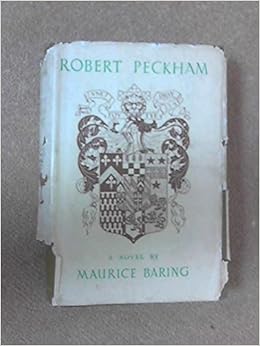
Robert Peckham by Maurice Baring, 279 pages

"Here lies Robert Peckham, Englishman and Catholic, who, after England's break with the Church, left England because he could not live in his country without the Faith and, having come to Rome, died there because he could not live apart from his country."

Reggie Balfour quoted the epitaph of Sir Robert Peckham, found in the Roman church of San Gregorio Magno, in a letter to his friend Maurice Baring in 1899.  Thirty years later, it inspired Baring to base a biographical novel around Peckham, an English aristocrat driven into reluctant, self-imposed exile by the Elizabethan settlement.

Baring did his research thoroughly, and Peckham came from an interesting family.  His father was treasurer under Henry VIII and all of his children - Edward VI, Mary, and Elizabeth.  His quiet dedication and undoubted loyalty and competence helped him weather the political and religious changes that followed each change of monarch.  Robert's brother Henry was less successful, being executed for treason under Mary.  To further spice up his narrative, Baring introduces a love pentangle involving Henry, Robert, his wife, the woman he should have married, and the man who married her.  As the book itself seems to confess, this involves "further details, which to my mind, even if they were necessary, added nothing to what had already been said."

The Shore

The Shore by Sara Taylor  303 pages
 
I’m not sure how to classify Sara Taylor’s debut novel, The Shore. It’s part contemporary fiction, part historical fiction, and part futuristic fiction. Maybe this is one of those times that literary fiction fits the bill. as I was reading, it did remind me of Sherwood Anderson’s classic Winesburg, Ohio.
 
Told in related vignettes, these are the stories of those who live on a remote group of three islands off the coast of Virginia.  At times, the islands have a significant population and at times the population is so low it’s not worth counting. The population makes up three classes of people: the wealthy vacationers, those who work on the mainland, and those who are so poor that those who inhabit the Appalachian Mountains seem rich. However, Taylor focuses her stories on that lowest rung.
 
At the beginning, there is a complicated genealogy chart that became easier to decipher as I read. The first story is about Chloe and Renee. It’s a heartbreaking tale of abuse, poverty, and childhood. Chloe narrates this episode that has a shocking conclusion.
 
After the first narrative, I found it difficult to figure who exactly who was narrating, but usually by the time I read each chapter’s end, I could figure it out. However, (there’s that troublesome word again) in the chapters where the characters did not fit into the family tree, I had no idea who was talking.
 
I will admit that I only read about 10 pages of the last story. It takes place in 2143, and I couldn’t out how the characters fit in; they are not listed on the chart. I don’t feel like I missed anything by passing on the final few pages. 
 
I have mixed feelings about this novel. At times at I LOVED it; at times I HATED it.  That’s why I give The Shore 3 out of 5 stars.
 
 I received this book for free from Blogging for Books for this review.
 

Forever Odd

Forever Odd by Dean Koontz, 334 pages
Cover image for
When Odd Thomas discovers that his childhood friend Danny has been kidnapped and his step-father brutally murdered , he believes Danny's homicidal birth father, recently released from prison, has taken him. Fearing the worst Odd begins to investigate, and is led by his powers on chase through back alleys, water tunnels, and an abandoned hotel casino.

This is the second book of this series and is just as good as the first. The pace and the amount of suspense keep the reader on the edge of their seat, and make it hard to set this book down. I look forward to reading and reviewing the rest of this series. 

Tuesday, June 23, 2015

Ancillary Sword

Ancillary Sword by Ann Leckie
391 Pages

"The sequel to Ancillary Justice, winner of the Hugo, Nebula, British Science Fiction, Locus and Arthur C. Clarke Awards. Breq is a soldier who used to be a warship. Once a weapon of conquest controlling thousands of minds, now she has only a single body and serves the emperor. With a new ship and a troublesome crew, Breq is ordered to go to the only place in the galaxy she would agree to go: to Athoek Station to protect the family of a lieutenant she once knew - a lieutenant she murdered in cold blood."

I actually had this book checked out since November and kept putting it on the back burner, partially because there were no holds and partially because I find it difficult to get invested in Leckie's books right away.  But after the reader gets through the first few chapters the reader is engrossed in the world Leckie has created.  I look forward to her next book which is due out later this year. 

How to Start a Fire

How to Start a Fire by Lisa Lutz
339 Pages


" When UC Santa Cruz roommates Anna and Kate find passed-out Georgiana Leoni on a lawn one night, they wheel her to their dorm in a shopping cart. Twenty years later, they gather around a campfire on the lawn of a New England mansion. What happens in between--the web of wild adventures, unspoken jealousies, and sudden tragedies that alter the course of their lives--is charted with sharp wit and aching sadness in this meticulously constructed novel. Anna, the de facto leader, is fearless and restless--moving fast to stay one step ahead of her demons. Quirky, contemplative Kate is a natural sidekick but a terrible wingman ("If you go home with him, might I suggest breathing through your mouth"). And then there's George: the most desired woman in any room, and the one most likely to leave with the worst man. Shot through with the crackling dialogue, irresistible characters, and propulsive narrative drive that make Lutz's books so beloved, How to Start a Fire pulls us deep into Anna, Kate, and George's complicated bond and pays homage to the abiding, irrational love we share with the family we choose."

The author of the Spellman Files embarks on a different trek with this entry but the narrative voice is very similar to her earlier books.  The format of the book has each chapter jumping around in time which makes it more difficult to follow the story but give enough hints of the present that the reader wants to find out what happened in the past. 

American Ghost

American Ghost by Hannah Nordhaus
320 Pages

"The award-winning journalist and author of The Beekeeper's Lament attempts to uncover the truth about her great-great-grandmother, Julia--whose ghost is said to haunt an elegant hotel in Santa Fe--in this spellbinding exploration of myth, family history, and the American West. The dark-eyed woman in the long black gown was first seen in the 1970s, standing near a fireplace. She was sad and translucent, present and absent at once. Strange things began to happen in the Santa Fe hotel where she was seen. Gas fireplaces turned off and on without anyone touching a switch. Vases of flowers appeared in new locations. Glasses flew off shelves. And in one second-floor suite with a canopy bed and arched windows looking out to the mountains, guests reported alarming events: blankets ripped off while they slept, the room temperature plummeting, disembodied breathing, dancing balls of light. La Posada--"place of rest"--had been a grand Santa Fe home before it was converted to a hotel. The room with the canopy bed had belonged to Julia Schuster Staab, the wife of the home's original owner. She died in 1896, nearly a century before the hauntings were first reported. In American Ghost, Hannah Nordhaus traces the life, death, and unsettled afterlife of her great-great-grandmother Julia, from her childhood in Germany to her years in the American West with her Jewish merchant husband. American Ghost is a story of pioneer women and immigrants, ghost hunters and psychics, frontier fortitude and mental illness, imagination and lore. As she traces the strands of Julia's life, Nordhaus uncovers a larger tale of how a true-life story becomes a ghost story--and how difficult it can sometimes be to separate history and myth."

This isn't really a ghost story.  Instead I would label as a genealogical trek to the past as the author tries to flesh out family myths and assumptions.  The author also made several visits to various mediums and psychics which I felt weakened the book.  

Early Warning

Early Warning by Jane Smiley
475 Pages

"Early Warning opens in 1953 with the Langdon family at a crossroads. Their stalwart patriarch, Walter, who with his wife, Rosanna, sustained their farm for three decades, has suddenly died, leaving their five children, now adults, looking to the future. Only one will remain in Iowa to work the land, while the others scatter to Washington, D.C., California, and everywhere in between. As the country moves out of post-World War II optimism through the darker landscape of the Cold War and the social and sexual revolutions of the 1960s and '70s, and then into the unprecedented wealth--for some--of the early 1980s, the Langdon children each follow a different path in a rapidly changing world. And they now have children of their own: twin boys who are best friends and vicious rivals; a girl whose rebellious spirit takes her to the notorious Peoples Temple in San Francisco; and a golden boy who drops out of college to fight in Vietnam--leaving behind a secret legacy that will send shock waves through the Langdon family into the next generation."

The second of Smiley's trilogy is not quite as strong as the first part mainly due to the sheer number of characters.  I had some difficulty keeping track of who was who as the book went from 1953 to the early 80's. 

Seveneves

Seveneves by Neal Stephenson
867 Pages

" A catastrophic event renders the earth a ticking time bomb. In a feverish race against the inevitable, nations around the globe band together to devise an ambitious plan to ensure the survival of humanity far beyond our atmosphere, in outer space. But the complexities and unpredictability of human nature coupled with unforeseen challenges and dangers threaten the intrepid pioneers, until only a handful of survivors remains . . .; Five thousand years later, their progeny; seven distinct races now three billion strong; embark on yet another audacious journey into the unknown . . . to an alien world utterly transformed by cataclysm and time: Earth."

When the moon explodes humanity must find a way to survive into the future.  Two thirds of the book deals with this struggle over a period of 10 years.  Then suddenly it is 5,000 years later.  There is a lot of science in the book which can be daunting but Stephenson manages to make it interesting.  Good for fans of Sci-Fi.

Last Chain On Billie

Last Chain on Billie: How One Extraordinary Elephant Escaped the Big Top by Carol Bradley
320 Pages

Summary

"Against the backdrop of a glittering but brutal circus world, Carol Bradley's Last Chain on Billie charts the history of elephants in America, the inspiring story of the Elephant Sanctuary and the spellbinding tale of a resilient elephant who defied the system even as she struggled to conquer her past, who never lost sight of the life she was meant to have. Left in the wild, Billie the elephant would have spent her days surrounded by family, free to wander the jungles of Asia. Instead, traders captured her as a baby and shipped her to America, where she learned to carry humans, stand on a tub and balance on one leg - the full repertoire of elephant tricks. For decades, Billie crisscrossed the country, dazzling audiences as she performed breathtaking stunts. But behind the scenes she lived a life of misery: traveling in trucks, chained for hours on end, barely able to move, giving eight-minute performances under harsh lights and to the sounds of blaring music. And worse. Finally, she got a lucky break. As part of the largest elephant rescue in American history, Billie wound up at a sanctuary for performing elephants in Tennessee, able once more to roam through open meadows and share her days with a herd. She would never be beaten again. But, overcome with anxiety, she withdrew from the rest of the elephants and refused to let anyone remove a chain still clamped around her leg. Her caregivers began to wonder if Billie could ever escape her emotional wounds. The compelling story of Billie's battle to reclaim her old self is a testament to the intelligence, emotional complexity and remarkable strength of all elephants, captive or free."

The book is less about Billie and more about all elephants in captivity both in circuses and in zoos.  Each chapter tells the story of Billie followed by a section recounting the history of elephants in America and in circuses.  The book was actually hard to read at times because of the sheer cruelty places upon elephants which studies have shown to have complex and long-reaching family structures.  

Inside the O'Briens

Inside the O'Briens by Lisa Genova
343 Pages

" Joe O'Brien is a forty-four-year-old police officer from the Irish Catholic neighborhood of Charlestown, Massachusetts. A devoted husband, proud father of four children in their twenties, and respected officer, Joe begins experiencing bouts of disorganized thinking, uncharacteristic temper outbursts, and strange, involuntary movements. He initially attributes these episodes to the stress of his job, but as these symptoms worsen, he agrees to see a neurologist and is handed a diagnosis that will change his and his family's lives forever: Huntington's Disease. Huntington's is a lethal neurodegenerative disease with no treatment and no cure. Each of Joe's four children has a 50 percent chance of inheriting their father's disease, and a simple blood test can reveal their genetic fate. While watching her potential future in her father's escalating symptoms, twenty-one-year-old daughter Katie struggles with the questions this test imposes on her young adult life. Does she want to know? What if she's gene positive? Can she live with the constant anxiety of not knowing? As Joe's symptoms worsen and he's eventually stripped of his badge and more, Joe struggles to maintain hope and a sense of purpose, while Katie and her siblings must find the courage to either live a life "at risk" or learn their fate."

A compelling novel, almost as good as Still Alice.  I would highly recommend.

The Mysterious Island

The Mysterious Island by Jules Verne, 493 pages

Cover image for During the Civil War five Union prisoners escape from Richmond in a balloon however they are blown off course and crash on an uncharted island in the middle of the Pacific. On the island the castaways must learn how to survive, their only possessions are the clothes are their back. 

This was quite an enjoyable book with just enough excitement to keep the story going. Verne also does a great job of taking the time to explain in detail how the castaways are able to do what they do, as well to provide a detailed description of the island. This book is easily worth reading if you don't mind a bit of technical language used.

Monday, June 22, 2015

Study of Man

The Study of Man by Michael Polanyi, 102 pages

The written compilation of a series of lectures given by Polanyi at the University College of North Staffordshire in 1958, these essays serve as an addendum to his book Personal Knowledge.  Primarily, they serve as a brief introduction to some of the epistemological theories elaborated in the book, and a subsequent argument for the unity of the natural sciences, social sciences, and historical scholarship.

Polanyi establishes a logical hierarchy, with parts lower than wholes, and with inanimate objects below subrational animals and animals below rational human beings.  Higher levels require greater understanding, a more complex and intimate relationship between subject and object.  As rational creatures, the persons studied by historians are subject to respect and reproach, but only with the proper qualifications necessary to avoid presentism and relativism.

An interesting contribution to a seemingly obscure discussion, the results of which carry considerable ramifications for the place of the humanities in the modern academy.

Friday, June 19, 2015

Felicities

Felicities by Thomas Traherne, edited by Sir Arthur Quiller-Couch, 114 pages

Thomas Traherne was one of the 17th century Metaphysical poets.  An Anglican priest, he lived and died in obscurity, but his unpublished works were discovered in manuscript form in the late 19th century.  Upon publication, they established their author's reputation as a remarkable poet and mystic, a 17th century forerunner of figures like Blake and Hopkins.

Felicities is an amalgamation of selections from Traherne's works, primarily Poems of Felicity and Centuries of Meditations, chosen and organized by Quiller-Couch into loose thematic groups.  It is a tribute to the sensibility of the editor that this succeeds, giving good tastes of Traherne's poetry and spirituality.  While Traherne is not the equal of Donne or Herbert either aesthetically or intellectually, he certainly deserves better than to be forgotten.

Thursday, June 18, 2015

Vision in Silver

Vision in Silver by Anne Bishop
400 Pages
 "The Others freed the Cassandra Sangue to protect the blood prophets from exploitation, not realizing their actions would have dire consequences. Now the fragile seers are in greater danger than ever before--both from their own weaknesses and from those who seek to control their divinations for wicked purposes. In desperate need of answers, Simon Wolfgard, a shape-shifter leader among the Others, has no choice but to enlist blood prophet Meg Corbyn's help, regardless of the risks she faces by aiding him. Meg is still deep in the throes of her addiction to the euphoria she feels when she cuts and speaks prophecy. She knows each slice of her blade tempts death. But Others and humans alike need answers, and her visions may be Simon's only hope of ending the conflict. For the shadows of war are deepening across the Atlantik, and the prejudice of a fanatic faction is threatening to bring the battle right to Meg and Simon's doorstep.."

The third novel of the series is repetitive and slow moving.  We don't need to be told of the main characters motivations the 20-25 times Bishop insists on using throughout the book.  There is no big plot development until the last few pages and then of course we are left hanging. 

Midnight Riot

Midnight Riot by Ben Aaronovitch
310 Pages

"Probationary Constable Peter Grant dreams of being a detective in London's Metropolitan Police. Too bad his superior plans to assign him to the Case Progression Unit, where the biggest threat he'll face is a paper cut. But Peter's prospects change in the aftermath of a puzzling murder, when he gains exclusive information from an eyewitness who happens to be a ghost. Peter's ability to speak with the lingering dead brings him to the attention of Detective Chief Inspector Thomas Nightingale, who investigates crimes involving magic and other manifestations of the uncanny. Now, as a wave of brutal and bizarre murders engulfs the city, Peter is plunged into a world where gods and goddesses mingle with mortals and a long-dead evil is making a comeback on a rising tide of magic."

The start of a promising series, I enjoyed the setting created by the author and the characters.  There is plenty of room for future development and I look forward to reading the next installment.

The Demographic Cliff

The Demographic Cliff: How to Survive and Prosper during the Great Deflation of 2014-2019 by Harry S Dent, Jr.
357 Pages

"Bestselling author and financial guru Harry Dent shows why we're facing a "great deflation" after five years of desperate stimulus -- and what to do about it now Throughout his long career as an economic forecaster, Harry Dent has relied on a not-so-secret weapon: demographics. Studying the predictable things people do as they age is the ultimate tool for understanding trends. For instance, Dent can tell a client exactly when people will spend the most on potato chips. And he can explain why our economy has risen and fallen with the peak spending of generations, and why we now face a growing demographic cliff with the accelerating retirement of the Baby Boomers around the world. Dent predicted the impact of the Boomers hitting their highest growth in spending in the 1990s, when most economists saw the United States declining. And he anticipated the decline of Japan in the 1990s, when economists were proclaiming it would overtake the U.S. economy. But now, Dent argues, the fundamental demographics have turned against the United States and will hit more countries ahead. Inflation rises when a larger than usual block of younger people enter the workforce, and it wanes when large numbers of older people retire, downsize their homes, and cut their spending. The mass retirement of the Boomers won't just hold back inflation; it and massive debt deleveraging will actually cause deflation--weakening the economy the most from 2014 into 2019. Dent explores the implications of his controversial predictions. He offers advice on retirement planning, health care, real estate, education, investing, and business strategies. For instance . . . BUSINESSES should get lean and mean now. Identify segments that you can clearly dominate and sell off or shut down others. If you don't, the economy will do it for you, more painfully and less profitably.INVESTORS should sell stocks by mid-January 2014 and look to buy them back in 2015 or later at a Dow as low as 5,800.FAMILIES should wait to buy real estate in areas where home prices have gone back to where the bubble started in early 2000.GOVERNMENTS need to stop the endless stimulus that creates more bubbles and kills the middle class, and should assist in restructuring the unprecedented debt bubble of 1983-2008. Dent shows that if you take the time to understand demographic data, using it to your advantage isn't all that difficult. By following his suggestions, readers will be able to find the upside to the downturn and learn how to survive and prosper during the most challenging years ahead."

An interesting take and I don't know if it will become true.  However as an individual, the book doesn't give much to the reader on how to personally take care of themselves during the predicted downturn.

Fool’s Errand

Fool’s Errand by Robin Hobb, 662 pages


This is the start of a new trilogy called The Tawny Man, but it picks up the story of FitzChivalry from the Farseer Trilogy fifteen years later.  Fitz is being called back into service by the Farseers, this time to help the young prince, Dutiful, who doesn’t even realize how much help he needs.  The prince needs a teacher for both the Sight and the Wit, but unfortunately, he has disappeared and Fitz and the Fool, now disguised as Lord Golden, must hunt him down.  This was a terrific story, although a little bit sad, but I loved it and would definitely recommend Hobb’s books to anyone who enjoys fantasy.

Scorpion Mountain

Scorpion Mountain by John Flanagan, 451 pages


This is the fifth book in the Brotherband series.  Truthfully, I can’t get enough of this author.  Every book he writes is just as good as the last one.  Although they are a little long, they are actually pretty quick reads and books that I would definitely recommend to boys who like adventure, especially who also like humor.  In this story Hal and his group have set out to try to help the Ranger Gilan cancel a death contract that’s out for Princess Cassandra of Araluen.  This involves fightinf their way through more than large group of people, but also invlolves bearding the leader of a dangerous cult inside Scorpion Mountain.  This was a thoroughly entertaining story.

The Bane Chronicles

The Bane Chronicles by Cassandra Clare, Sarah Rees Brennan & Maureen Johnson, 507 pages


This is a collection of short stories about Magnus Bane, featured warlock in The Mortal Instruments and The Infernal Devices series.  The stories are fun and really give us an inside look into Magnus’s life.  Clare wrote the stories, sometimes with just one of the other women and sometimes with both, but all of the stories sound mostly like Clare’s voice.  The stories start as early as the 1700’s and relate Magnus’s adventures in various countries, and come up to present day, as he is when we meet him in the series.  I almost liked this book better than any of the books in the series, actually, so I would definitely recommend that fantasy fans read it and any teens who have read the series will absolutely want to read this also.