Saturday, December 27, 2014

Millennials & management : the essential guide to making it work at work

Millennials & management : the essential guide to making it work at work by Lee Caraher
203 Pages


Not surprisingly, the book is about managing employees that fall within Generation Y.   This includes determining their motivations, learning how to train them to meet expectations, etc.  Most of the information and advice given is self evident and the book is aimed toward Baby Boomer generation managers rather than Generation X managers.  However, there were a few tidbits I found to be useful, including working with the employee to find out what they wanted to gain in experience during their tenure at the job.  This is based on the assumption that Millennials aren't looking for long-term development at one position but ready to move along toward more money when the opportunity arises.


Wanna Cook?

Wanna Cook?: The Complete, Unofficial Companion to Breaking Bad by Ensley F. Guffey + K. Dale Koontz, 433 pages

I kept hearing people talk about Breaking Bad, but I didn't start watching it until it was almost over on television. It is as addictive as the meth that is cooked on the show. Seriously. I love Bryan Cranston and he was phenomenal in this series. So of course, when I saw that this companion existed, I had to read it. It is very detailed, with a chapter dedicated to every episode, explaining characters, plot, etc. It outlines things to watch for in the episodes, brings your attention to cinematography and themes, as well as any errors in the episodes. All this, and the authors are very careful not to give away too much for those who might be reading this before actually having seen the episodes. There are a few specific sections that do contain spoilers, but they tell you this up front.
This book is a must-read for anyone who obsessively watched this show and wants a little extra to think about when going back and obsessively re-watching the episodes. Which I might have done. Maybe.

Catholicism

Catholicism: Christ and the Common Destiny of Man by Henri de Lubac, SJ, translated by Lancelot C Sheppard and Sister Elizabeth Englund, OCD, 369 pages

By the middle of the twentieth century it had become commonplace for Christianity to be criticized, especially by those who sought to force the world into a utopia of their own imagining, as an excessively otherworldly belief system which disdained earthly communities.  Indeed, Christianity, with its emphasis on individual salvation, was alleged to be corrosive to the well-being of society.  This criticism was given added plausibility by the weight of centuries of bourgeois individualism shaping Christian practice.

Jesuit theologian de Lubac responds by reaching back to before the modern era to demonstrate the importance of solidarity in the Catholic understanding of redemption.  Drawing upon an impressive range of patristic texts, he explicates the Church's understanding of itself as the means by which Christ draws all men to Himself in an ongoing saga of salvation.  This social dimension of the Church not only responds to modern criticism, it also illuminates the Church's understanding of other religions and the historical economy of salvation.

A triumphant exposition of the saying of St Gregory the Great, "In Holy Church each bears the other and is borne by him."

(I read a personal copy of the Ignatius Press edition.  St Louis Public Library does not own this, but does have a 1958 Sheed and Ward edition with the alternate title Catholicism: A Study of Dogma in Relation to the Corporate Destiny of Mankind)

Wednesday, December 24, 2014

The Getaway God

The Getaway God by Richard Kadrey
387 Pages


James Stark, also known as Sandman Slim has spent time as Lucifer, fought the forces of good and evil and is once again called upon to save the world as the gods who originally owned it try to come back into the universe.  If he fails it will be the end of humanity. 

The sandman slim series is okay, it was originally recommended as a possible substitute for people who couldn't wait for the next Jim Butcher Harry Dresden book to come out.  While there are some similiarities, it is a poor man's substitute.

Tuesday, December 23, 2014

The Glory of Christendom

The Glory of Christendom by Warren H Carroll, 713 pages

The third volume in Carroll's History of Christendom series begins with the first Cistercian monks building a monastery in the wilderness, and ends with an Augustinian monk nailing a manifesto to a door.  In between the Kingdom of Jerusalem evaporates, the Byzantine Empire declines and falls, the great Gothic cathedrals are built, universities and hospitals are founded, the plague kills, the Church is riven by schism, and Prince Henry the Navigator and Christopher Columbus open the Age of Discovery.  Throughout appear a leaven of saints, the commanding St Bernard and the scholarly St Thomas Aquinas, the militant St Joan of Arc and the equally fierce St Catherine of Siena, and above all the towering figures of Sts Dominic and Francis.

There are definite differences between this third book and its two predecessors in the series.  Carroll replaces the abundant notes that formerly closed each chapter with terser footnotes, yet the book is half again as long as the previous volumes.  More problematically for some readers, as the series progresses it increasingly becomes a specifically Catholic Christian history and decreasingly a generically Christian history.  Carroll is no simple-minded partisan, but he does wear his Catholicism on his sleeve.  Finally, although this book is half-again as long as its predecessors, there is no room in its packed pages for anything more than the most cursory summary of artistic and philosophical developments, due to its concentration on political and hagiographical material.

This is the central book in the six volume series, not only sequentially but thematically.

Monday, December 22, 2014

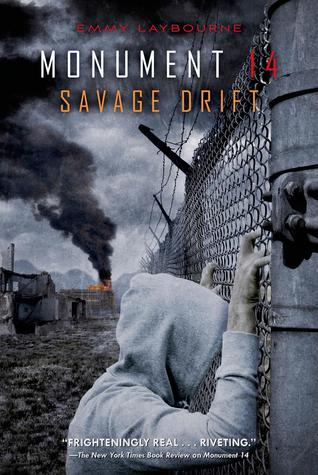
Savage Drift

Savage Drift, by Emmy Laybourne, 306 pages

Savage Drift (Monument 14, #3)In the final book of the Monument 14 trilogy, most of the kids have found themselves in a safe place in Canada.  But Josie is trapped in a Missouri prison for Type O's, Astrid is convinced the military has an unhealthy interest in her pregnancy, and Dean and Jake cannot stop fighting over Astrid's affections.  So another road trip begins. It's always nice to see an end to a trilogy that sort of feels like it could have ended at least one book ago, but this one felt way too tidy for my tastes.   This is a good read-alike for fans of post-apocalyptic fiction,though,  especially if you like Mike Mullin's Ashfall series.

Bangkok 8

Bangkok 8 (Sonchai Jitpleecheep #1)Bangkok 8, by John Burdett, 336 pages

I'm always trying to expand my RA skills by reading outside of my usual "zone," and I was glad I did with this one.  This is the first in a series of mysteries that take place in Bangkok, Thailand, and features a Buddhist police officer named Sonchai Jitpleecheep.  This is just such a sensory immersion in the "real" heart of Bangkok- from transsexuals and prostitution, to drugs and murder, no topic is untouched.  All of these are part of the investigation Sonchai must undertake when his best friend and partner is murdered.  I think that Burdett did a pretty good job of discussing police corruption and prostitution in a sympathetic manner while also leaving enough unknown that the reader will want to continue with this series.  Also, I really want to go to Thailand now.

Treasure Island

Treasure IslandTreasure Island, by Robert Louis Stevenson, 311 pages

I realized that the only version of Treasure Island or A Christmas Carol that I was really familiar with were both the Muppet versions... so I am attempting to change that.  Step one was reading the original Treasure Island.  And while it shouldn't be hard to imagine, seeing as it's a classic and all, this book actually stands up to the test of time (mostly).  Young Jim Hawkins finds himself in possession of a treasure map- and there the seafaring and pirate adventure begins.  It's interesting to read this and realize how many current pirate tropes truly originated in this one work- sort of like reading Dracula and realizing its long-lasting effects.  There are quite a bit of nautical and ship terms thrown about that my eyes kind of glazed over in response to, but this is an approachable work of classic fiction for those looking to read an older book.  Also, it's one of those that you can read for free via Project Gutenberg (which is where I read it, so this book cover and pages are an approximation made courtesy of goodreads).

Intuition

IntuitionIntuition, by Allegra Goodman, 385 pages

Cancer research can be a cut-throat field, with everyone looking to make the next big breakthrough.  But what is a breakthrough if it can't be reproduced?  This was an interesting, if not totally enjoyable, work of fiction about characters working in a research laboratory.  Cliff's tests start showing amazing results, but Robin, his ex-girlfriend and fellow scientist, has a feeling that all is not what it seems.  This book has alot of great character studies, it raises many good discussion questions regarding intuition in the field of science and out, and was praised by many in the science field for its ability to make the not-so-glamorous process of science research so accessible to lay readers.  It would make for good book discussion if your group can get past the first 100 pages.
Sidenote: this is terrible cover art for this book- it does not reflect in any way the contents of the book.

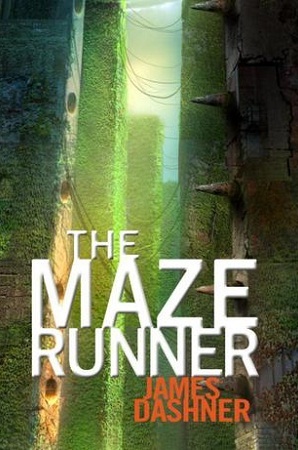
The Maze Runner

The Maze Runner (Maze Runner, #1)The Maze Runner, by James Dashner, 374 pages

Thomas wakes up with no memory, in the middle of a strange place and surrounded by a group of boys with the same issue.  They are in a closed-in area surrounded by tall walls- the middle of a maze full of deadly creatures and danger, and the only way out is to solve the maze. Thomas' arrival starts a series of changes in the community, and not all are for the better.  This is the first book in a trilogy (or what do you call it when a trilogy has a prequel? shrug.), a movie was made out of it, and it has a teen male protagonist, for those hoping to engage a reluctant male reader.  I thought that it was not very good at all, full of lackluster explication, weak language, and a story that did not feeling compelling.  But to each their own.

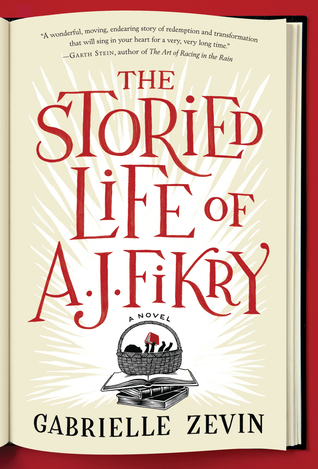
The Storied Life of A.J. Fikry

The Storied Life of A.J. FikryThe Storied Life of A.J. Fikry, by Gabrielle Zevin, 260 pages

This is one of those books that I recommend reading if you work in a library/around books/in a bookstore.  You'll like some of the references and inside jokes.  A.J. Fikry is recently widowed, probably an alcoholic, and having a hard time running his independent bookstore in New England.  He comes home one night to find a baby has been left in his store, his retirement plan has been stolen, and his life changes overnight.  It has all of the markers of a typical "Hallmark" story- there's a quirky shop owner, a blooming romance, and reading has the power to change lives.  Despite that, though, I thought it managed to steer clear of sappy territory, and provide bits and pieces of poignancy, humor, and literary discussion.  It would make a good book for discussion groups.

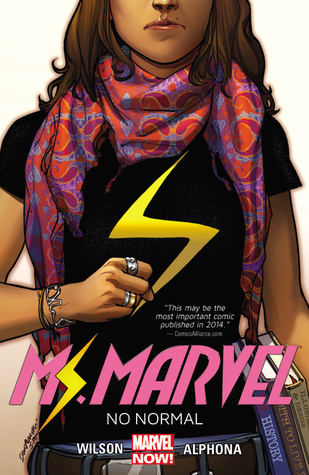
Ms. Marvel Vol 1: No Normal

Ms. Marvel Vol 1: No Normal, by G. Willow Wilson, ill by Adrian Alphona, 120 pages

Ms. Marvel, Vol. 1: No NormalI am so excited by this new Marvel incarnation- Kamala Khan is a Pakistani-American teenager who gets super-powers and takes on the moniker of Ms. Marvel.  Is it a great story?  Not more so than the usual Marvel series.  But I get so pumped when I see a comic book featuring a character who is not cut from the traditional comic hero cloth.  She is a "she," she is Muslim (the first Muslim to have her own comic book series, says Wikipedia), not white, daughter of immigrants, the main plot is not about meeting a guy, and the depiction of her is just so honest.  Kamala Khan wants to be a good Pakistani daughter, and she wants to abide by her family's rules, but when she obtains great powers, she remembers that the Quran states that "whoever has saved one person, it is as if he has saved all of mankind."  Talk about feeling torn.  I don't feel the need to finish out this run, but it is so refreshing to know that it exists.  I would encourage young women interested in comics to check this out.

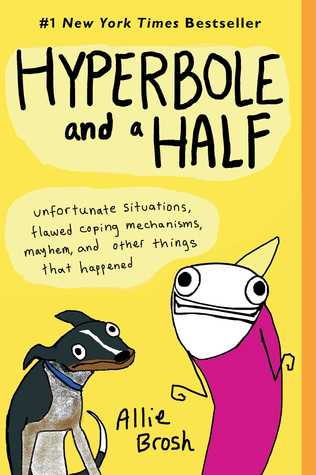
Hyperbole and a Half: Unfortunate Situations, Flawed Coping Mechanisms, Mayhem, and Other Things That Happened

Hyperbole and a Half: Unfortunate Situations, Flawed Coping Mechanisms, Mayhem, and Other Things That Happened, by Allie Brosh, 369 pages
Hyperbole and a Half: Unfortunate Situations, Flawed Coping Mechanisms, Mayhem, and Other Things That Happened
Oh my glob- have you ever read a book where once you were finished, you thought "This author GETS it" ? That's kind of how this was for me.  It was hilarious and heartwarming and just a wonderful escape.

This book is a collection of written/illustrated short pieces by Allie Brosh, most of which were featured on her blog . The topics range from her dogs and their idiosyncrasies, to depression, to her inhuman, childhood need for sugar.  This book is hilarious, but not in a cheap joke sort of way- in a way that you have to go along with her for the ride.  The illustrations may be a turn-off at first for some people, but if you stick with it, you'll realize that they are perfect.

Sort of unrelated, but the humor in here reminded me of Maria Bamford's standup, if you're a fan of either.

The Strange Library, by Haruki Murakami


The Strange Library, by Haruki Murakami, 96 pages
The Strange LibraryThis is a lovely little work of fiction- if you are a sucker for book design, as I am, you might want to check this out just for that.  The book has an interesting cover design, and is full of illustrations that I found fascinating.  (Sidenote: I did a search for Murakami's illustrations, and there's at least one edition with completely different, but also cool, illustrations.  Interesting.)  Story-wise, though, I had to just read this like some kind of a transcription of a child's dream. A boy who has trouble standing up for himself finds himself in a part of the library he never knew existed... That's about all that can be said without revealing the whole story.  This is one of those books that after you read it, you kind of wish you had a friend to talk it over with.  I was left with more questions than anything.                                                                                                                                                                                                  

From Flanders to Florence


Cover image for By the end of the Renaissance, a narrative was established which has dominated art history ever since, that Italy, and especially Florence, was the undisputed capital of art, and that the new artistic styles of the Renaissance were virtually entirely derived from classical models.  Flemish painting might be beautiful, but its beauty was the product of a mastery of color and technique, inferior "crafts" compared with the "art" of design which was the heart of the Italian achievement.  Northern works might stimulate emotion, but they lacked the intellectual content of Italian art.

Nuttall overturns this conventional wisdom with an in-depth exposition of the trade networks and cultural exchanges which brought Flemish art into fashion in Quattrocento Italy, and the many ways in which the examples of Northern works influenced Italian artists, both in what they imitated and in what they rejected.

Friday, December 19, 2014

Art and Scholasticism

Art and Scholasticism with Other Essays by Jacques Maritain, 114 pages

In his short but influential essay "Art and Scholasticism", Maritain applies the tools of scholastic philosophy to the problems of art and aesthetics.  The result is a careful examination of the relationships between art and truth, art and goodness, and art and man.  In Maritain's analysis, the artist mimics the Creator in the work of incarnating the spiritual in the physical, a work which can be undertaken with saintly humility or Luciferian pride.

This collection also includes "The Frontiers of Poetry", which considers the metaphysical nature of poetry, and "Some Reflections Upon Religious Art", which addresses problems which arise when art is self-consciously religious.

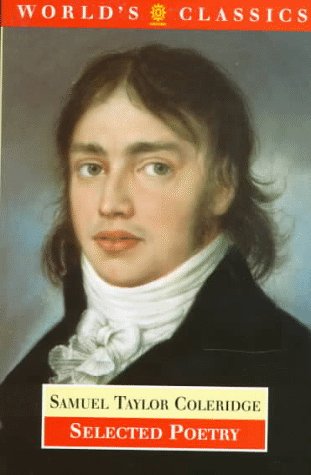
Selected Poetry

Selected Poetry by Samuel Taylor Coleridge, 153 pages

Throughout his poetic career, Coleridge was compared to and overshadowed by Wordsworth, and it's not difficult to understand why.  Especially in his earlier poems, Coleridge's use of deliberately antique (even for its time) language detracts rather than adds, and he seems to have often left promising projects unfinished, perhaps as a result of his personal struggles.  Unfortunately, as he matured his productivity correspondingly slackened.  Still, he gave us "The Rime of the Ancient Mariner", "Christabel", "Kubla Khan", and "The Nightingale", as well as other works of enduring beauty and power.  Like his most famous poem, however, his poetry as a whole is ultimately haunted by what might have been.

Thursday, December 18, 2014

Soldier Dog

Soldier Dog by Sam Angus, 246 pages

A very sweet but also terrible story about a boy named Stanley, who, after losing his dog, feels like he has nothing left.  He leaves home and joins the army at 14, during World War I.  He ends up in the division handling Messenger Dogs, a new idea for the British army.  They are responsible for training the dogs to carry messages between battle lines.  The dogs must be able to complete their task, despite cannons and bullets and all of the other chaos erupting around them.  Their handlers stay with them through training into the field.  Stanley, although only 14, is actually a good soldier and an even better dog handler.  His superiors can see that he is young and try to avoid sending him to the lines in France, but Stanley and his dog are needed, so off they go.  Although this particular story is fictionalized, some of the action is based on a real Messenger Dog, Jack, who saved his battalion and earned a Victoria Cross, although he died in the course of his duties.  This is a good story for kids who like animal or war stories or historical fiction.

On A Clear Day

On A Clear Day by Walter Dean Myers, 244 pages


I honestly didn’t enjoy this book a lot.  Maybe the knowledge that this would be Myers’s last book spoiled it for me.  This is a story told in a not too distant future, of a world that has basically been taken over by technology and a conglomerate of corporations called the C-8.  They control the food production, energy resources, media, money, etc.  Most people live in gated communities, some better than others, but the people who are worst off are simply living on the streets.  Some people are part of gangs, trying to get by.  Dahlia is a girl who has been approached by a small group of older teens and young adults who want to help put a stop to C-8’s activities.  The group is idealistic and has good ideas but is that enough when dealing with something as large as the C-8?  The idea behind this story was really good but the execution fell a little flat for me.  The characters seemed kind of one dimensional, especially the more peripheral characters.  I didn’t feel like it was Myers’s best work, but fans of his other books and fans of dystopian stories may want to check out this book.

Splintered

Splintered by A.G. Howard, 371 pages


Alyssa is descended from Alice Liddell, otherwise known as Alice in Wonderland.  The women in her family, starting with the original Alice, have all eventually gone mad.  The year that Alyssa hit puberty, she started hearing bugs and flowers talking to her.  Afraid of what her father might think, especially since her mother has been in an asylum since Alyssa was five, she tells no one.  Now, Alyssa is about to be a senior in high school and is coming to find out that Wonderland is all too real and she has to fix the trouble that Alice caused during her visit to break the curse that the women in her family have been under all of these years.  I thought this was a pretty good Wonderland spin-off, a lot darker than the original story with a little bit of a surprise twist at the end.  Recommend this to teens that like fairy tale retellings.