Tuesday, August 22, 2017

National Geographic Kids Weird But True! Human Body: 300 Outrageous Facts About Your Awesome Anatomy

National Geographic Kids Weird But True!  Human Body: 300 Outrageous Facts About Your Awesome Anatomy          Paperback Book:  206 pages          

Another excellent job by National Geographic.    You will learn so many things, well, 300 as advertised in the title about the human body, some you may have heard before, many you likely will not have heard about.   I love these books!   I love to learn new things and I always come away with several new wrinkles in my brain from this series of books.   By the way, you will learn in this book that if you could flatten all the wrinkles out of the brain it would be the size of a pillowcase.   I learned your body gives off light you can’t see, so I am thinking the aura but no the body actually produces light from some of the microns inside you just like the fish that produce light from their bodies in the deep sea its just that human eyes aren’t sensitive enough to see it which is mostly concentrated around the face and neck so when someone tells you that you are glowing, you really are.    It has been scientifically proven that children who are allowed to move around during Spelling and Math tests have better scores than those who sit at their desks.   Maybe to ease the stress?   Teachers might want to encourage that although I’m thinking it might take a progressive curriculum to get away with that.  Lots of interesting finds here like scientists have mapped 97 new areas of the brain,  watching bright lights before getting on a plane eliminates jet lag, your lungs change color as you age, ad infinitum.   A wealth of knowledge in this series of books and they will really be eye openers, oh yeah that little fold in the inner corner of your eye is thought to be the remnants of a third eyelid.   I love this stuff!

Monday, August 21, 2017

Power of Silence

The Power of SilenceThe Power of Silence: Against the Dictatorship of Noise by Robert Cardinal Sarah with Nicholas Diat, translated by Michael J Miller, 244 pages

In this remarkable book-length interview, Cardinal Sarah launches an assault against the "empire of noise" that, he warns, threatens to colonize our minds and souls.  Sarah's message is equal parts admonition, exhortation, and challenge.  In his view, modern man is sunk in a sea of noise both as the result of his membership in a society driven by mass consumerism and as a deliberate choice to narcotize himself from the problems of thought.  As the power of noise has grown, so our public life has become increasingly dominated by the "raving madness" of demagogues and activists.  Meanwhile, the "buffered self" is insulated against the transcendent by a cocoon of noise.  Truth, goodness, and beauty cannot be seized - they must be received, and this requires contemplation, and contemplation requires silence.  Modern man's bottomless appetite for novelty alienates him from the eternal and enslaves him to the ephemeral.  

Worse still is modern man's sense that he himself must be a noisemaker, the consequence of a fixation on action at the expense of contemplation, on doing at the expense of being.  This preoccupation extends even to prayer and the liturgy, driving out all sense of mystery and the sacred with banal talk and insipid music.  Cardinal Sarah finds in the silence of the Divine the meekness of God and the root of human freedom.  In silence we participate in the silence of the Incarnation, of Bethlehem, Nazareth, and Gethsemane, the silence before the Sanhedrin, Herod, and Pilate, and finally the silence of the cross and the tomb, and in that silence we encounter a God who suffers with us and for us.  Silence is at the heart of communion and therefore of all authentic community - it is in silence that we offer ourselves and in silence that we accept what is offered us.

Saturday, August 19, 2017

Strange Weather

Strange Weather: four short novels by Joe Hill.  Due out October, 2017. I read an e-galley.  448 pages

I had previously gotten part-way through my print galley of this book before I gave it away to someone --- so I downloaded the e-galley so I could keep reading.  I had been partway through the second story and couldn't wait until October, and I'm really glad I didn't wait.

I already wrote about the first story, "Snapshot," which was great. The second story, "Loaded," is about a mall security guard who courageously stops a mass shooting and becomes a hero to the modern gun rights movement. However, did he really stop a mass shooting?  The reader knows, because you get his perspective, but you also read along as a reporter starts to uncover more about him and unravel his story.  No spoilers, but the ending was not quite what I thought it was going to be (although perfectly in line with what I guess I would expect).

The third story, "Aloft," gives us a young man who is about to experience his first parachute jump (which he really doesn't want to do). When he jumps, he winds up a castaway on what appears to be a solid cloud. Obviously, though, it's not a cloud. But what is it, and why does it seem to have a mind of its own?

The last story, "Rain," is pretty scary. On a seemingly ordinary day in Boulder, Colorado, the skies open up and there's a downpour.  Not of rain, though, but razor-sharp crystalline splinters. Shredding the skin of anyone who doesn't take cover, these shards wreak havoc on people, animals, planes, and more.  This story is about an escalating event, and I found it to be the most somewhat realistic and thus the scariest.

Great book, and just as enjoyable as I had hoped it would be.

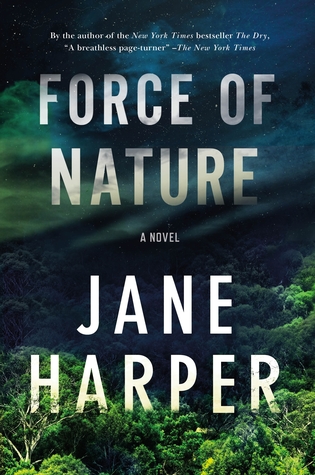
Force of Nature

Force of Nature by Jane Harper.  (Aaron Falk, #2).  Due out February, 2018.  320 pages   I read a galley.

On a business retreat in the wilderness, five women reluctantly pick up their backpacks and start down a trial. By the time they reach the other side, only four women remain. Just what happened on this hike that was supposed to teach team building and resilience? Did one woman wander off by herself or did something more sinister happen between this group? Federal Police Agent Aaron Falk has a sharpened interest in the case, since Alice, the missing woman, happens to be the whistleblower in his latest case. However, when he starts to talk to the four remaining women, he discovers that instead of a hike that encouraged teamwork, there was suspicion, disintegrating trust and violence among them. Just where is Alice Russell? And will she be alive when she's found?

Told with a keen sense of crafting a setting that is a character unto itself, combined with a steadily increasing pace and suspenseful tone, this book captures both the panic felt by the women on the hike, as well as the increasing suspicion and dread that follows the investigation into Alice's disappearance. Immersive to the point where you close the book and blink, surprised to find that you're not in the Giralang Ranges.


I have not read the first Aaron Falk book, but will remedy that soon. I enjoyed this one and would now like to go back and learn about his character. Despite the fact that this is the second book, I never got a sense that I had no idea who this guy was, or that I needed a lot of background on him. Instead, the story about the women and the suspense about what happened to Alice was what really kept me reading.

Hunger: A memoir of my body

Hunger: A memoir of my body by Roxane Gay.   320 pages.  Audiobook 5 discs (6 hours)

“I ate and ate and ate in the hopes that if I made myself big, my body would be safe. I buried the girl I was because she ran into all kinds of trouble. I tried to erase every memory of her, but she is still there, somewhere. . . . I was trapped in my body, one that I barely recognized or understood, but at least I was safe.”

I had previously read this book and posted my review.  I enjoyed the book so much that I checked out the audiobook, which is read by the author.  It was interesting listen to her read her own book, and also listening made parts of the book sink in even more.  Admittedly, I'm a fast reader and can, if the book is good enough, proceed at "whip" speed.  By listening to Gay read, I really was able to go at her pace, and listening made the book into a different experience than when I had read it.  The vulnerabilities that she exposes in the book are even more so when you listen to her reading her own words. The emotional qualities that come through in an audiobook just enhance the experience --- which meant that at times, I had to turn off the book and switch to some music, just so I could take time and digest what she had been reading.


National Geographic Kids Ultimate Weird But True! 3:

National Geographic Kids Ultimate Weird But True! 3:  1,000 wild & wacky facts & photos by the National Geographic Society        Hardback Book:  192 pages    

What a fun book to read!   Man!   You see the coolest things world-wide in great photographs and learn so many interesting facts you could host your own Trivia Night.    Excellent stuff here any one young, teen, adult, senikor all will love what you find here.    And this is 3, I have got to read the first 2 and are there more?   I’m totally hooked.   What a great book, seriously.   There is this amazing 49 foot tall Mother Nature living sculpture in Montreal Canada that looks like the dear lady could rise up and walk.   Gorgeous, complete with 13 foot waterfall cascading from her right hand.   There are glass frogs with green bones that are see-through as well as several other “glass” creatures shown here.  Who knew John Quincy Adams had a pet alligator?  Or that the Obamas keep bees (70,000 when this book went to press).   You may have heard the Eiffel Tower gets struck by lightning about 30 times a year but did you know there are lightning rods fitted to its top.  Metal cables conduct the lightning strikes powerful charge deep into the ground where the earth which is a poor conductor makes the charge and the heat harmless.   Whew!  Merci, mon Dieu!    We knew owls can swivel their heads but did we know they can do it to 270 degrees because they have specially adapted bones and blood vessels?   Hmmm?    Or that a platypus (the plural is platypodes – who knew, right?) closes its eyes and ears when it swims and picks up electrical impulses from its prey in the water that guides it right to its dinner?    I know!   Don’t you love this stuff?  Me, too!    The Dragon Bridge in Da Nangm, Vietnam actually breathes real fire from its mouth!  Cool, huh?   The Moses Bridge in Fort de Roovere, the Netherlands is built in such a way that goes below the water level (but the people stay dry) and the water is right there on either side giving the visual effect that the people crossing are experiencing a parting of the water (hence Moses).   That would be pretty freaky.   I would be hoping that the water on either side wasn’t very deep just in case it started spilling over.  But hey, it does look really cool.   There are 10 times more bacterial cells than human cells in our bodies – 500 different kinds of bacteria live in our mouths alone!  But most of the bacteria we carry around (the freeloaders!) is good for us so it’s not all bad.   A farmer in England bit a bi furry car in the shape of a sheep herding dog that is not street legal but he actually uses it to herd his sheep it looks like “MOM” from the film, “Babe.”     I love this book!

The 21 Day Financial Fast

The 21 Day Financial Fast: Your Path to Financial Peace and Freedom by Michelle Singletary        Paperback: 255 pages            

Excellent book!   This book answered many questions I have had regarding finances that I had not found anywhere else and in terms that weren’t so over my head I had to look up accounting and law terms to decipher.  Michelle Singletary is a terrific writer and does not give you a bunch of vague stuff this lady cuts right to the chase in a direct manner that you only get from someone who really knows you.   Michelle Singletary knows us people!   We can’t pull anything over on her she has been there herself and knows from want to prosperity.   She knows from true need and she knows from desire to have which is not need but greed.   She shows in simple steps how to set up a budget, how to arrive at your financial worth, how to keep going when the tightening of your belt may not be what your family, friends and lovers want to hear from you.   She also tells you how to keep heart for 21 days –just 3 weeks-to get your spending under your notice and under control.   She knows how easy it is to spend when all you have to do is whip out a credit card and she cites studies that show how when the average individual is using a credit card instead of cash more will be spent because psychologically we don’t link the credit card to cash – we think – oh we have a month or more to pay this off so why not get a few more things.   During the 21 days of the financial fast - not a doing without food fast but a doing without spending fast for 3 weeks except for only what is needed not what is wanted - Michelle wants you to only spend cash because when we see our cash going out we find it dearer and want to spenf less because when we actually see our hard earned dollars that we have toiled for leaving our hand to go into someone else’s cash register, it makes us pause and settle for only 2 things when Visa and Mastercard would have given us the go ahead to purchase 5 or 6 things.   Cash says, “You want WHAT???   Credit says, “Oh Baby let me get that for you!”   And we believe it.   Credit seduces us subliminally.   Like my 6 year old nephew told me once, “don’t worry about it, just write a check!”   I schooled him, “Yeah, but, I have to have the money in the bank to cover that check!”   Michelle Singletary will become your new best friend in this book or at least you will want her to be.    She is the mentor we all need with wise councel in all things financial and like a best friend who gives you that dose of reality when you’re thinking,  “I want to go on that trip,”  but actually you owe 14 creditors and only have $5 in cash to your name thinking you’ll just put everything on your credit cards.   Michelle counters like the voice of your conscience, “That trip is a WANT not a NEED no matter how badly you want to go.   If you really want to go on this trip – pay your creditors first then save up to go when you are financially able when you will be able to truly enjoy yourself without the worry of how you are going to pay your bills when you get back.”    This lady knows her stuff.   I recommend this book to everyone on the planet.    

Lebanon

LebanonLebanon: A History 600-2011 by William Harris, 283 pages

William Harris' Lebanon follows the history of the fascinatingly diverse peoples dwelling in the shadow of Mount Lebanon beginning with the Arab conquest and ending with the Arab Spring.  Down through the centuries, Maronite Christians, Shiite and Sunni Muslims, and the Druze have lived, fought, and suffered with each other as great empires rose and fell around them.  Last century's Maronite-led, Western-mediated attempt to unite this complex patchwork, further complicated by an extensive diaspora, into a single modern nation-state soon collapsed into sectarian strife, civil war, and a new series of foreign occupations.

Harris consciously concentrates on the political rather than cultural history of Lebanon, an odd decision for the history of a country that did not have an independent political existence until the twentieth century.  The result is a narrative offering a wealth of facts, but a paucity of understanding.

Thursday, August 17, 2017

The Girls in the Picture


The Girls in the Picture by Melanie Benjamin    448  pages


I love books about Old Hollywood. Just love them. Bestselling author, and one of my favorites, Melanie Benjamin, takes on America’s Sweetheart, Mary Pickford, and her best friend, actress/writer Frances Marion in what is sure to be another big hit. The new novel won’t be released until January 16, 2018, but I was lucky enough to get my hands on an Advanced Reader’s Copy (yeah).


The story is framed by what appears to be Mary and Frances’ last meeting that ends, again what appears to be, a long-standing feud between the two women. Then the story moves back in time to 1914 and their first meeting.


So sit back and enjoy a look about the early movie industry and two of its most famous pioneers.  Funny, that one of the things that is predominant in this work is that women had a much (much) more active role in the industry than they seem to today. Female directors back then were more prevalent than they seem to be today. For her scripts, Frances was the first woman to win an Academy and the first writer to win two Oscars.


We see how the two women shared a duplex, how Frances helped ease the stress of being Mary Pickford. Not only did America feel that they owned the child-like women, but that Mary, whose real name was Gladys Smith, was the sole support of her mother and her sister and brother for most of the rest of their lives.


Mary and Frances had complicated lives. Several marriages between them, drive, ambition, determination and perfection. Benjamin had to gloss over most of the marriages and only concentrate on the ones that were the most meaningful and significant. Heck, they even had a double honeymoon with the loves of their live. The chronological story ends with their estrangement in 1932.


I enjoyed watching them grow in their craft and their friendship. Mary and her hubby, Douglas Fairbanks, Sr., and Frances and hubby (the almost forgotten cowboy star), Fred Thompson’s war bond (WWI) trip was eye-awakening for me. I didn’t realize how the crowds went bananas for the couples, more so than anything like it I’ve seem today. They were the first true movies stars.

They built mansions unlike anything seen today. Most movie buffs are familiar with Mary and Doug’s over-the-top palace, Pickfair. Fran and Fred also had an elegant home, The Enchanted Hill.


The book alternates between Mary and Frances’ point of view. I did find it strange that Frances’ sections are in first person, but Mary’s are told in third person.


I felt like I had been transported back in time and was witnessing these events as they happened. Benjamin’s novels do that to me.  The Girls in the Picture  receives 6 out of 5 stars in Julie’s world.

The Gentleman’s Guide To Vice and Virtue


“A hilarious and swashbuckling stand-alone teen historical fiction novel, named one of summer's 20 must-read books by Entertainment Weekly! A young bisexual British lord embarks on an unforgettable Grand Tour of Europe with his best friend/secret crush. An 18th-century romantic adventure for the modern age written by This Monstrous Thing author Mackenzi Lee--Simon vs. the Homo Sapiens Agenda meets the 1700s. Henry "Monty" Montague doesn't care that his roguish passions are far from suitable for the gentleman he was born to be. But as Monty embarks on his grand tour of Europe, his quests for pleasure and vice are in danger of coming to an end. Not only does his father expect him to take over the family's estate upon his return, but Monty is also nursing an impossible crush on his best friend and traveling companion, Percy. So Monty vows to make this yearlong escapade one last hedonistic hurrah and flirt with Percy from Paris to Rome. But when one of Monty's reckless decisions turns their trip abroad into a harrowing manhunt, it calls into question everything he knows, including his relationship with the boy he adores. Witty, dazzling, and intriguing at every turn, The Gentleman's Guide to Vice and Virtue is an irresistible romp that explores the undeniably fine lines between friendship and love.”  This book was incredible!  I will recommend it to any teen that enjoys reading, especially humor and historical fiction.

Elite

Elite by Mercedes Lackey, 360 pages

“Hunting monsters was supposed to be the hard part. When Joy came to Apex City, all she cared about was protecting the Cits from the dangers lurking outside protective barriers. She understood the need for the secrecy surrounding her Hunts-no need to cause a panic by announcing just how real a threat the Othersiders pose. But as she quickly discovered, the conspiracies of the city run much deeper. And a dangerous new covert mission leaves Joy with a target on her back once more. Joy desperately seeks answers to figure out who her real enemies are before all-out war.”  This is the Sequel to Hunter, which I didn’t realize when I started reading it.  I would have preferred to read them in order, because there were a lot of references in the beginning to events from the previous book.  Despite that, I really liked the book.  I would highly recommend it to teens who like fantasy and adventure, especially if they like battle scenes and death.

The Sword of Summer

The Sword of Summer by Rick Riordan, 497 pages

Magnus Chase has been having a really bad life lately.  He’s been homeless for the last few years, since his mother was killed and now his Uncle Randolph, who his mother told him to avoid, has found him.  Randolph has an incredible story about a sword, Norse mythology, and Magnus’s father.  Magnus doesn’t really believe much until a sword appears, and a fire giant kills him.  That should be the end of the story, but, of course, it isn’t.  This was a really good story.  Riordan is an awesome storyteller and this book was hilarious and full of adventure and heroics.  Any teen fans of mythology, humor, or Riordan’s other books will want to read this.

Ignore It!

Ignore It! by Catherine Pearlman, 256 pages

“This book teaches frustrated, stressed-out parents that selectively ignoring certain behaviors can actually inspire positive changes in their kids.  With all the whining, complaining, begging, and negotiating, parenting can seem more like a chore than a pleasure. Dr. Catherine Pearlman, syndicated columnist and one of America's leading parenting experts, has a simple yet revolutionary solution: Ignore It!  Dr. Pearlman's four-step process returns the joy to child rearing. Combining highly effective strategies with time-tested approaches, she teaches parents when to selectively look the other way to withdraw reinforcement for undesirable behaviors. Too often we find ourselves bargaining, debating, arguing and pleading with kids. Instead of improved behavior parents are ensuring that the behavior will not only continue but often get worse. When children receive no attention or reward for misbehavior, they realize their ways of acting are ineffective and cease doing it. Using proven strategies supported by research, this book shows parents how to: - Avoid engaging in a power struggle - Stop using attention as a reward for misbehavior - Use effective behavior modification techniques to diminish and often eliminate problem behaviors Overflowing with wisdom, tips, scenarios, frequently asked questions, and a lot of encouragement, Ignore It! is the parenting program that promises to return bliss to the lives of exasperated parents.”  This was interesting.  I can definitely see how the technique would work with kids and I’d be curious to know how well it worked if anyone I knew personally was using it with their kids.

Creeping Shadow

CreepingShadow by Jonathan Stroud, 445 pages

“A terrible crime forces Lockwood to turn to Lucy for help, setting them on the trail of dark secrets at the heart of London society. Both professionally and personally, their investigation stirs up forces they may not be able to control. . .”  Every single one of Stroud’s books is excellent.  This, like many, requires that the teen like science fiction or fantasy, but if the teen likes to read in that genre at all, this should be a huge hit.  This is the fourth book in the series and they are better read in order but certainly each stands alone.

Hunter

Hunter by Mercedes Lackey, 374 pages

“They came after the Diseray. Some were terrors ripped from our collective imaginations, remnants of every mythology across the world. And some were like nothing anyone had ever dreamed up, even in their worst nightmares. Monsters. Long ago, the barriers between our world and the Otherworld were ripped open, and it's taken centuries to bring back civilization in the wake of the catastrophe. Now, the luckiest Cits live in enclosed communities,behind walls that keep them safe from the hideous creatures fighting to break through. Others are not so lucky. To Joyeaux Charmand, who has been a Hunter in her tight-knit mountain community since she was a child, every Cit without magic deserves her protection from dangerous Othersiders. Then she is called to Apex City, where the best Hunters are kept to protect the most important people. Joy soon realizes that the city's powerful leaders care more about luring Cits into a false sense of security than protecting them. More and more monsters are getting through the barriers,and the close calls are becoming too frequent to ignore. Yet the Cits have no sense of how much danger they're in-to them, Joy and her corp of fellow Hunters are just action stars they watch on TV. When an act of sabotage against Joy takes an unbearable toll, Joy uncovers a terrifying conspiracy in the city. There is something much worse than the usual monsters infiltrating Apex. And it may be too late to stop them.”  Excellent book.  I hope more books in this series are planned because I love it.  I would highly recommend it to teen fans of fantasy and adventure.

Wednesday, August 16, 2017

Love and Other Consolation Prizes


Love and Other Consolation Prizes by Jamie Ford     320 pages


It’s been eight and four years, respectively, since author Jamie Ford released his first two novels. I must say, that the wait for “Love and Other Consolation Prizes,” has been worth it.


With his “never ending appetite for lost history,” Ford stumbled upon the story of a healthy boy who was raffled off during the Alaskan-Yukon-Pacific Exposition (AKY) of 1909. The five-year-old, half-Chines/half white boy was won by the madam of one of Seattle’s most notorious brothels, The Tenderloin.


The novel is Ernest’s story. It is framed with the AKY of 1909 and the Century 21 Exposition of 1962. I love the dualing timelines, and no one does them better than Jamie Ford.


The book follows Ernest from 1902, when his mother sends him to America because they are near death from starvation. The journey by ship is harrowing and frightening, but Ernest makes a few friends in the cargo hold stuffed with other children. He arrives safely in American where he spends a year at the Holy Ward School, paid for by his sponsor. When he asks to attend another school, his sponsor, Mrs. Irvine, takes him to the AYP and donates him to be raffled off.


Ernest is won by Madam Flo and taken to her brothel. There he becomes a houseboy and begins to find the family that he longed for. As fate would have it, Ernest meets up with one of the girls from the ship, but she is so healthy now, he hardly recognizes her. The period details are remarkable, proving that Ford has done is homework.   


Then the story flashes forward fifty years. It’s now 1962. Ernest lives live a flea bag hotel so that he can afford hospital care for his dementia-suffering wife, Gracie. Their daughter, Judy, is a reporter and has stumbled upon what she believes is the biggest story of her career: the little boy raffled away like a set of cheap dishes. When she learns that the boy is her father, she tries her best to convince him to tell his story.


I loved this story, this search for family, love and belonging that Ford does so well.  “Love and Other Consolation Prizes” receives 6 out of 5 stars in Julie’s world.

The Schmuck in My Office

The Schmuck in my Office: How to deal effectively with difficult people at work by Jody J. Foster, MD, MBA   288 pages.

"Everyone has a “schmuck” in their office---a difficult, disruptive person who upsets the workplace, confuses coworkers, and causes concern. It’s hard to understand why schmucks act the way they do, but one thing is certain---they seem to come in all shapes and sizes. . . ."

I had seen a reference to this book in a recent article and was happy to find that it had some pretty insightful information.  While I wasn't familiar with all of the major work personalities covered in this book, I am familiar with some.  Dr. Jody Foster explains the spectrum of people that many find difficult to work with and looks at how dysfunctional interactions among coworkers can lead to workplace stress.  By helping people understand the people they feel are schmucks, Foster shows how to work with them and ultimately solve workplace problems.

While this book isn't for everyone, it did have some insightful information. It's helpful to understand why some people act as they do, because if you can understand them (or at least try to), you can figure out a better way to work with them.  And this can benefit everyone in an organization.

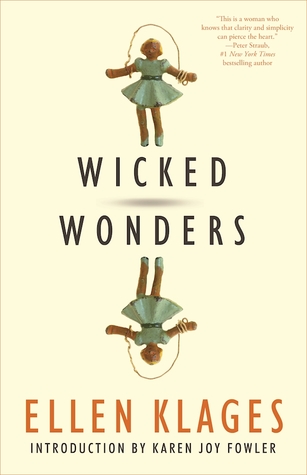
Wicked Wonders

Wicked Wonders by Ellen Klage  284 pages.

This collection of stories features singular, smart and sometimes subversive characters. In the introduction to the book by Karen Joy Fowler, Fowler states, "Ellen's young protagonists are both tough and sensitive. Like so many of us, they don't quite fit in. So they're always looking for the chance, unavailable in their home and schools and communities, to be their true selves."  For example, in one of the first stories, the main character is a girl who identifies more with Maleficent instead of Sleeping Beauty. In another one, a girl who starts a game realizes that she'll need more than mere luck to win once she's engaged a faerie.  All of the stories have a bit of adventure to them, sometimes some melancholy and sometimes a bit of humor (especially the last story in the book, "The Scary Ham").

I really enjoyed this book and found the stories to be interesting, thoughtful and memorable.  Definitely adding this one to my Christmas wish list!

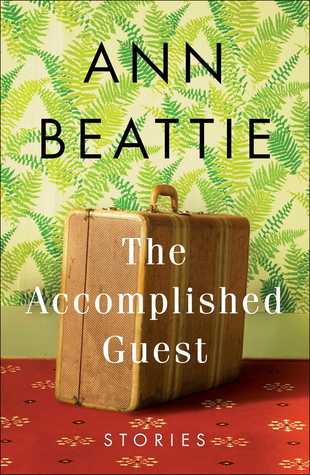
The accomplished guest

The Accomplished Guest by Ann Beattie        Audio Book: 7 hours    Hardback Book:  288 pages          

Many short stories here all written with good understandings of human and animal nature.   Most are amusing, some a bit melancholy, some make you scratch your head and wonder if they were happy or sad, but all were enjoyable.    There is much bonding going on here and not always with the ones you think which underlines the fact that people don’t always end up with the one they start out with but fate leads them to others they might not ever have considered.    I kind of like the moments when the light comes on in the characters minds and they get it that the person they wanted was not necessarily as fun or as compatible as the person they only saw as a friend for years.     Sometimes we see past those closest to us instead of actually seeing them.    Some of the stories are about letting go and being o.k. with that.   Some are about knowing when something is beyond what you can contend with and loving the person with issues and yourself and all those affected enough to let go and let someone get the help they need somewhere else - ie. psychological situations beyond your capabilities to handle or better said, when it is time to call in a professional.   Some are about allowing others to move on when the fit with you just isn’t working and my favorite is from a dog’s perspective of unconditional love.   But there are sweet stories of families and friends who also share that quality of giving unconditional love.    Human or animal these are all good stories.

The Longevity Plan

The Longevity Plan: Seven Life-Transforming Lessons from Ancient China  by Dr. John D. Day and Jane Ann Day with Matthew LaPlante            Audio Book: 7 hours, 46 minutes       Hardback Book: 304 pages        

Dr. Day is a renowned heart cardiologist who received his medical degree from Johns Hopkins and who completed his residency and fellowships in cardiovascular medicine and cardiac electrophysiology at Standford University.    Dr. Day was schooled in and was of a mind that as the body ages, deterioration and disease were a part of the natural aging process.   He prescribed his patients medicine for heart ailments that in the scheme of things were all actually preventable.    He too suffered from overweight, insomnia, high blood pressure, high cholesterol and degenerative joint disease.    It left him with a tinge of melancholia knowing as a doctor and particularly as a heart surgeon he should be living and eating differently than he was but he told himself given his schedule it was just easier to grab whatever was at hand to eat – the sugary goodies always available at the hospital or the pizza or other junk food on the way to or from work.    Exercise was as non-existent in his routine as was eating a healthy meal.    Family time didn’t fare much better as he was always tired when he was at home.    While delivering a lecture at a medical conference in China he heard about a village where Diabetes, Cancer, Heart Disease, Irritable Bowel Syndrome, High Blood Pressure etc. were non-existent.   Not only that but that many of the residents in this remote mountain village were over the age of 100 years old!   He couldn’t believe it could be true but he was curious to find out.    He made the trek to Bama what many Chinese people called Longevity Village.    A place high in the mountains in north eastern China about 20 miles from the border of Viet Nam.   The doctor spoke Mandarin which enabled him to communicate with the people there.   He was introduced to several inhabitants that looked to be elderly who were either out working in the fields, some were practicing Kung Fu, or lifting things and moving with such agility he couldn’t believe they were doing it.   He was really floored when he learned that many were 100 years old or older and had living children in their 80s!   These people were clear minded and great storytellers.    He offered to help one woman who was lifting furniture onto a cart and she told him, ‘oh no, doctor, you might hurt yourself!  I’m used to this.     Another time he had been helping a centenarian work in her field harvesting crops.    She had filled a bag very full and hoisted it onto her back and started to walk back to the village.    He insisted on carrying it for her but when she sat it down he couldn’t pick it up!   It took all he had to hoist it up on his shoulder and struggle to get it back.   The lady offerered to take it back from him and he asked her how could she carry such a heavy load and at her age?   She said she was used to it she had been doing it all her life, why would she stop now?   He met this answer with all of the hard chores and work the centenarians did there.    They always answered I’ve been doing it all my life why should I stop now?    On one of his visits one of the 100+ ladies had taken a fall and was in a wheelchair for a year.    The next time he was back she was up walking and working in the field.     He asked her how she felt and she answered “Like I could fight an army!’  And proceeded to skip away like a young girl and do a Kung Fu routine down the road kicking her legs up and throwing punches.   The doctor thought there must be some special something that made these folks this way like superhumans able to carry on long beyond what the rest of the world could.    He found no disease, no hypertension and observed their diet which consisted of all they wanted to eat at every meal but he noted they ate no dairy though they had water buffalo and could have drank that milk or used it in recipes.   When he asked if they ever drank it or used it in cooking they said, “No, why would we?   It would make us sick!”   Somebody knew something there that the rest of the world didn’t.    He said they ate meat but only a couple of times a week.    They ate pigs and chickens and fish.    One man quoted an old Chinese proverb saying,  “the Chinese eat anything with 2 legs except people and anything with 4 legs except a chair.”   They used spices and herbs, ate a lot of legumes, nuts and seeds, particularly pumpkin seeds, vegetables, fruit and meat as they had available the thing missing from their diets was dairy and processed foods that are so prevalent in the Standard American Diet (SAD).   They also used no oil in their cooking and didn’t know why anyone would.    The village at the time the doctor began visiting was rural with no electricity so no t.v.    People got about 12 hours of sleep per night because without electricity they found no reason to stay up much beyond sundown.   They had no gastric problems and no insomnia and went to sleep soon after laying down.      The doctor was so amazed by all he observed that when home he tried to follow the villagers’ precepts.    It was a marvel!   The doctor dropped 40 pounds following the eating pattern he learned from the villagers – no processed food, no dairy, by going to bed earlier and getting 12 hours of sleep instead of the 5 or less hours he had been sleeping each night if he were lucky, he found himself changing for the good.    He felt better, he lost weight, he wasn’t pushing himself on a caffeine based diet – the villagers only drank water from the river so the doctor stopped drinking anything but water and with the diet change, no chocolate nor caffeine drinks hyping him up and a more restful schedule he began to transform into a healthier man even getting in exercise at last and making time for his family by not pushing a go-go-go schedule of work only.   He felt better, he looked better, he was better health-wise.     He asked some of his patients if they would like to try the new plan and 92% of those who began it are still on it.   He calls it the Longevity Plan rather than a diet because diet has such negativity of denial attached to it and on this food plan you can eat as much as you want just avoid dairy, caffeine and processed food (Oh man!   That’s almost everything in the American menu!  Sorry Vegans, but, we are bombarded with processed everything and fed to bursting on hidden corn [starches that turn into sugars] and wheat [whey that more people than realize it are allergic to].      Really good book.   I loved the doctor’s and his family’s visits to the village and the wisdom of the elders when they told their stories or reacted to things the doctor asked them about.   A  worthy read for anyone wishing to do their body good.