Wednesday, June 21, 2017

From Christendom to Americanism and Beyond

From Christendom to Americanism and BeyondFrom Christendom to Americanism and Beyond: The Long Jagged Trail to the Postmodern Void by Thomas Storck, 207 pages

The central theme in this volume of Thomas Storck's collected essays is the exhaustion of the West as the consequence of the Western rejection of absolutes, beginning with the rise of nominalism in the 14th century.  This alienation of Western culture from its roots, he argues, has led to an increasingly narrow outlook divorced from reality, an antinomian utilitarianism which has conquered the intellectual, political, and economic worlds, combining usurious capitalism, social contract political theories, and sexual revolution antihumanism.  This is the essence of postmodern nihilism - a blanket rejection of intangible goods in pursuit of material wealth and pleasure, trading justice for avarice, solidarity for solipsism, genuine politics for tribalism, true virtue for moral preening.  The alternative he offers is the social reign of Christ, built on justice and solidarity, a true and therefore a moral community, the "civilization of love" of Bl Paul VI and the "culture of life" of St John Paul II.

The first thing that must be said about Storck's book is that it is not entirely, or even primarily, negative - Storck praises post-modernism for rejecting many of the errors of modernism, discerns signs of hope for renewal in leftist protest movements, and tends to blame the wrong turns of history, not on sinister cabals, but on Catholics not being sufficiently Catholic.  Throughout, he demonstrates the impact of two divergent views of the Church and the world, one of which represents the Church as one institution among many in the world, and the other which recognizes the truth of Chesterton's observation that the Church is bigger than the world.  The former, he demonstrates, produces apostasy and certain failure, the latter, faithfulness and the only hope of success.

Monday, June 19, 2017

Reformations

ReformationsReformations: The Early Modern World, 1450-1650 by Carlos MN Eire, 757 pages

It is not an accident that Carlos Eire's study of the fragmentation of Western Christianity in the early modern era, between the start of construction on the new St Peter's Basilica and the end of the Thirty Years War, is titled Reformations rather than "the Reformation".  Taking a broad view of his subject, Eire traces the development of a diverse range of expressions of the perennial Christian desire for reform, given new force and direction by the humanism of the Renaissance.  This is complemented by a distant but nevertheless real appreciation of the intimate relationship between religion, politics, economics, and culture, as well as a conscious commitment "to allow the past to be understood on its own terms" and avoid "either-or reductionism."

While it is much too late to avoid variations on the value-laden word "reform", it might be hoped that a better effort might be made in the employment of such ambiguous terms as "Scriptural", "superstition", and "rational".  Of course, to thread one's way through all of the theological niceties would require at least a dozen books each as long as Eire's, which makes some simplification a necessary evil. While Reformations is hardly the final word on such a complex and contentious period, neither does Eire imagine it to be.  It is, however, an excellent beginning for anyone seeking to understand the era and its legacy.

Saturday, June 17, 2017

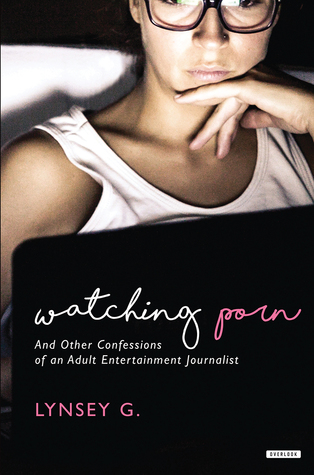
Watching Porn

Watching Porn: And Other Confessions of an Adult Entertainment Journalist by Lynsey G.  320 pages.

At 24 years old, with a degree in English Lit, Lynsey G. found herself reviewing a pornographic film for an adult magazine in New York City.  The job was supposed to be a temporary paycheck until she could get her legitimate writing career going, but as it turned out, she loved it. After about a decade of reviewing, she worked with a friend and founded a magazine where she had a platform to voice her observations and thoughts on the adult film world (as well as to educate people about what really goes on behind the scenes).

This book is described as provocative book about an average girl’s foray into the porn industry and the people who make it what it is, both in front of and behind the camera."  While I found parts of it interesting, I don't know if I would say it's provocative.  But then again, I read a lot -- so maybe that's just me.

One of the things that Lynsey writes about that I found interesting was the fact that a) people who star in these films don't necessarily make a lot of money and b) you make the most money if you're a white woman. While I wasn't surprised to learn about the lack of diversity in the adult entertainment industry, it was disappointing to learn that there's a huge lack of diversity, and also that if you're not a white woman, you definitely get paid a lot less, and are less in demand. Lynsey's writing, in particular, about the stereotypes that still exist in this industry was interesting.   I also liked that the author delved into the business aspects of this industry and how when the Internet blossomed into what it is today, it completely changed the business model for a lot of people.  

While there are some parts that I guess are provocative (and about what you might expect, especially when the author writes about some of the people she meets at adult entertainment conventions), this book is more informative than titillating, which made it an interesting read.

The Further Adventures of Ebenezer Scrooge

The Further Adventures of Ebenezer Scrooge by Charlie Lovett            Hardback Book:  107 pages            

I really wanted to love this book but I don’t.    I love the original story and when I saw this title while a bit skeptical since let’s face it Charles Dickens did not write a sequel, I was willing to give it a try in hopes that it might be a fun read,  however, it was not.   At least not for me.    I was put off by how the author portrayed Scrooge as an eccentric bordering on near lunacy.    Dickens’ characterization of Ebenezer Scrooge left no doubt that he was a learned man who ran a money making business.    He knew his craft well and he knew how to do the math or keep the ledgers as it were.   Scrooge was a smart man who knew how to make money and while his stone heart was turned to a charitable giver who knew  how to give generously and do good for the needy there is no reason to believe that he stopped caring for the business that made him a living  nor due to his philanthropy he was never interested enough in his business to continue in it very seriously and gave every cent he had away.   It was his livelihood afterall and I don’t think Mr. Scrooge would have given up his last cent though he would see to the well being of those in need in his power to do so.    This telling has Ebenezer losing his credibility with people because they believe him to be a loony as he goes down the street wishing people a Merry Christmas every day of the year.    Come on, Charlie Lovett, that is taking that keeping the spirit of Christmas in your heart way out of context and it lessens the effect of a good thing.     Like when we overuse the word love lessening its value and impact.   Also, Bob Cratchit who was such a dear man and loving father, to become a hard nose take only 1 day off a year guy after Scrooge makes him a full partner – No.   And Scrooge’s nephew who was fun and jovial, loving and sincere to become a lay about lout scared of his own shadow, what???     I like the idea that Jacob Morley continued to visit Scrooge and that they even had the occasional whiskey together (which went right through Jacob and onto the chair he hovered in) and that Scrooge was able to help Jacob lighten his load of chains over time.       I don’t agree with Scrooge getting the same 3 spirits to come back and in the Summertime to meet with 4 people of Scrooge’s choosing to show them Christmases past, present and future in the Summertime.   I get the climax, I get the author trying to tie the original story and his tale together but this one just did not do it for me try as I might to like it.    To me this was not an homage to Dickens but a case of fan fiction gone wrong.    

Friday, June 16, 2017

Meditations on the Life of Christ

Meditations on the Life of Christ attributed to St Bonaventure, translated by Sister Mary Emmanuel, OSB, 441 pages

This book presents 100 meditations on events in the life of Christ, either as reported in the Gospels or inferred by the pious imagination of the author.  Traditionally, this book was paired with St Bonaventure's Meditations on the Passion of Christ and was therefore often mistakenly attributed to him, however it was actually composed by an unknown Franciscan friar early in the 14th century.  The early date is itself somewhat surprising, since we have been told over and over that the harnessing of the imagination in the service of piety was an innovation of the devotio moderna of the 15th century Rhineland.

The meditations themselves are both succinct and rich.  Most of the commentary comes, not from the anonymous author, but from the writings of St Bernard of Clairvaux, particularly his sermons on the Song of Songs.  The arrangement of the material demonstrates a deep sensibility well-formed by practice - but although the placement of short treatises on the active and contemplative life in the center of the book is organically necessary, the decision to place a reflection on the use of the Sacred Humanity as a window into Divinity at the end rather than at the beginning is questionable. 

Thursday, June 15, 2017

Strangers Tend to Tell Me Things

Strangers Tend to Tell Me Things: A Memoir of Love, Loss, and Coming Home by Amy Dickinson   240 pages.

I read Amy Dickinson's column, Ask Amy, and I listen to her as a guest on NPR's Wait, Wait, Don't Tell Me --- but I really didn't know anything about her.  Someone had told me this was a good book, and since I like reading Ask Amy, I thought it would be a good read.

Through a series of linked essays, Dickinson writes about herself, her family, and how she settled into life when she moved back to the small town she grew up in. Her writing is very honest, and so reading this was like listening to a friend tell stories about their life.  I found her chapters about her mother to be especially poignant, and I loved reading about how she fell in love with her husband.  Some parts are funny, and some were reflective (sometimes, both at the same time).

This book picks up where her previous memoir left off, and since I enjoyed this book, I'll pick that one up in the future.

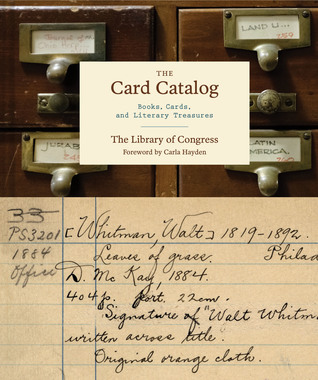
The Card Catalog

The Card Catalog: Books, Cards, and Literary Treasures by Library of Congress (Compilation), Carla Hayden (Foreword), Peter Devereaux.  224 pages

It's hard for a librarian to resist this book about the card catalog, but I think loads of book lovers would find it an interesting and fun read.  I mean, right at the beginning, there's a little pocket with a card in it!  This book has more than 200 full-color images of original catalog cards, first edition book covers, photos from the Library of Congress archives, and a ton of information about libraries and the first cataloging systems up to the modern day.  I found I was enjoying all the photos, but definitely learned some new things.  For example, I didn't know that Thomas Jefferson adapted his cataloging scheme from Sir Francis Bacon's classification that started with the categories of Memory, Reason and Imagination.*  Jefferson did later modify these to History, Philosophy and Fine Arts (although I think he would have kept the category of Imagination if he ever knew there would be Ray Bradbury, Neil Gaiman and other authors to come along).

This book is filled with interesting bits of information and some pretty cool photos. I liked the page about "Library Hand," a script that was taught to librarians so that all catalog cards were legible and had a standard appearance.  I feel like I should make that my next New Year's resolution: learn Library Hand (and improve my sometimes messy scribbling).  Fun book!

* I totally think this would be a cool way to organize my personal collection.  Memory = History, Reason = other nonfiction and Imagination = all fiction.

Check These Out

Check These Out: One Librarian's Catalog of the 200 Coolest, Best, and Most Important Books You'll Ever Read by Gina Sheridan.    256 pages.

"There you are, in the library, head tilted sideways, doing your best to navigate a blur of spines and titles to find one worth reading. Luckily, the hunt is over. Librarian, author, and book devourer Gina Sheridan has sorted through the stacks to compile a list of read-worthy titles you may have skipped over in your search."

Actually, I don't usually  have this problem of trying to find something to read. My problem is too many books and too little time (typical book addict, I know).  However, did my problem of having more than enough books to read stop me from reading this book?  Absolutely not!  And luckily, the book leads you to Gina Sheridan's website, where you can print out a list of the books in this book, so you can find them when you want them (and check them off as you go, if you like to do that).  I printed out the list and kept it handy, so that when a book sounded really good, I could mark it to put on hold for myself (not now, of course . . . maybe in 2 weeks when I've gone through my current book stack).

I appreciated that Sheridan broke down her suggestions into categories like "Daisy Dukes" (short stories), "Reel Good Books," and more.  I also really like that her suggestions are really diverse, pulling together all kinds of stories, writing styles, authors, etc etc.  Each book suggestion has a little summary along with some details about the book or author, and she has a way of making all of these sound great!   I was happy to see some books I've read and enjoyed here, but I've also got a list of some that will be new reads for me.   

Why Time Flies

Why Time Flies by Alan Burdick               Audio Book: 9 hours, 30 minutes    Hardback Book:  320 pages             

Alan Burdick sites some fascinating studies and their findings on how people and animals relate to time, to sequencing and how their concepts relate to their existence in the known now, the known past and their best guess for their futures.    As is often said, “Time Flies” or for Latin scholars, “Tempus Fugit” which sounds really catchy doesn’t it?    He explores the reasoning behind why the young think time passes so slowly while folks 50 and over feel time seriously flies.    It boils down to a math calculation that is based on the number of years you have been alive which is what  your perception is based on.    Those with many years ahead of them see years spreading out ahead of them while people on the half century mark see their mortality ahead of them and not that many years hence as when they were young.    It’s that space time continuum thing Einstein spoke of.   Your position on the question depends on where you are at on the time line of your life.    Lots of good stories and research on the subject here.    Fascinating people and insightful studies going on that will give you pause to ponder.   This book is a good mind stretcher and will have you looking at time in a far more significant way than just passing time.    You will want to be sure you utilize every second to its fullest potential.     He leaves you with Niche’s analogy of man’s relationship to time by how he builds a sandcastle.   The first man will proceed hesitantly, intent on craftsmanship yet all the while fretting all the time about the inevitable wave that will come then he is shocked by his loss when it does come.    The second man won’t even try to build a sandcastle seeing the futility of it,  why bother when the wave will just destroy it.   The third man, the paragon of manhood in Niche’s view, embraces the unavoidable and throws himself into the work regardless, joyful but not oblivious.   Burdick watched his sons building sandcastles on a beach in Normandy, France one day.    When the tide came in and destroyed the sandcastle the first time his one young son cried but he rebuilt only to have the sand castle city he and his brother rebuilt diminished again.   They built it a third time and by then the tide was coming back in and the ocean ran over the sand city, first the moat, then the city walls and then it flowed down through the streets.   Burdick’s second son stood up with his arms outstretched and faced the tide saying, “The end is near!   The end is near!”   Burdick enjoyed that response so much he envied it.   Time is full of surprises.    Time allows the builder to learn new ways of insuring the sand castle withstands the wave - incase it in something that will protect the integrity of the design and hold fast regardless of the torrent beating against it.   Time allows the builder to learn, if, he is willing to expand his mind and accept the consequence of his actions then learn from what was and what is to prepare a better way for the future.    Or as Burdick’s sons reacted either cry about where time has taken us or face it head on full force  standing up to it with that “HERE I AM TIME, COME AND GET ME!   LET’S SEE WHERE WE GO FROM HERE!’   Yeah, buddy!
  

What a Fish Knows: The Inner Lives of Our Underwater Cousins

What a Fish Knows: The Inner Lives of Our Underwater Cousins by Jonathan Balcombe          Audio Book:  8 hours, 15 mins     Hardback Book:  304 pages         

An in-depth but very reader friendly book on fish, from the way they are able to solve psychological tests faster than primates,  mind you,  to how they are able to make/use tools to achieve their goals much like humans trying to figure out the best way to accomplish a task.    The author has researched pretty much every current scientific testing going on and has visited sites and seen for himself the magnitude of what fish are capable of and sadly on the other side of that,  he has also visited locations that are farming fish for food as the public demand for fish on the menu rises and the oceans are so over harvested that he sees fish becoming an endangered species.     He likens fish farming tanks to the industrial farm buildings where chickens are kept in conditions where there are so many they can’t move around and they are fed steroids, etc. to pump them up to become supersized to get more meat out of each one.    Fish are undergoing like treatment.   Raised purely for food, the fishes needs are not taken into consideration, they are fed to become large and meaty and have no room to swim.   He talks about the technological equipment fishermen use now to find schools of fish and then go after them taking them all.   He likens it to bobbing for apples with both hands – the fish have no chance.    All of the oceans are being over-fished to the point of extinction.  Hence, the popularity of fish farms.  He describes how fish can show emotional attachments to the people they live with as pets.     One lady puts her hand in the tank and her fish will swim into the palm of her hand and stay there while she lovingly pets him.    Other people talk about how their fish will swim up to the glass when they are near the tank and not just when it is time for food, but, always.    Experiments have been done to show that fish do bond to their people.   Another person can come up to the tank and the fish won’t react but the person they bond with receives their utmost attention.   The book goes into how fish get a bad rap.   Because they aren’t cute and cuddly like puppies, they are thought to be cold with dead eyes and no expression as mammals do.   Birds and reptiles get more respect than fish who are thought to be floating emotionless creatures that do not even feel the hooks they get caught on.    This is not true as several studies point out.   He describes things done to fish in the name of science that are very cruel just to test whether fish do feel pain like putting burning stingers from sucker fish in their mouths.   Yes, they do feel pain as they have sensory parts on their bodies similar to humans that react to pain just like humans do, but, because their features stay the same people think they don’t feel anything but fish do cry out in pain when under water they just aren’t able to articulate audibly above water.   Balcombe also busts many other fallacies about fish, salmon do not all die after swimming upstream to spawn.   Some have been tracked by researchers to have returned to the ocean and living out their lives to ripe old ages for fish, though they never feel the urge to go through the spawning process again (Geez!  Who could blame them?)   Lots of amazing things to learn from this book about our fellow travelers on this planet.    It is an eye opener to a much maligned species.    Well done Jonathan Blacombe, terrific job on the research and the chronicling.

The Simpler Living Handbook

The Simpler Living Handbook by Jeff Davidson            Paperback: 288 pages          

This book is overwhelming there is so much good stuff packed between its pages!    It took me a long time to read this one because it is seriously so jam-packed on every page with useful ideas and tips.   It is a great book with information for absolutely everything from simplifying your life by minimalizing your material goods to when best to buy that new car and even tips on fixing your car.   From cooking to cleaning, from decorating to having the garage of your dreams with helpful hints, ideas, projects thrown in for practically anything you could want.   The author even throws in chapters on getting your finances under control and organizing your business needs and simplifying your paperwork, making your work flow more efficiently with offerings on customer service and how best to work with the clients your business or organization serves.    There is even a whole section on making your romantic relationship work, how to make sure you are taking good care of your nutritional health, and exercising the easy way while reaping the rewards of weight loss and toning ending with a chapter on taking it easy and finding your happy place.    I love this book even if it did take me an eon to finish it.   It is so worth your time you will learn so much from this book.   I feel like I completed 4 years of college and 2 of graduate work after this read.   You will come away so enlightened you will be glad you put the time in to really glean the immense amount of knowledge offered here.

Wednesday, June 14, 2017

Handful of Dust

A Handful of DustA Handful of Dust by Evelyn Waugh, 308 pages

A Handful of Dust is an emotionally devastating, wickedly funny novel of shameless self-interest.  Tony and Brenda Last have found a measure of peace and comfort in Tony's spacious but unfashionable ancestral home, seemingly insulated from both the ordinary vicissitudes of life and the treacherous jungle of London society.  All that crumbles with stunning speed, however, sending Tony fleeing into the relatively safer confines of the Amazon.

The title is an allusion to The Waste Land, and the book shares the same moral universe as Eliot's early poetry - a heap of broken images inhabited by genteel savages.  The writing is executed with Waugh's renowned wit and light touch, all in service to a tale of moral despair, resulting in a novel that masterfully manages to be both dreadful and amusing.

Tuesday, June 13, 2017

The Salt Line

The Salt Line by Holly Goddard Jones.  400 pages.   Due out in September - I read an e-galley.

When you decide what freedom really means, how far will you go to attain it? That's what drives this spin on a dystopian story about survival in a world where the United States' borders are all behind a ring of scorched earth. Nature, in the form of deadly disease-carrying ticks, has waged war on humanity and those within the safe zone live a safe (although very limited) life. Most people have no desire to leave, but some, driven by a need for an adrenaline rush, use their wealth to sign up for an expedition into the dangerous, tick-ridden areas outside the salt line. This latest group, however, include a few people who have different reasons for going on this expedition. When they find themselves at the mercy of a community of outer-zone survivors, and defenseless against the ticks, alliances and friendships in the group start to shift.

This is a tautly written story that starts you off thinking you know what's going to happen and by the end, you feel like you have no idea how you ended up there.  There are plot twists and character development that come at several points in the book, which keep the pacing taut with suspense. There are some interesting characters, and not all of them are easy to like or completely figure out (which I liked).  I will say that the idea of making ticks extremely nasty and dangerous gave me the creeps throughout the entire book --- and every time I was walking outside, I was jumpy; it's definitely a well-done plot element.

That's not to say the book is without flaws. However, I really liked the author's take on a dystopian (and what sounds like near-future) setting. The story explores how friendship can change, depending on how far circumstances can push people, and in fact, how circumstances can make people question their own humanity.

The People We Hate at the Wedding

The People We Hate at the Wedding by Grant Ginder.  336 pages

Alice and Paul's half-sister Eloise has just invited them to her wedding in London! It's going to be a beautiful event with fancy hotels, dinners, and a reception at a country estate. Sounds great? Actually, Alice and Paul couldn't hate it more.

And so begins this story of a family that is far from perfect. Alice, in her thirties, is smart, beautiful and single (although she's stuck in a predictable affair with her married boss). Paul lives with his older, tenured-track professor who lately has been dropping comments about how monogamy is an oppressive construct (uh oh).  Donna, their mother, is a widow living in the Chicago suburbs and dealing with her life by smoking pot and watching endless episodes of House Hunters International (and trying not to think of her previous husband, Eloise's father).

And then there's Eloise. She's cultured, beautiful and perfectly nice about everything . . . which, of course, just makes Alice and Paul completely hate her.  However, Alice, Paul and Donna all make the decision to attend Eloise's London wedding. Will this be the event that brings them all together into a happy family?

This is a funny book, although with some biting and bitter humor in it.  Alice is kind of a nasty person, and Paul's no treat, either.  Donna's okay, but I didn't find her super-appealing, either. At first, you think the three of them deserve each other and you have no idea why Eloise keeps making an effort to be so nice.  It's an interesting book about family dynamics, though, and it kept me reading up to the end.

One note: this is a bit of a personal irritation, but I found something in the book that made me want to smack the author.  I feel like it's clear that he hasn't been to the Chicago suburbs (where Donna lives) because for one, the Oakbrook Mall (where Donna goes shopping) does not have a food court. I know. I lived in the Chicago area for almost my entire life (up until about 2 years ago, actually) and have been to Oakbrook Mall more times than I can count.  It's an upscale, outdoor mall.   Ok. Snarky little rant over.

Trumpet

Trumpet by Jackie Kay, 278 pages


The novel starts soon after Joss Moody's funeral. It is mostly set in London in 1997. We find out that Joss was a legendary British jazz trumpet player. His wife Millie is mourning him. We find out that Joss was biologically a woman and the only person who knew before he died was Millie. The novel is told from the perspective of his wife and people who didn't know such as a doctor, a registrar, the funeral director, fellow jazz musicians, their adopted son Colman, a reporter, etc. Their reactions are all different.


The doctor, registrar and funeral director have to find a way to digest what they have never come across before.  The fellow jazz musicians don't care and indicate that the music was the important part. Colman didn't know until he was told by the funeral director and feels betrayed that he was never told. His father has left him a letter that he refuses to open. This leads him to accept a tabloid reporter's offer to write a book about his father. As time goes on, Colman begins to doubt the motivations (the reporter's and his) behind the book. In seeking answers about his father's life, he finds out that Joss's mother is still alive and goes to visit her. Will he come to peace with who his father was and open the letter?


This novel won the 1998 Guardian Fiction prize and was inspired by the real life of jazz musician Billy Tipton.


I thought this novel was good but I was also unsatisfied. On one hand, I realize it was meant to be mostly told from the perspectives of others but the lack of Joss's perspective left me with too many unanswered questions. Maybe that was the point.

Monday, June 12, 2017

Fairy Tales of Oscar Wilde

Fairy Tales of Oscar Wilde: The Selfish Giant and The Star Child; The Young King and The Remarkable Rocket by Oscar Wilde, adapted by P Craig Russell, 88 pages total

These are the first two of the five volumes of comic adaptations created by legendary illustrator  P Craig Russell from the fairy tales of Oscar Wilde.  These, in turn, have their origin in stories Wilde told to his own children.  The writing strikes the perfect balance between child-like simplicity and adult appeal, while the art is stunning.

All of the stories are similarly moralistic - each features a self-absorbed protagonist whose self-importance is shattered, although it is only the readers who witness this in the case of The Remarkable Rocket.  It is interesting how some of these characters - particularly the Young King and the Star Child, but even the Rocket - echo, or perhaps parody, Wilde's own public persona before learning their lesson (or, in the case of the Rocket, not).
The Young KingThe Selfish Giant

Saturday, June 10, 2017

Rocking-Horse Catholic

A Rocking-Horse Catholic by Caryll Houselander, 148 pages

Noted twentieth century spiritual writer and mystic Caryll Houselander was not born to Catholic parents, nor was she an adult convert, rather, like her contemporary JRR Tolkien, she was brought into the Church as a child when her mother converted - hence "rocking-horse Catholic" instead of "cradle Catholic".  A Rocking-Horse Catholic is her short memoir about her long education in the ways of God and men.

Although the book includes accounts of three mystical experiences in which the supernatural broke abruptly into the world of the author, the focus is on her growth through the influences of those around her, some despite and some because of their imperfections.  Throughout, Houselander maintains a charming tone, approaching even the most trying times and people with at least a retroactive generosity and spirit of gratitude, seeking - and finding - her Lord in the crowd.

Friday, June 9, 2017

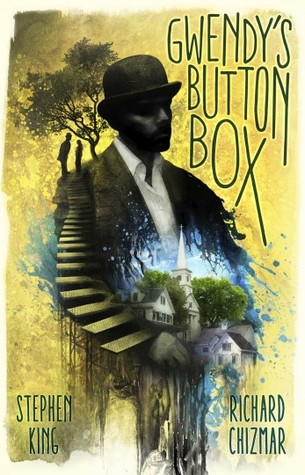
Gwendy's Button Box

Gwendy's Button Box by Stephen King and Richard Chizmar Book 164 pages

Gwendy's Button BoxFrom Publisher's Weekly: "It's 1974 when 12-year-old Gwendy Peterson is offered a magic box by a man named Richard Farris, whom she meets at the top of one of the cliffside Suicide Stairs in Castle Rock, Maine. Farris wears a "small neat black hat" and seems to know just who Gwendy is and what she wants. Eight buttons grace the mahogany box he offers to Gwendy, and a lever dispenses silver dollars and intricate chocolates that Farris claims will help Gwendy lose weight and escape being called "Goodyear" by her classmates. Lose weight she does, but that's not all. Wonderful things keep happening in Gwendy's life, and she's happier than she's ever been. But when she decides to press one of the buttons, the consequences are horrendous."

I enjoyed reading this book. However, it did take some adjusting to realize that it wasn't going to be scary despite its authors. It is billed as horror, but I found no horror and also not a lot of suspense. The story reads like a normal life of a young girl who turns into a young woman. The addition of the button box is what makes it slightly different. Of course this is not an original story line, but it was nicely done. The box has some profound effects on Gwendy's life, but I felt sorry for her as the bad circumstances weren't her fault. I did like Gwendy, she was doing the best she could with what she had. As is usually the case with these types of stories, she had to discover a lot of information on her own. Sometimes I find teen characters hard to read, but I applaud King and Chizmar with their writing of the protagonist. After she pressed the red button the first time and blamed herself for a tragedy, I thought that was going to be the theme for this book. I was grateful it wasn't. This was an easy read that keeps the reader engaged. Although there are some holes in the story, I still liked it. The plot of the book suggests that it should have been longer. The black button alone deserved more page time, but that's a novella for you. Throughout the story and at the end, I could not help but wonder what Gwendy's life would have been like if she had never received the button box. I wonder if that was the authors' intent. Hmmm....

Thursday, June 8, 2017

Swan Deception

 Swan Deception  by Glede Browne Kabongo    411 pages

Dr. Shelby Cooper is a scientist in the field of bioinformatics. I never did understand what that is, but fortunately, in this novel that is not an issue. It’s what Shelby does, not who she is. She is a wife to Jason, a mother to Abbie and Miles, and a best friend to Vivian, but unfortunately, she is also Alessandro’s mistress. And that’s not the only secret she’s trying to keep.

Shelby has a past that no one, except Vivian, knows about and she has perfected the lies that keep is buried way down deep.  But a mysterious stalker soon enters the picture, killing Alessandro and setting Shelby up to take the rap. And it all starts innocently enough when she is pulled over for a broken taillight.

Browne Kabongo does an excellent job in keeping the reader off balance, pretty sure of what’s going on, but not one hundred percent confident that what they are reading is the truth…or even a facsimile what they think is happening.

The screws around the deconstruction of Shelby’s life get tighter and tighter with every page. However the novel is not without its flaws. The first 178 pages have a tense problem. I t drove me nuts, but not enough to stop reading, which is an indication of how well Browne Kabongo tells a story.

Another issue is when the identity of the stalker is finally revealed, it doesn’t seem possible. If there had been more of an explanation, I probably would have bought it, but without one, I felt setup and cheated.

Then there is bombshell that Browne Kabongo drops at the very end that really ticked me off.  There was a unresolved thread that lurked, but as I got closer and closer to the end, I was willing to let it go, figuring it would be explained in a follow-up novel. There is no foreshadowing of that tidbit of information, which added to my irritation.

So, I guess you can say that this review is full of mixed emotions. Browne Kabongo obviously has talent and can write, but she needs a good editor. For this reason, Swan Deception receives 3 out of 5 stars in Julie’s world.


Home on the Range

Home on the Range by Ruth Logan Herne    352 pages

Return to the Double S Ranch in Gray’s Glen, Washington, in this second novel of the Double S Ranch Series. 

In the first book, we met the Stafford family. Patriarch Sam is grievously ill. Oldest brother, Colt, came home after losing his job on Wall Street. And while Colt was the star of the first book, the second book concentrates on the middle brother, Nick, and his shattered family.

Home on the Range seems to pick up practically where the first book, Back in the Saddle, left off. Both brothers, along with the youngest, Trey, know the feelings of a mother’s abandonment; feelings Nick two little girls, Cheyenne and Dakota, are wrestling with. 

Nick has finally agreed to get his girls professional help. Recommended by the school principal, Dr. Elsa Andreas, is grappling with problems of her own. She left Seattle after a devastating outcome with two of her patients. She’s living in the woods, far off the beaten path, outside Gray’s Glen.

When Nick first pulls up, he feels attracted to the beautiful young woman. His oldest daughter immediately hates Elsa but feels the strong tug of attraction.

The story is about forgiveness, redemption, second chances and new beginnings.

Home on the Range  is predictable, but nonetheless a worthy read. A perfect beach reads. It’s well written, follows a well-planned story arc and is sprinkled liberally with some interesting plot twists.  I found myself eagerly awaiting my evening read-time so I could see how it would all turn out.  I enjoyed getting to know the Stafford family, Nick especially, better. Home on the Range gets 4 out of 5 stars in Julie’s world. Why 4 stars? It’s a formulaic plot that is a good read. I would recommend it to those looking for a light, happily-ever-after- novel.

Wednesday, June 7, 2017

Earning It

Earning It by Joann S. Lublin        Audio Book:  8 hours, 15 mins     Hardback Book:  304 pages  

Joann S. Lublin shares her trials and tribulations as a woman working to achieve her career goals.    She is honest in describing not just her personal journey up the corporate ladder but also the stories of about 50 or more other women working at the CEO level in a number of fields.   The copyright on this book is 2016, I had to check that date because so many of the stories involve women in corporate America who are still being treated as underlings.    While I realize there is still a glass ceiling to a large degree (yes girls there honestly is still an old boys network out there),  I was surprised that women are still being ogled, pawed,  asked to get coffee,  and asked to step out of photos of their male colleagues because the wives aren’t in this shot.    People, this is 2017 not 1964!    Whaaaaat?    Truly, I was surprised.    Women CEOs are not new they have held the helm of major corporations for a long time now so how anyone can think such unconscionable behavior could be ignored or accepted is beyond belief.   Oh, there will always be someone who has questionable ethics regardless the field,  and now and then some “player” who feels he is the office Cassanova who might see how far he can push the boundaries but, when a woman who has earned her position through diligence in pursuing her education and/or working her way up the levels to achieve the top spot running an organization is treated with such a dismissive attitude on the parts of the males in the room I have to ask, “How can that be in this day and age?”   While there is still somewhat of an equality imbalance and the stereotypical “suits rule” remains imbedded in the social psyche (think “Mad Men”) isn’t there at least a crack in the glass ceiling by now?    Not shattered, not gone, but a definite crack should be felt.    Women still have to prove themselves capable and work harder, put up with more b.s. and no matter how good they do their job are still made to feel less than their male counterparts.     The book ends with the hope that by the time the daughters of the current female CEOs come of age the stories they tell them of what they had to endure will sound like something so foreign they just might not believe them.    Very well written.   This book gives you insight into just how difficult and how much of an uphill battle women still struggle as suffragettes in the board rooms across the world.    

Stranger from Paradise

The Stranger From ParadiseThe Stranger from Paradise: A Biography of William Blake by GE Bentley Jr, 446 pages

It has become a cliche to refer to artists (even the most pedestrian) as "visionaries".  In the case of William Blake, however, it is no poetic exaggeration - he literally saw angels in the streets and conversed with fairies in his study.  As GE Bentley describes it in his sprawling biography, the reality of Blake's visions formed the primary basis for his understanding of art, religion, and the world, with the spiritual freedom of the imagination contrasted to the rational slavery of matter, the state, and organized religion.  Blake's faithfulness to this internal vision, however opaque it might be to others, led one of his friends, the poet Allan Cunningham, to confess that "what he meant by them even his wife declared she could not tell, though she was sure they had a meaning, and a fine one..." and caused the portraitist John Hoppner to dismiss his work as "like the conceits of a drunken fellow or a madman".  The verdict of history has tended to balance the two, echoing Robert Southey's view that "the highest genius alone could have conceived it, and only madness have dared attempt the execution."

A marginal figure during his lifetime, the material for a biography of Blake is somewhat threadbare, primarily consisting of diary entries and letters dealing with matters that seemed important at the time but assuming much and neglecting much that seems essential now.  Bentley's lack of organization, leaping quickly between analysis and anecdote, risks losing the narrative in the labyrinth of the London publishing industry circa 1800, but also lends his biography a feverish quality of half-hallucinatory (or perhaps heightened) reality which complements Blake's own "wildness and Enthusiasm". 

Tuesday, June 6, 2017

The Marriage Pact

The Marriage Pact by Michelle Richmond.  418 pages.

How far would you go to have a strong marriage? To show that you love and respect your partner? In this fast paced thriller, Michelle Richmond explores that concept, giving us newlyweds Jake and Alice, whose life together holds endless possibilities.  When one of their wedding guests gives them an invitation to join an exclusive group known as The Pact, they feel they're up for the challenge.  After all, the goals seem simple: keep your marriage happy and intact. Most of the rules make sense, like "exchange thoughtful gifts monthly," and "plan a trip together once per quarter." And no one really needs to worry too much about the fine print, right?

Wrong. As it turns out, The Pact is all about the fine print and enforcing the stringent rules, written in a legal-ese to confuse even an attorney.  It all seems glamorous at first, but then it becomes more and more frightening and Jake and Alice are drawn further into the group of Pact members. When one of them breaks a rule, it becomes even more terrifying.

I had eagerly anticipated this book and really liked how the author set things up and then just started increasing the pace, steadily, so that about halfway through the book, I didn't want to put it down. It's a relentless book and the story really explores how far people will go, and what the limits of love might be. It's a bit hard to believe, but then as you get sucked into the story, it doesn't sound completely implausible, and that's what makes this such a chilling (and thrilling) read.  It has a few slow moments, but I felt like this only contributed to the feeling that something worse was right around the corner and the characters were in danger.  Fun read!

Monday, June 5, 2017

The Life She Was Given

The Life She Was Given by Ellen Marie Wiseman.  356 pages  due out in July, 2017

On a summer night in 1931, Lilly Blackwood glimpses circus lights from the window of her attic bedroom.  She's not allowed outside, ever, and Momma insists it's for her own protection because people would be afraid if they ever saw her. She's an abomination, after all. However, on this night, Lilly is taken outside for the very first time, by Momma, and sold to the circus sideshow.

More than 20 years later, 19 year-old Julia Blackwood has inherited her parents' estate and horse farm. Hoping that her return will erase her childhood memories of an unhappy home, Julia becomes immersed in the care of the horses. However, her attention soon turns to her family's history when she discovers a hidden attic room and photos of circus scenes and notes featuring a striking young woman.

This book gives two perspectives, so you have Lilly's story from 1931 and beyond, and then Julia's story as she's in the present but also digging into her family's past.  Lilly's introduction to circus life is pretty brutal and while she eventually makes friends and then becomes the circus' main attraction, her life has a lot of difficult and tragic moments. The author gives a lot of realistic details about circus and sideshow life at the time, and I appreciated that there was this realism; there's no candy-coated dream here of running away to join the circus and having it all be spangles and spotlights.  Realistically, as well, is what one of the circus proprietors points out to Lilly: the way that she is, her life would either be one of being locked in an attic and abused (or worse, put in an asylum) or it could be traveling with the sideshow, where she would be among other "different" people.  I think it's difficult for people today to think about what sideshow life was like, but in 1931, people who were different didn't always have a lot of choices. Sideshow life could give them an opportunity to work and have some control over their own lives (at least, that was the best-case scenario.  Sadly, it wasn't always like that for many of the sideshow performers). The author also gives heartbreakingly accurate details about what life was like for many of the animals in the traveling circuses of the time, so if you're sensitive to sad animal stories, maybe skip this book.

The dual perspectives and timelines made this an interesting read. You're learning about Lilly's life through her perspective, but also discovering things about her as Julia delves into her family's past and discovers the connection.  I know you're wondering what makes Lilly different -- but no spoilers here. You'll have to read the book!

Democracy in America

Democracy in AmericaDemocracy in America and Two Essays on America by Alexis de Tocqueville, translated by Gerald E Bevan, 935 pages

There is an amusing irony in the fact that the book which best defines the American character was written in French, by a Frenchman, for a French audience.  Yet, especially when the ideological struggles of the twentieth century made the question of national identity a matter of considerable urgency, it has been in Democracy in America that Americans have found their standard.  Henry Adams declared it the "gospel of my private religion", and it has been quoted by every president from Eisenhower to Obama (and quoted just as avidly by the opponents of those same presidents).  It has been suggested (no doubt correctly) that, like the Bible, Democracy in America has passages that can support virtually any argument (and when none will suit, invention fills the need, as is the case with the famous but spurious "America is great because America is good" quotation) - its popularity and flexibility prompted Russell Baker to quip, "of all the great unread writers I believe Tocqueville to be the most widely quoted."

A minor aristocrat pursuing a career in the civil service, in 1831 Alexis de Tocqueville visited America in search of the future.  He had become convinced that the inexorable tide of history was pushing towards the elimination of all distinctions between persons - something he did not regard as an unalloyed good.  In the United States during the presidency of frontiersman Andrew Jackson he found the ideal of the classless society which somehow managed to avoid anarchy.  His examination of the peculiarities of the American Constitution, culture, and character that made this possible demonstrates remarkable insight and holds far-reaching implications.

It is difficult to refrain from reading Tocqueville with a jaundiced eye, noting the failing of those qualities he admired in the American experiment and the widening of the faults.  It is no longer possible to say that the American people feel responsible for making their laws and therefore respect them, that universal religiosity detoxifies individualism by inspiring a commitment to the common good, or that debates in the US Senate "would bring glory to the greatest parliamentary debates of Europe."  Instead, it seems that we have travelled further into an age "where nothing is consistent, where virtue is without genius, genius without honor, where the love of order is joined to an inclination for tyranny and the holy worship of liberty to a disdain for the law, where conscience casts a dim light upon human actions and where nothing any longer seems to be prohibited or permitted, honest or shameful, true or false".  Indeed, nothing seems to threaten the continuing ascendancy of those "who strive, in the name of progress, to turn men into materialistic beings and who want to discover the expedient while paying scant attention to fairness, knowledge far removed from beliefs, and prosperity which has nothing to do with virtue."   Nothing, unless the same strengths Tocqueville identified nearly two hundred years ago can somehow be given new life.

Sunday, June 4, 2017

The Path of Daggers

The Path of Daggers by Robert Jordan, Audiobook: 23.5 hrs, Paperback book: 525 pages.


This is the eighth book in the Wheel of Time series. This book mainly focuses on storylines related to the women of the series. Rand has some significant chapters, Perrin is in the thick of some important events but their parts are condensed and Mat is absent from this book.

The Seanchan have returned by invading Ebou Dar. Rand is determined to prevent them from advancing into Illian and push them back. Perrin is in Ghealdan to contact the ruler and to bring the Prophet of the Dragon, Masema, back to Rand. Elayne and Nynaeve are travelling back to Caemlyn so Elayne can try to claim the throne of Andor. Egwene and the rebel Aes Sedai are travelling on their way to the White Tower. Along the way, they run into an army of Murandians and Andorans who don't want them going through Andor. They promise them they won't and Travel via magic to the White Tower.

None of the event in this book were especially significant but there were a few developments that change the pattern of the overall story. This one wasn't one of my favorites in the series so far but it was pretty good. One theme of the series is that some groups of people and some people think they are infallible or not likely to be defeated, events reveal their hubris and they are humbled. 

Friday, June 2, 2017

The Island of Knowledge

The Island of Knowledge: The Limits of Science and the Search for Meaning by Marcelo Gleiser, 335 pages


Marcelo Gleiser is Appleton Professor of Natural Philosophy and Professor of physics and astronomy at Dartmouth College. Gleiser proposes a new metaphor to use when thinking about knowledge in general and science specifically.


Human knowledge is an island that grows as our knowledge grows (and sometimes shrinks some when we find out our knowledge is not true). The island grows but is always surrounded by water and never reaches a boundary. We can continue to learn more but never learn everything. Some would find despair in this but Gleiser doesn't.


There are three sections in the book. In the first, Gleiser talks about the evolution of humanity's knowledge about the origin of the Earth and the Universe. The second is titled From Alchemy to the Quantum: the Elusive Nature of Reality. He talks about atoms, heat, light and quantum physics. He describes the limits of what we can know. The third and shortest part is titled Mind and Meaning. This section is devoted to whether mathematics is an invention or a discovery, consciousness and a conclusion.


Gleiser sees science as a way to search for meaning. It is an open ended search that will never end. He does not see science as the only way of finding meaning. Not all scientists would agree with him that there is a limit to how much we can know.


I found the metaphor of knowledge as an island an apt one. Sure, all islands don't grow but they can. This book provided great food for thought. While some of the science may be a review I would recommend this to people who are interested in science or philosophy.

Gwendy's Button Box

Gwendy's Button Box by Stephen King and Richard Chizmar.   175 pages.

Every day in the summer of 1974, 12 year-old Gwendy Peterson takes the Suicide Stairs up to Castle View (in the town of Castle Rock).  At the top of the stairs, she always takes a few minutes to catch her breath, listening to the sounds from below of playgrounds and baseball games. One day, a stranger calls out to her, "Hey, girl. Come on over here for a bit. We ought to palaver, you and me." And there a man sits, on a bench in the shade, wearing black jeans, a black coat and on his head, a small, neat black hat. When he gives her a box, it all seems surreal . . . and a time will come when Gwendy will have nightmares about that hat.

If you like a dark, delicious story that's a quick read (but will linger in your mind), pick up this little gem. King and Chizmar make a great team, putting their character-building and storytelling skills together in this short book.  I liked how the book takes you through time with Gwendy, so you start in 1974, but you're with her as years pass and the effect of the "button box" become apparent.  There's a nice, steady pace to the book with a palpable underscore of dread that runs through the story (because you just know in a story like this that something awful is going to happen at some point).  I'm adding this one to my wish list for my own library -- lots of fun!


In A Glass Grimmly

In A Glass Grimmly by Adam Sidwitz                      Audio Book:  6 hours and 25 minutes    Paperback: 352 pages                        

If you loved, “Into the Woods,”  as much as I did,  you will truly enjoy this rendering and maybe a little fracturing and reconfiguring of several of the tales of the Brothers Grimm which are all rolled into one long continuous story with Jack and Jill as the lead characters.   It is a very worthy telling and you might come away thinking, “You know, it really could have happened that way.”    I highly recommend this new take on several good stories complete with that edge that the Brothers Grimm are known for but with just a little R. L. Stine (“Goosebumps” series)  and even a dash of Mother Goose thrown in.    It could also be linked to the stylings of S. Morgenstern’s “The Princess Bride.”   There are giants and swordplay, a goblin king, mermaids, a dragon (who is other than he seems), by the way amphibians play a big part in this story (don’t want to give too much away here)  it also gets a bit gross at times so, be warned, don’t eat while reading the scene with the giants doing the food competition, there are other places that are not for the squeamish, luckily the book will warn you in plenty of time to skim those pages if you aren’t up for it.    This is a tale where nothing is as it seems.    It has very moralistic lessons to share throughout the book in the vein of Aesop’s fables.   You will come away with the concept that “Age and size don’t matter,” at least not in this fairytale.

May totals

see all those books? Carrie Brownstein might read them all...
This month, the team's totals were:

6 bloggers
62 books
19,331 pages


And Shirley wins this month, with a total of 6353 pages!!!!

Let's see if we can blow past 19,331 pages in June!  

Strangers in a Strange Land

Strangers in A Strange LandStrangers in a Strange Land: Living the Catholic Faith in a Post-Christian World by Charles J Chaput, OFM Cap, 246 pages

Early on in Strangers in a Strange Land, Archbishop Chaput declares that his intended audience is "everyday Catholics who love Jesus Christ and his Church more than they love their own opinions".  The word "love" is critical, since Chaput, unlike those for whom "truth" is no more than a political slogan, believes that Truth is not only real, but a Person - not only can Truth be sought but He is seeking us, and not only can Truth be found but finding Him demands a response from us, obligates us.  So, too, the adjective "everyday", as the challenges of "living the Catholic faith in a post-Christian world" belong primarily not to the clergy but to an active laity aware of the grace granted to them by God - and aware also that for Christians this means not power and privilege but service and sacrifice.  Finally, he might have said "more than their own illusions" or "more than the good opinion of their neighbors", since it is precisely these things which, he insists, we must be willing to lose if we are to follow "the Way, the Truth, and the Life" faithfully in twenty-first century America.

Archbishop Chaput has been alternately derided and celebrated as a "culture warrior", but no matter how accurate that title may be in recognizing his determination and courage, it does a major injustice to him if it is taken to imply that he is a partisan or a propagandist.  To the contrary, Chaput is eminently sober, not given to rhetorical exaggeration, and gentle to his opponents without denying that opposition exists.  Strangers in a Strange Land is consistent with this approach - thoughtful rather than bombastic, offering quiet strength instead of outrage.

Thursday, June 1, 2017

The Way Life Should Be


The Way Life Should Be  by Christina Baker Kline    320 pages

Three things drew me to this novel. First, it takes place in Maine. I’ve always wanted to live on the coast of Maine; it’s just so darn beautiful. Second, sometimes when I reflect upon my life, I think, “This isn’t what I signed up for; this isn’t the way life was supposed to be.” The third reason is the author, Christina Baker Kline. After reading, and loving, Orphan Train and A Piece of the World, Kline is one of my favorite authors and I want to read all the books she has published. And just icing on the cake, the front cover blurb is from Caroline Leavitt, an author I’m just discovering. So I ask you, “How could I resist this novel?”

Angela Russo lives in New York City and is thirty-three years old. She is an event planner for one of the lesser-known museums. On her office bulletin board is a cutout magazine photo showing a cottage on the coast of Maine. It portrays such a simple life; the life Angela has always wanted.

With her love life is nonexistent, she decides to look into some internet dating sites. A profile name MaineCatch. He’s thirty-five, has ice-blue eyes and lives in Cushing, Maine. Angela spends more time mooning over MaineCatch than she does thinking about the big fundraising event she is planning for the museum. She has to go to Boston on business, and luckily, MaineCatch sails down to meet her. The sparks fly.

When the event goes horribly, horribly, horribly wrong, Angela is fired from her job. She decided to move north to be with her catch. Things go horribly, horribly wrong; seems she has misunderstood MaineCatch’s intentions.

Without a job to return to, Angela decides to stay in Cushing. She finds a little shack to rent that she can renovate, gets a job in a local coffee house, and begins to rebuild her life. The knack for the Italian cooking she learned from her grandmother rises to the surface.

The novel is written in first person, which I think helps add immediacy to the story while Kline’s scenic description have me longing to pack me bags and head Northeast. I was able to live vicariously through Angela. I could barely put this story down and I didn’t want it to end. I hope in the future Kline writes a follow-up novel. The Way Life Should Be 6 out of 5 stars in Julie’s world.

Blackberry Winter

Blackberry Winter by Sarah Jio    290 pages

A blackberry winter is a colloquial expression used in the Southern and Midwest sections of North America. It refers to a cold snap in occurs in the later spring when the blackberries are in bloom. To me, it seemed odd then that this story takes place in the state of Washington, and Google was no help in researching if the tasty fruit grows in the Pacific Northwest or not. It’s of little consequence since the title is one of the main reasons I picked up this novel. The other reason is one that always captures my attention: dualing timelines.

In this novel the story vacillates between 1933 and current time. On May 1, 1933, a snowstorm rattled Seattle. In contemporary times, another snowstorm blankets the city on May 2.

In 1933, the Great Depression is strangling America. Vera Ray is lucky. She has a job as a night maid at one of the local hotels. The downside is that she’s forced to leave her three-year-old son, Daniel, home alone.

In present day, Claire Aldridge is a feature writer for the Seattle Herald. Her editor assigns her the task of writing a 6,000 word piece on the blackberry winter in two days. She isn’t thrilled and is wondering where she is going to find enough interesting info to create a piece of that magnitude. Not only is she face with a seemingly impossible task, her marriage is on the verge of collapse.

Digging through the archives, Claire discovers that Vera’s son disappeared without a trace. The only thing she ever found was Daniel’s teddy bear, Max, face down in the snow. There were no reports of is ever being found. Having recently lost a child, Claire is eager to learn what happened to Vera and Daniel. And so the hunt begins.The story weaves back and forth across the decades.

Blackberry Winter isn’t the best written novel I’ve ever read. However, it kept my attention, and I didn’t want to put it down. Jio’s third novel receives 5 out of 5 stars for those reasons.