An American Summer: Love and Death in Chicago by Alex Kotlowitz 304 pages
Kotlowitz, the author of There Are No Children Here, revisits Chicago over a summer to write about the individuals affected by violence. Told through intimate profiles of people, Kotlowitz talks to and writes about people who have committed acts of violence, social workers, teachers, and many more.
I had read There Are No Children Here pretty recently and had been eagerly anticipating this new book from the author. He cites that over the past 20 years in Chicago, 14,033 people have been killed and another roughly 60,000 wounded by gunfire. What he does in this book is look beyond those statistics and examine what this kind of violence does to the spirit of individuals and their community. Kotlowitz has a great way of helping tell people's stories without making it seem like they should be pitied; instead, what he shows is how many people have commonalities and how violence can have a devastating impact that creates a ripple effect through communities. I found this book to be interesting and thought-provoking. Coming from the Chicago area and living in different neighborhoods in Chicago, I feel ties to Chicago; however, I am not proud of all of Chicago's history, nor its current state. What I appreciated was that Kotlowitz brings a completely human aspect into all of these news stories and statistics. It's a sobering read.
This blog is the home of the St. Louis Public Library team for the Missouri Book Challenge. The Missouri Book Challenge is a friendly competition between libraries around the state to see which library can read and blog about the most books each year. At the library level, the St. Louis Public Library book challenge blog is a monthly competition among SLPL staff members and branches. For the official Missouri Book Challenge description see: http://mobookchallenge.blogspot.com/p/about-challenge.h
Showing posts with label Gun Violence. Show all posts
Saturday, March 30, 2019
Saturday, December 22, 2018
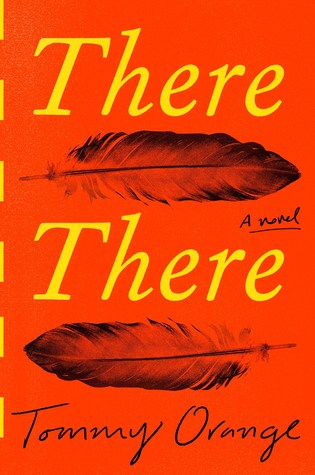
There There
There There by Tommy Orange 294 pages
From Goodreads:
There There is a relentlessly paced multigenerational story about violence and recovery, memory and identity, and the beauty and despair woven into the history of a nation and its people. It tells the story of twelve characters, each of whom have private reasons for traveling to the Big Oakland Powwow. Jacquie Red Feather is newly sober and trying to make it back to the family she left behind in shame. Dene Oxendene is pulling his life back together after his uncle’s death and has come to work at the powwow to honor his uncle’s memory. Opal Viola Victoria Bear Shield has come to watch her nephew Orvil, who has taught himself traditional Indian dance through YouTube videos and has come to the powwow to dance in public for the very first time. There will be glorious communion, and a spectacle of sacred tradition and pageantry. And there will be sacrifice, and heroism, and unspeakable loss.
My Review:
From Goodreads:
There There is a relentlessly paced multigenerational story about violence and recovery, memory and identity, and the beauty and despair woven into the history of a nation and its people. It tells the story of twelve characters, each of whom have private reasons for traveling to the Big Oakland Powwow. Jacquie Red Feather is newly sober and trying to make it back to the family she left behind in shame. Dene Oxendene is pulling his life back together after his uncle’s death and has come to work at the powwow to honor his uncle’s memory. Opal Viola Victoria Bear Shield has come to watch her nephew Orvil, who has taught himself traditional Indian dance through YouTube videos and has come to the powwow to dance in public for the very first time. There will be glorious communion, and a spectacle of sacred tradition and pageantry. And there will be sacrifice, and heroism, and unspeakable loss.My Review:
| I didn't really know what I was getting into when I started this book, but wow it sure took me places. Things I liked: the dichotomy that Orange explores about being Native, being mixed race, of having ancestors who owned this land and some who took that land away. I loved the different ways he explored this topic through the lens of so many people with such different backgrounds. I also loved how all these characters struggled with the feeling of "acting Indian" because it feels like a trope now, just one more thing that White culture has taken away. This struggle is then met with Orange's discussions on how Indians have evolved, that they can be Urban and still Native. Things I didn't like: the multiple view points. I know I said I liked seeing all the different perspectives, but I also don't like reading so many perspectives. It's hard for me to keep them all straight, and since only a small amount of time is given to each person, it made it harder for me to remember the intricacies of each character. I also had a hard time getting into the way the story organically grew out of nothing and then ended right at the climax. It was a strange build to a story, one that I could see the outline of, but it also didn't really help keep me invested. I didn't like how sudden the ending was and I'm still trying to wrap my head around what it all meant, which in a way is a good thing, because that means the story has stuck with me, but in a way it's bad because I don't feel I'm likely to get any answers. I would recommend this story because it's a hard-hitting one from a Native voice and it demands to be heard. It's sad and it's hopeful and it'll make you sit up and pay attention. Orange has a commanding voice in this book and I think it really reached me. So dig into it if you can. |
Labels:
Abuse,
Family,
Fiction,
Gun Violence,
Native Americans,
poc,
Sara M
Friday, December 22, 2017
Long Way Down
Long WayDown by Jason Reynolds, 304 pages
“An ode to Put the Damn Guns Down, this
is National Book Award finalist and New York Times bestseller Jason Reynolds's
fiercely stunning novel that takes place in sixty potent seconds--the time it
takes a kid to decide whether or not he's going to murder the guy who killed
his brother.
A cannon. A strap.
A piece. A biscuit.
A burner. A heater.
A chopper. A gat.
A hammer
A tool
for RULE
Or, you can call it a gun. That's what fifteen-year-old Will has shoved in the back waistband of his jeans. See, his brother Shawn was just murdered. And Will knows the rules. No crying. No snitching. Revenge . That's where Will's now heading, with that gun shoved in the back waistband of his jeans, the gun that was his brother's gun. He gets on the elevator, seventh floor, stoked. He knows who he's after. Or does he? As the elevator stops on the sixth floor, on comes Buck. Buck, Will finds out, is who gave Shawn the gun before Will took the gun. Buck tells Will to check that the gun is even loaded. And that's when Will sees that one bullet is missing. And the only one who could have fired Shawn's gun was Shawn. Huh. Will didn't know that Shawn had ever actually USED his gun. Bigger huh. BUCK IS DEAD. But Buck's in the elevator? Just as Will's trying to think this through, the door to the next floor opens. A teenage girl gets on, waves away the smoke from Dead Buck's cigarette. Will doesn't know her, but she knew him. Knew. When they were eight. And stray bullets had cut through the playground, and Will had tried to cover her, but she was hit anyway, and so what she wants to know, on that fifth floor elevator stop, is, what if Will, Will with the gun shoved in the back waistband of his jeans, MISSES. And so it goes, the whole long way down, as the elevator stops on each floor, and at each stop someone connected to his brother gets on to give Will a piece to a bigger story than the one he thinks he knows. A story that might never know an END...if WILL gets off that elevator. Told in short, fierce staccato narrative verse, Long Way Down is a fast and furious, dazzlingly brilliant look at teenage gun violence, as could only be told by Jason Reynolds.” Hard hitting and timely, this would be a great choice for reluctant readers.
Subscribe to:
Posts (Atom)