Showing posts with label war. Show all posts

Friday, November 7, 2025

White Eagle, Red Star

White Eagle, Red Star: The Polish-Soviet War 1919-20 by Norman Davies, 278 pages

In the aftermath of the First World War, the Russian Empire fractured.  While the Bolsheviks consolidated their hold over the core territories, the Baltic States asserted their independence, and Poland became a sovereign nation again after a century of foreign domination.  As Norman Davies relates, this was not a simple, clean, or peaceful process.  With the Bolsheviks preoccupied with the Russian civil war, the Poles rushed forward to establish their eastern border near Minsk.  The Soviet response was conditioned not only by the border question, but by their dialectical fantasies of a general European revolution, which envisioned Poland as a stepping stone to Germany and the West.  In the end, the superior Soviet forces overextended themselves and were routed by a counterattack at the gates of Warsaw, and the whole episode concluded with a hasty peace which pleased neither government.

Writing in the early 1970s, Davies laments that the war is little known and poorly understood.  The Soviets were badly embarrassed by their defeat, and soothed their wounded pride by casting the bourgeois Allies as the actual belligerents.  However, as Davies chronicles, the British particularly gave the Poles little support, with David Lloyd George far more interested in building bridges with the Soviets than guaranteeing the future of the Polish state.  After the victory was won, the Western powers were glad to share in this view, with much of the credit accruing to the French general Maxime Weygand who was sent to Poland as an advisor and was credited as the architect of the Polish victory.  Yet Davies demonstrates that Weygand was treated with indifference and even contempt by the Poles and contributed little of value.  For the Poles those most responsible were Commander-in-Chief Pilsudski and God Almighty, and having dismissed the latter Davies gives the credit to the former.

As Davies demonstrates, despite the brief duration of the war and the compromise peace that ended it, the Polish-Soviet War had far-reaching consequences, especially in the area of Soviet foreign policy and the growing rivalry between Trotsky and Stalin.  For the Poles, of course, the war merely bought them a couple of decades before Nazi and Communist occupation.  For Davies, from his position in the early '70s, this seemed a small enough thing, but from a later perspective it is undoubtedly significant that Karol Wojtyla spent the first 19 years of his life in a free, Catholic Poland.

Monday, July 24, 2023

Short Timers

The Short-Timers by Gustav Hasford, 180 pages

"The Marines are looking for a few good men."  So the young man we know only as Joker enlists.  He soon learns more.  "The Marine Corps does not want robots.  The Marine Corps wants killers.  The Marine Corps wants to build indestructible men, men without fear."  If he never quite reaches that ideal, he pursues it, never alone, but always in the company of his fellow Marines, through the narrow hell of boot camp on Parris Island and the wider hell of war on the banks of the Perfume River.  "I understood that my own weapon could do this dark magic thing to any human being.  With my automatic rifle I could knock the life out of any enemy with just the slightest pressure of one finger.  And, knowing that, I was less afraid."

The Short Timers is no doubt best known as one of the two semi-autobiographical novels on which the film Full Metal Jacket is based (the other being Dispatches by Michael Herr).  The book is significantly different from the film - more brutal, more repetitive, and also more obvious.  Questions of credibility arise at certain points - how many Stars and Stripes photojournalists dabbled in cannibalism?  Perhaps more than one might think, but at times the reader will be very conscious that this is a novel and not a direct factual account, a problem that is compounded by some surreal sequences and others which are ambiguously unreal.  If the writing is uneven, however, there are certainly more than enough unforgettably visceral passages to justify the trouble.

Monday, January 23, 2023

"Peach Blossom Spring" by Melissa Fu


Peach Blossom Spring by Melissa Fu

400 pp

Peach Blossom Spring covers the years 1938-2005 in the lives of a family.  The story starts in China during the war with Japan (the early days of WWII) and follows his wife and son as they travel through China to meet his brother to find safety from the Japanese bombers.  Meilin (the wife) has a valuable scroll that her husband took in trade so that she and he could have their own business someday.  She uses this scroll to tell her son stories through much of the book.  Meilin and her brother-in-law and his family come together for some time, but when one of the nieces dies, Meilin is blamed and she decides to sever ties.  They make their way to other parts of China eventually coming to settle in Taiwan.  Her son goes to school and is a good student.  He goes through high school and college in Taiwan, but gets the opportunity to go to the US for his master's degree.  Meilin sees her brother-in-law while she is working at a party and gets him to help her son qualify to go to the US.  The story then mainly follows the son who takes the Americanized name Henry when he goes to the US.  Henry eventually marries an American woman and they have a child named Lily.  The story they follows Lily after she goes to college, but has brief interludes with Henry and Meilin.

This was an excellent story.  I particularly liked the stories from the scroll that were native to China. There is also a part set in St. Louis since the woman the son marries family is from here. The author is a woman with a background from China and the US Southwest, but who lives in Great Britain now.  Were I to give it stars, it would definitely make four our of five for me.


Wednesday, October 6, 2021

Fire in the Steppe

Fire in the Steppe by Henryk Sienkiewicz, translated by WS Kuniczak, 717 pages

In With Fire and Sword, Poland was saved from the Cossacks.  In The Deluge, she was saved from the Swedes.  In Fire in the Steppe it is the Turks who threaten the Commonwealth, and again her heroes, gathered around the incomparable swordsman Volodyovski, stand ready to defend her.  One final time they take their places on the ramparts of Christendom, disregarded by the sensible men of their own time and sensible historians of times to come, but glorious giants in the world of song and story.

In many ways Fire in the Steppe parallels With Fire and Sword.  Again, steppe warfare features prominently, again the most prominent villain is an easterner living among the Poles who is driven to treason by his desire for the hero's woman, again there is a climactic siege in which the defenders face impossible odds.  The last novel in Sienkiewicz's trilogy is far superior to the first, however.  Love at first sight has been replaced with a dramatic romance and courtship with as many twists and turns as any battle.  Where the love interests in the first two novels fell easily into the role of damsel in distress, Volodyovski's wife is more capable of handling herself physically.  Best of all, the climax dramatizes in unforgettable fashion one of the central themes running through the entire trilogy, the necessity of brave men to defend Poland and the cowardice that turns soft men into traitors in spite of themselves.

Saturday, December 19, 2020

Anabasis

 The Anabasis by Xenophon, from Xenophon (vols 2 and 3), translated by Carleton L Brownson, 316 pages

As the year 400 BC approached, a Persian prince named Cyrus hired ten thousand Greek mercenaries to help him seize the throne from his brother, Artaxerxes.  Recruited under false pretenses from across Greece, the decisive battle of the campaign ended with the Greeks holding the field but Cyrus dead and their Persian allies inclined to appease the king. Isolated in the midst of a hostile empire, the Ten Thousand managed to fight their way back to Greece. How they did so is the subject of Xenophon's Anabasis, which is not only a historical record but also an eyewitness account, Xenophon himself having been caught up in the Persian adventure and playing a significant role after the death of Cyrus.

Not that long ago, Xenophon's classic was a standard school text.  It is not difficult to understand why.  The book provides an immersion into the lives and culture (and, if one chooses to read it in the original, the language) of the ancient Greeks, packaged within a story of military adventure, manly virtue, and heroic speeches.

Monday, October 5, 2020

With Fire and Sword

 With Fire and Sword by Henryk Sienkiewicz, translated by WS Kuniczak, 1135 pages

With Fire and Sword, the first book in Sienkiewicz's great historical trilogy, follows the trials and travails of the noble Polish officer Yan Skshetuski, who falls in love with the angelic Helen just before a Cossack revolt plunges the Ukraine into chaos.  The two lovers are aided in their quest to survive and reunite by the clever Zagloba, the puissant Michal, and the giant Longinus, as well as by Yan's cunning squire Zjendjan, even as the storms of war and political intrigue rage around the person of Prince Yeremi, the only man who can save the Commonwealth.

With Fire and Sword offers sweeping, epic romance and adventure.  Unfortunately, it is somewhat unsatisfying.  Unlike in The Deluge, where the central conflict takes place within the main character's heart, the threats here are entirely external.  Even then, the villains, the magnificent rebel chief Hmyelnitzki and the virtuous barbarian Bohun, while they are both complex, interesting characters, recede into the background well before the final act.  Indeed, the ostensible protagonist Skshetuski himself disappears for long stretches in the middle of the novel, eclipsed by the duo of Zagloba and Michal, who would go on to play significant roles in The Deluge before getting their own novel in Fire in the Steppe.  While excellent on its own terms, With Fire and Sword ultimately lacks the apocalyptic, eucatastrophic genius of The Deluge.

Saturday, August 15, 2020

Memoirs of the Polish Baroque

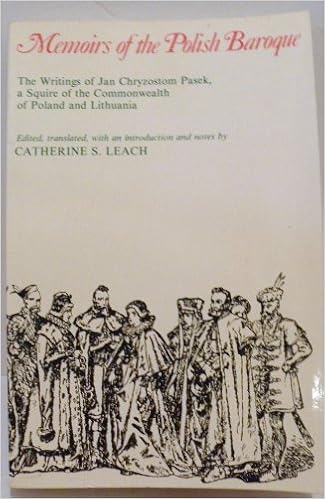
Memoirs of the Polish Baroque: Pasek, Jan Chryzostom, Leach ...Memoirs of the Polish Baroque: The Writings of Jan Chryzostom Pasek, A Squire of the Commonwealth of Poland and Lithuania by Jan Chryzostom Pasek, translated by Catherine S Leach, 296 pages

In his time, Jan Pasek fought in battles, got in duels, trained an otter to fish, flirted with treason, helped elect kings, and fretted endlessly about his finances.  It was, on the whole, an unremarkable life for a member of the 17th century minor Polish nobility.  What was remarkable was that Pasek chose to memorialize his life, writing summaries of his activities during each year to edify the children that, as God willed it, he would never have.  Long neglected, his memoirs were rediscovered in the 19th century and created a sensation, feeding into both the romantic fantasy of a picturesque past and a conquered people's dream of a nation.

Most 21st century readers will not share the concerns of either Pasek or his 19th century admirers, so that the appeal of the text depends on Pasek's charm and talent.  Fortunately, these are considerable - strong enough, in fact, to make the literal truth of the narrative largely irrelevant.  It helps that Pasek's embroideries of history lean towards edification more than self-justification.

Thursday, July 16, 2020

The Deluge

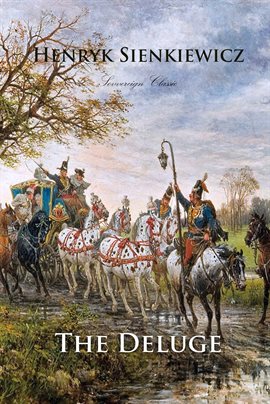
The Deluge, Volume 1The Deluge by Henryk Sienkiewicz, translated by WS Kuniczak, 1761 pages (2 vols.)

In the 17th century, the Polish-Lithuanian Commonwealth, already staggered by attacks from the Russians and the Cossacks in the east, was buried under the weight of the disciplined armies of Sweden which invaded from the north.  This dark time in Polish history is known as the Deluge.  It was a time when many who might have been expected to lead the nation instead betrayed her, but also a time when heroes arose from unlikely places and circumstances.  Sienkiewicz's epic novel centers on one of the latter, the passionate, impetuous, spirited young officer Andrei Kmita, who finds himself unexpectedly betrothed to the beautiful, virtuous Olenka and becomes locked in a battle with himself to become worthy of her.  Their world is populated by memorable characters: the valiant, diminutive Volodyovski, the silver-tongued braggart Zagloba, the fractious Kemlitches, the devious Radzivill, and the diabolical Prince Boguslav.

The Deluge is an unqualified masterpiece.  It is natural to compare it to Tolstoy and Undset, but it can just as accurately be placed alongside Homer, Virgil, and the Romance of the Three Kingdoms.  The "modern translation" by WS Kuniczak was released in 1991, after the end of another, even longer and darker chapter in the history of Poland.  In that context, it should be even clearer that what was fought for was something much greater than the "rights and privileges" of the nobility, greater too than what Thomas Napierkowski, in his introduction to this edition, celebrates as "political pluralism... democratic institutions and... a free economy", something glimpsed at the turning point when Andrei, expiating his sins by risking his life in defence of the great Marian shrine of Jasna Gora, declares himself "a soldier of the Holy Mother, fighting Her battles."

Friday, September 20, 2019

There Will Come a Darkness

There Will Come a Darkness by Katy Rose Pool, 496 pages

This is a pretty solidly written action-adventure fantasy. The world is interesting and different. I felt like lots of elements of it were based on ancient history, in areas like Greece and Rome. I also liked the prophecy aspect of it, of five different characters whose stories will eventually overlap, each with their own role to play in this prophecy.

This book, while having familiar elements like good vs. evil, people with powers vs. people without, and prophetic hints for the future, it still managed to surprise me every once in a while.

The only thing that held me back from liking it was the fact that I didn’t care for any of the characters, which is usually a big bummer for me and keeps me from enjoying the book very much. But, I’d still recommend it, because I’m sure there are plenty of readers out there, especially fans of the fantasy genre, who would enjoy this book a great deal. It’s got action, it’s got supernatural elements, and it’s got a classic “end of the world” scenario on the horizon. So definitely check it out.

Wednesday, April 17, 2019

We're Doomed, Now What?

We're Doomed, Now What? Essays on War and Climate Change by Roy Scranton, 348 pages

This collection of essays is divided into three parts. The first part is on climate and change. The second part is on war and memory. The third part is on violence and communion.

Scranton does a good job of laying out the issues related to climate change. Unfortunately, he doesn't have any answers for fixing it. In one of his essays he argues that we may be past the point of preventing climate change and that we are probably better off preparing for what comes after our current civilization collapses.

In the second section, in talking about why he joined the military after 9/11, he admits that part of the reason was that he wanted to be able to write about it afterward. The essays reminded me of some things I had forgotten about the war and the aftermath.

Another essay bring us up to date on what the state of the arts and politics are in Iraq. He also talks about writing about war.

I can't say that I loved this collection but I did appreciate some of the writer's thoughts on the second Iraq war, the aftermath and the personal effects of thinking about climate change.

Tuesday, October 16, 2018

Daughter of Xanadu

Daughter of Xanadu by Dori Jones Yang     352 pages

From Goodreads:

Athletic and strong willed, Princess Emmajin's determined to do what no woman has done before: become a warrior in the army of her grandfather, the Great Khan Khubilai. In the Mongol world the only way to achieve respect is to show bravery and win glory on the battlefield. The last thing she wants is the distraction of the foreigner Marco Polo, who challenges her beliefs in the gardens of Xanadu. Marco has no skills in the "manly arts" of the Mongols: horse racing, archery, and wrestling. Still, he charms the Khan with his wit and story-telling. Emmajin sees a different Marco as they travel across 13th-century China, hunting 'dragons' and fighting elephant-back warriors. Now she faces a different battle as she struggles with her attraction towards Marco and her incredible goal of winning fame as a soldier.

Review:

I was very intrigued by this story when I first came across it. I have not really read anything about the Mongolian Empire, nor do I remember much about it from history classes. I was interested to see how the author would make this early empire come to life, especially as its told from a young woman's perspective.

And not just any young woman, but a princess and granddaughter of Khubilai Khan who wants to be a soldier in his army. Emmajin was a fascinating character, full of courage and strength. Even in her moments of fear and "weakness" she still showed a strong sense of self and a desire to be better, to be open minded, to learn. I loved watching her grow over the course of the novel, from a woman fighting for her right to her own future, a position in the army (a place no woman had been allowed before), and a strong desire to prove herself to someone who values peace, the cooperation with peoples of other nations, and a desire to end wars. Not only is Emmajin an excellent example of a strong female protagonist, she is also a really interesting person and seeing the world through her eyes was very enjoyable.


Overall, this was a good historical fiction story. It had twists and turns and a really well written character arc. If you're into historical fiction, or if you really dig character development, this is a good one to pick up.

Thursday, September 6, 2018

Good Omens

Good Omens: The Nice and Accurate Prophecies of Agnes Nutter, Witch by Terry Pratchett and Neil Gaiman     412 pages

According to The Nice and Accurate Prophecies of Agnes NutterWitch (the world's only completely accurate book of prophecies, written in 1655, before she exploded), the world will end on a Saturday. Next Saturday, in fact. Just before dinner.

So the armies of Good and Evil are amassing, Atlantis is rising, frogs are falling, tempers are flaring. Everything appears to be going according to Divine Plan. Except a somewhat fussy angel and a fast-living demon—both of whom have lived amongst Earth's mortals since The Beginning and have grown rather fond of the lifestyle—are not actually looking forward to the coming Rapture.

And someone seems to have misplaced the Antichrist . . . 


This was an interesting read - it took me a while to get into it and get used to the format of the book. If you're not a fan of constantly switching pov, then you might want to skip this, because there is a large cast of characters and many of them get at least a little portion of the text from their perspective. In this way, it was a bit tricky remembering people as you read the book, especially if they were just a minor character and they popped up early in the book and many not again until much later.

In this way, I think the movie of this book might actually be a better format for this kind of story. It will be easier to remember characters, for one, but also the humor that Pratchett and Gaiman employ might come off better told from actual people than being read on a page.

The humor was another thing that made it difficult for me to absolutely love this book. I guess since I'm not British, some of the humor just went over my head. Also, because I'm not as familiar with certain customs or companies that were either real and mentioned or parodied, it didn't come off as funny to me, per say. There were also lots of references and playing off of Biblical subject matter, and since I did not grow up learning Biblical subject matter, a lot more might have gone over my head. However, there were some pretty funny bits and I did enjoy a good portion of the book.

All in all, it was fun read, but it didn't roll along easily for me. I definitely read it in chunks. I would recommend it, but only to people who I think this humor would go over well with.

Wednesday, July 18, 2018

Red Rising

Red Rising by Pierce Brown     382 pages

Darrow is a Red, a member of the lowest caste in the color-coded society of the future. Like his fellow Reds, he works all day, believing that he and his people are making the surface of Mars livable for future generations.

Yet he spends his life willingly, knowing that his blood and sweat will one day result in a better world for his children.

But Darrow and his kind have been betrayed. Soon he discovers that humanity already reached the surface generations ago. Vast cities and sprawling parks spread across the planet. Darrow—and Reds like him—are nothing more than slaves to a decadent ruling class.

Inspired by a longing for justice, and driven by the memory of lost love, Darrow sacrifices everything to infiltrate the legendary Institute, a proving ground for the dominant Gold caste, where the next generation of humanity's overlords struggle for power. He will be forced to compete for his life and the very future of civilization against the best and most brutal of Society's ruling class. There, he will stop at nothing to bring down his enemies... even if it means he has to become one of them to do so.


This book took some time getting into it. The setting up of this futuristic world was tricky to take on and anyone who is not very fond of sci-fi might have difficulty getting past it to the more interesting bits of the dystopia/character building/plot.

There are things I enjoyed very much reading this book and things that made me feel less interested in it. The things I didn't care for are that it trods in the path of many previous sci-fi books with a male lead who must save the world. That wouldn't be so bad because, after all, one of my favorite books is Ender's Game, buuuut, the fact that this book has that and that the catalyst that starts the whole thing is the death of his wife. A woman has to die to give Darrow the rage and drive he needs to take down the system. I feel like this is such an overused trope that it makes me depressed when I read it these days. Of course a woman has to die to give the main character the start he needs. Of course, of course, of course.

Aside from that, once the story really gets going there is a lot of violence, rape, and anger that is not my cup of tea. So many people are brutally maimed or killed, the mention of "pissing" on people happens at least a dozen times. I don't really care for that aggressive, animalistic stuff. It's not interesting to read and it's also gross.

Things I did like were the characters. I think Mustang, Pax, Roque, Sevro, and many others are really what makes this book strong. The building of a team, an army, what makes them all work together and trust their leader, Darrow, unconditionally is what really gets you interested in where the story will go. It reminded me a lot of Ender's Game. And the name "Wiggin" is even used, as if that story were an actual part of history. It made me smile.

The plot is strong, once you get past the first twenty or so chapters. That's where the book really hits its stride. If you can wade through the beginning to get this far, it is worth the time. It's action packed, the characters are finally becoming whole people, building off each other, and the plot is full of neat surprises and twists. It is enough of crest to ride till the end. I will definitely finish reading this series. The story captured me enough for that.

I would recommend this book to those who are fond of sci-fi, in addition to liking dystopias. There's also a lot of Greek/Roman mythology mixed in there, so if that's something you're into, it's a neat little feature in this book. Cheers.

Friday, May 25, 2018

Behemoth


Behemoth by Scott Westerfeld, 485 pages
Bottom of Form
“The behemoth is the fiercest creature in the British navy. It can swallow enemy battleships with one bite. The Darwinists will need it, now that they are at war with the Clanker Powers. Deryn is a girl posing as a boy in the British Air Service, and Alek is the heir to an empire posing as a commoner. Finally together aboard the airship Leviathan, they hope to bring the war to a halt. But when disaster strikes the Leviathan's peacekeeping mission, they find themselves alone and hunted in enemy territory. Alek and Deryn will need great skill, new allies, and brave hearts to face what's ahead.” I can’t believe that I waited so long to read Westerfeld’s books.  I love this series and teens who like steampunk, adventure, or fantasy will want to read it.

Tuesday, April 3, 2018

Furyborn

Furyborn by Claire Legrand     512 pages (read an ARC of this book)

Rielle and Eliana fight in a cosmic war that spans millennia, their stories intersect, and the shocking connections between them ultimately determine the fate of their world--and of each other.

This book is a wild, high-fantasy ride. There is war, there is "elemental" magic, there is love-triangle madness, and there is lots and lots of female-badassery.

This book felt like a hot-mess to me in a lot of ways, starting with the world building. I could never quite get a handle on the general lay of the land these characters moved about in, nor get a feel for what everyday life is like for the average citizen living either in the "past" portions of the story or the "future" portions. I couldn't really tell if Celdaria was a kingdom by itself or was one of many kingdoms, I couldn't tell what other areas were allies with Celdaria. It was just a lot going on and not a lot well defined.

Also, the magic. It never seemed well described to me. Elementals can wield a certain element, but from the descriptions I couldn't tell what "wielding" it actually looked like, and why everyone need a casting in order to do this and how that effects their magic. I also couldn't tell if some people were better at using their element then others, or even how many people are born elemental (like, is it a large portion of the population? Is it genetic? Is one elemental likely to birth a child who is able to use the same element? Do people without elemental ability begrudge those who do have the ability? Does the existence of elementals make ruling the kingdom difficult if you're not an elemental ruler? How are elementals policed so they don't use their elements for bad? I could go on, but that would take too long for this review). All in all, I'm left with lots of questions and no answers. It was a bit distracting while I read this book.

I'll be curious to see how the rest of the series goes, since so much of Rielle's story is already given knowledge in Eliana's world. I am definitely curious enough to keep reading the series as it progresses, but I certainly hope the following books will shed more light on the things I want to know. Overall, I would say I enjoy the story this series is trying to tell and I would recommend it to people I know who love high-fantasy (with romance).

Saturday, March 31, 2018

The Alice Network


The AliceNetwork by Kate Quinn, 503 pages
“In an enthralling new historical novel from national bestselling author Kate Quinn, two women--a female spy recruited to the real-life Alice Network in France during World War I and an unconventional American socialite searching for her cousin in 1947--are brought together in a mesmerizing story of courage and redemption. 1947. In the chaotic aftermath of World War II, American college girl Charlie St. Clair is pregnant, unmarried, and on the verge of being thrown out of her very proper family. She's also nursing a desperate hope that her beloved cousin Rose, who disappeared in Nazi-occupied France during the war, might still be alive. So when Charlie's parents banish her to Europe to have her "little problem" taken care of, Charlie breaks free and heads to London, determined to find out what happened to the cousin she loves like a sister. 1915. A year into the Great War, Eve Gardiner burns to join the fight against the Germans and unexpectedly gets her chance when she's recruited to work as a spy. Sent into enemy-occupied France, she's trained by the mesmerizing Lili, the "Queen of Spies", who manages a vast network of secret agents right under the enemy's nose. Thirty years later, haunted by the betrayal that ultimately tore apart the Alice Network, Eve spends her days drunk and secluded in her crumbling London house. Until a young American barges in uttering a name Eve hasn't heard in decades, and launches them both on a mission to find the truth...no matter where it leads.” I loved the movement between the two stories in this book.  I love historical fiction and I loved that this moved between the two World Wars, instead of between contemporary and historical.  This will appeal to people who like historical fiction, realistic fiction, and adventure.  It was an amazing book.

Saturday, December 16, 2017

The Power

The Power by Naomi Alderman     386 pages

What would happen if women suddenly possessed a fierce new power?

In THE POWER, the world is a recognizable place: there's a rich Nigerian boy who lounges around the family pool; a foster kid whose religious parents hide their true nature; an ambitious American politician; a tough London girl from a tricky family. But then a vital new force takes root and flourishes, causing their lives to converge with devastating effect. Teenage girls now have immense physical power--they can cause agonizing pain and even death. And, with this small twist of nature, the world drastically resets.


This was going to be a four star book for me, but it ended up just being something I liked, rather than loved. I think the premise is really interesting - if the tables were turned, would women truly take the power they were given and use it any differently than the power men have? I believe the author is trying to make the claim that power corrupts and it doesn't matter what gender you are, if you've got power over other's you're going to naturally dominate and take that power as far as you can go with it.

Overall, the story was compelling. I don't think the events in the story were totally believable in the end, but I like the idea of it and I applaud Alderman for showing that gender doesn't matter when it comes to power-hungry individuals. 

Thursday, November 30, 2017

Shadowcaster

Shadowcaster by Cinda Williams Chima, 551 pages

Fells Princess Alyssa Lyss Gray, aka The Gray Wolf, much prefers the battlefield to the throne room, but her sister's assassination by King Gerard of neighboring Arden means she's now heir to the throne. The war with Arden is dragging on, and finally she convinces her mother to stage a preemptive strike, capturing an attractive Ardenine lordling in the process. Meanwhile, Breon a fugitive, magically talented musician who has no idea of his heritage is trying to avoid both Lyss' men and a mysterious, ruthless empress bent on taking his magic for herself.”  Excellent sequel to Flamecaster.  I’m anxiously awaiting the next book in the series.  I would give this to anyone, especially teens, who likes fantasy.

Thursday, November 2, 2017

The Standard Grand


The Standard Grand  by Jay Baron Nicorvo    368 pages

I was excited when I obtained a copy of Nicorvo’s debut novel. Set in 2012, it’s the story of a halfway house for homeless veterans suffering from PTSD and located in an abandoned Catskills (NY) resort.

One of the vets, Antebellum Smith, is actually AWOL from her post in Fort Leonard Wood. She can’t face a third deployment to Iraq and is sick and tired of her deadbeat civilian husband. She makes the trek from the Missouri Ozarks to Manhattan. She’d rather sleep in the park than go back.

She meets Milton Wright, a Vietnam vet and widower. Milt’s late wife’s family once owned the derelict property.

That was as much as I could decipher in this convoluted tale. There is a huge cast of characters, but thankfully, Nicorvo provides a list of who’s who before the story even starts. Most of the book is written in military lingo that was easy to figure out what it was, but for me it slowed the story down.

This work has been getting rave reviews, but it didn’t click with me. Every book had its reader(s), but this one isn’t for me. The Standard Grand gets 1 out of 5 stars in Julie’s world.

Wednesday, July 5, 2017

Crimean Nexus

The Crimean NexusThe Crimean Nexus: Putin's War and the Clash of Civilizations by Constantine Pleshakov, 170 pages

Geographically, the Crimea offers a gateway to - and from - the Eurasian heartland.  Climatically, it brings the sub-tropical Mediterranean into contact with the northern steppes.  Culturally, it is one of the great crossroads of civilizations.  Colonized in turn by the Greeks, Romans, Goths, Byzantines, Mongols, Turks, and Russians, by the nineteenth century it was said to be the home of over fifteen nationalities, a place where every town spoke a different language, but like so many places in the "bloodlands" between the Volga and the Elbe its ethnic history was largely rewritten in the first half of the twentieth century.  Under Khrushchev, the Crimea was incorporated within the Ukrainian Soviet Socialist Republic, and it remained part of the Ukraine when the USSR dissolved despite its large Russian population and strategic importance to Russia.  Meanwhile, despite Kiev's status as the first city of the Rus, the Ukraine has had little experience as an independent nation, having been under the rule of the Poles, the Ottomans, the Habsburgs, and especially the Russians, who dubbed the territory "Little Russia".

In many ways, Russia's undeclared war with the Ukraine, including the seizure of the Crimea, follows the now-familiar pattern of ethnic war, but that bloody pattern is further complicated by the direct involvement of great powers and the resurgence of Russian exceptionalism.  In Constantine Pleshakov's telling, "Putin's war" was the predictable consequence of a long sequence of events, but it is not the end of the sequence.  Pleshakov's short, readable guide to the region, its history, people, and significance is an excellent primer for whatever happens next.