Showing posts with label World War II. Show all posts

Tuesday, June 13, 2023

Chiang Kai-Shek

Chiang Kai-Shek: China's Generalissimo and the Nation He Lost by Jonathon Fenby, 505 pages

Chiang Kai-Shek rose from humble beginnings to rule over the most populous nation in the world.  In his time he fought Chinese warlords, Communists, and the army of Imperial Japan.  He was a general who throughout his career lost more battles than he won, but only in his war with Mao Tse-Tung was he irrevocably defeated.  For the remainder of his life he plotted his return, and even in death his body remains unburied, awaiting a final rest in a restored Kuomintang China.

In his biography, Jonathan Fenby has attempted to tell the story of Chiang's rise and fall, ending with the retreat to Taiwan.  He does so passably, providing a broad, readable biography without much depth or special insight.  The real matter is implied in the second half of the subtitle.  In Fenby's estimation, it was Chiang Kai-Shek who lost China, and no one else, certainly not the American and British allies who demanded Chiang support their goals and worldview.  How he could have saved it is another matter, and here Fenby only offers some weak gestures in the direction of a Western-style liberalism that he acknowledges would have likely accelerated the disintegration of the Kuomintang government.  For some readers, the dogmatic insistence that China had to Westernize, with the only choice being between liberal "reforms" and Marxist revolution, will only sharpen the poignancy of the tale.

Wednesday, July 13, 2022

Girls of Slender Means

The Girls of Slender Means by Muriel Spark, 176 pages

When the Jesuit priest Nicholas Farringdon is martyred in Haiti, he is remembered with fondness by the girls of the May of Teck Club, a boarding house for young women making their way in London.  Those girls, now women, grew to know him in the closing months of the War not as a priest or even a believer, but as the aspiring anarchist poet who once spent a night with Selina on the roof.  His acquaintance with the girls of the Club, it turns out, changed his life profoundly in ways none of them intended or could foresee.

The Girls of Slender Means is a beautiful novel that is exactly as long as it needs to be.  The obvious comparison is to Graham Greene, although Spark's novel is lighter and more feminine, without, however, becoming either superficial or sentimental.

Tuesday, March 8, 2022

Stalin's War

Stalin's War: A New History of World War II by Sean McMeekin, 666 pages

Sean McMeekin's provocative thesis in Stalin's War is that it is Stalin, not Hitler, who should be regarded as the central figure of World War II.  In proposing it, he is defying decades of Western historiography which has centered the war on Hitler's showdown with the French and British empires, as well as the Russian perspective in which the USSR is portrayed as the victim of Western perfidy and German aggression.  In McMeekin's persuasive retelling, neither the European nor the Pacific wars would have happened absent Stalin's active encouragement, and even Barbarossa was just as much a consequence of Stalin's ambitions in Central Europe as Hitler's.  Even more importantly, Stalin received from the war more than he could ever have hoped for, not only a mostly free hand in Central Europe and East Asia, but immense subsidies from US taxpayers to help build the Soviet military-industrial base.

The book is necessarily long and repetitive, yet McMeekin writes in a way that saves it from becoming ponderous.  Some may find the seemingly endless catalogues of lend-lease material supplied to an ungrateful mass murderer tiresome, but this is more than compensated for by the foregrounding of information which will be new even to those generally well-informed about the Second World War.

Saturday, June 5, 2021

Radar Girls

Radar Girls by Sara Ackerman 368 pages

Daisy Wilder lives on the Hawaiian island of O’ahu (the spelling the author uses and is correct). She lives in an oceanfront shack with her mother, who is suffering a deep, deep depression. Daisy works on a nearby ranch to support them, and she loves working with the horses. Other than the people she works with, she has no other social life.

On the morning of December 7, 1941, Daisy has “borrowed” one of the ranch’s finest stallions, Moon, for a run on the beach. He is coal black with a gently fierce heart. As the Japanese planes roar overheard, headed to Pearl Harbor, Moon bolts and runs away.

Terrified for the animal, Daisy looks for him, but to no avail. She needs to get back to the shack to be with her mother. Her mother is oblivious, but Daisy is terrified. Will there be a land invasion? There have been rumors. What about Moon? What will the Japanese do to him if they find? What about her mom?

As the day progresses, Daisy’s anxieties dim, but never go away (and they will stay with her for the next four years). She tries, in vain, to find Moon. There is talk of relocating all civilians to the Mainland. She knows she has to get her mother to California to be with a relative, but Daisy plans on staying on the island.

After searching for Moon, who seems to have just disappeared, Daisy must tell the ranch’s owner what has happened. Hal Montgomery is beside himself, accusing Daisy of stealing and fires her. She is devastated.

Mr. Montgomery’s son, Walker, comes home before the bombs fall to heal from a severe concussion.. He is a navy pilot, but now it’s all hands on desk.  He is stationed aboard the USS Enterprise. And we all know what happens when boy meets girl.

Wanting to do her part for the war effort, and since she is out of a job, Daisy signs up for the Women’s Air Raid Defense. The military is looking for twenty intelligent women to help provide air defense for Hawaii. Daisy passes all the tests and is made part of the team. There she finds something she has never had before, female friendship. She must learn to navigate these are much as she learns to navigate the radar system.

Throughout the entire war, Daisy never loses hope of finding Moon and is always on the lookout.

The details about those early days in radar were fascinating and author Ackerman does a wonderful job balancing too much information and teaching me something new.

Thanks to Ackerman’s vivid descriptions of the Hawaiian Islands, the ocean, the fish, the salty air, reading “Radar Girls” is like taking a beach vacation without getting sand in your underwear. It’s also a boy-meets-girl-loses-boy-gets-girl story set against the beauty of Hawaii and the fears and the uncertainties of World War II. Therefore, “Radar Girls” receives 5 out of 5 stars in Julie’s world.


Friday, November 27, 2020

From the Terrace

From the Terrace by John O'Hara, 897 pages

Born to an alcoholic mother and a father who had spent all his love on a son who died too young, Raymond Alfred Eaton grew up in a cold home with a cold future - one day he would inherit the family steel mill and live out his days as the biggest fish in the small pond of Port Johnson, Pennsylvania.  The larger world beckoned, however, and after a spell at Princeton he chose instead to seek his fortune on Wall Street and to serve his country in Washington, DC.  Along the way he struggles to maintain his integrity and reputation in the boardroom, the war room, and the bedroom.  His failure is an American tragedy.

John O'Hara, once considered to be a major American writer - even a potential Nobel Prize winner - is mostly forgotten today.  A mere two years after its publication, From the Terrace was made into a "major motion picture" starring Paul Newman and Joanne Woodward, but it is no better remembered than the novel.  If this is unjust, it is hardly surprising, as From the Terrace is today as redolent of its own moment in time as its descriptions of life in the first half of the twentieth century are reflective of those eras, particularly its prurient obsession with sex.  On the other hand, it is a remarkably complex page-turner.

Monday, December 30, 2019

Grass

Grass by Keum Suk Gendry-Kim   471 pages

This adult graphic novel tells the true story of a Korean "comfort woman" and documents how the atrocity of war devastated women's lives.  Telling the life story of a girl names Lee Ok-sun who was forced into sexual slavery for the Japanese Imperial Army during World War II, this book unflinchingly gives the compelling and horrifying details of what she went through, as well as other "comfort women."  Using an art style that is detailed, and heavy on black ink brushwork, the author/artist brings her interviews with Ok-sun into compelling detail. 

I had read a review of this book and was interested in the topic, and was curious about the treatment that a graphic novel would give to this first-person narrative. It's a very good book, although the topic is quite serious and at times, I had to close the book and just think and reflect a bit -- because it was sometimes tough to get through.  Definitely an interesting book for students of World War II history who are not familiar with this particular bit of history, or what these women went through.

The Huntress

The Huntress by Kate Quinn    530 pages

This historical fiction story focuses on a team of people searching for a woman who is a Nazi war criminal, who is hiding somewhere in America. Going back and forth in time, the story has some unforgettable characters.  Nina has always dreamed of flying and when she gets the chance to join the legendary Soviet night bomber regiment, she doesn't mind that the life is hard and dangerous. However, when she is stranded behind enemy lines, Nina becomes the prey of the lethal woman known as The Huntress.

In the present, British war correspondent Ian is working with another man to try to find The Huntress, who has apparently gone to ground somewhere in America. In Boston, 17 year-old Jordan is interested in going to college and becoming a photographer, although her father has other ideas. When he brings home a beautiful new fiancee, Jordan is thrilled --- but there's something a little off about this woman.

And, as you probably suspect, the new fiancee is likely the Nazi war criminal . . . or is she?  This is a novel of cat-and mouse, which includes real life details of people during World War II, making it an immersive, exciting story.  Definitely a great book for fans of historical fiction, especially stories about unusual and brave women.

Sunday, September 22, 2019

The Daughter's Tale

The Daughter's Tale: A Novel by Armando Lucas Correa     Audio Book:  9 hours, 8 mins       Hardback Book:  320pages     

Good Book.   One I couldn't put down.   A tragedy.   A Jewish family torn apart by the SS coming into the town.   First the father, a heart surgeon, who refuses to leave and take his family to safer shores because he does not want to leave his patients.   A mother left with 2 daughters and the stigma of being Jewish under Nazi rule.    It is told with such deep emotion that the reader will be touched by the multitude of horrific acts occurring.   The mother in the story has the great opportunity to save her daughters from the life she has endured but at the last minute chooses only to save the one leaving her all alone sailing away to an Uncle she has never met asking another passenger to please keep an eye on her 6 year old daughter.   For what reason I cannot understand she keeps the youngest daughter with her and the girl's life becomes a travesty of abuse.  It never made sense to me to force one girl to face the world alone and terrified then keeping the other girl seeing clearly the writing on the wall of where and how life was going to go.   The story is so good but like watching a trainwreck you know how it is going to go but you cannot turn away,.  The hard times may make you strong, but, why force one to endure hard times when there was a chance for escape.   At the end of the story I still did not forgive that woman for denying one daughter her freedom thereby sentencing her to the whims of Jew hating Nazis.   I can't even justify the act by the mother being self-ish and wanting to keep her, because, she never seemed love her overly much.   There are many things that come to light in this story and it is gripping.   Well written.  I would highly recommend this story to all who enjoy stories from WWII from Middle Schoolers on up,.   The tragic lives will stay with young readers and adults.    A good look at people enduring WWII.

Wednesday, July 10, 2019

The Light Between Worlds

The Light Between Worlds by Laura E. Weymouth                 Audio Book:  9 hours, 30 minutes     Paperback Book:  384 pages              

At first I though, o.k. this is a Narnia knock-off, but then midbook it takes a different turn.   Instead of staying with the fantasy of the magical other life in the Woodlands, when war begins to rage in the Woodlands though they have spent 6 ½ years in the fantasy world they are sent back to their childhood selves in London to the time before they were allowed to enter the Woodlands.    Lots happens and a really good account of what it must have been like living in London during the dropping of the bombs from German planes.   Also a trip into the brokenness of a young girl’s mind when she finds she cannot cope with living in this world anymore asit is killing her.    She loses her adventuress spirit as she does her best to contend with boarding school life amid growing up a second time, being cut-off from the sister who had been more a mother to her as the bonds between her and her parents were fairly non-existent.   While the parents tried to save the children by bundling them off to relatives and friends evry chance they got to keep them safe, they also destroyed whatever bond there had been between the children and themselves.  The only thing the children could count on was moving to another locations and staying with people they hardly knew some who expected them to work for them others who tried to be understanding but they had no real ties to.   Escaping to the Woodlands made the children feel loved and cherished, but, even after all the time they spent there proving their metal they still were made to leave.   Like Alice down the rabbit hole then returning home once changed home is never home any more.  As the sisters do their best to make their way and their brother remains concerned but aloof, Ev, the youngest sister slips into a lethargy she cannot shake.  She stops eating, she loses weight, though her brother has a friend watch over her, who falls in love with her, nothing can ease the sorrow Ev undergoes having to stay in this world when the world she feels a part of is denied her.    She calls for the Guardian of that world to please let her return as he always said while they were living with him, “A Woodlanders heart will always find a way back home.”  But how?   It turned out to be a good story, more cerebral and bound by WWII, tea time and a family that just cannot find its way back together, though, the parents were caring they just didn’t know how to repair the gap they created with their children.    The fantasy world seemed like a place so many of us would love to visit and maybe stay in though it wasn’t without its evil, too.    I would recommend this book, I think it would be better received by those unfamiliar with the Narnia series by C.S. Lewis then there wouldn’t be that mental comparison going on, but, the story does go off in a different direction so readers can wonder which world would have been their choosing and if that world was actual or a means of dealing with the horrors of war?   A lot like Narnia.

  - Shirley J

Saturday, April 13, 2019

Duty: A Father, his son and the man who won the war

Duty: A Father, His Son, and the Man Who Won the War by Bob Greene              Hardcover: 296 pgs.

     The dropping of the atomic bomb is a very interesting part of history to me, so this book was a thrill to read, as it’s largely about Col. Paul Tibbets, the man who piloted the plane that bombed Hiroshima.  Greene, a columnist for the Chicago Tribune and Life magazine, narrates how he met, interviewed and ultimately became good friends with the aging World War II pilot (who has now passed away).  The author is obviously very curious about “the man who won the war” and asks many insightful questions; Tibbets responds with some very interesting answers about the war and his general outlook on life.  What’s especially interesting, of course, is reading what Tibbets thought of his bombing of Hiroshima.

     Tibbets’ perspective alone would make for an engaging book, but the author adds a second layer.  A very skillful writer, Greene weaves in the story of his father’s attitude on life and experience in World War II with that of Col. Tibbets.  The result is a compelling portrait of the opinions and outlook of the World War II Generation.  The book title, Duty, is a great one-word summary of that generation’s emphasis and perspective.

     This is a very well-written book and will help readers of younger generations better understand and appreciate their parents, grandparents or great-grandparents.  Greene’s wonderfully-crafted book gets 5 out of 5 stars in my book.   ⭐⭐⭐⭐⭐   

 - John W.


Friday, March 22, 2019

Lee Miller: A Woman's War

Lee Miller: A Woman's War by Hilary Roberts   224 pages

So, after reading the novel based on the life of Lee Miller, I went into our Fine Arts collection and found some books on Miller and her work.  This book was published to coincide with an exhibition at the Imperial War Museum and shows that Miller's work as a war photographer showed that she was one of the most important photographers of the twentieth century. The book has an introduction by Miller's son, Antony Penrose, and is divided into chronological chapters, so you get an understanding of her work along with the photographs. The extended captions that accompany photos, some of them previously unpublished, really make this book an excellent way to understand Miller's work and also her work in the context of the role of women in World War II.  As a journalist, Miller documented the social consequences of the war, particularly the impact of the war on women across Europe.  Definitely a great way to learn more about her and her work if you read The Age of Light.


Saturday, January 5, 2019

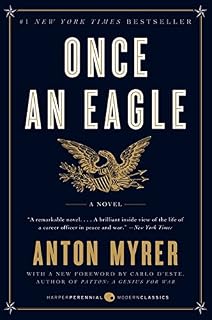
Once an Eagle

Image result for Once An Eagle Myrer, AntonOnce an Eagle by Anton Myrer, 817 pages

Once an Eagle is the story of Sam Damon, a square-jawed Nebraskan with an unerring instinct for the right thing.  When the US enters the First World War shortly after he has managed to secure a place at West Point, Sam enlists as a common soldier.  Through intelligence, luck, and courage he wins a commission and the Congressional Medal of Honor.  Then follow his marriage to the spirited general's daughter Tommy, the long, slow, difficult interwar years, and the long, fast Hell of the Pacific Theater of World War II.  Throughout, his career is paralleled by that of Courtney Massengale, a Machiavel who understands only power and disdains Sam's values of obligation, sacrifice, and love.  Together, they represent opposing forces in the American military, government, and society - Sam's personal virtue against Massengale's careless self-aggrandizement.

Anton Myrer does not write with the sweep of Herman Wouk or the battlefield intensity of Harold Coyle, and, as a result, is less engaging than either.  This is true despite having a length sufficient for one of Wouk's soap opera epics.  One of the themes of the novel's central third is the tedium of peacetime military service - unfortunately, it proves tedious for the reader as well.

Wednesday, October 31, 2018

Different Days


Different Days by Vicki Berger Erwin, 270 pages
“Twelve-year-old Rosie is fiercely proud to be an American, and has a happy life with her family in their comfortable home in sunny Honolulu, Hawaii. Then, on the morning of December 7, 1941, Pearl Harbor is bombed and everything changes. Rosie's parents, both of German descent — but American citizens who have lived in Hawaii nearly all their lives — are immediately rounded up by the military. Though they've done nothing wrong, they are interrogated as German spies and imprisoned, and all the family's possessions are seized. Within days, Rosie and her brother are abandoned and homeless. A relative begrudgingly takes them in until their beloved aunt (who was also rounded up, but released) comes for them. Even then, the children's once-idyllic lives are filled with darkness and discrimination as they can only wait — and hope — for their parents' safe return. Based on true events, Different Days tells the story of a little-known aspect of World War II: the Internment of German Americans.” I had no idea that German Americans were also sent to internment camps during World War II.  This book felt a little unfinished and unpolished to me but I liked the story.  Kids who like historical fiction would like it.

Monday, October 29, 2018

The Year of Our Lord 1943

The Year of Our Lord 1943The Year of Our Lord 1943: Christian Humanism in an Age of Crisis by Alan Jacobs, 206 pages

Samuel Johnson famously quipped that when a man knows he is to be hanged, it "concentrates his mind wonderfully."  For Christian thinkers in Europe and America, the catastrophe of the Second World War wonderfully concentrated their minds on the problem that liberal democracy could not, on its own, provide a convincing account of human nature to rival those proposed by fascist and socialist ideologies.  In The Year of Our Lord 1943 Alan Jacobs explores the disparate ways a number of disparate philosophers and poets, including Jacques and Raissa Maritain, TS Eliot and Simone Weil, CS Lewis and WH Auden, sought to rectify that deficiency.  Despite substantial differences, their thoughts all focused on culture and education, not only their necessity but also their limitations - indeed, all were insistent that any education which sought to contribute to the building up of the human person must preeminently be an education in limits and ends.

Jacobs perceptively highlights both the sympathies and antipathies among his subjects.  He is clear about his own biases, or is possibly simply unable to resist the occasional editorial comment, and those biases do not prevent him from being fair to those with whom he disagrees.  It is from this attitude that he is able to conclude with the observation that, at a point in history when the technical appears to have vanquished the human, Christians can find comfort and inspiration in their faith that history is itself ruled, not by a process, but by a Person.

Sunday, October 7, 2018

Nomonhan, 1939: The Red Army’s Victory That Shaped World War II

Nomonhan, 1939: The Red Army’s Victory That Shaped World War II by Stuart D. Goldman            Hardcover: 185 pgs.             Genre: History, World War II, Mongolia, China, Japan, Soviet Union

     Nomonhan is a Mongolian village straddling the boundary between Mongolia and Manchuria.  Today, Mongolia is an independent country and Manchuria is part of China, but in 1939, on the eve of World War II, the former was a client state of the Soviet Union, while the latter region was controlled by Japan.  The border between them was hotly disputed at the time— so hotly disputed, in fact, that an undeclared war erupted between the Japanese and the Soviets near the small village.  In this book, author Stuart Goldman makes the case that this forgotten border war significantly influenced World War II.  As a result of being soundly defeated by the Russians in the conflict, Goldman contends, Japan turned its attention toward expansion into Southeast Asia, putting it on a collision course with America and resulting in the Pearl Harbor attack.  Hence, the so-called “Nomonhan Incident” (also known as the Battles of Khalkhyn Gol) had a major influence on America’s entry into the war.  Another effect of the decisive Soviet victory, according to the author, was enabling Russia to survive the German invasion of 1941 and ultimately drive the Germans out of their country and all of Eastern Europe, helping to win the war for the Allies.  Goldman gives us a look at the diplomatic strategies of Britain, France, Nazi Germany and Russia leading up to the Second World War, allowing this reader, at least, to better understand the Nazi-Soviet Pact and the Rome-Berlin-Tokyo Axis agreement.  The author paints Stalin, especially, as a very shrewd leader.  I found these passages fascinating, but they make up less than half of the book.  Most of the book, understandably, talks about the conflict itself (the movement of armies on both sides), but in a very detailed, academic way that I found boring and hard to slog through.  I’m sure military historians and military personnel would find this part fascinating, but I think the average reader would agree with my assessment.  My opinion about the book, then, is divided: one “thumb up” for the diplomatic history and descriptions of grand strategy, but the other “thumb down” for an overly-detailed narrative of the conflict itself.

Friday, July 27, 2018

Battleship Yamato

Battleship Yamato: Of War, Beauty, and Irony by Jan Morris, 96 pages
Battleship Yamato

The Yamato was the largest and most powerful battleship ever built.  She played a minor role in two battles before being ordered, in the final months of World War II, to launch a Special - suicide - Attack against the American fleet assaulting Okinawa.  This mission was not expected to have any success, rather, it was intended to distract the Americans and provide an opening for a simultaneous kamikaze sortie.  The Yamato was tracked from the moment she left the Inland Sea and sunk barely halfway to her destination.  Over two thousand Japanese sailors died with her.  The attacking American planes suffered minimal losses.

In her brief, lyrical account, Jan Morris describes the Yamato as a beautiful ship, "a Dreadnought of Dreadnoughts", but obsolete before she was even finished.  The pride of the Imperial Japanese Navy, she was too valuable to be risked in battle, and so conserved until the war was lost, then sacrificed in a futile gesture.  Sacrificed with her were the imperial ambitions of the homeland whose name she bore.

Wednesday, July 11, 2018

Battle of Bretton Woods

The Battle of Bretton WoodsThe Battle of Bretton Woods: John Maynard Keynes, Harry Dexter White, and the Making of a New World Order by Benn Steil, 348 pages

In July of 1944, even as American and British troops fought side-by-side through the hedgerows of Normandy, representatives of the two governments squared off against each other in a resort hotel overlooking the small town of Bretton Woods, New Hampshire.  They were gathered there, along with over 700 delegates from 42 other nations, to begin to construct a postwar international economic system.   Attention was centered on Lord John Maynard Keynes, the most famous economist in the world and the head of the British delegation.  As a result of the war the United Kingdom was "mortgaged to America", a situation their delegation was eager to mitigate or escape.  The US delegation, meanwhile, saw the British Empire as a potential postwar rival, and would pursue an economic strategy designed to promote its dismemberment and assure postwar American dominance.  The architect of this American strategy was Assistant Secretary of the Treasury Harry Dexter White, who organized and manipulated the conference, and who was also, unbeknownst to both his American and British peers, a Soviet agent.

Although the story of what happened at Bretton Woods - how it both succeeded and failed - is doubtlessly an important one, it mostly takes the form of interminable committee meetings and memoranda exchanges in which the most abstruse minutiae of international finance are discussed.  Somehow, Steil finds enough interest in the characters and enough humor in the proceedings to keep the reader awake despite these handicaps.

Saturday, June 30, 2018

The Girls of Atomic City


Girls of Atomic City by Denise Kiernan   373 pages
In this true story, the author traces the story of the unrecognized WWII workers in the Tennessee town of Oak Ridge through interviews with dozens of surviving residents. One of the Manhattan Project’s secret cities created in 1942, didn’t appear on any maps until 1949, and yet at the height of World War II it was using more electricity than New York City and was home to more than 75,000 people, many of them young women recruited from small towns across the South. Their jobs were shrouded in mystery, but they were buoyed by a sense of shared purpose, close friendships—and a surplus of handsome scientists and Army men!
But against this vibrant wartime backdrop, a darker story was unfolding. The penalty for talking about their work-even the most innocuous details-was job loss and eviction. They all knew something big was happening at Oak Ridge, but few could piece together the true nature of their work until the bomb "Little Boy" was dropped over Hiroshima, Japan, and the secret was out. The shocking revelation: the residents of Oak Ridge were enriching uranium for the atomic bomb.
Although difficult to view through the lens of modern technology and communication, it is fascinating to imagine thousands of people accepting uncertain jobs in an unknown location for an undetermined amount of time, and then to keep what little became known a secret, even from those closest to them. Although it is a great story, it often read like a combination science/social studies textbook, information that was interesting the first time but dry after repeated telling. Had the story been told in half as many pages, it would have kept me engaged; as it were, however, I felt obligated to struggle through simply because it was a book club choice.
Posted By:   Regina C. 


Wednesday, May 23, 2018

The Taster

 The Taster  by V. S. Alexander   320 pages


Amid the turbulence of World War II, a young German woman finds a precarious haven closer to the source of danger than she ever imagined - one that will propel her through the extremes of privilege and terror under Hitler's dictatorship . . . 

In early 1943, Magda Ritter's parents send her to family in Bavaria, hoping to keep her safe from the Allied bombs strafing Berlin. After an interview with the civil service, Magda is assigned to the Berghof, Hitler's mountain retreat, and only after weeks of training does she learn that she will be one of several young women tasting the Fuhrer's food, offering herself in sacrifice to keep him from being poisoned.

Perched high in the Bavarian Alps, the Berghof seems worlds away from the realities of battle. Every bite is nerve wracking, but Magda gradually becomes used to her dangerous occupation. Equally dangerous is voicing her misgivings about the war, but her love for a conspirator within the SS, and her growing awareness of the Reich's atrocities, draw Magda into a plot that will test her wits and loyalty in a quest for safety, freedom, and ultimately, vengeance.

I love historical fiction, especially differing perspectives of the same event, proving time and again that reality is never black and white, but many, many shades of grey.  The Taster delights in the promise of young love, exposes aspects of Hitler on a personal level, depicts the dangers of living with paranoid personalities, and most importantly, examines the moral dilemmas and desperate decisions required by those living through war.

Posted By:   Regina C.   (submitted to Jen 5/21/18)


Sunday, March 11, 2018

Code Girls

Code Girls: The Untold Story of the American Women Code Breakers of World War II by Liza Mundy   416 pages

"In the tradition of Hidden Figures and The Girls of Atomic City, Code Girls is the astonishing, untold story of the young American women who cracked key Axis codes, helping to secure Allied victory and revolutionizing the field of cryptanalysis."

This nonfiction book reads like fiction, which is something I think makes for the best nonfiction. The author does a great job of bringing together a lot of information, but never losing sight of the fact that the focus is on the more than 10,000 women who served as codebreakers during World War II. The meticulous job of codebreaking is explained fully (although I never found it boring), so you really get a sense of what their work was like. This is a riveting part of U.S. history and I felt like the author's combination of research along with personal interviews with surviving code girls make this an important and fascinating read. I didn't really know very much about women's roles in codebreaking before reading this book ---- which is a shame, considering how many books have been written about World War II.  Really a great book!