Showing posts with label Maritain. Show all posts

Wednesday, September 17, 2025

Notes on the Lord's Prayer

Notes on the Lord's Prayer by Raissa Maritain, 122 pages

Assembled posthumously from notes left by the author for a work that was never completed, Notes on the Lord's Prayer is a commentary on the seven petitions of the Paternoster as recorded by St Matthew: Hallowed be thy name, Thy Kingdom come, Thy will be done, Give us this day our daily bread, Forgive us our trespasses, Lead us not into temptation, and Deliver us from evil.

In his foreword, Thomas Merton laments the modern division between "spirituality" and "theology", recommending this book as a corrective.  This should provide a suggestion of the depth of thought as well as feeling, of sense as well as sensibility, present in this meditation, designed not only as a pious exercise but also as an exploration of the divine mysteries.

Monday, October 29, 2018

The Year of Our Lord 1943

The Year of Our Lord 1943The Year of Our Lord 1943: Christian Humanism in an Age of Crisis by Alan Jacobs, 206 pages

Samuel Johnson famously quipped that when a man knows he is to be hanged, it "concentrates his mind wonderfully."  For Christian thinkers in Europe and America, the catastrophe of the Second World War wonderfully concentrated their minds on the problem that liberal democracy could not, on its own, provide a convincing account of human nature to rival those proposed by fascist and socialist ideologies.  In The Year of Our Lord 1943 Alan Jacobs explores the disparate ways a number of disparate philosophers and poets, including Jacques and Raissa Maritain, TS Eliot and Simone Weil, CS Lewis and WH Auden, sought to rectify that deficiency.  Despite substantial differences, their thoughts all focused on culture and education, not only their necessity but also their limitations - indeed, all were insistent that any education which sought to contribute to the building up of the human person must preeminently be an education in limits and ends.

Jacobs perceptively highlights both the sympathies and antipathies among his subjects.  He is clear about his own biases, or is possibly simply unable to resist the occasional editorial comment, and those biases do not prevent him from being fair to those with whom he disagrees.  It is from this attitude that he is able to conclude with the observation that, at a point in history when the technical appears to have vanquished the human, Christians can find comfort and inspiration in their faith that history is itself ruled, not by a process, but by a Person.

Friday, April 6, 2018

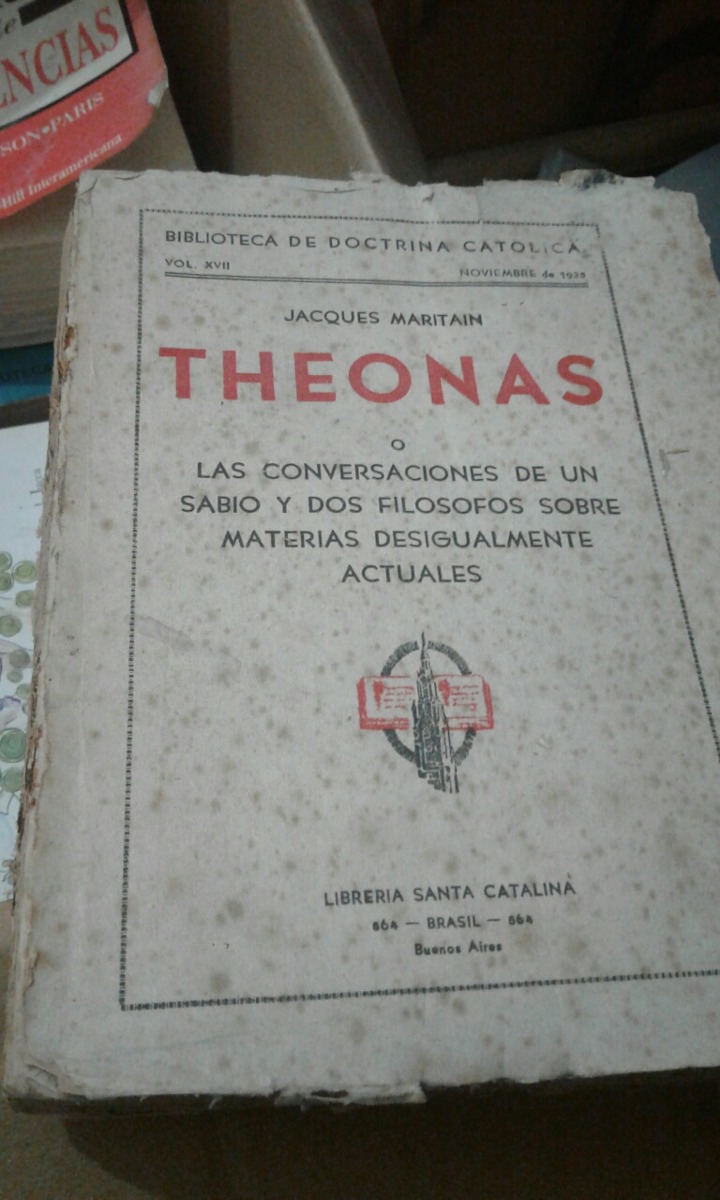
Theonas

Image result for theonas maritainTheonas: Conversations of a Sage by Jacques Maritain, translated by FJ Sheed, 185 pages

Theonas is a set of eleven dialogues centered on Theonas, a "hermit who reads newspapers", and his interlocutor, the modernist Philonous.  The text encapsulates much of Maritain's philosophical career in miniature - the possibility, reality, and necessity of a Christian humanism, the preservation of the human intellect from both angelism and bestiality, and, above all, Thomism as the only philosophical tradition capable of harmonizing these tensions and discriminating between healthy development and decadent corruption.

Given the dialogic form, it should not be a surprise that the book is more polemical than systematic.  Not that it is shallow or simplistic (the central dialogue compares the theory of time advanced by Einstein to that proposed by St Thomas), but here Maritain is more interested in showing the shortcomings of other philosophies than in more fully explicating his own.  Unfortunately, since his opponents are the fashionable thinkers of '30s France, this also makes Theonas itself more dated than most of Maritain's other work.

Wednesday, September 21, 2016

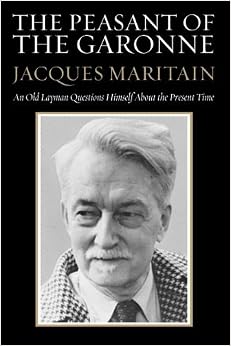
Peasant of the Garonne

The Peasant of the Garonne: An Old Layman Questions Himself about the Present Time by Jacques Maritain, translated by Michael Cuddihy and Elizabeth Hughes, 277 pages

This is Maritain's final testament, written from his retirement among the Little Brothers of Jesus in Toulouse, along the banks of the Garonne.  It is, however, more of a look ahead than a look back.  In the wake of the Second Vatican Council, Maritain chose "to offer known or unknown friends an opportunity... to hear some imprudent talker stammer out truths which are not welcome."

The first of those truths concerns the relationship between the Church and the world, a central theme of the Council.  Maritain distinguishes the different senses in which Scripture and Tradition speak of the world, criticizing those who would entirely reject the world as fundamentally wicked, but more pressingly warning against embracing the world uncritically, substituting its natural ends for the supernatural ends of the Church.  He moves on to a criticism of modern philosophy, which he maintains is better described as ideosophy, divorced from reality most powerfully experienced in the intuition of being.  This leads naturally to a consideration of the post-conciliar state of Thomism, about which Maritain proves remarkably sanguine, regarding the particular virtues of St Thomas Aquinas and his thought as necessary for the development of understanding, however infrequently his disciples have shared those virtues.  For the celebrated worker in the groves of academe now a humble peasant in a house of prayer, the only hope - for Thomism, philosophy, the Church, and the world - is in the activity of a clerisy of small groups and individuals who possess and share a sense of the love of God deepened through lives devoted to contemplation, in the cloister but especially outside.

Friday, July 29, 2016

Very Rich Hours of Jacques Maritain

Cover image for The Very Rich Hours of Jacques Maritain: A Spiritual Life by Ralph McInerny, 211 pages

In Ralph McInerny's account of the thought of Jacques Maritain, one of the recurrent themes is the Thomistic distinction between the knowledge connected with thinking and the knowledge associated with inclination.  In his account of the life of Jacques and his wife Raissa, the attainment of both kinds of knowledge is the central theme.  The couple heroically sought not only to know virtue and holiness as concepts but to live them as realities, dedicating themselves to the truth they found in the conclusion of Leon Bloy's The Woman Who Was Poor - "There is only one tragedy in life, not to be a saint."

McInerny (a philosopher by trade but best known as the creator of Father Dowling) models the biography on the hours of the Divine Office - Matins, Lauds, Prime, Terce, Sext, Nones, Vespers, and Compline - tracking the life of his subject from the dark of the morning to the dark of the evening.  Throughout, the personal lives of the Maritains are interwoven with the development of Jacques' philosophy.  The result is revelatory - a biography of a public intellectual and an examination of the thought of a great philosopher, but also a demonstration of what philosophy and faith can offer each other, and what both can offer life.

Friday, December 19, 2014

Art and Scholasticism

Art and Scholasticism with Other Essays by Jacques Maritain, 114 pages

In his short but influential essay "Art and Scholasticism", Maritain applies the tools of scholastic philosophy to the problems of art and aesthetics.  The result is a careful examination of the relationships between art and truth, art and goodness, and art and man.  In Maritain's analysis, the artist mimics the Creator in the work of incarnating the spiritual in the physical, a work which can be undertaken with saintly humility or Luciferian pride.

This collection also includes "The Frontiers of Poetry", which considers the metaphysical nature of poetry, and "Some Reflections Upon Religious Art", which addresses problems which arise when art is self-consciously religious.