Showing posts with label Comics. Show all posts

Monday, October 19, 2020

X-Tinction Agenda

 X-Men: X-Tinction Agenda by Chris Claremont, Louise Simonson, Jon Bogdanove, John Caponigro, Jim Lee, Rick Leonardi, Rob Liefeld, Marc Silvestri, Guang Yap, and others, 316 pages

The X-Men are not dead.  This seemingly unremarkable fact comes as a considerable surprise to some of their closest friends, including their old teammates in X-Factor and their former charges in the New Mutants, who, along with the rest of the world, believed they had been killed battling the Adversary in Dallas.  Life means they must continue to evolve - their leader, Storm, is trapped in the body of a child, the Cajun thief Gambit has joined the team, and the New Mutants are now led by the mysterious man known only as Cable.  

They will not have the leisure to work these issues out.  The apartheid state of Genosha, where mutants are genetically indoctrinated into becoming servants of the human population, launches an audacious raid against the X-Mansion, kidnapping a handful of young mutants.  As the American government and the international community consider their responses to this attack on US soil, the X-Men make their own assault on the island nation, little suspecting that the Genoshan forces are led by a brainwashed Havok, Cyclops' younger brother.  Worse, the entire crisis is being orchestrated by Cameron Hodge, Angel's former friend and business manager, who used the Worthington fortune to bankroll an anti-mutant militia and was ultimately responsible for the amputation of Angel's wings.  Now equipped with a monstrous cyborg body as hideous as his twisted soul, Hodge has manipulated the Genoshan government into open war with the X-Men, a war only one side can survive...

Despite being a crossover "event", X-Tinction Agenda feels much less like an interruption of ongoing storylines than most of the species, and this may, in fact, be part of the reason it is not as well-remembered as it deserves to be.  The strong continuity is no doubt largely due to the strength of the storytelling partnership between Claremont and Simonson.  Unfortunately, the art is a different story.  Lee's work is consistently excellent, but Bogdanove's is uneven and Liefeld proves here that his much-maligned later work was actually an improvement.  The trade paperback also includes the three issue arc which introduced Genosha, a serviceable story centered on Rogue with little hint of the many transformations the fictional nation would undergo in the ensuing decades.

Thursday, January 31, 2019

Blueprint For Disaster


Blueprint For Disaster by Darby Conley, 128 pages
The Get Fuzzy comics are hilarious.  This is a fun collection in which Bucky Katt tries to trap Fungo, the ferret next door, and loses his tooth.  Satchel is his usual sweet, bumbling self, and Rob just tries to keep the peace as much as possible.  Unfortunately, the library doesn’t own this volume, but fans will like several of the other Get Fuzzy collections the library does own.

Tuesday, January 15, 2019

Pantheon

Pantheon by Hamish Steele     179 pages

From Goodreads:

The most important myth in Ancient Egypt is faithfully retold in glorious black and white! Horus, son of Isis, vows bloody revenge on his Uncle Set.

Review:

A comic of Egyptian mythology told with dirty humor and violent imagery. This is a fun, quick read and you don't have to know anything about Egyptian mythology to enjoy it.

Wednesday, November 7, 2018

The Chilling Adventures of Sabrina

The Chilling Adventures of Sabrina by Roberto Aguirre-Sacasa     160 pages

From Goodreads:


On the eve of her sixteenth birthday, the young sorceress Sabrina Spellman finds herself at a crossroads, having to choose between an unearthly destiny and her mortal boyfriend, Harvey. But a foe from her family's past has arrived in Greendale, Madame Satan, and she has her own deadly agenda. Archie Comics' latest horror sensation starts here! 

My Review:

This dark, horror rendering of the traditionally peppy Sabrina series is very interesting. Full of Satan-worshiping witches, hellish creatures, death, and revenge, this comic is not for the faint of heart. I can't say I really loved the illustrations, but the story was interesting, new, and definitely out there. It's worth a look if you like the dark, creepy retro take on classics.

Friday, June 15, 2018

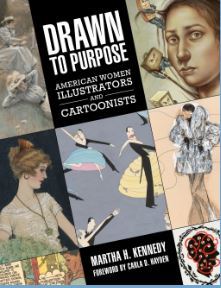
Drawn to Purpose: American Women Illustrators and Cartoonists

Drawn to Purpose: American Women Illustrators and Cartoonists by Martha H Kennedy   255 pages

This book was published in partnership with the Library of Congress and is a presentation of women in American illustration from the late 19th into the 21st century.  The author focuses on forms that haven't received much attention before, including political cartoons, editorial illustrations and cover designs, to show off the contributions of many women whose work has been overlooked.  She breaks down the book into sections, so you read about women who did cover designs, advertising work, etc. The book focuses on 80 women who created these works and you learn about their stories, artistic training, their experiences of gender bias in the workplace and much more.

I found this book fascinating!  I knew about some of these women, but I didn't know about a lot of them ---- and being able to learn about them and their work in the context of the societal norms of their day was really interesting. 

Wednesday, September 13, 2017

Archie, Vol. 3

Archie, Vol. 3 by Mark Waid, Joe Eisma (Illustrator)     176 pages  


This is the third volume in the "new," contemporary Archie series. This volume features the introduction of Cheryl Blossom to the Riverdale mix. The issues revolve around Archie and Veronica missing each other, due to Veronica's new placement at a boarding school in Switzerland. She meets Cheryl there and a new rivalry is formed.

I love the illustrations for this new series. It features many different comic illustrators and I think it really gives the series a refreshing look. The contemporary feel is reinforced by a more diverse cast - which includes both POC characters as well as LGBTQ+ characters. The story is silly and goofy, but that's the main point. It's just a fun, quick read.

Tuesday, February 28, 2017

A Right to Be Hostile

A Right to Be Hostile by Aaron McGruder  Book: 255 pages

A Right to Be HostileTwo young black boys and their grandfather move from the South side of Chicago to the suburbs and hilarity ensues. This book had me laughing and really the only reason it's so funny is that all the leftist diatribe is coming from a school-aged boy. If these lines were spoken by a grown man this would just be a political comic, but coming from a boy of maybe 10 it is hilarious. I'm not sure why it's funny when children talk like adults, but it's a formula that works. Huey (named after Huey P. Newton of course) is a revolutionary whose goal it is to take down the capitalist, racist regime known as the American government. His views on society, entertainment and especially politics are unwavering. This comic is controversial and it's easy to see why, but it is also easy to see why it's so popular. Huey's younger brother Riley wants to be "gangsta" complete with cars, money, girls (even though he doesn't want them to touch him!), and the fear of the people around him. Grandad adds his own special quality to the picture, being a traditionalist and thinking Huey really needs to calm himself down and act like other kids his age and Riley needs to do better in school and be less disrespectful. Along the way they meet some interesting characters that also add to the humor. Caesar is my favorite, he is basically the straight-man to Huey's insanity, agreeing with him on some things but calling him insane on others. I would recommend this book for those who are not easily offended because it does have some views with which certain people would strongly disagree.  

Tuesday, January 31, 2017

Cosplayers

Cosplayers by Dash Shaw, 111 pages

I went into this book knowing virtually nothing about it -- I needed something written by an author my age to fulfill a reading challenge category and went with this one because I like comics.  Based on the title and cover* I figured it was going to be something in the vein of Sam Maggs' The Fangirl's Guide to the Galaxy, but ended up having much more in common with Daniel Clowes' Ghost World and all the ennui of a Chris Ware comic.  The book features seven loosely connected stories about two friends going to cons, comic shops, making videos for YouTube and generally farting around in the year after high school before going to college.  There's not much here about finding the perfect fabric for your Captain Marvel cosplay, but there's plenty about feeling listless and trying to figure out what makes you happy.  Which is fine by me -- I'd rather read about the latter than the former.

*I realized after the fact that it's published by Fantagraphics.  I would have drawn different conclusions if I'd noticed this sooner.

Friday, September 30, 2016

Trashed

Trashed by Derf Backderf; 244 pages

I made the mistake of using Trashed as my lunch break reading this week.  The fact-laden, lightly-plotted story made it a good choice for reading in small chunks, but the subject matter was less than ideal for reading at mealtime.  Exploding garbage bags.  Maggots.  A disgusting substance known to sanitation workers as "garbage soup".  YUCK.

As our protagonist, J.B., points out -- most people don't give much thought to what happens to their garbage after it goes out on the curb or into the alley.  I like to think that I've given the matter some thought from time to time, but nothing has driven home the point more soundly than Trashed.  We generate A LOT of garbage and a lot of energy goes into collecting and storing that garbage.  Recommended for anybody wondering about the nitty-gritty details of trash collection.  Not recommended for mealtime reading.

Friday, October 16, 2015

Velvet

Velvet: Before the Living End, written by Ed Brubaker, illustrations by Steve Epting, 128 pages

Velvet Templeton is the personal secretary to the director of a super-secret spy agency.  Velvet, however, is no Miss Moneypenny; she's a former operative put on desk duty after some questionable shenanigans and now has been framed for murdering the agency's top spy.

Spy movies are a total guilty favorite of mine. I'll go see whatever the new Bond or Mission Impossible movie is and I'll enjoy it despite its misogyny and failure to pass the Bechtel test. Velvet totally hits all my favorite spy movie tropes and its about a lady spy. A MIDDLE AGED lady spy. (Though, I don't think Velvet actually passed the Bechtel test until issue 5). On top of that wonderful twist to the genre, the art and writing are really solid. Will definitely keep reading this series.

Thursday, April 16, 2015

You Get What Anybody Gets - You Get A Lifetime


Can't We Talk About Something More Pleasant by Roz Chast
228 pages

Whew. Where to begin...

If you have parents or guardians that you are close to, somewhere down the line, you have to start thinking about what to do when they get older. And even worse, what to do when they're about to die. It's not something many people want to talk about. I certainly am TERRIFIED of dying, so I can't even imagine what steps I'd have to take when my parents start to walk down that path.

This is different from someone dying suddenly in an accident or if they contract a disease that takes them from you without any warning. This is a story about dying of old age. It's not pretty. It's not easy. It's not cheap, and it's certainly not pleasant.

Roz Chast writes about her relationship with her ever aging parents as she is forced to move them out of their homes into assisted living. The physical strain that her mother and father go through isn't just taking a toll on them, but also Roz. Chast manages to write about this depressing subject in a way that can help you find humor and also understanding in that time of life. Some pages are absolutely silly and ridiculous: like the completely made-up stories her mother begins to tell as she becomes more senile. Others are heartbreaking: like when her mother loses control of her bowels. or her father falls and breaks his hip.

It's all in all, kind of a depressing comic. But what I enjoyed about it was the honesty of it. It was intense because it was something many of us will have to go through. It's a sad truth.

How I felt after reading Can We Talk About Something More Pleasant reminded me of how I felt after reading Daytripper by Gabriel Ba and Fabio Moon.

In Daytripper, at then end of every chapter, the main character dies. He dies at different points of his life and it makes the reader really appreciate the time they have. Because you never know when your last day will be. As someone who is really scared of death, reading these comics kind of make me feel better about it. Daytripper teaches you that without death, life wouldn't be as wonderful. And with Can We Talk About Something More Pleasant, I understand that I'm not the only one afraid. Death is a human condition.

Roz Chast is a fantastic creator, and I'm very glad I read this book. I feel like everyone should read this, no matter what kind of comics they tend to prefer. It offers a detailed (though depressing) insight into death and how people respond to it. It was so personal, but also felt incredibly relate-able. After reading this comic, I definitely want to talk about something more pleasant, though.

---
"You get what anybody gets. You get a lifetime" - Neil Gaiman's 'Death' from The Sandman series

Wednesday, March 25, 2015

Spera and Tomboy: See You Later, Gender Norms!

Spera Vol 1 by Josh Tierney - 175 pages 
Tomboy by Liz Prince - 251 pages

This week I read two AMAZING books. Spera and Tomboy. I'm reviewing them together because they both cover the ideology of gender norms! Spera in a fantasy realm, and Tomboy as an autobiographical memoir.

Tomboy is by Liz Prince. She writes about growing up and not feeling like she's a girl and not really wanting to feel like a girl. As a child, she felt more comfortable in typical boy clothes. She was interested in things other than princesses, pink, and frills. And as she grew up she realized that the way she felt made people label her a tomboy.

What was amazing about this memoir is that it covers how she felt about the way girls "should behave" and it had nothing to do with romance. She was not dressing like a boy and "acting" like a boy in order to be more pleasing to girls. She did it because it was a natural progression for her. She behave in a way that felt right, and because of that she felt like a weirdo outsider. A lot of the reason why she felt so separated was because she didn't see girls like her anywhere. Not in school and certainly not in the media. I felt the same way growing up and I feel like Spera would have been the perfect book for Liz Prince to read.

Spera by Josh Tierney (illustrated by a variety of artists including AfuChan) follows two princesses (Pira and Lono) from two warring lands. They decide to get the heck outta there, and have adventures on their own! Their destination: Spera. They travel with a fire spirit (Yonder) who is not only their transportation, but also a friend.
In Spera, I actually didn't realize until the 2nd chapter that Lono was a girl! She dresses is typical men's fashion, and has a short haircut. Also, I don't think it was ever explicitly said in the first chapter that Lono's gender was female. (to be fair, I really could have just missed it.) BUT, it was a happy surprise, nonetheless. I have become too accustomed to the stories of princes saving a princesses from her unfortunate life. While in Spera, these two ladies decide their fate together!

In Tomboy, Liz Prince says it's not that she hates girls. She hates the fact that women seem to only have the option of being pretty, thin, vapid creatures. While boys can either be dweebs, jocks, hippies...   

"A boy can be celebrated because of his personality ad talents, regardless of how he looks. In fact, talent can make a guy attractive who may not be by traditional standards. But a girl is usually only popular if she looks good." - Liz Prince

Josh Tierney gives readers the typical timid princess in Pira, but you also have the confident warrior in Lono. Variety! And again, this is not tied to romance. Lono decided to act the way she does because that's just how she is. The same goes for Pira. They make the choice to travel together because that's what friends do!

Spera is great for young and old readers, and it excites me that young girls who read this will have someone outside of the typical female gender norm to look up to. And if you want a glimpse at the childhood of a tomboy, definitely give Tomboy a read.

I'm glad I read these two books one after the other. They're the perfect companion pieces and it made me appreciate my own brand of femininity!

-----
If you're interested in reading other feminist comics like these, I'd recommend:
Princess Princess by Katie O
Princeless by Jeremy Whitley
Princess Ugg by Ted Naifeh

Monday, March 23, 2015

A Drifting Life - Yoshihiro Tatsumi

A Drifting Life - Yoshihiro Tatshumi - 834 Pages

Yoshihiro Tatsumi (calling himself Hiroshi in this autobiographical memoir) is the man behind the alternative style of manga gekiga. Gekiga refers to manga that transcended flights of fancy, action, and humor. Gekiga is about drama, and change, and real life! He wanted the world to experience manga the way he did: as an emotional experience and not just pure entertainment. Gekiga has depth. This manga paralleled those themes perfectly.

A Drifting Life follows Hiroshi from is early days of creating manga to becoming a manga editor and professional mangaka*. The more he read, the more he wanted to create. And the more he created, the more he wanted the medium to evolve. Hiroshi started submitting his work to local manga publishers, which led him to meet his hero Osamu Tezuka. From then he realized that manga was his passion. He drew inspiration, not just from other manga, but from films, from prose novels, and even from the people around him.

I loved this book, but I will say, it's a LONG one. It's so detailed! My favorite kind of manga and anime is 60s, so this was right up my alley. Tatsumi also does a great illustrative job showing Hiroshi's age progression throughout the manga.

A Drifting Life inspired me to create more. Hiroshi would spend so many nights awake, and take on so many projects, and deal with so many toxic people in his life, and yet his love for manga still remained. It may have waned and grew as life took hold of him, but it always remained.  Another great part of A Drifting Life was that Tatsumi included current events mixed in with the story. This helped me understand what Japan was going through at the time and how it may have inspired or deterred him from writing.

Which brings me to why I felt sad for him as well. He spent so much time trying to get people into the idea of gekiga all the while trying to make ends meet, that he ended up not writing as many long form stories in that style. He never felt like he did gekiga justice. He felt as if he kept coming back to those ideals, but real life kept getting in the way. Even if he didn't feel that way, he certainly made a lasting impression on readers.

I would definitely recommend this book if you're interested in the history of manga. It's a very specific sect of manga, but if you want to follow the story of a man hoping to stay inspired and hoping to inspire others, definitely read this!

RIP Yoshihiro Tatsumi (1935-2015)

*Mangaka: is the Japanese word for a comic artist or cartoonist. Outside of Japan, manga usually refers to a Japanese comic book and mangaka refers to the author of the manga, who is usually Japanese.
Other Gekiga Mangaka:
Osamu Tezuka (Astro Boy, Kimba The White Lion)
Rumiko Takahashi (Inuyasha)
Tetsuo Hara (Fists of the North Star)
Kazuo Koike (Lone Wolf and Cub)

Thursday, March 12, 2015

The Sculptor

The Sculptor by Scott McCloud - 487 Pages

David Smith is a starving artist. Literally. The Sculptor starts off in a café where he's barely able to pay for the coffee he ordered.  It's clear that being a sculptor in New York isn't easy. Especially when you no longer have anyone who wants to buy your work.

So the Devil comes up to him in the form of a trusted relative. He gives him the chance of a life time. He has the ability to sculpt whatever he wants. It's magical, really. He can mold anything he touches into whatever he imagines. It definitely takes "time" out of his creative equation. But the deal is that he only has 200 days to live. Is it worth it? To David, absolutely. He has nothing to else to live for!

Until he meets the girl of his dreams. When you only have 200 days to live, starting a relationship can be tough. The comic follows his journey of learning to embrace creativity even when its not making you money, learning to love, and finding what matters in your life.

I hated this book. It's been lauded as a revolutionary piece of work, but honestly, I see it as common. We see a Sad White Guy™ (typical in many indie comics these days), who falls in love with the "manic pixie dream girl*" Meg while she's with someone else! He tells her he loves her after knowing her for two days. She says she's not interested, and yet he continues to pursue her. And when she finally breaks up with her mysterious boyfriend for him, it's not romantic. It's icky. And without spoiling anything, the end does not help his case.

I'm tired of books perpetuating the idea that you can get the girl of your dreams by being sad, lonely, and just by wanting it. It's unrealistic, and I couldn't suspend my disbelief. On top of that, there is a dismal amount of people of color in this comic. He lives in New York. Why is this comic primarily white? And the one character that is a person of color: used to be a criminal.  It just felt like a "nice guy**" anthem and it overpowered what was actually wonderful about this book: The art!

The way Scott McCloud uses panels is extraordinary and inspiring for comic artists! Layering of panels, the difference between high and low contrast and its effect on the story. He masterfully shows the process of thought and creation without having to rely on dialogue. It truly is impressive!

I did like the last half better than the first half, but that's really not saying much. Read it if you want to know what the hub-bub is all about, but it is filled with problematic themes and its kind of disappointing.


*"That bubbly, shallow cinematic creature that exists solely in the fevered imaginations of sensitive [writers] to teach broodingly soulful young men to embrace life and its infinite mysteries and adventures. MPDGs are said to help their men without pursuing their own happiness, and such characters never grow up; thus, their men never grow up." - Nathan Rabin

**"uses acts of ostensible friendship with the unstated aim of progressing to a romantic or sexual relationship" - Rivu Dasgupta

Thursday, February 26, 2015

Go Add Value Someplace Else

Cover image for Go Add Value Someplace Else by Scott Adams, 165 pages

After reading a chapter of Les Miserables called Argots in which Hugo spends twenty plus pages justifying the use of them I needed something that was light, carefree and did not give me a headache. That something was this collection of Dilbert comic strips. This collection tends to focus on trying to add value to a company only to get quashed by the management. Or in Wally's case how not to add anything and stay employed.

There is not much to say except if you like Dilbert comic strips you will like this book.

Friday, March 14, 2014

New Engineering by Yuichi Yokoyama

New Engineering by Yuichi Yokoyama - 232 pages

Whereas the two books by Yuichi Yokoyama I've previously posted here (Garden and Travel) were each complete graphic novels, New Engineering is a collection of shorter works.  Most of these shorter scenes focus on the creation of some odd and imaginative work of engineering: Workers create a mountain out of rocks, astro-turf, and fake trees and paint rivers down the sides.  A man photo copies another man's clothes and creates his own outfit by taping together the copies.  In the title story, workers create a glass room at the bottom of a a lake, and then celebrate their achievement.

A large minority of shorts in the collection focus on highly kinetic and acrobatic fight scenes and gymnastic feats featuring a similar cast of characters to Garden.  New Engineering adds to the "myth" of  Garden (if you could get away with using a word like "myth" to describe such avant garde compositions) by showing how some of the highly geometric and decorative masks and costumes  from the latter were "engineered."  It's almost as if the "stories" are a fun "how-to" on creating sculptural and architectural forms that have no real purpose other than their beauty and the rewards of the process of creation.

Like with the other books, I am again blown away by the way Yokoyama distills actions and movement into brisk procedural bursts.  One highly mechanic one page short is merely the requisite actions and exchanges of a man buying a drink from a vendor.  "Characters" in his works are merely anonymous role players who are either building something, breaking something, or admiring such works.  Who knows and who cares why they do it.  The process of creation and the beautiful architectural forms are their own reward.  As three of his anonymous characters put it after completing their underwater room, "The planned action has been competed.  The view is beautiful.  The project is a success."

Saturday, December 28, 2013

Ultra Violet: Ten Years of Violet Days

Ultra Violet: Ten Years of Violet Days by Chris Monroe, 169 pages.


     This collection of daily strips by Duluth artist Chris Monroe had me scouring the internet for other goods she might have written.  While the strips cover a variety of topics, she returns to squirrels, skeletons, and the musings of Violet with frequency.  Mostly hilarious with the occasional melancholic strip, her approach never feels contrived. Ultra Violet is a comic book for the kind of person who loves to go camping but brings along a blender so they can make their friends delicious margaritas. It's great.

Tuesday, November 26, 2013

When I'm Old and Other Stories

When I'm Old and Other Stories by Gabrielle Bell, 127 pages

I first read Gabrielle Bell in the pages of Kramer's Ergot, an anthology now in its 8th volume which I consider the holy grail of experimental comics.  The short excerpt was part of the graphic novel Cecil and Jordan in New York.  This story, which reads like autobiography, takes an amazing turn when the main character, feeling both objectified and paralyzed actually turns into chair!

Later I was amazed to find that filmmaker Michel Gondry adapted this story for his addition to the film tryptic Tokyo!, (which for my money wins hands down over the New York tryptic New York Stories.)  I also enjoyed Bell's addition to the Drawn & Quarterly Showcase.  So, when this book turned up as a possible withdrawal item, I made sure it made it back to the shelf where it belongs (if only to have a chance to read it myself.)

When I'm Old collects Bell's early work which focuses on the trials of youth trying to find its place in the world through jobs, relationships, traveling, art etc.  Graphically and thematically, it's all over the place. You get a sense Bell is playing around with different styles and genres(fairy tale, gothic, slice-of-life) in an attempt to find her voice.  While most of the stories have a rough, zine-like feel, Bell's storytelling abilities, as well as her sharp social observations, are as keen as ever.  And, like any good zine, there's plenty of angsty commiseration that will make you nod your head in recognition.

Tuesday, November 19, 2013

Flight: Volume 1

Flight: Volume 1 edited by Kazu Kibuishi, 208 pages

Published in 2004, this graphic anthology is the first of eight Flight volumes. The volume brings together 22 short stories that all somehow involve some definition of "flight," from airplanes to angel wings to the flying trapeze to taking a leap of faith.

The collection is intensely visual, and by that I mean that the art is at the forefront, sometimes to the detriment of the story being told. For example, "Dummy Brother" by Jacob McGraw-Mickelson is flat-out gorgeous, with a collage style that blends old maps with sketches. But the story itself is scrawled around the outer edges of each page, making it hard to read; simply put, I was much more interested in viewing the compelling images than twisting the book around to read the accompanying story.

On the other hand, my favorite of the stories is an untitled entry from Phil Craven that centers on a penguin dreaming of flight. This one is completely wordless, yet Craven's cartoony style evokes so much whimsy, joy, and wonder that the story feels complete; words, I think, would have ruined it.

While there were a few entries that I could have lived without, on the whole, this was an excellent volume. I'll definitely be seeking out the remainder of the series.

Saturday, November 16, 2013

Garden by Yuichi Yokoyama

Garden by Yuichi Yokoyama, 319 pages.

Having read Yuichi Yokoyama's Travel(see previous post), I was eager to read more.  Garden is very much in the same vein as Travel with its lack of narrative and focus on movement and landscape.

A group of explorers with varied physiological make-up (many have strange objects for heads and geometric shapes for hands) traverse bizarre manufactured landscapes, confronting physically and mentally demanding challenges and discovering exciting new landscapes, machines, rooms, and roads.  All the while, its growing hoard of explorers discuss the purpose of what they've found and the best route forward.

The feel of the book is somewhere between playing a highly abstract video game and being pulled forward though a strange and vivid dreamscape.  Garden's world is one of unlimited discovery, a kind of child's playground for its strange characters to crawl, climb, and glide over.  There's a camera that projects your face on a mountain, jets that fly over taking aerial photographs that rain to the ground like puzzle pieces that form a map, and a town where hills, houses, and trees are all on castors and can be moved around at will.  There is a staggering amount of architectural/spatial imagination packed into its 319 briskly read pages.

I enjoyed Garden even more than Travel.  For me, Yokoyama's work is an exciting new direction in comics that I hope to see much more of.