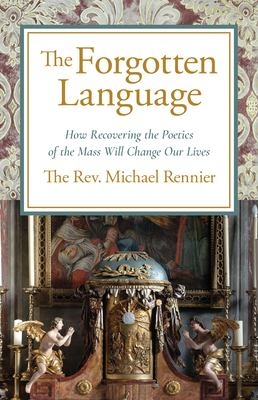
The Forgotten Language: How Recovering the Poetics of the Mass Will Change Our Lives by the Rev Michael Rennier, 196 pages
This blog is the home of the St. Louis Public Library team for the Missouri Book Challenge. The Missouri Book Challenge is a friendly competition between libraries around the state to see which library can read and blog about the most books each year. At the library level, the St. Louis Public Library book challenge blog is a monthly competition among SLPL staff members and branches. For the official Missouri Book Challenge description see: http://mobookchallenge.blogspot.com/p/about-challenge.h
Showing posts with label culture. Show all posts
Wednesday, July 5, 2023
Forgotten Language
It sometimes seems that never before in human history has so much poetry been written and so little read. Indeed, even the ability to recognize, still less to comprehend, poetry seems to have almost completely atrophied. The modern mind demands solutions, while poetry requires understanding, the modern world celebrates pride, but true beauty cannot be received without humility. Great poetry draws the audience beyond a superficial knowledge into deeper and deeper layers of meaning, towards beauty that is transcendent and truths that are mysteries. As William Hazlitt explained, "Poetry is the universal language which the heart holds with nature and itself. He who has a contempt for poetry cannot have much respect for himself, or for any thing else... all that is worth remembering in life is the poetry of it."
The greatest poem of all is, of course, Creation itself, which cannot be rivalled but only participated in. The second greatest is the Divine Liturgy, that prayer in which the human is joined to the Divine, which likewise is not a work of man alone but of the Man who is God. It is impossible to enter meaningfully into either without a poetic imagination. There is no way to learn a language, however, without practice. This is the genius of The Forgotten Language: it is not only a prescription, but also a primer. Fr Rennier alternates between liturgical commentary, spiritual reflection, literary appreciation, conversion story, and personal anecdote in a way that may initially seem confused and off-putting, until the reader begins to perceive how they rhyme, and a new world opens or the old world is made explicit.
Friday, September 17, 2021
Culture and Anarchy
Culture and Anarchy by Matthew Arnold, 212 pages
In the seminal essays that make up Culture and Anarchy, originally published serially in 1869, Matthew Arnold attempted to convince his hardheaded English countrymen, who prided themselves on practicality and efficiency, of the value of culture. For Arnold, the cult of efficiency amounts to an idolatry of machinery, a confusion of ends and means, and a worldview closed to the "sweetness and light" that make life worth living. In the process, Arnold famously distinguishes two rival tendencies in Western civilization, which he dubs the Hebraic and the Hellenic - the former demanding faithful action, the latter rational thought. Both pursue the same goal of human perfection, but that goal is unattainable by either alone.
It is easy to criticize Arnold's scheme as overly simplistic and reductive, although the notion of a rivalry between Athens and Jerusalem can be traced back at least as far as Tertullian. It is equally easy to point out its weaknesses - to ask, for example, whether Hellenism is not just as likely to lead to the kind of radical individualism Arnold deplores as Hebraism, or whether other forms of Hebraism beyond Puritanism might not admit sweetness and light as readily as Hellenism. To do so, however, would be to fundamentally misunderstand what Arnold means by Hebraism and Hellenism, to imagine the former as simply religious and the latter as purely secular. Arnold wants contemplative philosophers, not scientific administrators, true intellectuals, not chattering policy wonks. Indeed, the latter are the vanguard of the mechanical anti-culture he abominates.
Tuesday, August 17, 2021
Fiery Angel
The Fiery Angel: Art, Culture, Sex, Politics, and the Struggle for the Soul of the West by Michael Walsh, 224 pages
On one level, The Fiery Angel is Michael Walsh's celebration of the power of art and storytelling, of how they shape us and our future. On another, it is an argument for the heroic ideal he believes is central to Western culture and civilization. Walsh is well aware that the heroic tends to shade into the luciferian, indeed he sees this as a positive - Western man is never comfortable with the status quo and acknowledges no limits except those which he places on himself. This is a vision that Walsh believes is threatened by the rising forces of leftism and Islam, each of which finds the concept of the heroic threatening for ideological and theological reasons.
Walsh leaps quickly from topic to topic and idea to idea in a way that is equal parts thrilling and disorienting. It isn't clear whether this is deliberate - a little reflection reveals how thin is his distinction between the idea of progress he advances and the progressive definition he deplores, as well as how consistently his archetypal superman served as a cautionary tale rather than a model to be imitated in the premodern West, and especially how it is precisely the rejection of limits that has led us to our present crisis. If his overall vision seems lacking, however, the passages where he discusses music are notable for their depth of thought and feeling.
Wednesday, April 17, 2019
The Origin of Consciousness in the Breakdown of the Bicameral Mind
The Origin of Consciousness in the Breakdown of the Bicameral Mind by Julian Jaynes, 491 pages
The title of this book is confusing. The most basic way to explain it is that Jaynes believed the right hemisphere gave orders to the left hemisphere and that system (bicameral mind) broke down when consciousness emerged. People described it as taking orders from god(s). Part of his argument lies in the similarities of ancient religions including ones that are halfway around the world. It includes the way they depict their gods and where holy sites are located in towns or settlements.
Jaynes believed this happened much later in human history than we think. He puts the time somewhere in the time of the Greeks. Part of his evidence lies in analyzing the language in the Iliad and the Odyssey. His analysis indicates that while humans had bicameral minds people didn't think they were in control. The Odyssey's language contains evidence of people believing they are in charge of their own actions.
Jaynes believes that schizophrenia is a situation where the brain has partially reverted to the bicameral mind and makes the argument that evidence proves his idea.
While I don't buy Jaynes's theory I am glad that I read this book because it is a classic and now I am going to have to re-watch the first season of Westworld with the theories from the book in mind. I did find it noteworthy that when Jaynes was defining what consciousness isn't the ways mirrored what Koch mentioned in Consciousness: Confessions of a Romantic Reductionist.
The title of this book is confusing. The most basic way to explain it is that Jaynes believed the right hemisphere gave orders to the left hemisphere and that system (bicameral mind) broke down when consciousness emerged. People described it as taking orders from god(s). Part of his argument lies in the similarities of ancient religions including ones that are halfway around the world. It includes the way they depict their gods and where holy sites are located in towns or settlements.
Jaynes believed this happened much later in human history than we think. He puts the time somewhere in the time of the Greeks. Part of his evidence lies in analyzing the language in the Iliad and the Odyssey. His analysis indicates that while humans had bicameral minds people didn't think they were in control. The Odyssey's language contains evidence of people believing they are in charge of their own actions.
Jaynes believes that schizophrenia is a situation where the brain has partially reverted to the bicameral mind and makes the argument that evidence proves his idea.
While I don't buy Jaynes's theory I am glad that I read this book because it is a classic and now I am going to have to re-watch the first season of Westworld with the theories from the book in mind. I did find it noteworthy that when Jaynes was defining what consciousness isn't the ways mirrored what Koch mentioned in Consciousness: Confessions of a Romantic Reductionist.
Tuesday, March 26, 2019
First Society
The First Society is many things, all of them excellent. It is an exploration of Catholic teaching on marriage, society, grace, and the sacraments. It is also an examination of contemporary society and the much-heralded "death of liberalism". Most of all, it is an exhortation to the Catholic faithful to live the truth faithfully and proclaim it boldly. As Hahn explains, the family is the original and fundamental community and thus the basis for every other kind of community. While philosophy tells us that we are social creatures, the Church deepens this by revealing that we are made for communion, because we are made in the image and likeness of a God who is Himself a communion of Persons. The desacralization of marriage, then, sabotages the very basis of civil society even as it alienates the individual from the only possible sources of true happiness. If, as Hahn asserts, the secular world has spent the last several centuries desperately trying - and failing - to find a replacement for the Catholic Church, it follows that it is the social as well as the evangelical duty of Catholics to offer precisely that which makes their faith distinctive.
As always, Hahn somehow manages to combine a popular approach with theological depth, producing a book which is accessible enough for neophytes without boring the more learned. Most remarkable, in this case, is the integrity of the book, not only its evident sincerity but its convincing demonstration of the coherence of the Church's teaching.
Friday, September 7, 2018
Moral Imagination
The Moral Imagination collects a series of biographical sketches by Gertrude Himmelfarb - some old, some new - exploring the humanist disposition as it expressed itself in the lives of her subjects. In her telling, each celebrated the reality of truth, goodness, and beauty, while condemning the dictatorial ideologies of a narrow rationalism.
Whether by accident or design, Himmelfarb's choice of subjects begins with the moral disaster of the Enlightenment and ends with the moral disaster of the '60s. It therefore begins with the quest for values in the wake of the revolutionary overthrow of tradition, and ends with the ascendancy of anti-intellectual technocratic nihilism. As befits her theme, her subjects are amazingly varied - the philosophers Mill and Burke, the clergymen Wilfred and Ronald Knox, the economists Adam Smith and Alfred Marshall, the statesmen Disraeli and Churchill, the novelists George Eliot, Austen, Dickens, and Buchan. They include skeptics and believers, conservatives and liberals. They are all the more diverse because they are themselves so multifaceted - Ronald Knox, Disraeli, and Churchill were all literary men in addition to their primary vocations, while Smith was a philosopher as well as an economist and Burke a politician as well as a philosopher. In each case Himmelfarb exhibits (without explaining) how this breadth of activity and thought enhanced rather than detracted from the quality of their work.
Monday, May 21, 2018
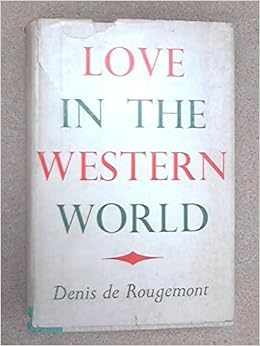
Love in the Western World
Love in the Western World by Denis de Rougemont, translated by Montgomery Belgion, 323 pages
In Love and the Western World begins with an analysis of the genre of chivalric romance as typified by the story of Tristan and Isolde. For de Rougemont, the protagonists are not in love with each other, but are rather in love with Love itself, in such a way that the fulfillment of their desires would be the end of the romance. Their love, then, is real only insofar as it is frustrated - it is a passionate love, which is to say a suffering love, ultimately consummated only in the final negation of death. He connects these themes to a stream of mysticism with its sources in the Greek, Celtic, Hindu, and Arab worlds, a stream which in the High Middle Ages fed the pool of Catharism. In de Rougemont's view, this heretical mysticism, which seeks the total absorption of the individual into the Godhead, has fundamentally perverted the Western view of love, transforming the Christian ideal of a communion of persons into a paradoxically selfish quest for self-destruction. The former is a humble religion of incarnation, the latter a prideful spirituality of disincarnation.
De Rougemont's historical claims have been strongly criticized, and doubtless the author somewhat exaggerates the influence of the Cathars. Yet it is part of his argument that Catharism was itself part of a much larger, largely underground heterodox tradition. Such criticism cannot touch his startling contention that, contrary to the reductive belief that all mysticism has its origins in repressed eroticism, much of our romantic language - and dysfunction - is the product of sublimated mysticism.
Monday, May 7, 2018
Not That Bad
Not That Bad: Dispatches from Rape Culture -- introduction by Roxane Gay and contributions from multiple authors 350 pages
In this anthology, Roxane Gay collects both original and previously published pieces that "address what it means to live in a world where women have to measure the harassment, violence, and aggression they face, and where they are “routinely second-guessed, blown off, discredited, denigrated, besmirched, belittled, patronized, mocked, shamed, gaslit, insulted, bullied” for speaking out."
There are a range of topics and experiences covered here, all of them very personal, even as some address wide-reaching issues (like the rape epidemic in the refugee crisis). Because these are personal essays, I think that some pieces will resonate more with readers than others. However, I felt that all pieces were thought-provoking and discussion-provoking, especially if this was read and discussed in a group setting.
In this anthology, Roxane Gay collects both original and previously published pieces that "address what it means to live in a world where women have to measure the harassment, violence, and aggression they face, and where they are “routinely second-guessed, blown off, discredited, denigrated, besmirched, belittled, patronized, mocked, shamed, gaslit, insulted, bullied” for speaking out."
There are a range of topics and experiences covered here, all of them very personal, even as some address wide-reaching issues (like the rape epidemic in the refugee crisis). Because these are personal essays, I think that some pieces will resonate more with readers than others. However, I felt that all pieces were thought-provoking and discussion-provoking, especially if this was read and discussed in a group setting.
Saturday, November 25, 2017
Public Enemies
This book is the product of a half-year correspondence between two of France's most talked-about contemporary writers. One is Bernard-Henry Levy, the politically engaged Jewish public intellectual and journalist, author of Barbarism with a Human Face and Left in Dark Times. The other is Michel Houellebecq, the self-described "absolute atheist" (disdaining both religious and political faiths), author of The Elementary Particles and Submission. The former travels all over the world chronicling injustice, the latter lives as a tax exile in the Irish countryside.
In one memorable passage, Houellebecq compares their dialogue to miners working parallel shafts, each hearing the other digging and searching for the breakthroughs that will bring them together. Levy describes it, in turn, as a correspondence in search of correspondences. These seem to come, when they come, in two basic forms: the first is the common experience of living as celebrities in a hostile media environment, while the second is the French literary culture they both share. If the first is the major theme of the book, the second is the most interesting, for an Anglophone reader especially. Both correspondents write engagingly, if not always candidly, their apparent sympathy with one another (not untainted by a certain amount of narcissism) underlining the irony of the title.
Wednesday, November 8, 2017
Vision of the Soul
The Vision of the Soul is James Matthew Wilson's thorough, thoughtful rebuttal of "the assumption that to be free means to refuse all form; to be intelligent means not to believe in anything; to be well cultured means to see all cultural judgments as, at best, 'merely subjective,' and, at worst, as expressions of power and ideology", a view propounded with "evangelical zeal" by many of today's cultural, political, economic, educational, and religious elites. His rebuttal begins with his affirmation of Christian Platonism, which he considers the mainstream of Western civilization and culture. Specifically, he argues for the transcendental nature of beauty, as variously understood by such diverse thinkers as Theodor Adorno, Jacques Maritain, and Umberto Eco, exhibiting it as a window into an intelligible order that underlies the cosmos, and therefore a repudiation of a reductive rationalism that cripples the intellect. Not only is Beauty real, in this view, it reveals the Real. With the intellect understood as including imagination as well as logic and responding to beauty as well as truth, the narrative element in human understanding becomes apparent, allowing simultaneously for a revival of the dialectic of tradition which is at the heart of true conservatism and the recovery of purpose and meaning - and with them joy and wonder - in our culture.
The Vision of the Soul demonstrates Wilson's considerable (and complementary) insight into both contemporary cultural issues and scholastic philosophy. For that very reason, it is a difficult book, shifting smoothly from discussion of the shortcomings of modern conservatism to an examination of Plotinus' aesthetics to tracing the outlines of the ouroboros of postmodern academicism. Wilson's arguments are not unchallengable, but they are certainly challenging and definitely worth consideration.
Tuesday, September 5, 2017
England
England: An Elegy is philosopher Roger Scruton's paean to an England that disappeared in his lifetime. During the decades following the Second World War, a culture that relied on enchantment was subjected to a rude disenchantment by "seditious bigots" enflamed by a prejudice against history and tradition - but placing blame is not the purpose of Scruton's work. He writes to praise what was lost, not to blame her murderers.
Central to Scruton's celebration of the England that was - not the "Merrie England" of legend but England as it lived and grew down through the centuries - is his awareness of her as primarily a work of moral imagination, endowed with her own personality through the contributions of her members and the landscape from which she was born. The key to that personality is found in the quality of reserve, a skeptical distance conducive to honesty and its daughter virtue, humility. This emotional distance makes possible a gentle neighborliness quite different from the impassioned involvement which so easily turns into meddling. Scruton admits that the old England was not perfect - nothing merely human is - but at least it was something, and, for his part, he sides with "somewhere against nowhere".
Monday, August 21, 2017
Power of Silence
In this remarkable book-length interview, Cardinal Sarah launches an assault against the "empire of noise" that, he warns, threatens to colonize our minds and souls. Sarah's message is equal parts admonition, exhortation, and challenge. In his view, modern man is sunk in a sea of noise both as the result of his membership in a society driven by mass consumerism and as a deliberate choice to narcotize himself from the problems of thought. As the power of noise has grown, so our public life has become increasingly dominated by the "raving madness" of demagogues and activists. Meanwhile, the "buffered self" is insulated against the transcendent by a cocoon of noise. Truth, goodness, and beauty cannot be seized - they must be received, and this requires contemplation, and contemplation requires silence. Modern man's bottomless appetite for novelty alienates him from the eternal and enslaves him to the ephemeral.
Worse still is modern man's sense that he himself must be a noisemaker, the consequence of a fixation on action at the expense of contemplation, on doing at the expense of being. This preoccupation extends even to prayer and the liturgy, driving out all sense of mystery and the sacred with banal talk and insipid music. Cardinal Sarah finds in the silence of the Divine the meekness of God and the root of human freedom. In silence we participate in the silence of the Incarnation, of Bethlehem, Nazareth, and Gethsemane, the silence before the Sanhedrin, Herod, and Pilate, and finally the silence of the cross and the tomb, and in that silence we encounter a God who suffers with us and for us. Silence is at the heart of communion and therefore of all authentic community - it is in silence that we offer ourselves and in silence that we accept what is offered us.
Monday, August 7, 2017
I'll Take My Stand
I'll Take My Stand: The South and the Agrarian Tradition by 12 Southerners, 385 pages
The twentieth century was a time in American history when virtually everyone in a position of power or influence - from Ivy League intellectuals and Washington politicians to the members of the local Chamber of Commerce - sought an answer to the problems created by "progress" in more and more "progress", a faster and faster race to the bottom of the spiral of their neverending war with nature. In such a time, the "backwardness" of the South became an advantage. I'll Take My Stand, first published in 1930, collects twelve essays that cut deeply against the prevailing grain, calling for an anti-industrial counter-revolution and a reconnection with the land. In complimentary but not identical ways the authors sought the development of more human ways of living, emerging from their own integral humanism, an awareness that a truly human life cannot be founded on mechanism with culture added, but must begin with a humane foundation.
Any book rooted in the Old South must face the issue of race, and it is here, unsurprisingly, that I'll Take My Stand has its greatest problems. Generally, blacks are treated as invisible, or worse, as the unwitting dupes of Northern interests. The history of slavery is revised so as to absolve the South of all moral responsibility, with the Civil War cast as a simple power struggle between centralizing Northern interests and the provincialist South. Fortunately, the authors' racial attitudes (which some of them, at least, later revised), although distracting, do not effect the power of the book's central arguments. Those are of interest to anyone who shares in the perpetual hope that intelligence may yet conquer greed.
Monday, July 24, 2017
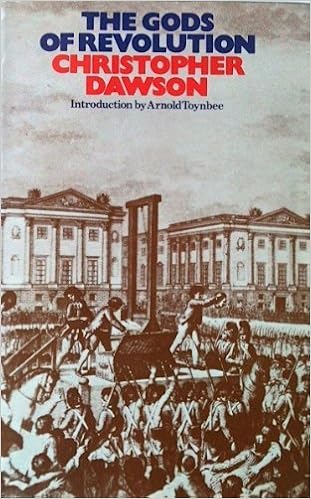
Gods of Revolution
The Gods of Revolution by Christopher Dawson, 166 pages
In The Gods of Revolution eminent cultural historian Christopher Dawson explores the history of the French Revolution, its development and aftermath. As Dawson finds the cultural, spiritual, and intellectual causes and consequences more significant than the merely material, political, or economic, this is where he focuses, beginning with the end of the Wars of Religion and continuing on through the world wars. In this analysis, the Revolution is revealed, despite its anti-clericalism, as a part of, and a key shaper of, a broader spiritual revival in the late eighteenth and early nineteenth centuries.
Dawson's study provides a deep understanding of the origins and progress of the Revolution, as well as insight into the rise of the competing idols of rationalism and nationalism, freedom and equality, for whose glory so much blood was, and continues to be, spilled.
Saturday, July 22, 2017
Resurgent in the Midst of Crisis
In the view of Peter Kwasniewski, the crisis currently facing the Catholic Church is not primarily the product of outside forces, but of internal collapse, brought about by a turning away from discipline, self-sacrifice, and the transcendent. Essential to this reorientation was the introduction of the Novus Ordo Mass following the Second Vatican Council, for liturgy functions not only as prayer but also as paideia, ideally not only petitioning God but making the Church more Christ-like. Central to Kwasniewski's argument is his awareness of human beings as equally body and soul, and therefore receptive to physical languages - gesture, costume, architecture, decoration - as well as the spoken word. This results in a particularly incisive critique of the didacticism and informality of the Novus Ordo, whose wealth of words is actually less effective at communicating the truths of the faith than the sign and symbol of more traditional liturgies, even as its casual approachability seems to implicitly contradict those same truths.
An obvious problem arises in that many of Kwasniewski's arguments are predicated on observations akin to aesthetic judgments, which will be of little currency in a culture where aesthetic judgments are dogmatically held to be entirely relative. It is part of his argument that conventional denials of aesthetic or moral hierarchy cannot long endure contact with genuine beauty and goodness. In the end, as the title suggests, his outlook is hopeful, grounded in faith and an understanding of the Church as a unity transcending time, drawing past and present and future together in eternity.
Wednesday, June 21, 2017
From Christendom to Americanism and Beyond
The central theme in this volume of Thomas Storck's collected essays is the exhaustion of the West as the consequence of the Western rejection of absolutes, beginning with the rise of nominalism in the 14th century. This alienation of Western culture from its roots, he argues, has led to an increasingly narrow outlook divorced from reality, an antinomian utilitarianism which has conquered the intellectual, political, and economic worlds, combining usurious capitalism, social contract political theories, and sexual revolution antihumanism. This is the essence of postmodern nihilism - a blanket rejection of intangible goods in pursuit of material wealth and pleasure, trading justice for avarice, solidarity for solipsism, genuine politics for tribalism, true virtue for moral preening. The alternative he offers is the social reign of Christ, built on justice and solidarity, a true and therefore a moral community, the "civilization of love" of Bl Paul VI and the "culture of life" of St John Paul II.
The first thing that must be said about Storck's book is that it is not entirely, or even primarily, negative - Storck praises post-modernism for rejecting many of the errors of modernism, discerns signs of hope for renewal in leftist protest movements, and tends to blame the wrong turns of history, not on sinister cabals, but on Catholics not being sufficiently Catholic. Throughout, he demonstrates the impact of two divergent views of the Church and the world, one of which represents the Church as one institution among many in the world, and the other which recognizes the truth of Chesterton's observation that the Church is bigger than the world. The former, he demonstrates, produces apostasy and certain failure, the latter, faithfulness and the only hope of success.
Friday, May 12, 2017
Midnight in the Garden of Good and Evil
Midnight in the Garden of Good and Evil: A Savannah Story by John Berendt, 386 pages
The title relates to doing Voodoo magic. In the graveyard, the Voodoo to cause good is done before midnight and the part to cause bad is done after midnight. This book is part history of Savannah, GA, part about the people of Savannah, especially the upper class, and part true crime. John Berendt was living in NYC and starting traveling. He decided to start living in Savannah part-time which turned into most of the time. Most of the events in this book happened in the 1980s.
The people of Savannah like to drink and have their parties, are ok with their relative geographical isolation and like things the way they are. Some of the eccentric people include Mr. Glover, Emma Kelly, Luther Driggers, Joe Odom, and Lady Chablis. Mr. Glover "walks" a dog that died years ago. It turns out that after the owner died he was to be paid by the estate to walk the dog. The judge continues to pay him to "walk" the dog even though the dog has died. Emma Kelly is a woman in her 60s who is known as The Lady of 6,000, a title given to her by Johnny Mercer, travels around Georgia playing piano and singing. Luther Driggers glues filaments to his pets flies, attaches the filaments to his clothes and walks around town with them. It is well known around town that he has a poison he could put in the water supply to kill everyone. Joe Odom is a lawyer of questionable character who has parties on a nightly basis. He lives in a series of historic homes that he gives tours of (sometimes illegally), He also plays piano and sings. Lady Chablis is a transgender woman who had drag shows at a local club until she has a dispute with the owner and takes her show on the road.
Most of the book is about Jim Williams. He is not one of the blue bloods. He has made his own fortune through house restorations and as an antiques dealer. He restored and lives in the famous Mercer House. One night, he shoots and kills one of his employees, Danny Hansford. Danny was a troubled young man who lived with him. Was it premeditated, did events happy as Jim said they did or did he try to cover part of it up? There have been other cases of murder in Savannah that have not been prosecuted or the perpetrator has gotten off lightly but the new District Attorney decides to prosecute Jim on the charge of murder. In the end, Jim Williams is tried four times. To help win, Jim employs a Voodoo witch named Minerva.
I liked this book but the sections on the trials were not my favorite parts. I enjoyed reading about the city of Savannah - its culture, history and people. I would recommend this to people who like true crime or are interested in finding out more about these parts of Savannah.
This book was turned into a movie starring Kevin Spacey and John Cusack. If you have to read this book for a school assignment I would not recommend watching the movie instead. Too much is different.
The title relates to doing Voodoo magic. In the graveyard, the Voodoo to cause good is done before midnight and the part to cause bad is done after midnight. This book is part history of Savannah, GA, part about the people of Savannah, especially the upper class, and part true crime. John Berendt was living in NYC and starting traveling. He decided to start living in Savannah part-time which turned into most of the time. Most of the events in this book happened in the 1980s.
The people of Savannah like to drink and have their parties, are ok with their relative geographical isolation and like things the way they are. Some of the eccentric people include Mr. Glover, Emma Kelly, Luther Driggers, Joe Odom, and Lady Chablis. Mr. Glover "walks" a dog that died years ago. It turns out that after the owner died he was to be paid by the estate to walk the dog. The judge continues to pay him to "walk" the dog even though the dog has died. Emma Kelly is a woman in her 60s who is known as The Lady of 6,000, a title given to her by Johnny Mercer, travels around Georgia playing piano and singing. Luther Driggers glues filaments to his pets flies, attaches the filaments to his clothes and walks around town with them. It is well known around town that he has a poison he could put in the water supply to kill everyone. Joe Odom is a lawyer of questionable character who has parties on a nightly basis. He lives in a series of historic homes that he gives tours of (sometimes illegally), He also plays piano and sings. Lady Chablis is a transgender woman who had drag shows at a local club until she has a dispute with the owner and takes her show on the road.
Most of the book is about Jim Williams. He is not one of the blue bloods. He has made his own fortune through house restorations and as an antiques dealer. He restored and lives in the famous Mercer House. One night, he shoots and kills one of his employees, Danny Hansford. Danny was a troubled young man who lived with him. Was it premeditated, did events happy as Jim said they did or did he try to cover part of it up? There have been other cases of murder in Savannah that have not been prosecuted or the perpetrator has gotten off lightly but the new District Attorney decides to prosecute Jim on the charge of murder. In the end, Jim Williams is tried four times. To help win, Jim employs a Voodoo witch named Minerva.
I liked this book but the sections on the trials were not my favorite parts. I enjoyed reading about the city of Savannah - its culture, history and people. I would recommend this to people who like true crime or are interested in finding out more about these parts of Savannah.
This book was turned into a movie starring Kevin Spacey and John Cusack. If you have to read this book for a school assignment I would not recommend watching the movie instead. Too much is different.
Wednesday, April 19, 2017
Confucius
Confucius: The Secular as Sacred by Herbert Fingarette, 79 pages
In this little book, Herbert Fingarette attempts to correct what he sees as a big misunderstanding. It is his contention that later commentators, due primarily to Buddhist or Western influences, have attributed to Confucius a concern for inwardness which is fundamentally foreign to the Analects. In his view, Confucius' concern is entirely with objective outward acts and right relationships, as embodied in traditional ritual. Confucius is therefore less interested in the intentional ends of ritual than in the function of ritual in maintaining societal order and harmony. It is through cult that a humane culture is nourished and sustained.
By thus prioritizing Confucius' insights into the necessity of ceremony in creating and upholding cultural unity, the necessity of culture for a fully human existence, and the necessity of tradition as a justification for ceremony, Fingarette presents Confucius as a great thinker of universal importance and continuing significance.
Monday, January 16, 2017
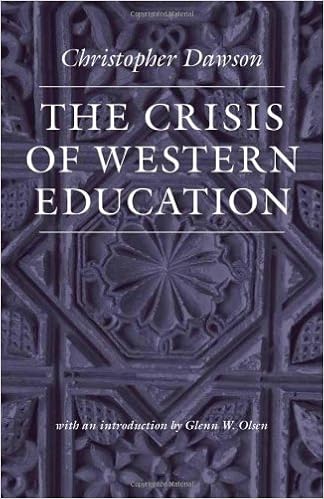
Crisis of Western Education
The Crisis of Western Education by Christopher Dawson, 246 pagesWednesday, November 30, 2016
On Looking into the Abyss
On Looking into the Abyss: Untimely Thoughts on Culture and Society by Gertrude Himmelfarb, 161 pages
In On Looking into the Abyss, historian Gertrude Himmelfarb looks at the state of the study of history in the last decade of the twentieth century and is appalled by what she sees. Humanism is simultaneously threatened by a history from below that not only excludes heroes, but also villains, and a structuralist approach that denies free will and therefore moral agency. Meanwhile, the absolute relativism of postmodernism advocates the abandonment of any kind of commitment to academic standards or objectivity, the latter being seen as a myth and the former instruments of repression in the service of that myth. The result, Himmelfarb claims, is "an invitation to intellectual and moral suicide".
Those seeking a sensationalistic jeremiad or a reactionary call to arms will be disappointed by Himmelfarb. While she takes seriously the dangers she perceives in postmodern fads, her response is consistent with the values for for which she is arguing. In place of cries of outrage she conducts careful analyses of the dehumanization essential to Marxist ideology and the nature of liberty in Mill's philosophy. The result is not only more interesting but more enduring than an impassioned screed.
Subscribe to:
Posts (Atom)