Showing posts with label liturgy. Show all posts

Wednesday, July 5, 2023

Forgotten Language

The Forgotten Language: How Recovering the Poetics of the Mass Will Change Our Lives by the Rev Michael Rennier, 196 pages
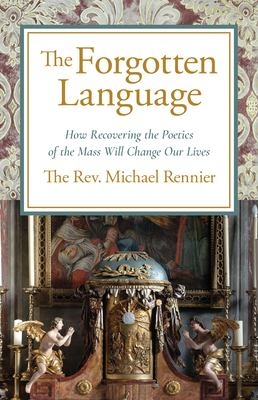
It sometimes seems that never before in human history has so much poetry been written and so little read.  Indeed, even the ability to recognize, still less to comprehend, poetry seems to have almost completely atrophied.  The modern mind demands solutions, while poetry requires understanding, the modern world celebrates pride, but true beauty cannot be received without humility.  Great poetry draws the audience beyond a superficial knowledge into deeper and deeper layers of meaning, towards beauty that is transcendent and truths that are mysteries.  As William Hazlitt explained, "Poetry is the universal language which the heart holds with nature and itself.  He who has a contempt for poetry cannot have much respect for himself, or for any thing else... all that is worth remembering in life is the poetry of it."

The greatest poem of all is, of course, Creation itself, which cannot be rivalled but only participated in.  The second greatest is the Divine Liturgy, that prayer in which the human is joined to the Divine, which likewise is not a work of man alone but of the Man who is God.  It is impossible to enter meaningfully into either without a poetic imagination.  There is no way to learn a language, however, without practice.  This is the genius of The Forgotten Language: it is not only a prescription, but also a primer.  Fr Rennier alternates between liturgical commentary, spiritual reflection, literary appreciation, conversion story, and personal anecdote in a way that may initially seem confused and off-putting, until the reader begins to perceive how they rhyme, and a new world opens or the old world is made explicit.

Saturday, August 3, 2019

Tradition and Sanity

Tradition and SanityTradition and Sanity: Conversations and Dialogues of a Postconciliar Exile by Peter A Kwasniewski, 211 pages

CS Lewis famously remarked that the value of studying history lies not in the delusion that previous eras had all the answers, but in the realization that their mistakes were different from ours.  Similarly, for Dr Kwasniewski the fact that the traditional liturgy was not specially made for our time enables it to offer the modern world precisely what the modern world desperately needs but is incapable of producing, a form of worship which is oriented to the transcendent and therefore not dependent on, or manipulable by, us.  In Tradition and Sanity this theme runs through the collected conversations, some real interviews, some invented dialogues.

Of course, invented dialogues often become polemics, but those collected here are characterized by their gentleness.  The author defies the stereotype of the narrow-minded traditionalist by refusing to play the angry activist and writing instead as a thoughtful contemplative.  Whether discussing the role of sacred music or the shortcomings of the current pontificate, he speaks not as an outraged partisan but as a joyful discoverer eager to share the treasures he has found.

Friday, July 12, 2019

Vestments and Vesture

Image result for Vestments and VestureVestments and Vesture: A Manual of Liturgical Art by Dom EA Roulin, translated by Dom Justin McCann, 298 pages

This is less a textbook than a primer for priests and others involved in the design, purchase, and care of all kinds of liturgical clothes, from chasubles to purificators to banners.  The focus is less on their historical development than on their design and use, with a continuous emphasis on simplicity and good taste.

The French original was published in 1930, a time which seems far removed from the liturgical wars of today.  Yet Dom Roulin's sensible advice indicts both the tawdriness of so much contemporary work and the theatricality of some traditionalist overreactions, instead supporting a liturgical art which is "dignified, solid, and devotional."

Monday, July 9, 2018

Meditations Before Mass

Image result for meditations before mass romano guardini
Meditations Before Mass by Romano Guardini, translated by Elinor Castendyk Briefs, 199 pages

Meditations Before Mass might be more accurately titled "Reflections on the Mass" - readers seeking a series of straightforward devotional exercises will be disappointed.  Rather, Guardini's goal is to provide insight into the meaning of the Mass so as to promote a more active intellectual and spiritual participation in its mysteries.  To this end, he explores the many dimensions of the sacred celebration, explaining the meaning of both the words and the silence, the Eucharist as memorial and as eschatological event, rooted in time but extending into eternity.

Friday, June 1, 2018

After Writing

Image result for after writing pickstockAfter Writing: On the Liturgical Consummation of Philosophy by Catherine Pickstock, 273 pages

Alfred North Whitehead famously characterized all of a European philosophy as "a series of footnotes to Plato."  For some postmodern philosophers, Plato has become the serpent in the garden who began Western civilization's obsession with objective, and therefore objectivizing, truth.  Through a careful reading of the Phaedrus, Catherine Pickstock argues that, contrary to this postmodern reading, what the great philosopher upheld was not a reified abstract truth, but a lived love of the good.  Indeed, at the heart of the Socratic project is a denial of easy certitude in favor of careful development, focused on a paideia of virtue.

In Pickstock's understanding, Plato's embodied dialectic is essentially liturgical, and the acknowledgement of the transcendent stands against a technocratic, commercial, leveling secular ethos which rejects reality for utility, the gift for the given.  Postmodern nihilism is thus revealed as the culmination rather than the rejection of indifferent rationalism.  A genuine alternative is found in the fulfillment of the Platonic vision in the practice of the medieval Christian liturgy, a work of praise that crowns and completes the ordinary world of work.  Leaving behind the postmodern world of alienation and absence, the narrative of becoming which constitutes the Mass restores the relational and personal through its revelation of the superabundant plentitude of the good.

Pickstock takes up two monumental tasks - a reinterpretation of postmodern philosophy and a liturgical analysis which challenges both the Tridentine traditionalist and postconciliar modernist approaches.  Her tools are the tools of deconstruction, and those who have little sympathy with that method will find it hard going, but Pickstock uses reason neither to bind mystery nor to sow confusion, but rather to open up the portals of the sublime.

Friday, April 20, 2018

Liturgy & Personality

Image result for Liturgy and Personality Von Hildebrand, DietrichLiturgy & Personality by Dietrich von Hildebrand, 130 pages

Dietrich von Hildebrand identifies the Divine Liturgy as the worship and adoration offered by the Body of Christ, united with its Head - "through Him, with Him, and in Him" - to the Triune Godhead.  As such, it forms the supreme instance of value-response, and it is in the light of this that all of our relationships with values ought to be measured.  The liturgy, he therefore maintains, provides the ultimate opportunity for the imitation of (and transformation in) Christ, but only if it is properly understood in terms of value-response as an end in itself.  The liturgy cannot be reduced to a mere technique for self-improvement, and yet it provides the most thorough education in the disciplines necessary to the development of an authentic personality - discrimination and sacrifice.

Although he was capable of writing for a broader audience, here Hildebrand wrote like the German philosopher he was.  Although not entirely opaque, the short book is certainly challenging, but the rewards of understanding are well worth the effort.

Wednesday, December 27, 2017

Heresy of Formlessness

The Heresy of Formlessness: The Roman Liturgy and Its Enemy by Martin Mosebach, translated by Graham Harrison, 209 pages

Martin Mosebach freely confesses that progress has passed him by.  He has not learned that words are meaningless, that truth is nothing but a bigoted opinion, or that beauty is entirely in the eye of the beholder.  He still clings to antiquated prejudices - that religion ought to connect man to a higher reality, that the best of what has been thought and done in past ages can never be irrelevant, that no one can consume trash and expect to remain healthy.  Most indicative of his backwardness is his belief that human beings are both soul and body, and that therefore what we believe and what we do are interconnected.

In the wake of the Second Vatican Council, a new wave of iconoclasm swept through the Catholic Church.  Great artworks which had stood the test of time were replaced with up-to-date substitutes which were obsolete the day after they appeared.  Even kitschy works that, though undeniably second rate, were popular with the average Catholic were replaced, when they were replaced at all, with pieces that allegedly spoke to modern sensibilities, but which pleased few beyond the artists who were paid to produce them and their clerical patrons who paid dearly for the pleasure of believing they were with-it.  Simultaneously, an elaborate language of ritual and gesture which had developed over the course of millennia was simply abandoned.  The iconoclasts claimed that all of this was distracting and unnecessary, modern man having outgrown the need for symbols, beauty, and supernatural hope.

In The Heresy of Formlessness Mosebach makes the case that the iconoclasts were wrong.  The nature of man, he contends, has not changed since the Stone Age.  We still live and die by symbols, still crave beauty, are still bound together - to the extent we are bound together at all - by rituals both civic and religious.  As a novelist by trade, his arguments are affective rather than logical, his investigations personal rather than philosophical or theological.  Ironically, this makes his book somewhat formless - the final essay, tacked on in the third edition, while cromulent in itself, greatly diminishes the power of the conclusion by its placement.

Saturday, July 22, 2017

Resurgent in the Midst of Crisis

Resurgent in the Midst of CrisisResurgent in the Midst of Crisis: Sacred Liturgy, the Traditional Latin Mass, and Renewal in the Church by Peter Kwasniewski, 206 pages

In the view of Peter Kwasniewski, the crisis currently facing the Catholic Church is not primarily the product of outside forces, but of internal collapse, brought about by a turning away from discipline, self-sacrifice, and the transcendent.  Essential to this reorientation was the introduction of the Novus Ordo Mass following the Second Vatican Council, for liturgy functions not only as prayer but also as paideia, ideally not only petitioning God but making the Church more Christ-like.  Central to Kwasniewski's argument is his awareness of human beings as equally body and soul, and therefore receptive to physical languages - gesture, costume, architecture, decoration - as well as the spoken word.  This results in a particularly incisive critique of the didacticism and informality of the Novus Ordo, whose wealth of words is actually less effective at communicating the truths of the faith than the sign and symbol of more traditional liturgies, even as its casual approachability seems to implicitly contradict those same truths.

An obvious problem arises in that many of Kwasniewski's arguments are predicated on observations akin to aesthetic judgments, which will be of little currency in a culture where aesthetic judgments are dogmatically held to be entirely relative.  It is part of his argument that conventional denials of aesthetic or moral hierarchy cannot long endure contact with genuine beauty and goodness.  In the end, as the title suggests, his outlook is hopeful, grounded in faith and an understanding of the Church as a unity transcending time, drawing past and present and future together in eternity.