Showing posts with label philosophy. Show all posts

Sunday, September 10, 2023

Who Killed Jerusalem?

Who Killed Jerusalem? by George Albert Brown  576 pages


How could I resist a novel whose main characters are Ickey Jerusalem and Ded Smith? Especially with this elevator pitch: “A rollicking murder mystery based on William Blake’s characters & ideas updated to 1970s San Francisco.” You’re right; I couldn’t. But what made me think that I would, all of a sudden, understand and adore Blake since I could do neither of those things when I was in college twenty-five years ago? What I was thinking! Unless it was the characters’ names, the setting is one of my favorite cities and I won the book from Bookishfirst.com.


Here's what synopsis from Amazon:


In 1977, Ickey Jerusalem, San Francisco's golden-boy poet laureate, is found dead in a locked, first-class toilet on an arriving red-eye flight.

Ded Smith, a desperately unhappy, intelligent philistine with a highly developed philosophy to match, is called in to investigate the poet's death. Thus begins a series of hilarious encounters with the members of Jerusalem's coterie.

Ded soon realizes that to find out what happened, he must not only collect his usual detective's clues but also, despite his own poetically challenged outlook, get into the dead poet's mind. Fighting his way through blasphemous funerals, drug-induced dreams, poetry-charged love-making, offbeat philosophical discussions, and much, much more, he begins to piece together Jerusalem's seductive, all-encompassing metaphysics.

But by then, the attempts to kill Ded and the others have begun.

Before Ded's death-dodging luck runs out, will he be able to solve the case, and perhaps in the process, develop a new way of looking at the world that might allow him to replace his unhappiness with joy?


I loved Chapter One, in which author Brown drops us right into the middle of the action. Ickey died a gruesome death there in the plane’s bathroom.  But by Page 5, I was so lost I found myself reading words and wondering WTH?


And I will admit to reading every blast word of this 576-page tome and only understanding about a fifth of it. Afterwards, I jumped on Amazon and perused the review section. This is what I wanted the book to be, from a review by Maddogish:


The book is loosely based on William Blake's poetry, characters and ideas... fortunately you do not have to be familiar with any of Blake's work to love this book. If anything it opens the world of poetry in an accessible manner so that maybe more people will learn to love epic poetry and romantic era classics. The book centers on the mysterious death of San Francisco Poet Ickey Jerusalem and his wild and crazy group of cohorts. An insurance adjuster, Ded Smith who is known as Dr. Death for his uncanny ability to determine cause of death and solve murders, is on board the flight when Jerusalem is found dead. He is initially asked to help the police with interviewing the suspects as a friendly courtesy, but when it is discovered that Ickey took out a life insurance policy a month before his death, Ded is called in to rule if the case a suicide or murder in an official capacity. While he investigates each of the suspects and the crime itself, he finds himself caught up in a web of philosophy, intrigue and murder. The poet not only collected delightfully weird friends the stand out on the page; he had seemed to develop strange ideas on life and existence in general. I can honestly say the author had me guessing until the end who the killer was, while at the same time weaving so much philosophical information and poetry that I found my self in awe of how he tied all of it together. This is a truly magical and unique book that will take readers on an epic journey.


But all I got was a series of headaches, a lot of re-rereading, so much that it took almost a month for me to get through this novel. I'm going to put it back on the shelf and tackle it again in a few years. Best of luck to anyone who tries to decipher this novel. Who Killed Jerusalem? receives 2 out of 5 stars in Julie’s world.


Thursday, September 8, 2022

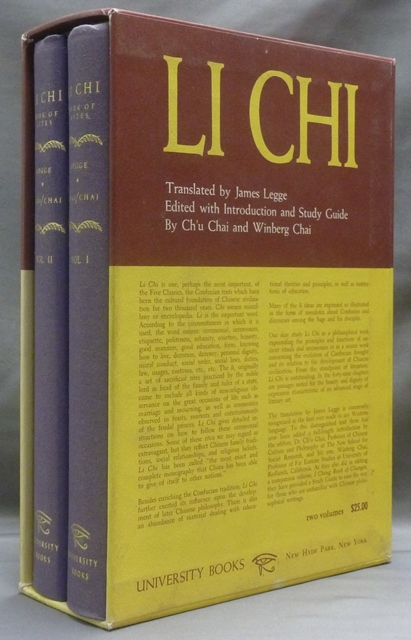
Li Chi

Li Chi: Book of Rites, translated by James Legge, 949 pages (2 vols)

The Li Chi (pinyin Liji) is a collection of Confucian texts compiled in the Han dynasty dealing with matters of classical Chinese ceremonial.  Much of it concerns the minutiae of proper observance, including difficult questions when unusual circumstances impose conflicting obligations.  Other texts consider the nature and value of ceremony against those who would reject it as mere outward show, maintaining that ritual is essential to the proper ordering of emotion, evoking the proper feelings in those who lack them and restraining the passions of those who cannot control themselves.

The Li Chi is one of the "Five Classics" of Confucian philosophy.  As such, it has been studied, interpreted, glossed, and debated by legions of scholars for thousands of years.  Legge attempts to condense some of this conversation into the footnotes, along with notes on difficult translations and the claims of textual critics, and he succeeds in doing so without burying the text in the commentary.  Most readers will find it to be primarily of antiquarian interest, which is hardly surprising given that the motives of the authors and compilers was itself antiquarian, a search into the past, not due to idle curiosity or academic ambition, but out of a love of wisdom and a deep need for models to be imitated.  

Tuesday, July 20, 2021

Unbroken Thread

The Unbroken Thread: Discovering the Wisdom of Tradition in an Age of Chaos by Sohrab Ahmari, 265 pages

In The Unbroken Thread, Sohrab Ahmari attempts to draw his readers' minds to a series of twelve questions, including "How Do You Justify Your Life?" and "What Do You Owe Your Body?"  He asks us to meditate on these questions in the light of the ideas and experiences of thinkers ranging from Confucius to Andrea Dworkin.  These are hard questions that defy simple answers, essential questions, yet questions that few seriously consider beyond the superficial responses that our superficial society provides.  In inviting us to consider such fundamental matters, Ahmari threatens to radically transform how we think about ourselves and the world.

The Unbroken Thread is not a self-help book.  It is not a quick survey of great books offering cheap self-satisfaction or conversation starters.  It isn't a diatribe against the ills of the modern world.  It isn't an especially challenging book, intellectually.  It is remarkably personal, seemingly for the author and certainly for those readers willing to engage with it.

Monday, May 3, 2021

Integralism

Integralism: A Manual of Political Philosophy by Thomas Crean and Alan Fimister, 279 pages

A spectre is haunting what was the West - it is the spectre of Integralism.  All the powers of the old liberalism have entered into an unholy alliance to exorcise this spectre: Democrat and Republican, libertarian and socialist, German and Brit, Dorsey and Zuckerberg, Bezos and Gates.  

This may seem a trifle overblown.  It is true, however, that as the liberal consensus crumbles, engaged Catholics, and especially younger Catholics, have begun looking for traditional alternatives to the naked emperor of modernity.  One of the most trenchant criticisms of the movement has been the lack of agreement as to what, precisely, is meant by "Integralism", particularly in a country founded on the rejection of throne and altar.  Is Integralism equivalent to Falangism, or is it a particular flavor of common-good conservatism, or is it a fundamentally unserious social-media phenomenon with no meaningful content whatsoever?

Although disagreements will no doubt continue, with the publication of Crean and Fimister's manual at least the last is no longer an entirely plausible answer.  Without being argumentative, they carefully build their argument for a rational society and a politics which respects the entire human person.  Although their conclusions are unlikely to convince anyone who does not agree with their premises, their political philosophy is at least coherent, which is more than can be said for any of the post-modern alternatives.  The result is a challenge to many, and an invitation to a few.

Wednesday, February 17, 2021

The Plague

The Plague by Albert Camus, translated by Stuart Gilbert, 308 pages

This book is set in Oran, a coastal town in North Africa. The narrator of the book isn't revealed until the end.

The bubonic plague breaks out in the town and everyone is slow to react. Eventually, protective measures are taken in stages. The town is quarantined. The disease is passed through fleas but later becomes airborne. 

People who were visiting the town are trapped there, unable to get back to their loved ones. As a doctor tries to create a serum, people come together to fight the plague the best they can.

In Camus's Absurdist philosophy the world is meaningless and people have three alternatives. One is suicide, the second is religion or spirituality and the third is acceptance and finding your own meaning. You can see how this relates to characters in the book and what Camus thinks.

In some ways the book mirrors current events involving Covid-19 but it is different in some ways too. Circumstances may have changed but human nature hasn't. That much is true. It means there are some lessons we can draw but it also means we may not be able to totally change the outcome.

As a novel I don't give it a great review but I give it a good review as a chronicle of how people react to a disease run rampant and Camus's philosophy laid out in fiction.


The Analects

The Analects by Confucius, translated by D.C. Lau, 248 pages

Summary from Goodreads: This lively new translation with clear explanatory notes by one of the foremost scholars of classical Chinese provides the ideal introduction to the Analects for readers who have no previous knowledge of the Chinese language and philosophical traditions.

"How dare I claim to be a sage or a benevolent man?"

By constructing the philosophy expressed through The Analects, Confucius might well dare to make such a claim. The Analects are a collection of Confucius' sayings, compiled by his pupils shortly after his death in 497 B.C., and they reflect the extent to which Confucius held up a moral ideal for all men. The aim is the perfection of one's moral character, the method one of arduous pursuit of such moral attributes as benevolence, wisdom, courage; the result is no recompense either in this life or the next – to follow the Way must be its own reward. A harsh philosophy perhaps, but shining through it is the splendid intellect and spirit of one of the most reasonable and humane thinkers of all time.

This introduction in this edition helps prepare you for the text. However, I think the second appendix, which covers his disciples in the text, should have come before the text. It would provide background for a lot of the names you encounter along the way.

I would recommend this book to those that are interested in philosophy, especially those interested in Chinese philosophy or the origins of Confucianism.


Tuesday, December 22, 2020

The Meaning of Life

 The Meaning of Life: A Very Short Introduction by Terry Eagleton, 109 pages

This slim book covers a lot in a relatively few amount of pages. From the beginning, Eagleton tackles the subject with some levity. He starts by asking if 'What is the meaning of life?' is a genuine question. He concludes that it is. He continues by looking at the uses of the word meaning. He briefly looks at times when meaning wasn't very much of a concern for people or when it was decided there was no meaning. He considers multiple answers to the question such as happiness, power, love, honor, etc. At the end, he provides his argument of what he thinks is the answer.

I appreciated Eagleton's take on the meaning of life. While he did spent a lot of time considering if it is a valid question and what the definition of meaning is I thought it was fruitful. I liked his humor as well. I would recommend this to those considered the question. 


Monday, December 7, 2020

Unity of Plato's Thought

 The Unity of Plato's Thought by Paul Shorey, 88 pages

There is a popular school of interpretation of Plato's works which insists that the philosopher profoundly changed his views on a variety of important topics over the course of his career.  In this book, Paul Shorey attempts to demonstrate that most of the evidence these critics rely upon is the product of Plato's rhetorical method (especially his tendency not to recapitulate discussions present in a fuller form elsewhere in the dialogues) and their own attempts to construct out of Plato's works a theoretical system more comprehensive than the one upheld by the actual Plato.

The Unity of Plato's Thought is somewhat deceptive.  The introduction is flashy, witty, and argumentative, while the main text is sober and methodical - in addition, it demands a certain knowledge of Greek.  This is a substantive book on an important subject, but quite technical.

Monday, October 26, 2020

Would You Kill the Fat Man?

 Would You Kill the Fat Man? The Trolley Problem and What Your Answer Tells Us about Right and Wrong by David Edmonds, 220 pages

Summary from Goodreads: "A runaway train is racing toward five men who are tied to the track. Unless the train is stopped, it will inevitably kill all five men. You are standing on a footbridge looking down on the unfolding disaster. However, a fat man, a stranger, is standing next to you: if you push him off the bridge, he will topple onto the line and, although he will die, his chunky body will stop the train, saving five lives. Would you kill the fat man?

The question may seem bizarre. But it's one variation of a puzzle that has baffled moral philosophers for almost half a century and that more recently has come to preoccupy neuroscientists, psychologists, and other thinkers as well. In this book, David Edmonds, coauthor of the best-selling Wittgenstein's Poker, tells the riveting story of why and how philosophers have struggled with this ethical dilemma, sometimes called the trolley problem. In the process, he provides an entertaining and informative tour through the history of moral philosophy. Most people feel it's wrong to kill the fat man. But why? After all, in taking one life you could save five. As Edmonds shows, answering the question is far more complex--and important--than it first appears. In fact, how we answer it tells us a great deal about right and wrong."

This is an excellent book that looks at the question from multiple angles and provides some insights in to why people answer the question (and similar ones) one way or another. The author does a good job of relating the hypothetical question to similar real world scenarios.  I would highly recommend this book.

Tuesday, July 28, 2020

Decline and Fall of Western Art

The Decline and Fall of Western Art by Brendan MP Heard, 319 pages

It is not particularly hard to say that the emperor has no clothes.  It is easy enough to notice when he flaunts his nakedness with the same assertiveness with which the modern art world flaunts its ugliness.  It is more difficult to explain why this deranged naked man is dancing his way through our museums and public spaces.  It is even more difficult to imagine how we can get him to stop.

To his credit, it is the difficult things that Brendan Heard attempts in The Decline and Fall of Western Art.  The extent to which he succeeds is another matter.  His account of the historical breakdown of Western art is tentative and somewhat superficial, with Picasso, Duchamp, and Kandinsky as the expected villains.  However, Heard is canny enough to understand that our cultural ruin has its roots in political and theological disorders, and his analysis of the impact of materialism and feminism on art is better developed, although more vituperative.  Heard's solutions hinge on a metaphysical revival, to which end he proposes a kind of mere neo-Platonism compatible with a wide variety of religious commitments.

Heard sets his ambitions high, but his scanty one-page bibliography is one sign that his reach exceeds his grasp.  He writes with passion and wit, but certain errors suggest that he is parroting second-hand (and possibly second-rate) sources rather than speaking from personal experience - although St Thomas Aquinas was doubtless more of a Platonist than is commonly supposed, he was certainly not a believer in a "universe-as-God Neoplatonic philosophy".  As this is Heard's first book, it can be hoped that there will be sequels, and that he and his writing will grow deeper and broader with time.

Friday, July 24, 2020

Ring of Truth

The Ring of TruthThe Ring of Truth: The Wisdom of Wagner's Ring of the Nibelung by Roger Scruton, 308 pages

In this book, written near the end of his life, philosopher and aesthete (and occasional composer) Roger Scruton celebrates Richard Wagner's masterpiece, the four-opera stage festival The Ring of the Nibelung.  In the process, he describes how out of the bones of ancient (yet timeless) myths Wagner constructed his own modern (yet timeless) myth, itself set in a primordial time-before-time yet reenacted again and again within history. 

From the outset, Scruton acknowledges that the Ring cycle is greater than any attempt to explain it, and therefore a rebuke to any system which would make an attempt.  Instead, he presents the philosophical themes of the cycle as a synthesis of the most powerful thinkers of nineteenth century Germany - bringing together Hegel's political theory, Schopenhauer's tragic account of the will, and Feuerbach's attempt to explain the rise and decline of religions into a unity which is more than the sum of its parts.  Scruton does this without losing sight of Wagner's intention that the music not serve as a mere accompaniment of the drama, nor the drama as an excuse for musical virtuosity, but that the music carry the weight of the drama.  The result is both an excellent introduction to the nineteenth century's greatest tragedy - and it is significant that Wagner's epic story of a conquering self-made hero who smashes through every restraint is ultimately, inevitably, a tragedy - and a fitting capstone to Scruton's own life's work, reminding us once again that "everything we hold as precious, including both love and law, rests upon a thin crust above a seething magma of resentment."

Tuesday, July 14, 2020

Scholia to an Implicit Text

Scholia to an Implicit Text, Nicolas Gomez-Davila, Bilingual ...Scholia to an Implicit Text by Nicolas Gomez-Davila, translated by Roberto Pinzon, 195 pages

Nicolas Gomez-Davila was born in Colombia, but spent much of his childhood in Paris, including two years in which he was bedridden with pneumonia.  Recovering and returning to his homeland, he set about assembling one of the largest private libraries in the country, which served him as a kind of secluded smithy in which he refined and shaped his volumes of aphorisms.  Scholia to an Implicit Text is thus far the only work of his to be published in an English translation.

A "defeated unbeliever" who turns modern skepticism back on itself, fishing "with a net of doubts", a careful crafter of sentences who insists on the importance of the sensuous and the liturgical, a romantic reactionary who knows that the past is irrecoverable but not unrepeatable, Gomez-Davila is profound and provocative and never, ever boring.  He is also not an ideologue - central to his worldview is the rejection of the distinctly modern belief that problems require solutions rather than understanding.  The values that Gomez-Davila treasures do not require defence because they are eternal and indestructible, whereas every sin is its own worst punishment, and therefore the twentieth century "will bequeath nothing but the traces of its hustle and bustle at the service of our filthiest desires."

It could be worse, of course, and will be, if Gomez-Davila is correct in his assessment that totalitarianism is the natural end of modernity, "the technification of politics."  "A totalitarian state is the structure into which societies crystallize under demographic pressures," when solitude and the inner life have been made impossible.  "The 'rational', the 'natural', the 'legitimate' are only that which is customary.  To live in compliance with an enduring political constitution, behaving according to enduring customs, surrounded by enduring objects, is the only way to believe in the legitimacy of the ruler, in the rationality of habitudes, and in the naturalness of things."  All that being rejected, the world is waiting, not for Pericles, but for another, doubtlessly very different, Pol Pot.

Monday, July 6, 2020

Liberty, Equality, Fraternity

Liberty equality fraternity | Political theory | Cambridge ...Liberty, Equality, Fraternity by James Fitzjames Stephen, 271 pages

In Liberty, Equality, Fraternity, James Stephen evaluates the revolutionary catchphrases and finds that they admit of both a broad interpretation, in which they lack any real content and are little more than empty slogans, and a narrower meaning, in which they are erroneous in their premises and pernicious in their consequences.  Acting as both the spur to and the primary target of Stephen's criticism is John Stuart Mill, whose landmark work On Liberty Stephen read and reread on the long voyage back to Britain from India, where he had held a post in the colonial administration.  This is not an incidental fact - Stephen's observations begin with his rejection of Mill's smug assumption that while lesser peoples might require strong paternalistic government, Western Europeans are amply prepared for a regime of pure freedom.  Central to Stephen's worldview is his conclusion that all law is ultimately an expression of morality, and that morality depends on metaphysical and theological claims, even if those claims are purely negative.  It is in this light that he denounces the religiously and morally neutral state Mill proposes as an illusion.  Stephen reveals that, despite his pretence of neutrality, Mill is making moral claims, they are only hidden, undeveloped, and inadequate.

Nearly two hundred years later, it would be easy to conclude that, given Mill's continuing reputation and Stephen's obscurity, history has judged in Mill's favor, but this would require foolishly assuming that history only moves in one direction and never revisits her judgments.

Tuesday, June 2, 2020

De Finibus

9780434990405: De Finibus (Loeb Classical Library) - AbeBooks ...De Finibus by Marcus Tullius Cicero, translated by Harris Rackham, 251 pages

De Finibus is a set of dialogues "on the ends" of human life, on the goods that give meaning and purpose.  It is explicitly not an original investigation, but rather a survey of the three primary schools of the first century BC - the Epicurean, Stoic, and Peripatetic - intended to serve as a primer for Romans unfamiliar with Greek language and thought.  So successful was this project that Tully's vocabulary became standard Latin and continues to influence the thought of the West, though doubtlessly less than it should.

The three schools considered are in agreement that the end of life is happiness.  Where they disagree is their definitions of happiness, and specifically the relationship - or lack thereof - between material well-being and moral virtue.  Quickly dispensing with the Epicurean view that the two are identical, the chief issue then becomes whether material goods can rightly be considered goods at all.  Tully's conclusion - that the disagreement between the Stoics and Peripatetics is more about words than substance - seems convincing, but the nagging fact remains that he does not even attempt to explain why insignificant material goods ought to be properly classed as goods at all.

Saturday, November 23, 2019

Platonic Tradition

Image result for The Platonic Tradition Kreeft, PeterThe Platonic Tradition by Peter Kreeft, 134 pages

The Platonic tradition, Peter Kreeft argues, is the mainstream of Western thought, which springs from Plato's central insights - that there exist transcendent truths, that these are accessible to human reason, and that this knowledge is communicable.  Subsequent thinkers from Aristotle to Aquinas, he contends, added to these claims without denying them.  He then briefly retells the story of philosophy since Ockham as the progressive narrowing of thought from nominalism to deconstructionism, ending with the suggestion that personalism may mark the beginnings of a new turn away from nihilism.

This short book is itself derived from a series of audio lectures, and it is more of a transcript than an adaptation - anyone familiar with Kreeft's voice will hear his distinctive cadence in these pages.  This is, of course, very fitting for a work inspired by Plato.  Unfortunately, it is also riddled with surface errors another round of proofreading might have caught.

Monday, November 18, 2019

Present Concerns

Present Concerns by C. S. Lewis                    Hardcover: 108 pgs.


This book is a collection of Lewis's essays, almost all written for newspaper and magazine publication.  The author writes about current events of 60-80 years ago, so it would seem they could hardly be called "present concerns."  But in another sense, as editor Walter Hooper explains in his introduction, the subject matter Lewis wrote about is indeed "present" with us today, for in discussing then-current news, he gives timeless wisdom, as true today as it was in World War II or the Cold War, when Lewis wrote about it.

In applying this wisdom to his own time, Lewis is very philosophical (as in all his non-fiction).  Obviously, this kind of writing isn't for everyone--for many, it can be sleep-inducing!  But this book gives the reader small doses of Lewis's philosophizing.  Instead of a whole tome on one subject, in this book, the author leaps from subject to subject, treating each topic in no more than a few pages.  As a result, this anthology may be a good introduction to Lewis for those who have never read his non-fiction.

Unlike his other works, these writings aren't mainly concerned with theology and literature (though these subjects are often touched on).  One theme in several of the essays is equality and democracy.  Befitting his identity as a citizen of England (and that country's constitutional monarchy), he believed things that we Americans (who live in a republic) may disagree with.  Here are some interesting quotes that may be controversial on this side of the Atlantic:
  • "Democracy demands that little men should not take big ones too seriously; it dies when it is full of little men who think they are big men."
  • "Equality (outside mathematics) is a purely social conception.  It applies to man as a political and economical animal.  It has no place in the world of the mind."
  • "Where men are forbidden to honour a king they honour millionaires, athletes, or film-stars: even famous prostitutes or gangsters.  For spiritual nature, like bodily nature, will be served; deny it food and it will gobble poison."
I found this book hard to understand in some places.  Even though Lewis wrote about timeless truths in talking about current issues, it was still hard to understand some of what he talks about without knowing more about the then-current events.  The editor shed some light on some of these events, but not enough, in my estimation.

At the same time, there are many great truths that can be gleaned from the parts that are understandable, which still includes most of the book.  For example, in the first essay, "The Necessity of Chivalry," Lewis defines in a different and more relevant way than I have heard before what chivalry is and shows why it is so necessary to civilization.  The best essay may be "On Living in an Atomic Age".  Lewis wrote it during the Cold War, when fears of nuclear war were at their zenith.  Using reason, the author makes his readers see that the specter of nuclear war only reminds us of the necessity of the spiritual world (including God) and the bankruptcy of naturalism.  For these and other examples of Lewis's sanity and amazing insight, Present Concerns earns 3 out of 5 stars in my book (⭐⭐⭐).

Friday, October 4, 2019

Sin

SinSin: A Thomistic Psychology by Steven J Jensen, 292 pages

It may be objected that St Thomas Aquinas' understanding of sin is inconsistent, unrealistic, and incoherent.  To the contrary, Steven Jensen argues that recent critiques of the Thomist position are the products of basic misunderstandings of the subtleties of Aquinas' thought.  Through a careful exposition of Aquinas' understanding of reason, passion, and the will, Jensen develops an account of the human person as a unified whole with genuine free will, capable of both deliberation and decision.

Despite the frequent use of examples, the theology here is both difficult and abstract.  The book is neither easy nor inspiring, and therefore may be rejected by some as neither practical nor relevant.  Yet given St Thomas' view that all sin is predicated upon willful ignorance and the unwillingness to think, it is doubtful that anything could be more practical than an exploration of these foundational principles, or anything more relevant in an age in which a commitment to superficiality has virtually banished the very word sin from our vocabulary.

Thursday, August 29, 2019

Vindication of Tradition

The Vindication of TraditionThe Vindication of Tradition by Jaroslav Pelikan, 82 pages

In this transcription of his 1983 Jefferson lectures, Jaroslav Pelikan discusses how the rediscovery and subsequent rejection or recovery of tradition is possible in the aftermath of Reformation and Enlightenment.  Where those movements claimed to embody ahistorical truths and directly attacked pre-existent traditions through the historical-critical method, post-modernity has exposed them as themselves historically and socially conditioned and thus traditions vulnerable to the same critiques.  Even at the height of nineteenth century rationalism, however, Newman established the concept of authentic and inauthentic development, which Pelikan suggests allows for an approach to tradition characterized by thoughtful gratitude rather than unquestioning idolatry or arrogant rebellion.

Tuesday, August 13, 2019

Dying for Ideas

Dying for Ideas: The Dangerous Lives of the Philosophers by Costica Bradatan, 238 pages


Summary from Goodreads: What do Socrates, Hypatia, Giordano Bruno, Thomas More, and Jan Patocka have in common? First, they were all faced one day with the most difficult of choices: stay faithful to your ideas and die or renounce them and stay alive. Second, they all chose to die. Their spectacular deaths have become not only an integral part of their biographies, but are also inseparable from their work. A "death for ideas" is a piece of philosophical work in its own right; Socrates may have never written a line, but his death is one of the greatest philosophical best-sellers of all time.

Dying for Ideas explores the limit-situation in which philosophers find themselves when the only means of persuasion they can use is their own dying bodies and the public spectacle of their death. The book tells the story of the philosopher's encounter with death as seen from several angles: the tradition of philosophy as an art of living; the body as the site of self-transcending; death as a classical philosophical topic; taming death and self-fashioning; finally, the philosophers' scapegoating and their live performance of a martyr's death, followed by apotheosis and disappearance into myth.

While rooted in the history of philosophy, Dying for Ideas is an exercise in breaking disciplinary boundaries. This is a book about Socrates and Heidegger, but also about Gandhi's "fasting unto death" and self-immolation; about Girard and Passolini, and self-fashioning and the art of the essay.


Bottom line: I wouldn't recommend this book to anyone. I learned some things I didn't know before but the book falls short for what it is supposed to be. It seems as if Bradatan is trying to provide an argument about philosophers who end up dying for ideas. It is more of a chronicle of instances where they have. While Bradatan does use sources from other disciplines I am not sure how much he is breaking boundaries.

Simone Weil

Simone Weil, Attention to the RealSimone Weil: Attention to the Real by Robert Chenavier, translated by Bernard E Doering, 81 pages

For Chenavier, Weil's whole approach can be summarized as an "attention to the real."  This provided the motivation for her lifelong search for a "spirituality of work" that would celebrate the interaction between the freedom of the spirit and material necessity.  Likewise, it drove her quest for a transcendent Truth which reoriented her life around the love of the Good.  This abandonment of self itself presents a higher form of the collision between freedom and necessity.  The higher values do not, however, replace the lower, to the contrary, they illumine and fulfill them.

In her thought as in her life, Weil was a consummate outsider, yet she was also very much a typical twentieth century figure in that her biography and her philosophy are each unintelligible without the other.  In only a few pages, Chenavier demonstrates the significance and coherence of the whole, for her time and for all time.