Showing posts with label Confucius. Show all posts

Thursday, September 8, 2022

Li Chi

Li Chi: Book of Rites, translated by James Legge, 949 pages (2 vols)
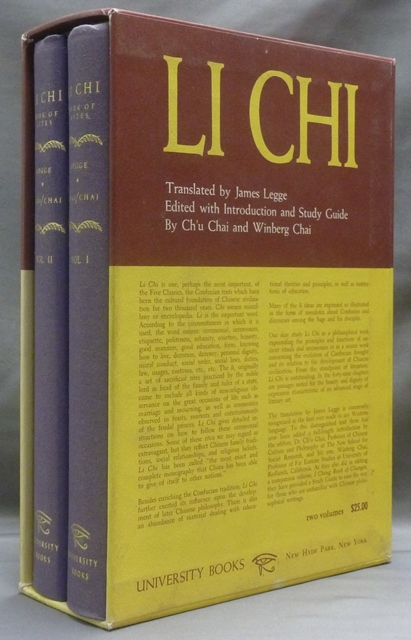
The Li Chi (pinyin Liji) is a collection of Confucian texts compiled in the Han dynasty dealing with matters of classical Chinese ceremonial.  Much of it concerns the minutiae of proper observance, including difficult questions when unusual circumstances impose conflicting obligations.  Other texts consider the nature and value of ceremony against those who would reject it as mere outward show, maintaining that ritual is essential to the proper ordering of emotion, evoking the proper feelings in those who lack them and restraining the passions of those who cannot control themselves.

The Li Chi is one of the "Five Classics" of Confucian philosophy.  As such, it has been studied, interpreted, glossed, and debated by legions of scholars for thousands of years.  Legge attempts to condense some of this conversation into the footnotes, along with notes on difficult translations and the claims of textual critics, and he succeeds in doing so without burying the text in the commentary.  Most readers will find it to be primarily of antiquarian interest, which is hardly surprising given that the motives of the authors and compilers was itself antiquarian, a search into the past, not due to idle curiosity or academic ambition, but out of a love of wisdom and a deep need for models to be imitated.  

Thursday, December 7, 2017

The Path

The Path: What Chinese Philosophers Can Teach Us About the Good Life by Michael Puett and Christine Gross-Loh, 204 pages


Puett is a professor of Chinese History. This book is based on a popular class that Puett teaches at Harvard.

This book covers Confucius and as-if rituals, Mencius and the capricious world, Laozi and generating worlds, The Inward Training and being like a spirit, Zhuangzi and a world of transformation, as well as Xunzi and putting pattern on the world.

One idea that stuck out for me is the malleable self. In the West, we tend to think that more of our self is set than necessarily is. The second idea is the capricious world. Despite knowing that the future is unpredictable, we act as if it is and when our plans don't work out it negatively affects us. Both of these ideas can influence how we think.

Unlike Greek philosophers who have distinctly different ideas, these Chinese philosophers have very similar ideas which can make it harder to remember which is which. In fact, Zhuangzi is a Daoist philosopher (Laozi) and Xunzi is a Confucian philosopher. They add to or refine the schools of philosophy rather than diverging from it.

There is an interview with the authors in the back of the book. They were asked what was the biggest challenge to writing the book. They said it was, "...to write complex ideas as clearly and simply as you can." I think they simplified too much in trying to appeal to a wider audience and lost some of what must make the class and subject so interesting. I didn't feel that there was enough depth to the ideas of the different philosophers. I would have preferred that this book have more depth rather than having to seek the original works of the philosophers or other sources. Despite it's shortcomings I liked this book and thinks it conveys some important wisdom.