Showing posts with label Catholicism. Show all posts

Tuesday, October 14, 2025

Real Presence

The Real Presence of the Body and Blood of Our Lord Jesus Christ in the Blessed Eucharist Proved From Scripture in Eight Lectures Delivered in the English College, Rome by Nicholas Cardinal Wiseman, 328 pages

As the full title explains, this is a printed collection of eight lectures which the future Cardinal delivered at the English College in Rome in 1836.  As might be expected by the audience, the lectures are academic in tone and content.  They are also straightforward defenses on Scriptural and philosophical grounds of the Catholic belief in the Real Presence, and there is no devotional spirit to them, nor do they reveal much about their author, who would soon become the first Archbishop of Westminster.  This does not mean that they have no value, but that there is little reason to prefer them to other texts on the same subject.

Monday, October 6, 2025

Life of Robert Southwell

The Life of Robert Southwell, Poet and Martyr by Christopher Devlin, 324 pages

Born into a well-connected family in England in the middle of the sixteenth century, as a teenager Robert Southwell, possibly under the influence of recusant relations, converted to Catholicism and departed to the Continent where he could practice his faith freely, beyond the reach of Protestant persecution.  Attracted, like many devout young men of the time, to the Society of Jesus, he entered the Jesuits after an initial rejection and became first a student and later a professor at the English College in Rome.  He left behind this position to become a missionary in his homeland, where he managed to minister to the Catholic community for several years before finally being cornered, captured, tortured, and executed.  Southwell's poetry, much of it written while in hiding, would serve as an inspiration to Shakespeare, Jonson, Donne, and Hopkins, among others, while his holy life and martyrdom led to his canonization in 1970, 14 years after this biography was published.

In the author's note that begins this biography, Christopher Devlin connects Southwell with St Edmund Campion, the illustrious Jesuit scholar and martyr of the preceding generation, and refers readers to the "brilliant study" of Campion by Evelyn Waugh.  Just as Southwell lived happily in the shadow of Campion, so Devlin writes in the shadow of Waugh.  While Devlin cannot match Waugh's literary genius, he compensates with thorough scholarship, something sorely needed when the historical record is so fragmentary.  

Wednesday, September 17, 2025

Notes on the Lord's Prayer

Notes on the Lord's Prayer by Raissa Maritain, 122 pages

Assembled posthumously from notes left by the author for a work that was never completed, Notes on the Lord's Prayer is a commentary on the seven petitions of the Paternoster as recorded by St Matthew: Hallowed be thy name, Thy Kingdom come, Thy will be done, Give us this day our daily bread, Forgive us our trespasses, Lead us not into temptation, and Deliver us from evil.

In his foreword, Thomas Merton laments the modern division between "spirituality" and "theology", recommending this book as a corrective.  This should provide a suggestion of the depth of thought as well as feeling, of sense as well as sensibility, present in this meditation, designed not only as a pious exercise but also as an exploration of the divine mysteries.

Wednesday, July 5, 2023

Forgotten Language

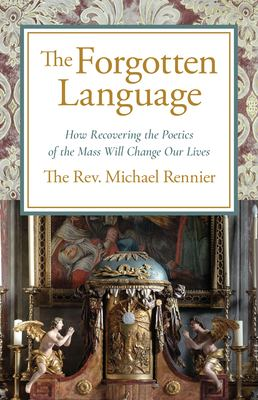
The Forgotten Language: How Recovering the Poetics of the Mass Will Change Our Lives by the Rev Michael Rennier, 196 pages

It sometimes seems that never before in human history has so much poetry been written and so little read.  Indeed, even the ability to recognize, still less to comprehend, poetry seems to have almost completely atrophied.  The modern mind demands solutions, while poetry requires understanding, the modern world celebrates pride, but true beauty cannot be received without humility.  Great poetry draws the audience beyond a superficial knowledge into deeper and deeper layers of meaning, towards beauty that is transcendent and truths that are mysteries.  As William Hazlitt explained, "Poetry is the universal language which the heart holds with nature and itself.  He who has a contempt for poetry cannot have much respect for himself, or for any thing else... all that is worth remembering in life is the poetry of it."

The greatest poem of all is, of course, Creation itself, which cannot be rivalled but only participated in.  The second greatest is the Divine Liturgy, that prayer in which the human is joined to the Divine, which likewise is not a work of man alone but of the Man who is God.  It is impossible to enter meaningfully into either without a poetic imagination.  There is no way to learn a language, however, without practice.  This is the genius of The Forgotten Language: it is not only a prescription, but also a primer.  Fr Rennier alternates between liturgical commentary, spiritual reflection, literary appreciation, conversion story, and personal anecdote in a way that may initially seem confused and off-putting, until the reader begins to perceive how they rhyme, and a new world opens or the old world is made explicit.

Saturday, July 1, 2023

Early History of Glastonbury

The Early History of Glastonbury by William of Malmesbury, translated by John Scott, 83 pages

The Early History of Glastonbury is a translation of William of Malmesbury's 12th century history De Antiquitate Glastonie Ecclesie, accompanied by the Latin text as well as commentary and notes. William undertook this project at the behest of the monks of Glastonbury, at least partially as a supplement to four Lives of Glastonbury saints he had written (of which only the Life of Saint Dunstan survives), but the primary aim seems to have been a catalogue of the various charters and bequests associated with the monastery.  Indeed, the short book is generally more of a legal record than a conventional history, as rights and privileges awarded to the abbot and monks are thoroughly documented - in the uncertain period following the Norman conquest, this was a necessity.

For a modern reader this focus proves something of an obstacle, as it does not make for particularly entertaining reading.  To the kind of reader who is likely to even consider reading a 12th century monastic history, however, the rewards will almost certainly be worth the price.

Wednesday, May 11, 2022

Birgitta of Sweden

Birgitta of Sweden: Life and Selected Revelations by St Birgitta of Sweden and others, translated by Albert Ryle Kezel, 235 pages

St Birgitta (often referred to as St Bridget but here given the more Teutonic variant in order to distinguish her from her more popular Irish namesake) was born in Sweden around 1303 and died in Rome in 1373.  Such was her reputation that she was canonized less than two decades later.  Beginning in early girlhood, she experienced a series of mystical visions of varying nature and subject matter, all drawing her into an ever more passionate love for God, a consuming flame that demanded to be spread to others. 

The core of St Birgitta's visions, as they are presented here, are of a dissolute monk (unnamed but known to the visionary) who interrogates God as to His nature and the nature of His creation.  This runs through an impressive catalogue of objections to God's existence, not only general questions about the existence of evil but also more specific inquiries into the cruelty of beasts, the economy of salvation, and the purpose of pleasure, all resolved with holy clarity and simplicity.  The collection of texts is rounded off with the rather dry Life prepared for her canonization and a selection of moving prayers to Christ and His Mother.

Friday, October 15, 2021

Three Ages of the Interior Life

The Three Ages of the Interior Life: Prelude of Eternal Life (Volume One) by Rev Reginald Garrigou-Lagrange OP, translated by Sister M Timothea Doyle OP, 470 pages

This book is an adaptation of a course Father Garrigou-Lagrange taught for over twenty years at the Pontifical College of St Thomas Aquinas (the Angelicum) in Rome.  The subject is mystical and ascetic theology, subjects which are sometimes treated as distinct but which the author demonstrates form a unity.  More importantly, he explains that these are not the concern merely of great saints and spiritual athletes, but are the heart of the universal call to holiness.  The interior life in which the soul ascends to God is both a foretaste of and a necessary preparation for that heaven which is true life in His presence.

The first volume treats of some foundational matters as well as the first of the three stages described by the great mystical writers, the purgative way.  Given the origin of the book, Garrigou-Lagrange's intended audience is current and future priests and spiritual directors, but despite occasional digressions into theological complexities, the work itself is imbued with a deep love of God and a concern for the souls of the faithful, so that it is pastoral in the best sense of the word.  A lay reader is likely to find himself both enlightened and inspired, though there is danger in reading beyond one's level.

Monday, September 27, 2021

Essays

Essays on Catholicism, Liberalism, and Socialism Considered in Their Fundamental Principles by Juan Donoso Cortes, translated by Rev William McDonald, 347 pages

In his celebrated 1988 Gifford lectures, Alisdair MacIntyre exposed the failure of both the modernist "encyclopedic" and postmodernist "genealogical" approaches to ethics, a failure rooted in their incommensurability, their inability to meaningfully dialogue with and assimilate alien systems.  Now we stand in the ruins of those towers of human pride, with leaders who, whether from knavery or imbecility or some mixture of the two, leap uncomprehendingly from one to the other, asserting at one moment that "my truth" is something manufactured, and at the next that it issues from the Delphic prophetess Science, once her mad ravings have been suitably interpreted by her labcoated priests.  If reason is the slave rather than the master of the passions, every subjectivity is at war with every other, convenient lies contending with convenient lies, and so the heathen rage.

This was all warned against by Juan Donoso Cortes in the early nineteenth century.  The liberal superstition that truth will triumph in a free marketplace of ideas is belied by the fact that men do not seek the truth, to the contrary, even when the Truth appeared to them they mocked Him, spit on Him, and ultimately crucified Him.  The entire liberal project is founded on the mistaken belief that human freedom consists of the power to choose between good and evil rather than the ability to will the good.  The result is moral chaos, the war of all against all by other means, and sin, Cortes reminds us, is nothing more or less than disorder, the confusion of lesser goods for higher, ending in the disunion of soul and body which is death.  Life, then, is order, true order, the harmony which exists in the presence of the supreme mysteries in the light of which all apparent contradictions are resolved.   

Friday, August 6, 2021

Real Music

Real Music: A Guide to the Timeless Hymns of the Church by Anthony Esolen, 274 pages

It is a truth rarely acknowledged that the Christian liturgy is at the center of the Western artistic tradition.  Both the fine and the practical arts developed as the handmaids of the Mass.  It can be argued that the seemingly undeniable decline of art over the course of the past few centuries is directly connected to the divorce of aesthetics from the sacred, and it is inarguable that this same divorce has impoverished the Church and resulted in much of what is seen, said, and sung being banal and second-rate.  It is under these conditions that Anthony Esolen invites us to consider the great hymns of the past, from the Protestant as well as Catholic tradition, and to appreciate their continuing power.

Esolen is a professor of English and not of music, which is reflected here in his concentration on poetry rather than melody.  Balancing this somewhat, the physical book includes a CD with performances of some relevant hymns by the St Cecilia Choir of Chicago's St John Cantius Church.  Despite the connection to St John Cantius, the book is not primarily a liturgical prescription, and Esolen is generally too preoccupied by the beauty of the hymns he is discussing to spend much time denigrating more recent compositions.  Instead, the book has the character of a devotional, exploring in a surprisingly moving way what these songs tell us about the Divine and our relationship with Him.

Tuesday, August 3, 2021

Christus Vincit

Christus Vincit: Christ's Triumph Over the Darkness of the Age by Bishop Athanasius Schneider and Diane Montagna, 421 pages

In the relatively new but vital tradition of book-length interviews of Catholic prelates, popularized by Cardinal Ratzinger and continued by Cardinal Sarah, Christus Vincit is an expansive, free-ranging conversation with the auxiliary bishop of Nur-Sultan, the capital of Kazakhstan.  It might understandably be asked what this man of the peripheries has to offer the Church and the world.  Quite a bit, as it turns out, and if little of it is new, most of it is excellent.

The heart of Bishop Schneider's message is that the naturalistic turn the Church took in the twentieth century has been a disaster pastorally, evangelically, and theologically.  To counter this, he calls for a renewed emphasis on the supernatural and the transcendent.  Again he reminds us that human beings are embodied creatures rather than pure spirits, that history is not Providence but has a providential aspect, and that while all earthly economic and political arrangements, debates, and crises are passing, there is a Kingdom which is eternal.  Unfortunately, there is also a certain amount of conspiratorial thinking, mostly involving the Freemasons, some of which may be true but which generally seems out of place and fantastical.

Monday, May 3, 2021

Integralism

Integralism: A Manual of Political Philosophy by Thomas Crean and Alan Fimister, 279 pages

A spectre is haunting what was the West - it is the spectre of Integralism.  All the powers of the old liberalism have entered into an unholy alliance to exorcise this spectre: Democrat and Republican, libertarian and socialist, German and Brit, Dorsey and Zuckerberg, Bezos and Gates.  

This may seem a trifle overblown.  It is true, however, that as the liberal consensus crumbles, engaged Catholics, and especially younger Catholics, have begun looking for traditional alternatives to the naked emperor of modernity.  One of the most trenchant criticisms of the movement has been the lack of agreement as to what, precisely, is meant by "Integralism", particularly in a country founded on the rejection of throne and altar.  Is Integralism equivalent to Falangism, or is it a particular flavor of common-good conservatism, or is it a fundamentally unserious social-media phenomenon with no meaningful content whatsoever?

Although disagreements will no doubt continue, with the publication of Crean and Fimister's manual at least the last is no longer an entirely plausible answer.  Without being argumentative, they carefully build their argument for a rational society and a politics which respects the entire human person.  Although their conclusions are unlikely to convince anyone who does not agree with their premises, their political philosophy is at least coherent, which is more than can be said for any of the post-modern alternatives.  The result is a challenge to many, and an invitation to a few.

Thursday, April 29, 2021

The Day Is Now Far Spent

The Day Is Now Far Spent by Robert Cardinal Sarah and Nicolas Diat, translated by Michael J Miller, 343 pages

The hour is late indeed, says Cardinal Sarah in this book-length interview with his favorite interlocutor, Nicolas Diat.  The Church, he tells us, is riven by dissension, compromised by unbelief, and stained with sin.  Meanwhile, the decadent ruins of Christendom are in the grip of a "fundamentalist liberalism" that pursues wealth and power (often under the guise of "justice" and "liberation") while treating the sacred with indifference and contempt.  The irony is that, by attempting to place himself at the center of the world, modern man has created a world in which he is increasingly superfluous.  Not content in its iconoclasm with the destruction of its own past, the neo-colonialist West actively works to erase the cultures of Africa and Asia even as it plunders their lands of their natural resources.  

It is necessary, then, for faithful Catholics to resist the temptations of compromise and despair.  This demands the cultivation of virtue and excellence - "The Church does not have the right to be mediocre."  Fittingly for the author of The Power of Silence, while Sarah's message is urgent, it is not primarily a "call to action", but a call to prayer and contemplation.  "Your mission is not to save a dying world... Your mission is to live out with fidelity and without compromise the faith you received from Christ."

Thursday, October 1, 2020

Before Church and State

 Before Church and State: A Study of Social Order in the Sacramental Kingdom of St Louis IX by Andrew Willard Jones, 454 pages

Post-enlightenment, the establishment narrative regards the thirteenth century as a chrysalis for the sovereign, secular state, when the irrational, theocratic pretensions of the papacy began to be overcome by the increasingly independent monarchs of the nations of Europe including, crucially, the pious, even saintly Louis IX of France.  As Andrew Jones convincingly demonstrates, however, this is a deformation of the actual history of the period, the product of the anachronistic imposition of modern concepts on medieval society.  For medieval Catholics, the natural state of man was not, as it would be for the "enlightened", a state of war against which the secular State must force a truce.  To the contrary, the natural state of man is peace, a peace broken by sin, but which grace restores and maintains.  It is the role of the secular as of the ecclesiastical authority to be a conduit for that grace, and they are partners rather than competitors.

Jones builds his remarkable book around the person of Gui Foucois, who served as an official in both the French church and state before becoming Pope Clement IV, but it is precisely Jones' point that Foucois saw his public service as a unified whole, not as divided into "religious" and "secular" but as part of the single "business of the peace and the faith".  It followed, then, that outlaws and heretics were equally "breakers of the peace", rebels against a sacramental order whose harmony was predicated upon difference rather than equality, being itself an expression of a Trinitarian rather than a Deist theology.

Monday, August 3, 2020

Life of Saint Teresa of Avila

The Life of Saint Teresa of AvilaThe Life of Saint Teresa of Avila: A Biography by Carlos Eire, 223 pages

In the 16th century, as the fires of the Protestant Reformation swept across northern Europe, a remarkable woman rose to prominence in Spain.  A Carmelite nun from the Castilian city of Avila, Teresa of Jesus was a mystic and visionary, and also a tireless foundress and reformer.  Living at a time when the Church had a healthy suspicion of those who claimed to be in direct communication with the Almighty, Teresa's autobiography, the Life of Teresa of Avila, was written both as description and defence, her mystical locutions having drawn her deeper into the Church rather than leading her astray to preach a new gospel.

As Carlos Eire details in his biography of St Teresa's autobiography, this defence entailed a series of drafts and revisions over the course of decades as Teresa and her spiritual advisors took care to cross every theological "t".  Even so, it was not until after her death that the work was allowed to be widely circulated, and it continued to have its detractors.  Their voices were drowned out, however, by the rapid spread of her cult, and she was canonized a mere forty years after her death, with the Life providing vital testimony to her sanctity.  Nor does Eire's story stop there, for the following centuries saw the book become a defining text of early modern Catholicism, inspire great art (most famously Bernini's sculpture of the transverberation), influence religious movements including the Jansenists, Quakers, and Methodists, and finally be reimagined as a study in hysteria or proto-feminist tract.  As Eire notes, this enduring influence of the Life is itself an undeniable testament to the force of its authors personality as well as the Power that moved her.

Thursday, July 2, 2020

Liberty, Equality, and Fraternity

Liberty, Equality, and Fraternity by Ven Fulton J Sheen, 170 pages

Written in 1938, as fascists and communists in Europe and America gathered their forces for their pending assault against the liberal order, Liberty, Equality, and Fraternity diagnoses the troubles of the time in terms of the internal contradictions of the slogans of the bloody revolution which established that order.  The liberals exalt freedom above all, the totalitarians demand equality, and as the values each proposes are seemingly incommensurable, their differences cannot be peacefully resolved absent a higher unifying principle.  Sheen finds this principle in fraternity, the principle which animates Catholic social teaching, which he advances as a cure for the world's ills.

Liberty, Equality, and Fraternity was written early in Sheen's public career, and suffers from a lack of focus.  After ably establishing his argument, Sheen proceeds to ramble on at length about the threat of communist subversion in the US - a timely warning, but one not directly connected to the main theme of the book or of much interest to a reader eighty years later.  Sheen's analysis of both liberalism and totalitarianism as sharing the same dehumanizing character despite their irreconcilable differences, however, remains powerful.

Tuesday, June 16, 2020

Introduction to Christianity

Introduction to ChristianityIntroduction to Christianity by Joseph Ratzinger, translated by JR Foster, 359 pages

Introduction to Christianity is an adaptation of a series of lectures given by Joseph Ratzinger in 1967 and first published in written form in the momentous year of 1968.  Although he would go on to become bishop of Munich, then a cardinal and the head of the Congregation of the Doctrine of the Faith, and finally ascend the throne of St Peter as Benedict XVI, at the time this book was written he was still the dashing young peritus of the Second Vatican Council, and the book itself is very much a response to the theological winds that had begun to blow through the windows the Council opened.  Indeed, in Introduction to Christianity Ratzinger outlines the theological project that would fill his remaining life.

This begins with the recognition that Christianity is unavoidably a historical religion, founded in a real past and not a mythic long ago, unfolding in the lives of the prophets and the saints with the Incarnation at the center.  One consequence of this is that the progressive attempt to inaugurate a revolutionary new Christianity freed from its actual historical development is inevitably futile.  Ratzinger argues instead for the providential role of Hellenistic philosophy in early Christianity, just as he argues that modern Christianity can be enriched rather than impoverished by the real contributions of modern scholarship.  His ultimate aim is to demonstrate the unity of the living "God of Abraham, Isaac, and Jacob" with the "God of the philosophers and scholars", the God of faith with the God of reason, and how the work of reason is vitally - indispensably - involved in establishing a personal relationship with this transcendent God.

Friday, September 20, 2019

On the Ignatian Spiritual Exercises

Hans Urs Von Balthasar on the Ignatian Spiritual ExercisesHans Urs von Balthasar on the Ignatian Spiritual Exercises: An Anthology by Hans Urs von Balthasar, edited by Jacques Servais, SJ, translated by Thomas Jacobi and Jonas Wernet, 262 pages

This volume gathers together thoughts inspired by the Spiritual Exercises of St Ignatius of Loyola found scattered throughout the writing of Hans Urs von Balthasar.  These thoughts are not those of an idle commentator, but of a man who had both repeatedly conducted the Exercises and been conducted through them.  What emerges are something like notes towards a theology of the Exercises, a theology of election and direction and therefore of movement and mission.  St Ignatius' spirituality is presented as distinctively modern, viewing the spiritual life as an endless struggle, but also strikingly theocentric, concerned not with human needs and ends but with the worship and service of the Almighty.  For Balthasar, the Suscipe of St Ignatius is one more echo of the Marian fiat which lies at the heart of the Church, itself the perfect reflection of the Son's obedience to the Father.

Tuesday, September 10, 2019

Indissolubility of Marriage

The Indissolubility of MarriageThe Indissolubility of Marriage: Amoris Laetitia in Context by Matthew Levering, 177 pages

Pope Francis' 2016 apostolic exhortation Amoris Laetitia, the papal response to the synods on the family held in 2014 and 2015, was contentious even before it was issued.  Controversy swirled around (and in) the synods over the Church's teaching that Christian marriage is indissoluble, which necessarily means that, while a civil divorce may be necessary in certain cases, remarriage constitutes adultery.  In Amoris Laetitia, the pope attempted to thread the needle by strongly reaffirming the indissolubility of marriage, but allowing that subjective factors may mitigate the objective sin of adultery and open a path for some, suitably penitent, divorced and remarried individuals to receive the Eucharist.  Whether by accident or design, however, the ambiguities of the exhortation and subsequent comments have generated a great deal of confusion and wide divergences in implementation.

In The Indissolubility of Marriage, Matthew Levering surveys the development of the Church's teaching on marriage, from the Gospel to Pope Benedict XVI, including examinations of Orthodox and Protestant positions on divorce.  In the process, he demonstrates that the sacramentality of marriage requires its indissolubility, and further argues that marriage ought to be recognized as indissoluble as a matter of natural law.  He therefore concludes that the betrayal of this teaching of reason as well as revelation would be gravely injurious, not only to the Church, but to the common good.

Saturday, August 3, 2019

Tradition and Sanity

Tradition and SanityTradition and Sanity: Conversations and Dialogues of a Postconciliar Exile by Peter A Kwasniewski, 211 pages

CS Lewis famously remarked that the value of studying history lies not in the delusion that previous eras had all the answers, but in the realization that their mistakes were different from ours.  Similarly, for Dr Kwasniewski the fact that the traditional liturgy was not specially made for our time enables it to offer the modern world precisely what the modern world desperately needs but is incapable of producing, a form of worship which is oriented to the transcendent and therefore not dependent on, or manipulable by, us.  In Tradition and Sanity this theme runs through the collected conversations, some real interviews, some invented dialogues.

Of course, invented dialogues often become polemics, but those collected here are characterized by their gentleness.  The author defies the stereotype of the narrow-minded traditionalist by refusing to play the angry activist and writing instead as a thoughtful contemplative.  Whether discussing the role of sacred music or the shortcomings of the current pontificate, he speaks not as an outraged partisan but as a joyful discoverer eager to share the treasures he has found.

Friday, July 12, 2019

Vestments and Vesture

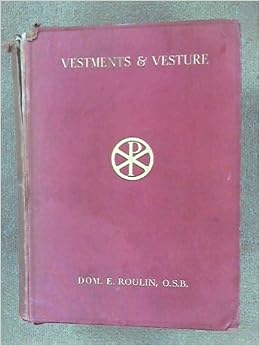
Image result for Vestments and VestureVestments and Vesture: A Manual of Liturgical Art by Dom EA Roulin, translated by Dom Justin McCann, 298 pages

This is less a textbook than a primer for priests and others involved in the design, purchase, and care of all kinds of liturgical clothes, from chasubles to purificators to banners.  The focus is less on their historical development than on their design and use, with a continuous emphasis on simplicity and good taste.

The French original was published in 1930, a time which seems far removed from the liturgical wars of today.  Yet Dom Roulin's sensible advice indicts both the tawdriness of so much contemporary work and the theatricality of some traditionalist overreactions, instead supporting a liturgical art which is "dignified, solid, and devotional."