Showing posts with label St Louis. Show all posts

Thursday, October 1, 2020

Before Church and State

 Before Church and State: A Study of Social Order in the Sacramental Kingdom of St Louis IX by Andrew Willard Jones, 454 pages

Post-enlightenment, the establishment narrative regards the thirteenth century as a chrysalis for the sovereign, secular state, when the irrational, theocratic pretensions of the papacy began to be overcome by the increasingly independent monarchs of the nations of Europe including, crucially, the pious, even saintly Louis IX of France.  As Andrew Jones convincingly demonstrates, however, this is a deformation of the actual history of the period, the product of the anachronistic imposition of modern concepts on medieval society.  For medieval Catholics, the natural state of man was not, as it would be for the "enlightened", a state of war against which the secular State must force a truce.  To the contrary, the natural state of man is peace, a peace broken by sin, but which grace restores and maintains.  It is the role of the secular as of the ecclesiastical authority to be a conduit for that grace, and they are partners rather than competitors.

Jones builds his remarkable book around the person of Gui Foucois, who served as an official in both the French church and state before becoming Pope Clement IV, but it is precisely Jones' point that Foucois saw his public service as a unified whole, not as divided into "religious" and "secular" but as part of the single "business of the peace and the faith".  It followed, then, that outlaws and heretics were equally "breakers of the peace", rebels against a sacramental order whose harmony was predicated upon difference rather than equality, being itself an expression of a Trinitarian rather than a Deist theology.

Wednesday, December 30, 2015

Curse of Jacob Tracy

Curse of Jacob Tracy by Holy Messinger
308 Pages

"St. Louis in 1880 is full of ghosts, and Jacob Tracy can see them all. Ever since he nearly died on the battlefield at Antietam, Trace has been haunted by the country's restless dead. The curse cost him his family, his calling to the church, and damn near his sanity. He stays out of ghost-populated areas as much as possible these days, guiding wagon trains West from St. Louis, with his pragmatic and skeptical partner, Boz.

During the spring work lull, Trace gets an unusual job offer. Miss Fairweather, a wealthy English bluestocking, needs someone to retrieve a dead friend's legacy from a nearby town, and she specifically wants Trace to do it. However, the errand proves to be far more sinister than advertised. When confronted, Miss Fairweather admits to knowing about Trace's curse, and suggests she might help him learn to control it in exchange for a few more odd jobs. Trace has no interest in being her pet psychic, but he's been looking twenty years for a way to control his power, and Miss Fairweather's knowledge of the spirit world is too valuable to ignore. As she steers him into one macabre situation after another, his powers flourish, and Trace begins to realize some good might be done with this curse of his. But Miss Fairweather is harboring some dark secrets of her own, and her meddling has brought Trace to the attention of something much older and more dangerous than any ghost in this electrifying and inventive debut."


Set as a series of short adventures that blend to a greater book I thought the novel was entertaining.  There is definitely room for further books and I would welcome more character development.  

Saturday, March 28, 2015

Angels and Demons

Cover image for The Mammoth book of Angels and Demons, 544 pages

This is another one of those collection of short stories novels based around a certain theme. As you might have been able to guess by the title every story is based on either angels, demons, or in some cases both. I am not sure what initially drew me to this book, maybe it was the cover art or the fact that it was edited by Puala Guran instead of the usual George R. R. Martin. Either way it was worth reading.

Like nearly every collective work I have posted on here, some stories were enjoyable, some were dull/boring, and others were just weird or interesting. While it did have stories by some of my favorite authors, Neil Gaiman, George R.R. Martin, etc. none of the stories really stood out as exceptionally noteworthy. Though the TSA using the full body scanners to check for demon possession instead of weapons was close.

What was noticeable though was how often St Louis featured into this book. Of the twenty seven short stories I noticed that four and maybe a fifth(it was a little vaguer) either mentioned part of St Louis, took place here, or passed though the town. One of the stories even specifically mentions the bus half hanging off the roof of the City Museum! Getting even closer to the library one of the demons who was originally passing though St Louis ends up staying and residing in the Park Pacific Building, which is right across the street. When I was reading that story I just happened to be sitting out front of Central and could not help but glance at the building and give it a suspecting glare.

Having a book both talk about, or even mention areas that are familiar really help to immerse the reader and in this case make me like the book that much more. But I tend to find this only works when I don't know that St Louis is going to be mentioned, otherwise it loses the thrill.

Wednesday, March 19, 2014

Bliss House

Bliss House by Laura Benedict
400 Pages


 An old family mansion comes back into the family when Rainey Bliss Adams and her daughter move back to Virginia after a tragedy in Virginia.  The house seems to be helping her daughter Ariel recover from the burns that left her disfigured but things don't seem right.  Soon a murder starts to uncover a past in which the evil of the house seems to be a major factor.

While this gothic novel has all the right elements to be a hit, poor characterization frustrates the reader of this novel.  This plus many plot holes, diminish the effect of the story.

Wednesday, February 26, 2014

Saint Louis

Cover image for Saint Louis / Jacques Le Goff ;  translated by Gareth Evan Gollrad.
Saint Louis by Jacques LeGoff, translated by Gareth Evan Gollrad, 746 pages

2014 not only marks the 250th anniversary of the founding of the city of St Louis, it is also the 800th anniversary of the birth of St Louis IX, King of France.  Jacques LeGoff's biography is an excellent resource for anyone seeking to understand this royal saint and the world he inhabited.

The first third of the book comprises the actual biography of Louis IX, boy king, crusader, peacemaker, royal judge, and saint.  The middle third is an analysis of the sources for this biography, from his own words, his hagiographers, and his close friends, particularly Jean de Joinville.  The last third attempts to break down how those sources presented St Louis in terms of those roles, how those socially constructed roles affected their understanding of him and his understanding of himself.

LeGoff clearly holds considerable affection for his subject, so that he treats him fairly even when he does not share his attitudes and views.  Indeed, it is clear that LeGoff's own beliefs are very different from those of his subject, but these differences are treated sympathetically.  He does not hesitate to highlight St Louis' failings - his policies towards the Jews being an obvious example - but he does not exaggerate them, either.

Although I have some minor quibbles, this is a commendable work.  Those looking for a simple biography may want to read the first third and skip the rest.  Those who read the entirety, though, will not be disappointed.

Saturday, January 25, 2014

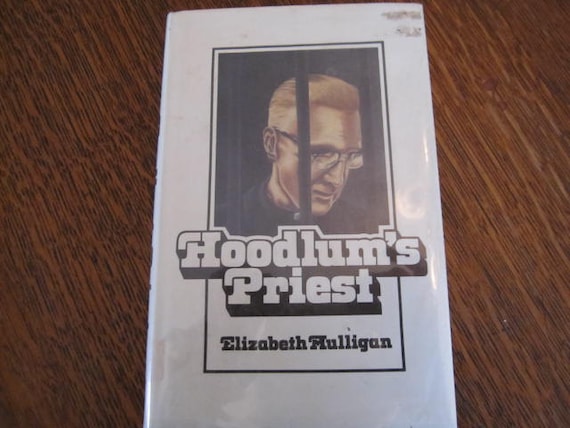
Hoodlum's Priest

Hoodlum's Priest by Elizabeth Mulligan, 169 pages

https://img0.etsystatic.com/042/0/8754371/il_570xN.581938914_6s5l.jpg The subject of this biography is Father Charles "Dismas" Clark, SJ, a Jesuit priest who spent much of his life working with those inside and recently released from prison.  His work led to the founding of Dismas House in St Louis in 1959, one of this country's first halfway houses.  Neither a romantic nor a cynic, Father Clark understood the evil of crime, but felt obliged to criticize a system he believed contributed to the hardening of criminals by denying them opportunities to change.  A tireless activist featured in many print, radio, and television reports on prison reform and recidivism, he achieved the height of his fame with the 1961 release of "Hoodlum Priest", a fictionalized movie account of his ministry, but a film which he personally loathed.

This is not a conventional, objective biography, but rather a memoir by a close friend, more a collection of anecdotes than a detailed record.  In many of the passages one can almost hear the voices of other friends of Father Clark sharing their own stories with the author.  Mulligan does not attempt to hide Clark's rough edges, whether relating his impatience with others less passionate about his cause, or the occasional rhetorical excess which sometimes alienated some of his own supporters.  By the end, the reader does not know all the details of Father Clark's remarkable life, but knows what it was like to know him.