Showing posts with label Medieval world. Show all posts

Saturday, July 1, 2023

Early History of Glastonbury

The Early History of Glastonbury by William of Malmesbury, translated by John Scott, 83 pages

The Early History of Glastonbury is a translation of William of Malmesbury's 12th century history De Antiquitate Glastonie Ecclesie, accompanied by the Latin text as well as commentary and notes. William undertook this project at the behest of the monks of Glastonbury, at least partially as a supplement to four Lives of Glastonbury saints he had written (of which only the Life of Saint Dunstan survives), but the primary aim seems to have been a catalogue of the various charters and bequests associated with the monastery.  Indeed, the short book is generally more of a legal record than a conventional history, as rights and privileges awarded to the abbot and monks are thoroughly documented - in the uncertain period following the Norman conquest, this was a necessity.

For a modern reader this focus proves something of an obstacle, as it does not make for particularly entertaining reading.  To the kind of reader who is likely to even consider reading a 12th century monastic history, however, the rewards will almost certainly be worth the price.

Tuesday, May 24, 2022

Charles the Bald

Charles the Bald by Janet L Nelson, 264 pages

Charles the Bald, the youngest son of Louis the Pious and a grandson of Charlemagne, has often been regarded as the first French king, even as he has often been characterized as a weak ruler who squandered his inheritance and empowered an increasingly assertive aristocracy.  In Janet Nelson's account of his life, however, he is understood as a semi-independent ruler within the greater Carolingian empire and as a deft politician who struggled with fractious vassals and relatives at a time when the end of expansion meant that rewards and inducements had to come from within the already existing realm.

Nelson manages to make even discussions about the distribution of coins from regional mints readable, if not enjoyable.  The book is neither revolutionary nor a particularly deep exploration of the Carolingian world, but it is an intriguing look at certain aspects of that culture, from an interesting perspective.

Wednesday, May 11, 2022

Birgitta of Sweden

Birgitta of Sweden: Life and Selected Revelations by St Birgitta of Sweden and others, translated by Albert Ryle Kezel, 235 pages

St Birgitta (often referred to as St Bridget but here given the more Teutonic variant in order to distinguish her from her more popular Irish namesake) was born in Sweden around 1303 and died in Rome in 1373.  Such was her reputation that she was canonized less than two decades later.  Beginning in early girlhood, she experienced a series of mystical visions of varying nature and subject matter, all drawing her into an ever more passionate love for God, a consuming flame that demanded to be spread to others. 

The core of St Birgitta's visions, as they are presented here, are of a dissolute monk (unnamed but known to the visionary) who interrogates God as to His nature and the nature of His creation.  This runs through an impressive catalogue of objections to God's existence, not only general questions about the existence of evil but also more specific inquiries into the cruelty of beasts, the economy of salvation, and the purpose of pleasure, all resolved with holy clarity and simplicity.  The collection of texts is rounded off with the rather dry Life prepared for her canonization and a selection of moving prayers to Christ and His Mother.

Tuesday, July 27, 2021

Word and Image

Word and Image: An Introduction to Early Medieval Art by William J Diebold, 148 pages

In Word and Image, William Diebold describes the development of early medieval art in the context of the interplay of the appeal of the visual arts and the Christian fear that such appeal might lead to idolatry.  Beginning with St Gregory the Great's famous defense of images as "the book of the illiterate", Diebold demonstrates how the language of images essentially differs from that of words, and how the Christian West made peace with those differences.

Diebold's argument is interesting and his writing clear.  The book is full of excellent (though inevitably mostly monochrome) illustrations.  Unfortunately, the text seems to present medieval Christianity as primarily a matter of certain intellectual propositions only incidentally reflected in practices, and likewise to consider writing as primarily a vehicle for rational argument rather than affective narrative.  Perhaps these deficiencies could have been eliminated had the book been a bit longer and deeper.

Monday, May 10, 2021

In Such Hard Times

In Such Hard Times: The Poetry of Wei Ying-wu by Wei Ying-wu, translated by Red Pine, 359 pages

Wei Ying-wu lived in hard times indeed.  The eighth century saw the crisis of the An Lushan rebellion, which forced the Tang court to flee Chang-an, and even the final suppression of the revolt only seemed to increase the power of the regional warlords.  Wei himself lived a life full of disappointments - a born aristocrat but a middling scholar, his career as a civil servant never equaled his early promise.  How much of this was a cause and how much a result of his desire for a retired, ascetic life is an open question.

     reports neglected for days
     no one dealing with ink or words
     it must be because of the quiet
     or because I met a man of the Way

In medieval China, poetry was the language of social discourse, and most of Wei's poems look to past meetings or present ones or future encounters, or all of these simultaneously.

     we met and got drunk among the flowers
     we were going in different directions but not very far
     what the evening tide took away the morning tide brought back

Wei's status as a man of culture with at least aspirations to virtue moving in and out of an imperial administration is one he shared with a number of celebrated figures in Chinese history, many of whom he acknowledges as models.  It gives him a certain sensitivity to human foibles.

     the price of a single cup was a hundred sacks of grain
     it was strong at first and then thin and finally robbery
     but patrons knew its name and nothing of its taste

The world was hardly clamoring for an English translation of the poetry of Wei Ying-wu.  That Red Pine took the task upon himself is itself evidence of the way the life and work of the poet resonate with those of his translator, and the latter's excellent commentary makes it available to the receptive reader.

     whistling out loud I hike past towering trees
     admiring the heights his footsteps have reached

Wednesday, March 31, 2021

Tales of the Early Franks

 Tales of the Early Franks: Episodes from Merovingian History by Augustin Thierry, translated by MFO Jenkins, 166 pages

It is no less a commonplace of our time than of Augustin Thierry's that the so-called "Dark Ages" are a confusing, dull, and unprofitable era to study - indeed, the sometimes-equivalent term "Middle Ages" seems to imply an unedifying interlude between the more significant Classical and more important Modern periods.  If scholars and ideologues are divided on when the "darkness" fell, in what, precisely, it consisted, and when and how it lifted, it seems certain that Gaul in the late 6th century was deep beneath it.  

It should be a pleasant surprise, then, to discover Thierry's tales of love, war, religion, politics, and intrigue in the Merovingian era.  Based largely on the histories and memoirs of St Gregory of Tours, Thierry's work is divided into seven interrelated narrative episodes covering events ranging from the tragic life of Queen Galswinth to the rigged trial of Bishop Praetextatus to the happy friendship of Radegund and Venantius Fortunatus.  Thierry delightfully combines a contagious love for the period with a deep awareness of the importance of personalities and character.

Saturday, March 27, 2021

Count Bohemond

Count Bohemond by Alfred Duggan, 281 pages

Eldest son of the Norman adventurer who conquered Apulia, Bohemond, Count of Taranto, is the "mightiest of the mighty Hautevilles", a physical giant whose strength is matched only by his ambition.  While his father's title may have fallen to a more politic half-brother, Bohemond dreams of the riches and recognizes the vulnerability of the emperor in Constantinople.  Yet when the Pope calls the knights of Christendom to come to the aid of that emperor and to fight for the Holy Sepulchre, Bohemond eagerly joins the Crusade.  In his pursuit of victory and glory, however, his fellow Crusaders and their Greek allies soon prove nearly as great an obstacle as the Turks.

Count Bohemond is not a particularly deep book, but it is a well-written, solid entry into the genre of historical biographical novels suitable for teenage boys that is exemplified by I, Claudius.  An excellent introduction to the complexities of the First Crusade packaged within a dramatic narrative.

Friday, October 16, 2020

Complete Poems

 The Complete Poems by Guido Cavalcanti, translated by Marc Cirigliano, 69 pages

Guido Cavalcanti attained immortality not through his own work, but as a friend of Dante, who finds him in the Inferno among the gluttons.  Cavalcanti, however, has also earned his own small group of discerning admirers.

     you see me - one who goes crying
     an example to all of Love's judgment
     and i don't find a pitying heart
     sigh even once looking at me

It is notoriously difficult to transfer the rhythm and rhyme of Romance languages into Germanic languages such as English - still, there must be a superior approach to this translation of the Sweet New Style into stale modernism.

     look at him and see his heart
     carried by Death's hand - carved into a cross.

Monday, October 12, 2020

Orkneyinga Saga

 Orkneyinga Saga: The History of the Earls of Orkney, translated by Hermann Palsson and Paul Edwards, 224 pages

The Orkneyinga Saga is a prose history of the jarls who ruled Orkney between the ninth and the thirteenth centuries.  It was probably written in Iceland in the 13th century, but is largely based on older, poetic accounts of the doings of the notable men and women of the islands.  In many places the anonymous compiler incorporates bits of these into his history.

     Ships grappled
     together; gore, as foes fell,
     bathed stiff iron, black
     with Scots' blood;
     singing the bows spilt
     blood, steel bit; bright
     though the quick points quaked,
     no quenching Thorfinn.

This is all the more effective given the highly repetitive narrative, a seemingly unending series of feuds, with aggrieved parties seeking aid from Scotland and Norway, normally ending in bloodshed but occasionally in reconciliation, the bloodshed often leading to more bloodshed and the reconciliations also often leading to more bloodshed.  That is not to say that there is nothing of interest - to the contrary, there's the story of how Rognvald, hiding from his enemies, was betrayed by his own lapdog, and of the time Svein three times politely asked Arni to settle a debt before driving an ax into his skull, and of Uni's cleverness in sabotaging his enemies' watchfires, among many other memorable incidents.  It is the poetry, though, that truly enchants.

     I fear my fate
     turns my face from Ermingerd;
     many a man
     would match her if he might.
     Her brow's such a beauty -
     I'd bed her gladly, even
     once would be worth it,
     a wish come true.

Thursday, October 1, 2020

Before Church and State

 Before Church and State: A Study of Social Order in the Sacramental Kingdom of St Louis IX by Andrew Willard Jones, 454 pages

Post-enlightenment, the establishment narrative regards the thirteenth century as a chrysalis for the sovereign, secular state, when the irrational, theocratic pretensions of the papacy began to be overcome by the increasingly independent monarchs of the nations of Europe including, crucially, the pious, even saintly Louis IX of France.  As Andrew Jones convincingly demonstrates, however, this is a deformation of the actual history of the period, the product of the anachronistic imposition of modern concepts on medieval society.  For medieval Catholics, the natural state of man was not, as it would be for the "enlightened", a state of war against which the secular State must force a truce.  To the contrary, the natural state of man is peace, a peace broken by sin, but which grace restores and maintains.  It is the role of the secular as of the ecclesiastical authority to be a conduit for that grace, and they are partners rather than competitors.

Jones builds his remarkable book around the person of Gui Foucois, who served as an official in both the French church and state before becoming Pope Clement IV, but it is precisely Jones' point that Foucois saw his public service as a unified whole, not as divided into "religious" and "secular" but as part of the single "business of the peace and the faith".  It followed, then, that outlaws and heretics were equally "breakers of the peace", rebels against a sacramental order whose harmony was predicated upon difference rather than equality, being itself an expression of a Trinitarian rather than a Deist theology.

Tuesday, March 3, 2020

First Masterpiece of Chinese Painting

First Masterpiece of Chinese PaintingFirst Masterpiece of Chinese Painting: The Admonitions Scroll by Shane McCausland, 139 pages

In the aftermath of the Boxer Rebellion, an officer from the Bengal Lancers approached the experts at the British Museum seeking someone who could repair an old scroll he claimed to have received as a gift from a high-born Chinese lady.  Recognizing the value of the object, the Museum proceeded to purchase it at a very reasonable price.  The scroll, the Admonitions of the Instructress to the Court Ladies, contains the text of the poem of that name, written in 292 AD by the courtier Zhang Hua as an admonishment to the Empress Jia, as well as ink paintings illustrating the themes of the poem.  The scroll, calligraphy as well as painting, was traditionally held to be the work of the classical genius Gu Kaizhi, but this is no longer believed to be true, with scholarly opinion divided on whether it is a copy of one of Gu's works or entirely unconnected to him.  Whatever its provenance, it is an undoubted masterpiece of Chinese art from the first millennium that has been held up as a model for both court women and Chinese painters for centuries.

If the beauty of the paintings are obvious to all, for most Westerners (and no doubt for most of today's Chinese) it will prove difficult to understand the Admonitions as a coherent whole, much less fully appreciate its historical value as a pedagogical tool and cultural exemplar.  Although necessarily only scratching the surface, Shane McCausland's short book at least lessens the difficulties.  Unfortunately. the color images of the scroll itself are somewhat muddy (other works, including later copies of the Admonitions, are better presented), but, as the author himself notes, there are much better reproductions readily available online.

Tuesday, January 28, 2020

Beowulf

BeowulfBeowulf by Santiago Garcia and David Rubin, 189 pages

This graphic adaptation of the epic poem generally avoids the banal postmodern revisionism of other adaptations, reducing the story down to the essential confrontations between four monsters - Grendel, his mother, a dragon, and the great Geat himself.  The art is stylized, the colors muddy, the overall effect undeniably ugly - which, however, both suits the brutal directness of the narrative and emphasizes the fleshy substance of the monsters, which are here portrayed not as elusive magic fairies but as viscerally real beasts, perhaps more real than some men.

Tuesday, November 26, 2019

Ivanhoe

IvanhoeIvanhoe by Walter Scott, 464 pages

Wilfred of Ivanhoe returns from the Crusades to an uncertain future and an unsettled England.  His proud Saxon father has disinherited him for following the lion-hearted Norman king.  His castle is occupied by a Templar who, by all rights, should be fighting in the Holy Land.  His beloved is betrothed to another.  Prince John plots to usurp the throne of his absent brother, Richard.  The forest is teeming with outlaws.  Corruption pervades both Church and State.  Yet there are heroes as well, men and women prepared to risk everything in defence of virtue.  It is time for Ivanhoe to take his place beside them.

Ivanhoe, first published anonymously in 1819, was a massive commercial success, and even more influential as a cultural phenomenon.  Although certainly a part of wider trends emerging out of Romanticism, Scott's novel was at the center of the English love affair with the Middle Ages which lasted throughout the 19th century, influencing the Gothic revival as well as the Pre-Raphaelite, Arts and Crafts, and Tractarian movements.  It is not difficult to understand why - Scott spins a tale of larger-than-life characters engaging in bold feats of adventure against a colorful backdrop, the kind of yarn that pleases audiences in any era and one which suggests the existence, somewhere or somewhen, of a higher and more noble world.  As a cultural artifact, however, it is interesting how critical Scott is of the Middle Ages, which he imagines as characterized chiefly by superstition and prejudice, and the extent to which he recasts the relations between Normans and Saxons to parallel those between Englishmen and Scots.

Sunday, November 3, 2019

Three Purgatory Poems

Three Purgatory PoemsThree Purgatory Poems: The Gast of Gy, Sir Owain, The Vision of Tundale, edited by Edward E Foster, 254 pages

This book collects three fourteenth century poems involving Purgatory and the bonds of love which connect the living and the dead.  In "The Gast of Gy" the titular gast (ghost) haunts his wife until she seeks help from the local Dominicans, who interrogate the spirit about his place in the afterlife and provide him with their prayers of assistance.  "Sir Owain" is a romance about a 12th century English knight who travels through a mystical Irish cave to Purgatory.  "The Vision of Tundale" tells the story of a crooked merchant who has what moderns would call a near-death experience in which his guardian angel gives him a tour of the afterlife, a tale the Latin original of which may have helped inspire Dante.

The texts are presented in Middle English (although some are themselves translations of older poems), with marginal notes when the language is sufficiently different from Modern English that such help is likely to be necessary and longer notes at the end of each work to more fully explain difficult passages.  The result is a text which maximizes both readability and clarity, making the original works accessible without burying them in commentary or rewriting them entirely.

Tuesday, July 16, 2019

Monastic Life at Cluny

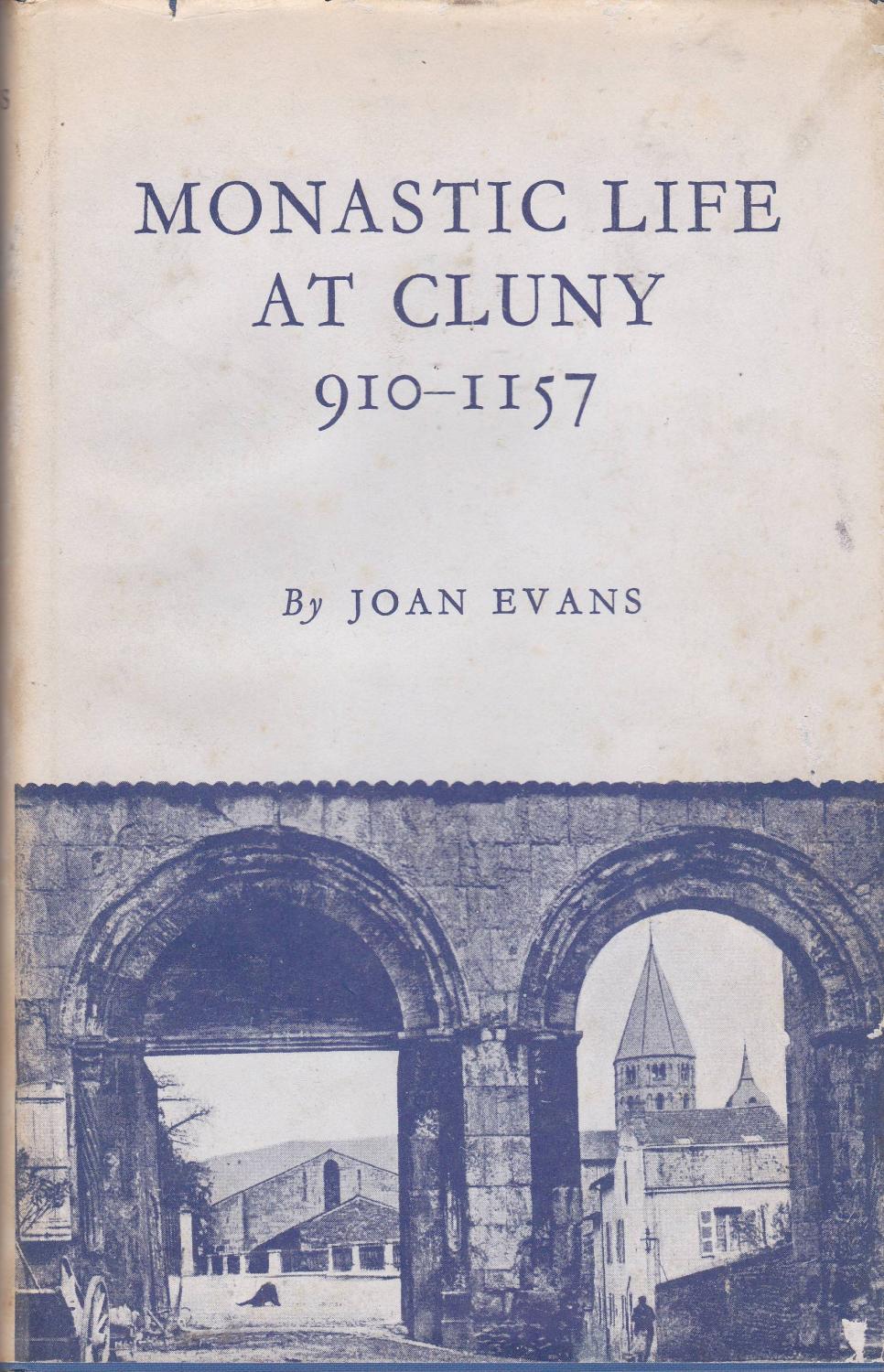
Image result for Monastic Life at Cluny joan evansMonastic Life at Cluny 910-1157 by Joan Evans, 130 pages

As Rome fell and the medieval world rose, Christian monasticism flourished.  As time passed, however, the same monasteries that served as fortresses of the faith fell into decadence and dissolution.  The Carolingian reform established the Rule of St Benedict throughout Western Europe, but the corruption was great and the workers few.  In 910 William of Aquitaine gifted a portion of his hunting preserve to the reforming abbot of Baume, St Berno, on which the monastery of Cluny was founded.  Adhering to strict interpretation of the Rule, dedicated to the celebration of the liturgy, and directly subject to the Pope, under a series of saintly abbots Cluny became the center of the 10th century monastic reform that ushered in the High Middle Ages.  

The Cluniacs were eventually overshadowed by the rise of the Cistercians, an eclipse which was perpetuated by posterity.  Joan Evans' short book does nothing to reverse this, indeed, it is barely interested with Cluny's role in the broader reform movement.  Instead, Monastic Life at Cluny is a more modest description of the history of the particular monastery of Cluny and the daily life of the monks.  It is no less valuable for that - it was through this life and for the sake of this life that the world-historical work of reform was carried out.

Tuesday, May 14, 2019

Ballad of the White Horse

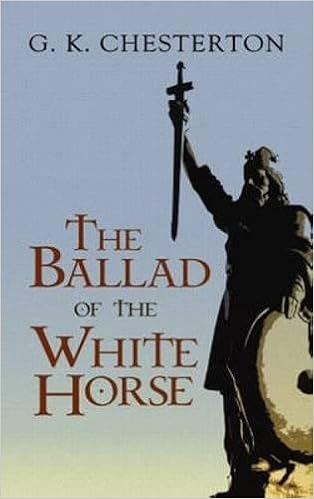
Image result for ballad of the white horseThe Ballad of the White Horse by GK Chesterton, 154 pages

Chesterton's remarkable epic poem takes as its subject the legendary history of King Alfred - the great king of Wessex who defeated the Danes at the battle of Ethandune and drove them from the south of England.  Chesterton celebrates this as a triumph of Christian civilization over a barbarous paganism, but he also understands that all such victories are provisional (and providential), for the barbarians always return, like grass on the chalk horse.

     And all the while on White Horse Hill
     The horse lay long and wan,
     The turf crawled and the fungus crept,
     And undid the work of man.

Yet this is not fatalism, for it is the fatalism of the pagans that Chesterton denounces as nihilism.

     'What have the strong gods given?
     Where have the glad gods led?
     When Guthrum sits on a hero's throne
     And asks if he is dead?'

He suggests that such is always the result of attempts to know - and thus control - what is to come.

     'The wise men know all evil things
     Under the twisted trees,
     Where the perverse in pleasure pine
     And men are weary of green wine
     And sick of crimson seas.

     'But you and all the kind of Christ
     Are ignorant and brave,
     And you have wars you hardly win
     And souls you hardly save.'

And with Alfred's voice he directs every generation to the necessary work of recovery.

     'And though the skies alter and empires melt
     This word shall still be true
     If ye would have the horse of old
     Scour ye the horse anew.'

Tuesday, March 19, 2019

Armenia

ArmeniaArmenia: Art, Religion, and Trade in the Middle Ages, edited by Helen C Evans, 302 pages

For millennia, Armenia sat astride the major trade routes connecting the Mediterranean world with Persia and East Asia.  Although often under foreign political domination, a distinctive Armenian faith and culture flourished which preserved the unique identity of the people even as they incorporated influences from both East and West.  This catalogue of an exhibition staged by the Metropolitan Museum of Art explores the art of Armenia and the Armenian diaspora from the 5th century to the 17th.  Particularly striking are the examples of illuminated books and intricately decorated memorial stones called khachkars, although the highlight is a spectacular carved monastery door.

Friday, March 8, 2019

The Bruce

Image result for the bruce barbour douglasThe Bruce by John Barbour, translated by Archibald AH Douglas, 476 pages

John Barbour is the Homer of Scottish poetry, and his masterpiece is this epic retelling of the adventures of Robert the Bruce during his fight for Scottish independence and succeeding reign as King.  Unlike Homer, Barbour was only a generation removed from the events he chronicled, and his work is apparently considered a valuable historical resource.  It is as poetry, however, that it stands or falls, and its excellence makes its relative obscurity difficult to understand.  In his introduction, translator Douglas suggests that the lack of a verse translation into modern English is largely to blame, and if this is the case hopefully another half century will see its rediscovery.

Friday, November 16, 2018

Black Prince

The Black PrinceThe Black Prince: England's Greatest Medieval Warrior by Michael Jones, 408 pages

He was three years old when he was named an earl.  He became a duke at six.  He was first placed in charge of the kingdom at the age of eight, while his father was overseas.  He fought in his first tournament at fourteen.  At sixteen he led men into battle, distinguishing himself commanding a division in the dramatic English victory at Crecy.  At twenty-six, he led the army that crushed the French at Poitiers.  At thirty-two, he ruled as Prince of Aquitaine.  After a long, debilitating illness, he died a week before his forty-sixth birthday, leaving behind his elderly father and nine-year-old son, the future Richard II.

Edward, the eldest son of England's Edward III, was not known as "the Black Prince" during his lifetime - indeed, the origins and meaning of the name are somewhat obscure.  In that lifetime, he was celebrated as the flower of European chivalry, combining bravery and piety, humility and magnificence.  Michael Jones recaptures these qualities in his lively portrait of Edward's life and world.

Tuesday, November 13, 2018

Laurus

LaurusLaurus by Eugene Vodolazkin, translated by Lisa C Hayden, 362 pages

Laurus is a beautiful, subtle novel set in a vividly recreated Medieval Russia.  It tells the story of Arseny, called Rukinets and Ustin and Amvrosy and Laurus, a doctor, a penitent, a pilgrim, and a hermit, not successively but progressively, as he and his world are poisoned by sin and healed by grace.  

In her introduction, translator Hayden candidly discusses the difficulties of bringing Vodolazkin's deliberately inconsistent use of archaic language into English - without being able to experience the original, it seems that she has done an excellent job, reinforcing the story's intimations of the relationship between time and eternity, the living and the dead.  This is only one of many profound themes in this marvel of a novel - richly imaginative, empathetic without being sentimental, historically authentic and yet timeless.