Showing posts with label Crusades. Show all posts

Saturday, March 27, 2021

Count Bohemond

Count Bohemond by Alfred Duggan, 281 pages

Eldest son of the Norman adventurer who conquered Apulia, Bohemond, Count of Taranto, is the "mightiest of the mighty Hautevilles", a physical giant whose strength is matched only by his ambition.  While his father's title may have fallen to a more politic half-brother, Bohemond dreams of the riches and recognizes the vulnerability of the emperor in Constantinople.  Yet when the Pope calls the knights of Christendom to come to the aid of that emperor and to fight for the Holy Sepulchre, Bohemond eagerly joins the Crusade.  In his pursuit of victory and glory, however, his fellow Crusaders and their Greek allies soon prove nearly as great an obstacle as the Turks.

Count Bohemond is not a particularly deep book, but it is a well-written, solid entry into the genre of historical biographical novels suitable for teenage boys that is exemplified by I, Claudius.  An excellent introduction to the complexities of the First Crusade packaged within a dramatic narrative.

Tuesday, November 26, 2019

Ivanhoe

IvanhoeIvanhoe by Walter Scott, 464 pages

Wilfred of Ivanhoe returns from the Crusades to an uncertain future and an unsettled England.  His proud Saxon father has disinherited him for following the lion-hearted Norman king.  His castle is occupied by a Templar who, by all rights, should be fighting in the Holy Land.  His beloved is betrothed to another.  Prince John plots to usurp the throne of his absent brother, Richard.  The forest is teeming with outlaws.  Corruption pervades both Church and State.  Yet there are heroes as well, men and women prepared to risk everything in defence of virtue.  It is time for Ivanhoe to take his place beside them.

Ivanhoe, first published anonymously in 1819, was a massive commercial success, and even more influential as a cultural phenomenon.  Although certainly a part of wider trends emerging out of Romanticism, Scott's novel was at the center of the English love affair with the Middle Ages which lasted throughout the 19th century, influencing the Gothic revival as well as the Pre-Raphaelite, Arts and Crafts, and Tractarian movements.  It is not difficult to understand why - Scott spins a tale of larger-than-life characters engaging in bold feats of adventure against a colorful backdrop, the kind of yarn that pleases audiences in any era and one which suggests the existence, somewhere or somewhen, of a higher and more noble world.  As a cultural artifact, however, it is interesting how critical Scott is of the Middle Ages, which he imagines as characterized chiefly by superstition and prejudice, and the extent to which he recasts the relations between Normans and Saxons to parallel those between Englishmen and Scots.

Friday, August 11, 2017

Eastern Schism

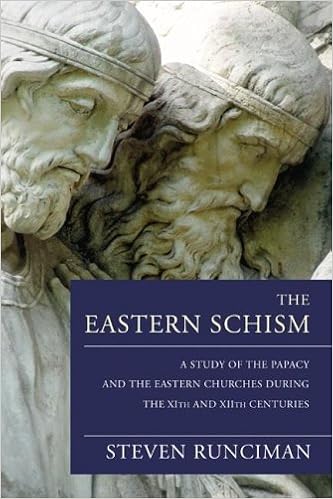
Image result for The Eastern Schism A Study of the Papacy and the Eastern Churches During the XIth and XIIth Centuries Runciman, StevenThe Eastern Schism: A Study of the Papacy and the Eastern Churches during the XIth and XIIth Centuries by Steven Runciman, 170 pages

In the simplified standard account, the great schism between the sees of Rome and Constantinople - and therefore between the Catholic and Orthodox churches - began with the excommunication of the Ecumenical Patriarch by papal legates in 1054.  As Steven Runciman elaborates, however, this was only one dramatic moment in a long process of ecclesiastical, theological, cultural, linguistic, and political estrangement - the roots of the schism predate Christianity and the sometimes heroic efforts to reverse it continue to this day.

Runciman struggles for objectivity and largely succeeds, but admits his own sympathies lie with the Byzantines - a slant which, as he argues, is more than compensated for by the fact that most Western studies of the schism tilt in the other direction.  The result is a balanced and nuanced presentation of the history of the most momentous split in the history of Christianity, necessary to understand the persistent divisions between what St John Paul II famously described as the "two lungs" of the Church.

Monday, March 13, 2017

Jerusalem Delivered

Jerusalem DeliveredJerusalem Delivered by Torquato Tasso, translated by Anthony Esolen, 419 pages

In the masterpiece he labored over for much of his troubled life, Tasso set out to translate the history of the First Crusade into the language of epic poetry, substituting the fancies of chivalric romance for those of pagan mythology.  In keeping with his models, Tasso fills his work with subplots beyond the story of how with great effort and even greater faith Godfrey de Bouillon held together the quarrelsome Christians and led them in the capture of the Holy City.  Memorable stories include the love quadrangle between the fierce warrior Argante, the impetuous knight Tancred, the gentle princess Erminia, and the proud warrior woman Clorinda, the sinister schemes of the seductive sorceress Armida and the enchantment with which she captures the peerless Rinaldo, and the sacrifice of the earnest Olindo and the chaste Sophronia.

Tasso uses his poetry to entertain, but also to explore inner struggles of faith and virtue, to illuminate the nature of true love and the nature of true leadership.  Esolen ably translates the language of the poem while providing keys to open the layers of allegorical meaning locked into the text.

Friday, August 29, 2014

Concise History of the Crusades

 
Cover image for The concise history of the Crusades / Thomas F. Madden.The Crusades have been interpreted and reinterpreted many times over the centuries.  The popular narrative at present is the residue of the twentieth century view of the Crusades as an imperialist endeavor by Europeans to colonize the Near East.  This, in turn, is a development of the nineteenth century interpretation of the Crusades as an early example of the civilizing mission of Western man.  The dawn of the twenty-first century has seen the Crusades as the root of conflict between Muslims and Christians (and post-Christians).
 
Recent research has overthrown some of the old certitudes about the Crusades, even if the popular mind has not yet assimilated this.  The Crusades were not primarily composed of surplus males - to the contrary, they were lead and manned by the cream of the European nobility.  They were not undertaken for financial profit - to the contrary, they were a constant economic drain.  They were not remembered vividly by Muslims - they were barely remembered at all until the nineteenth century, when the European powers invoked them during their colonization of the Middle East.  They were not considered at the time to be offensive wars, but a counterattack against an aggressively expansionist Islam, and an attempt to reclaim territories which were, at the time, still predominately Christian.
 
Madden, the Director of the Center for Medieval and Renaissance Studies at St Louis University, provides a basic overview of the Crusades as understood by their participants.  Covering four centuries in two hundred pages, the book is very readable despite being compact.  An excellent introduction to a complex, and often misunderstood, subject.