Showing posts with label religious life. Show all posts

Monday, August 3, 2020

Life of Saint Teresa of Avila

The Life of Saint Teresa of AvilaThe Life of Saint Teresa of Avila: A Biography by Carlos Eire, 223 pages

In the 16th century, as the fires of the Protestant Reformation swept across northern Europe, a remarkable woman rose to prominence in Spain.  A Carmelite nun from the Castilian city of Avila, Teresa of Jesus was a mystic and visionary, and also a tireless foundress and reformer.  Living at a time when the Church had a healthy suspicion of those who claimed to be in direct communication with the Almighty, Teresa's autobiography, the Life of Teresa of Avila, was written both as description and defence, her mystical locutions having drawn her deeper into the Church rather than leading her astray to preach a new gospel.

As Carlos Eire details in his biography of St Teresa's autobiography, this defence entailed a series of drafts and revisions over the course of decades as Teresa and her spiritual advisors took care to cross every theological "t".  Even so, it was not until after her death that the work was allowed to be widely circulated, and it continued to have its detractors.  Their voices were drowned out, however, by the rapid spread of her cult, and she was canonized a mere forty years after her death, with the Life providing vital testimony to her sanctity.  Nor does Eire's story stop there, for the following centuries saw the book become a defining text of early modern Catholicism, inspire great art (most famously Bernini's sculpture of the transverberation), influence religious movements including the Jansenists, Quakers, and Methodists, and finally be reimagined as a study in hysteria or proto-feminist tract.  As Eire notes, this enduring influence of the Life is itself an undeniable testament to the force of its authors personality as well as the Power that moved her.

Monday, April 30, 2018

A Box of Butterflies

A Box of Butterflies by Roma Downey      Audio Book: 5 hours, 7 mins.      Hardback Book:  256 pages                    

Roma Downey, known best for her role as Monica on “Touched by an Angel” with Della Reese, tells about her life and how she came up in Derry, Ireland.   Her mother loved the flowers called pansies because she said they looked like butterflies.    Her mother passed away when she was 10 years old and while she and her father were at her mother’s grave covered in pansies a real butterfly flew up to Roma.     Her Dad told her that was her mother’s spirit letting her know she was still close to her just behind the veil.    Throughout her life whenever she has been sad, down on her luck or needing her mother somehow a butterfly would appear either on a picture, a piece of jewelry, an ad on the side of a bus or truck or she would see an actual butterfly and know that was her mother sending her a message that she would be o.k.    Once while up on a mountainside her husband gave her a box and told her to open it very gently and carefully.    When she did out flew 50 butterflies.    Everyone in her family and all of her friends know about her love of butterflies and their association with her mother’s spirit.   Her Dad used to tell her when she was away from home and lonely to look up at the moon he had left a message for her there and when she gazed at the moon she could feel the heartfelt message from her father – so the moon has always been representative of his spirit to her.   She has been through two marriages and has a daughter by her first marriage (he left when their daughter was a month old and the divorce was finalized when the baby was two months old) she was living in New York City then moved to Los Angeles.   She had graduated from university with a major in theater and got top honors.   She performed in London for a time, then after her father’s death, after graduation she took the advice of her fellow students and moved to New York.   She worked part-time and auditioned the other part of the day.   Finally lucking into a role that was scene by actor Rex Harrison who loved her performance and asked her to audition for the show he was doing.   She did, got the role and travelled with the troupe for 9 months.     She was spotted in the show and asked to audition for the role of   Jackie Kennedy in an upcoming miniseries.  She got it.   That role gave her the momentum to move to Los Angeles and try her luck there – kismet- she landed the role of Monica that lasted 10 years.   She also became like family with her co-star, Della Reese.   Della lost her daughter during shooting the series and flew from St. Lake City, UT where they filmed the show back to Los Angeles.   Roma went with her.   Della told her, “I am not going to feel like talking.”    Roma told her, “you don’t have to.   I will sit beside you quietly holding your hand until we get there.   I want to be with you, I don’t want you to have to fly back alone.”  And so they flew back together.   When they arrived at the airport, Della’s husband was waiting for her and Roma said goodbye.    She prayed for Della and her family then began to wonder what she should do, she didn’t bring a suitcase, but, one of the assistants on set had brought her purse to her as they were getting in the car taking them to the airport.   She decided to stay at a hotel then fly back in the morning but one of the producers on the show called her name.    She had been in L.A. and had come to the airport to meet Della and see if there was anything she could do to help.     Turns out Della had gone already, but, she asked Roma to stay at her house.   God provided a solution for Roma.    She is a praying religious woman and Della later told her to ask God for a good man to come into her life.   It hadn’t occurred to her to do so, she was happy working on the series, visiting sick children in the local hospital on weekends and spending time with her daughter so she wasn’t looking for anyone.    But Della had planted the seed.    One day while at a hair salon getting a pedicure, Roma and a man getting a haircut hit it off, got in touch with one another via one of the ladies that worked at the salon and the rest is history.   He was also from the U.K., divorced with 2 sons and he was a Godly man.  Perfect, another miracle.   They fell madly in love and now years later, their 3 kids are now grown and out on their own and Roma and her second husband are producing films and travelling a lot.    Cherishing every minute when the kids get to come back home for visits.  Throughout her book she recites poetry and Bible verses.   She relates many biblical stories and sites both humorous and real stories of God’s work in action.    She and her husband pitched a series on the Bible to the History Channel and were given the green light to film them in Morroco.   They were so well received that the History Channel also greenlighted an additional series on the events in the Bible after Jesus’ death titled A.D.    They did a remake of Ben-Hur for CBS in Malta.    Such a blessed life.  No one can believe she and her husband work so well together as co-producers on all their projects.   God really is smiling on her.   Good book.  I enjoyed it.

Monday, November 20, 2017

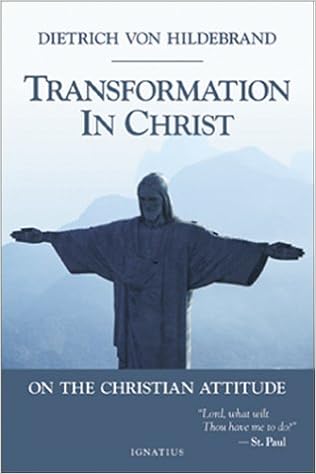
Transformation in Christ

Transformation in Christ: On the Christian Attitude by Dietrich von Hildebrand, 500 pages

Dietrich von Hildebrand's masterpiece has been called a "modern day Imitation of Christ", and this is only a slight exaggeration.  This long combination of theological treatise and spiritual meditation uniquely combines psychological acuity and philosophical rigor.  Most important, however, is the transformational love of God that radiates almost visibly from the text.  Startlingly, again and again von Hildebrand reveals the superficiality of conventional wisdom falsely-so-called and unveils the profound truths it conceals, all in the service of an ever deeper and more radical conversion.

It should be noted that although Transformation in Christ is von Hildebrand's most accessible work, it remains the work of a German philosopher, and although intended for a wider audience than his other works, it will present challenges for the average reader.  Indeed, its greatness consists precisely in the challenge it poses to modern cant - its revelation of Christianity not as a matter of intellectual propositions or ethical prescriptions, but of metaphysical vision and continuous conversion.

Wednesday, September 6, 2017

That Nothing May Be Lost

That Nothing May Be LostThat Nothing May Be Lost: Reflections on Catholic Doctrine and Devotion by Rev Paul D Scalia, 187 pages

That Nothing May Be Lost collects dozens of Father Scalia's short essays.  As the title suggests, the content is hardly original - the concern is to conserve rather than to innovate.  Most of the pieces were originally written for parish and archdiocesan publications, and are therefore very short and tailored for a readership with diverse social, economic, and educational backgrounds but a common Catholic faith.  Yet Fr Scalia's restatement of truths ever ancient, ever new is never trite or boring, to the contrary, they are presented here with hard crystal clarity, gently but without reservations or demurral.

Monday, August 21, 2017

Power of Silence

The Power of SilenceThe Power of Silence: Against the Dictatorship of Noise by Robert Cardinal Sarah with Nicholas Diat, translated by Michael J Miller, 244 pages

In this remarkable book-length interview, Cardinal Sarah launches an assault against the "empire of noise" that, he warns, threatens to colonize our minds and souls.  Sarah's message is equal parts admonition, exhortation, and challenge.  In his view, modern man is sunk in a sea of noise both as the result of his membership in a society driven by mass consumerism and as a deliberate choice to narcotize himself from the problems of thought.  As the power of noise has grown, so our public life has become increasingly dominated by the "raving madness" of demagogues and activists.  Meanwhile, the "buffered self" is insulated against the transcendent by a cocoon of noise.  Truth, goodness, and beauty cannot be seized - they must be received, and this requires contemplation, and contemplation requires silence.  Modern man's bottomless appetite for novelty alienates him from the eternal and enslaves him to the ephemeral.  

Worse still is modern man's sense that he himself must be a noisemaker, the consequence of a fixation on action at the expense of contemplation, on doing at the expense of being.  This preoccupation extends even to prayer and the liturgy, driving out all sense of mystery and the sacred with banal talk and insipid music.  Cardinal Sarah finds in the silence of the Divine the meekness of God and the root of human freedom.  In silence we participate in the silence of the Incarnation, of Bethlehem, Nazareth, and Gethsemane, the silence before the Sanhedrin, Herod, and Pilate, and finally the silence of the cross and the tomb, and in that silence we encounter a God who suffers with us and for us.  Silence is at the heart of communion and therefore of all authentic community - it is in silence that we offer ourselves and in silence that we accept what is offered us.

Monday, June 26, 2017

Jerome

JeromeJerome: His Life, Writings, and Controversies by JND Kelly, 339 pages

It sometimes seems as if the number of biographies of St Augustine of Hippo could fill a small library by themselves, with his own Confessions remaining the best.  By contrast, there are very few biographies of his interlocutor and rival St Jerome.  This is certainly not because he lived an uneventful life - to the contrary, wherever Jerome went, controversy swirled around him.  As Kelly ably reveals, this was the result of a character as passionately loyal to his friends as he was hostile to his enemies, "violently opinionated" with an "habitual tendency to exaggerate".  Jerome is best known as the translator who produced the bulk of the definitive Latin version of the Bible, the Vulgate, but in Kelly's biography this is secondary to Jerome's involvement in a range of contemporary disputes both theological and personal.  The result is a work which manages to be both lively and eminently scholarly.

This is not to say that Kelly lacks weaknesses - particularly troublesome is his consistent chronological snobbery that smirks at Jerome's sexual morality and airily waves about the latest word in biblical criticism as if it were the last word.  Throughout, it is clear that Kelly's own views are the yardstick by which he measures Jerome's successes and failures, and this colors somewhat his analysis of Jerome's mindset and motives.  Nonetheless, his solid scholarship compensates for these flaws, as the book is anchored solidly enough for the reader to dissent from Kelly's evaluations.

Friday, June 16, 2017

Meditations on the Life of Christ

Meditations on the Life of Christ attributed to St Bonaventure, translated by Sister Mary Emmanuel, OSB, 441 pages

This book presents 100 meditations on events in the life of Christ, either as reported in the Gospels or inferred by the pious imagination of the author.  Traditionally, this book was paired with St Bonaventure's Meditations on the Passion of Christ and was therefore often mistakenly attributed to him, however it was actually composed by an unknown Franciscan friar early in the 14th century.  The early date is itself somewhat surprising, since we have been told over and over that the harnessing of the imagination in the service of piety was an innovation of the devotio moderna of the 15th century Rhineland.

The meditations themselves are both succinct and rich.  Most of the commentary comes, not from the anonymous author, but from the writings of St Bernard of Clairvaux, particularly his sermons on the Song of Songs.  The arrangement of the material demonstrates a deep sensibility well-formed by practice - but although the placement of short treatises on the active and contemplative life in the center of the book is organically necessary, the decision to place a reflection on the use of the Sacred Humanity as a window into Divinity at the end rather than at the beginning is questionable. 

Saturday, June 10, 2017

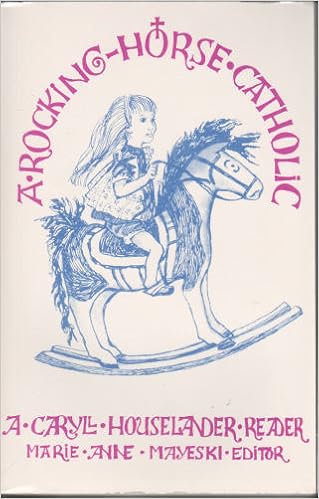
Rocking-Horse Catholic

A Rocking-Horse Catholic by Caryll Houselander, 148 pages

Noted twentieth century spiritual writer and mystic Caryll Houselander was not born to Catholic parents, nor was she an adult convert, rather, like her contemporary JRR Tolkien, she was brought into the Church as a child when her mother converted - hence "rocking-horse Catholic" instead of "cradle Catholic".  A Rocking-Horse Catholic is her short memoir about her long education in the ways of God and men.

Although the book includes accounts of three mystical experiences in which the supernatural broke abruptly into the world of the author, the focus is on her growth through the influences of those around her, some despite and some because of their imperfections.  Throughout, Houselander maintains a charming tone, approaching even the most trying times and people with at least a retroactive generosity and spirit of gratitude, seeking - and finding - her Lord in the crowd.

Saturday, April 29, 2017

Pilgrim of the Absolute

Pilgrim of the Absolute by Leon Bloy, edited by Raissa Maritain, translated by John Coleman and Harry Lorin Binsse, 351 pages

This is a selection from the writings, letters, and diaries of Leon Bloy, best known as the author of The Woman Who Was Poor, but self-described, at various times in his life, as the Thankless Beggar, the Hurler of Curses, and the Pilgrim of the Absolute.  As assembled by Raissa Maritain, these fragments combine to form an intoxicating "flower from the abyss".  Bloy lived a life without compromises, and he and his family suffered for it - his daughters complaining of hunger is a recurring theme - but they accepted it as the price of worshiping a Poor Man.  "God wants everything, he requires everything, and one cannot escape Him.  'We are sold to God,' my wife said to me, 'we are caught in His net, and we know this net cannot be broken.'"

Bloy sought the Absolute as the enemy of the Relative - the "springboard with which to escape" the empty despair of materialism.  His pilgrimage to the Absolute makes demands that are equally absolute, for it is "an ascension ever more lively, more impetuous, more thunderous, not toward God, but in God, in the very Essence of the Unbounded."  There is no group that he attacks with more fervor than those bourgeois Catholics who manage to get more than thirty pieces of silver for their Lord, unless it is their priests who preach sentimentality rather than sacrifice.  For Bloy, they are nothing but a rotting, gangrenous limb on the Body of Christ, and if they are not to be cured they must be cut off, either here or in the world to come.  Again and again, Bloy announces the universal call to sanctity - not respectability, not niceness, but holiness - "There is no man who is not potentially a saint."  Charity is not something one gives but something one begs for, the very Name of the Third Divine Person, and He is a Fire that burns away all that is not needful.

Monday, April 24, 2017

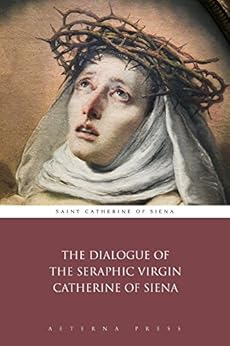
Dialogue of St Catherine of Siena

The Dialogue of the Seraphic Virgin Catherine of Siena, Dictated by Her, while in a State of Ecstasy, to Her Secretaries and Completed in the Year of Our Lord 1370, Together with an Account of Her Death by an Eyewitness by St Catherine of Siena and others, 344 pages

The full title of the Dialogue is most of the context provided in this edition - the brief introduction is primarily concerned with the spiritual state of Italy, Christendom, and the saint rather than a true biography of the author or commentary on the text.  That text is a transcription of conversations St Catherine had while in an ecstatic state with the first two Persons of the Trinity.  None of the voices - those of God or that of the saint - ever descends into the kind of babbling emotionalism popularly associated with ecstasy - they speak clearly, rationally, and, on the part of God, with a commanding authority.  There is not even a trace of self-aggrandizement - St Catherine is not interested in her status as the mouthpiece of the Almighty, but with how she - and we - can draw closer to Him.  The result is an eminently practical guide to the spiritual life, showing "clearly in each state the means of cutting away imperfection and reaching perfection, and how the soul may know by which road she is walking and of the hidden delusions of the devil and of spiritual self-love."

Sunday, April 16, 2017

Spiritual Exercises

The Spiritual Exercises of St. IgnatiusThe Spiritual Exercises of St Ignatius by St Ignatius of Loyola, translated by Louis J Puhl, SJ,127 pages

The young St Ignatius of Loyola underwent a profound conversion during his convalescence after being wounded in battle.  Renouncing the glories of the battlefield for the humility of the spirit, he pursued the conquest of self through the cultivation of detachment.  Sought after as a spiritual director first in Spain and later in Paris, he developed a series of exercises designed to enlist the imagination and the will in the soul's spiritual combat with the forces of sin and death.  The men formed by this method became the first members of the Society of Jesus, and five centuries later every year tens of thousands of men and women around the world benefit from undertaking the exercises.

A classic example of a process that must be experienced rather than documented, the text of The Spiritual Exercises consists of little more than notes for directors, and poorly organized notes at that.  Ignatius' method targets the individual without being individualistic - it demands a director to guide the exercitant through the exercises and to whom the exercitant is accountable.  At the same time it is extraordinarily flexible.  St Ignatius did include short treatises on prayer and the discernment of spirits, so there is some profit for the solitary reader.

Wednesday, April 12, 2017

Reform of Renewal

https://www.ignatius.com/Content/Site107/ProductImages/ROR-P.jpgThe Reform of Renewal by Fr Benedict J Groeschel, CFR, 216 pages

"Renewal" is a word much bandied about today.  Different, often competing, groups seek to renew America, renew the culture, renew the Church, renew your body, renew your mind, renew the planet.  It is the central contention of Fr Groeschel's book that authentic renewal must always begin with repentance, and the beginning of repentance is faith.  Faith, repentance, and renewal are bound together at the core of the Gospel, and the neglect of any one results in the falsification of the others.

Fr Groeschel makes his case for moral renewal with Franciscan simplicity, drawing extensively on his own personal experience and his work as a psychiatric counselor.  This background is particularly pronounced in his recommendation of twelve-step programs as a model for self-reform.  Although there are portions of the book specifically addressed to priests and religious, Groeschel's target audience includes anyone searching for the source of true renewal.

Saturday, February 18, 2017

Complete Francis of Assisi

The Complete Francis of AssisiThe Complete Francis of Assisi, translated and edited by Jon M Sweeney, 397 pages

The wealthy cloth merchant Bernardone was on a business trip in France when his son was born, so he named the boy "Francis".  As an adult, Francis stripped naked in the town square and handed his clothes to his father as the sacrament of his renunciation of any earthly inheritance, then went inside the cathedral wrapped in the cope of the bishop to seek imperishable treasure.  When he returned to Assisi to die he owned nothing except a worn brown robe he had patched himself, a robe in which he had begged for bread and stones, fasted and sang, and preached to the birds of the air as well as sultans, emperors, and popes.  Armed soldiers were sent to accompany him on his final journey to guard against kidnappers attempting to claim for their cities the honor of his burial.  Eight centuries later, this most Christ-like of men is still loved and revered the world over, not only by the tens of thousands of men and women who have solemnly vowed to follow his Rule, but by millions of others, including non-Catholics and even non-Christians.

The Complete Francis of Assisi, part of the "Paraclete Giants" series, collects many of the writings of the saint.  As St Francis actually wrote very little, these are sandwiched between two biographies - the modern Protestant The Life of St Francis of Assisi written by Paul Sabatier and the medieval Catholic The Little Flowers of St Francis written by his friends and followers.  There is a certain fitness to the resulting dominance of biography, for although Francis most likely never literally said, "Preach the Gospel at all times, use words when necessary", the famous aphorism is nonetheless an excellent refinement of his actual words and example.  

Saturday, February 4, 2017

Journey to Carith

Journey to Carith: The Story of the Carmelite Order by Peter-Thomas Rohrbach, OCD, 366 pages

The Order of the Brothers of the Blessed Virgin Mary of Mount Carmel was founded in the twelfth century on Mount Carmel, biblical home of the prophet Elijah, who at one time was commanded by God to "Go, and hide yourself by the torrent of Carith, east of the Jordan."  The medieval Carmelites, claiming Elijah's legacy for themselves, took this as a commandment to pursue charity and remove themselves from the sinful world.  Journey to Carith follows their quest to fulfill this vocation across nine centuries, through the heights of holiness and the squalid swamps of decadence, while noting those flowers of Carmel that bloomed in the latter as well as the former.

Journey to Carith was first published in the mid-'60s, and it bears the marks of its era.  Rohrbach seems uncomfortable with contemplation as an end in itself, and is therefore a bit too eager to insist on its value as a complement to the active life.  Likewise, Rohrbach is decidedly rationalistic - he flatly declares that the story of Elijah's ascension into heaven on a fiery chariot is merely a metaphor for his death - although this is an asset when dealing with the early history of the Carmelites, as shrouded in legend as it is.  The greatest strength of Journey to Carith, however, is Rohrbach's understanding of the Carmelites not primarily as an institution but as a family of prayer extending down through the centuries.

Monday, January 9, 2017

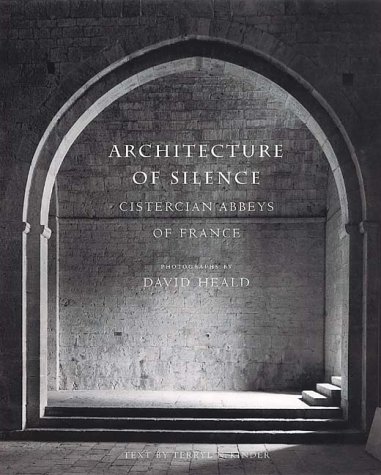
Architecture of Silence

Architecture of Silence: Cistercian Abbeys of France, text by Terryl N Kinder, photographs by David Heald, 137 pages

The Abbey of Citeaux was founded at the end of the 11th century by a group of Benedictine monks attempting to live according to a strict interpretation of the Rule.  Within a hundred years over 500 new monasteries had been founded across Europe in imitation of it.  With the Cistercian way of life came a distinct approach to art and architecture, its simplicity highlighted by the contrast with the contemporary splendor of Gothic.

Architecture of Silence is primarily an album showcasing David Heald's striking photographs of French Cistercian abbeys, with a brief but informative introduction by Terryl Kinder providing background and context.  The beautiful black and white photographs of the abbeys in varying stages of repair and disrepair perfectly capture the stillness that both produced Cistercian architecture and was produced by it.  Although nothing in this world lasts forever, these buildings were designed for eternity and even in ruins seem so naturally part of the landscape that it is possible to believe that they were always there and will always be there.

Monday, December 26, 2016

Katharine Drexel

Katharine DrexelKatharine Drexel: The Riches-to-Rags Story of an American Catholic Saint by Cheryl CD Hughes, 259 pages

St Katharine Drexel was the second of three children - all daughters - of Francis Drexel, scion of the Drexel banking empire.  With the death of their parents, the sisters - known collectively as the "All Three" - inherited a fortune worth hundreds of millions of dollars in today's money.  In keeping with the practice of their devout parents, the Drexels contributed to a wide variety of charitable and philanthropic enterprises, but Katharine went one step further than the others, abandoning wealth and comfort for a life of poverty and hardship as the foundress of the Sisters of the Blessed Sacrament, a religious order dedicated to staffing schools for Native American and African-American children.  By the time of her death in 1955 at the age of 97, there were over five hundred SBS sisters staffing 49 elementary schools, 12 high schools, and Xavier University in New Orleans, as well as 37 missions.

In this biography, Cheryl Hughes does not detail the minutiae of the saint's struggles to found and grow her order, only briefly passing over St Katharine's struggling with floodwaters in Arizona and catching typhus in Harlem.  The focus of this book is exactly where it should be - on Katharine's inner life and motivation.  Hughes finds the center of Katharine's life and work in her devotion to the Eucharist, the sacrament of total divine surrender that inspired her own total pouring out of self for others and thus transformed her into a source of inspiration for generations to come.

Saturday, October 29, 2016

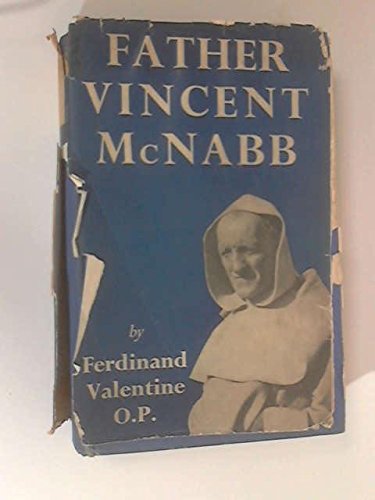
Father Vincent McNabb

Father Vincent McNabb, OP: The Portrait of a Great Dominican by Ferdinand Valentine, OP, 414 pages

Father Valentine's book was never intended as a comprehensive biography of his former teacher and fellow Dominican, but rather as an outline of his life and a collection of primary sources, particularly those gathered from Fr McNabb's own family.  Nearly half of the 414 pages are devoted to a collection of letters from McNabb, primarily to family members, disclosing much of the author's personality but rarely touching upon his public views.  As such, those looking for a detailed record of McNabb's work as a Catholic apologist or social reformer will be disappointed.  At the same time, as a brother in religion of his subject, Valentine brings to his study a special understanding, and this is further supplemented by the personal material.  The result is an intimate though uneven portrait of the man behind the work, the conflicts that drove him, and the loves that sustained him.

Monday, September 26, 2016

In No Strange Land

Cover image for In No Strange Land: The Embodied Mysticism of Saint Philip Neri by Jonathan Robinson of the Oratory, 274 pages

In No Strange Land is not quite a biography, although it has biographical elements, and Robinson has clearly put a great deal of thought and study into his understanding of St Philip Neri's life and work.  Robinson's main goal, however, is to examine the ways in which mysticism is inevitably embodied within a religious context, and that it cannot be abstracted outside of that context without serious deformation.  This presents a direct challenge to the school of thought which is epitomized by William James' The Varieties of Religious Experience.

While Robinson's study of mysticism is a solid contribution to an unfortunately underdeveloped field, it is the biographical elements of his book that will interest most readers.  St Philip Neri lived in a time of crisis and upheaval in the Church and in the world, and pursued his own unique vocation of reform and renewal, crafting a work that has reverberated down the centuries.  Sadly, he still has not received a great biographical study, but Robinson, like Bl John Henry Newman before him, provides fragments towards one.

Tuesday, September 6, 2016

Trust

Trust: In Saint Faustina's Footsteps by Grzegorz Gorny and Janusz Rosikon, 325 pages

St Maria Faustina Kowalska was born Helena Kowalska in 1905 in a land that had once been Poland and would soon be Poland again.  She died just thirty-three years later, mere months before Poland was again removed from the map by a conspiracy of Russians and Germans.  Throughout her life, she claimed to have seen visions of Jesus Christ, who commanded her to disseminate a devotion to His Divine Mercy, but at the time of her death these visions were barely known outside of a few Polish priestly circles already endangered by the genocidal Nazi and Communist ideologies descending upon Eastern Europe.  Just as discouraging, the Church hierarchy, both in Rome and in Poland itself, viewed the devotion and the purported visions from which it derived with their usual skepticism.

Like most true visionaries (prominently St Margaret Mary Alacoque, St Bernadette Soubirous, and Sister Lucia), St Faustina's life was one of humility and self-effacement - she was nothing, the message was everything.  Eighty years after St Faustina's death, the Divine Mercy chaplet is perhaps the second most popular Catholic devotion in the world, surpassed only by the Rosary.  Such is St Faustina's stature that, when millions of Catholic young people gathered in Krakow in July of 2016 for World Youth Day, it was considered entirely appropriate to open the event with a procession of her relics alongside those of St John Paul II.

Trust follows the life of St Faustina from her materially impoverished but spiritually rich childhood, through her time working as a domestic servant scrimping and saving to acquire the dowry she would need to enter the convent, through her struggles with doubts and doubters, and then to her life beyond life, the spread of the Divine Mercy devotion worldwide and her own ascent to the altars of the universal Church.  The book is straightforward hagiography, with no pretense to objectivity, if objectivity is even possible in a case where the subject must be either a saint, a fraud, or a madwoman.  It is lavishly illustrated - the book would be less than half as long without the many photographs, often taking up an entire page.  The overall effect is less artistic than documentary, which has the fortunate effect of turning the book into a kind of printed pilgrimage.

Friday, July 29, 2016

Very Rich Hours of Jacques Maritain

Cover image for The Very Rich Hours of Jacques Maritain: A Spiritual Life by Ralph McInerny, 211 pages

In Ralph McInerny's account of the thought of Jacques Maritain, one of the recurrent themes is the Thomistic distinction between the knowledge connected with thinking and the knowledge associated with inclination.  In his account of the life of Jacques and his wife Raissa, the attainment of both kinds of knowledge is the central theme.  The couple heroically sought not only to know virtue and holiness as concepts but to live them as realities, dedicating themselves to the truth they found in the conclusion of Leon Bloy's The Woman Who Was Poor - "There is only one tragedy in life, not to be a saint."

McInerny (a philosopher by trade but best known as the creator of Father Dowling) models the biography on the hours of the Divine Office - Matins, Lauds, Prime, Terce, Sext, Nones, Vespers, and Compline - tracking the life of his subject from the dark of the morning to the dark of the evening.  Throughout, the personal lives of the Maritains are interwoven with the development of Jacques' philosophy.  The result is revelatory - a biography of a public intellectual and an examination of the thought of a great philosopher, but also a demonstration of what philosophy and faith can offer each other, and what both can offer life.