Showing posts with label patristics. Show all posts

Friday, December 5, 2025

Life of St Dionysius

The Life of St Dionysius the Areopagite by Michael Syncellus, Anthony Pavoni, and Evangelos Nikitopoulos, 267 pages

The book of Acts records that St Paul, on his visit to Athens, converted one "Dionysius, a member of the Areopagus."  Tradition relates that this Dionysius, venerated as St Dionysius the Areopagite, would become the first bishop of the city, and was eventually martyred.  Halfway across the Roman Empire, the first bishop of what would become Paris, St Dionysius or Denis, was beheaded, his remains buried at the place where the church and abbey dedicated to him were eventually built, and it was sometimes claimed that this Dionysius was the Areopagite in exile from his native Greece.  In the early centuries of Christianity multiple works appeared which claimed to have been written by the Athenian bishop, among them foundational works on Christian mysticism and angelology, most of which seem to have been written by a single author.

Modern historians discount most of this, beyond the existence of two Dionysii, one in Athens and another, later one in Paris.  The writings are ascribed to a hypothetical pseudonymous author who is thought to have lived around 500 AD.  The Life of St Dionysius the Areopagite is a panegyric composed in the 9th century by the Greek scholar monk Michael Syncellus, a translation of which takes up about fifty pages of the present book.  Most of the rest is a scholarly attack on the historical consensus, arguing that the Dionysian corpus is actually the work of the Areopagite.  The authors argue that apparent seeming anachronisms are explicable in a 1st century context, and, more exhaustively, that what are assumed to be Pseudo-Dionysian borrowings from Proclus actually represent Proclean borrowings from Dionysius.  This last point is convincingly buttressed by what appear to be references to the corpus present in pre-fifth century writings.  

If the textual analysis is quite dense and sometimes baffling to a layman, it clearly deserves to be taken seriously and not dismissed with stale references to 19th century skepticism.

Thursday, June 20, 2019

Eucharist

The EucharistThe Eucharist: Mystery of Presence, Sacrifice, and Communion by Lawrence Feingold, 607 pages

Lawrence Feingold's The Eucharist is a comprehensive exploration of Church teaching on the nature and significance of the Blessed Sacrament, from its Old Testament types through the patristic age and medieval and modern developments.  In this narrative, all development occurs only so that what was held from the beginning may be more perfectly affirmed and understood, and a side effect of this is that deviations from orthodoxy are highlighted by their discontinuity.  Although the book was designed for use as a theology textbook, complete with study questions at the end of each chapter, it is well-written enough to captivate casual readers, drawing us deeper into the sacred mysteries.

Tuesday, February 5, 2019

Meaning of Tradition

Image result for The Meaning of Tradition Congar, YvesThe Meaning of Tradition by Yves Congar, OP, translated by AN Woodrow, 155 pages

The Meaning of Tradition is the third volume in the monumental 150 volume project The Twentieth Century Encyclopedia of Catholicism curated by the renowned Church historian Henri Daniel-Rops.  Although the ambitious series, which sought to bring together many of the mid-century Church's finest intellectual talents to contribute short works on their areas of expertise, is remarkably uneven, Fr Congar's exposition of the nature and significance of Sacred Tradition stands at the high end of the spectrum.

As Fr Congar explains, despite what literal-minded moderns might imagine, Tradition is not a set of unquestionable positive propositions handed down from antiquity, indeed, he cites no less an authority than St Hilary of Poitiers to establish that the act of formal dogmatic definition is a sometimes necessary but nevertheless regrettable "surrender to the dangers of a human word what should have been kept and worshipped in our hearts."  Sacred Tradition, properly understood, originates in the example, practices, and ways of life born out of the apostles' own imitatio Christi.  This Tradition is a living tradition precisely because it finds its continuation and development in the ongoing life of the Church, a life nurtured and sustained by the Holy Spirit.

Thursday, October 12, 2017

Consuming the Word

Consuming the WordConsuming the Word: The New Testament and the Eucharist in the Early Church by Scott Hahn, 146 pages

This short book is an examination of the role of Scripture in the early Church, particularly highlighting the connection between Scripture and the Divine Liturgy, the unity between the Word of God incarnate in Jesus Christ, the Word of God as He is proclaimed in the Scriptures, and the Word of God as He is received in the Eucharist.  Hahn draws upon a wide range of patristic and contemporary sources, but his purpose is less scholarly than devotional, and transparently personal - himself drawn deeper into the interconnected mysteries of the Bible and the Mass, he hopes to draw the reader in with him.

Friday, July 14, 2017

Athanasian Creed

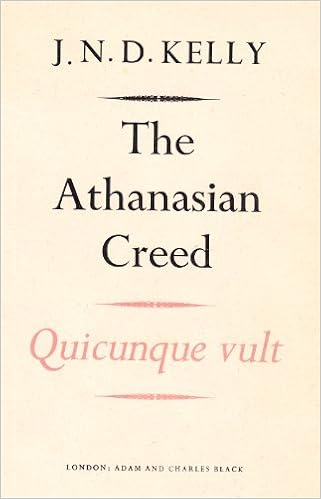
The Athanasian Creed by JND Kelly, 127 pages

Kelly begins these lectures on the Athanasian Creed - also known after its opening words in Latin as the Quicunque Vult - by acknowledging the truth of the quip that it is neither a creed nor written by St Athanasius.  As he explains, although traditionally ascribed to the great 4th century Alexandrian bishop and champion of orthodoxy, it was most likely composed in Gaul in the 5th century.  Not initially intended as a creed, but rather as a short exposition of the Trinitarian faith, its combination of brevity, comprehensiveness, and rhetorical rhythm nonetheless made it ideally suited for liturgical use - a use which has helped to ensure its longevity.

Carefully and thoroughly, Kelly exhaustively examines the questions surrounding the date, authorship, sources, content, and influence of the Quicunque.  The depth and detail of his scholarship are remarkable, although indeed likely to exhaust the patience of casual readers.

Monday, June 26, 2017

Jerome

JeromeJerome: His Life, Writings, and Controversies by JND Kelly, 339 pages

It sometimes seems as if the number of biographies of St Augustine of Hippo could fill a small library by themselves, with his own Confessions remaining the best.  By contrast, there are very few biographies of his interlocutor and rival St Jerome.  This is certainly not because he lived an uneventful life - to the contrary, wherever Jerome went, controversy swirled around him.  As Kelly ably reveals, this was the result of a character as passionately loyal to his friends as he was hostile to his enemies, "violently opinionated" with an "habitual tendency to exaggerate".  Jerome is best known as the translator who produced the bulk of the definitive Latin version of the Bible, the Vulgate, but in Kelly's biography this is secondary to Jerome's involvement in a range of contemporary disputes both theological and personal.  The result is a work which manages to be both lively and eminently scholarly.

This is not to say that Kelly lacks weaknesses - particularly troublesome is his consistent chronological snobbery that smirks at Jerome's sexual morality and airily waves about the latest word in biblical criticism as if it were the last word.  Throughout, it is clear that Kelly's own views are the yardstick by which he measures Jerome's successes and failures, and this colors somewhat his analysis of Jerome's mindset and motives.  Nonetheless, his solid scholarship compensates for these flaws, as the book is anchored solidly enough for the reader to dissent from Kelly's evaluations.

Monday, June 27, 2016

Gregory the Great

Cover image for Gregory the Great: Perfection in Imperfection by Carole Straw, 260 pages

Sixth century Italy was a turbulent place.  The Gothic kingdom of Theodosius was reconquered by the Roman Empire under Justinian, but the Emperor ruled from the capital at Constantinople, never setting foot in Italy.  Much of Imperial Italy was then conquered by the Lombards, leaving only Ravenna, Rome, and a thin strip of land connecting them in Roman hands.  The Emperor's representative, the exarch, resided in Ravenna, and the Eternal City became increasingly dependent on the papacy for patronage and even basic governance.  One pope was deposed by Justinian's general Belisarius, another was imprisoned by Justinian until he gave his assent to the rulings of the Second Council of Constantinople - and the conditional assent he eventually gave led to a significant schism, with the formation of a new church in northern Italy supported by the Lombards and headed by the bishop of Aquileia.

St Gregory the Great was born into an aristocratic Roman family in the midst of this turmoil.  After years of public service, he found peace in a monastery, but his gifts resulted in him being pressed into ecclesiastical service as a papal emissary, and later elected pope himself.  During his fourteen year reign St Gregory organized the defence of Rome against the Lombards, dealt with plague outbreaks, dispatched St Augustine of Canterbury to Kent to begin the reevangelization of England, inaugurated the papal title "Servant of the Servants of God", and, most enduringly, reformed the Roman liturgy - legend would associate him with the origins of "Gregorian" chant.

Straw is only passingly concerned with this biography - her interest is in the saint's thought, as it is expressed in his extensive writings.  St Gregory is a Doctor of the Church, and is commonly identified as the figure who marks the definitive transition between the classical and medieval worlds.  His eventful life was marked by the dual search for equilibrium, found in reason, and stability, found in love of God and neighbor.  For Gregory, the cosmos is founded in harmony, a harmony which is disturbed by sin and restored by sacrifice.  Sacrifice finds its ultimate significance in the sacrifice of Christ, both on the Cross and in the Mass, which unites heaven and earth.  This distinguishes the Christian saint from the Stoic philosopher, for while the latter pursues an ultimately solitary perfection, the saint is drawn into an often painful communion with others.  As Straw explains it, Gregory's Christian worldview is marked by an understanding of the ambiguity of a fallen world and the hidden complementarity of seeming opposites - prosperity and adversity, solitude and community, sorrow and joy, fear and love, flesh and spirit, God and man.

Monday, November 23, 2015

Spirit of Early Christian Thought

Cover image for The Spirit of Early Christian Thought: Seeking the Face of God by Robert Louis Wilken, 321 pages

It is highly significant that this book is titled The Spirit of Early Christian Thought and not The History of Early Christian Thought or A Compendium of Early Christian Thought.  Through the writings of the Church Fathers, returning most frequently to Origen, St Gregory of Nyssa, St Augustine, and St Maximus the Confessor, Wilken attempts to enter into the minds and hearts of the early Christians, to hear them as still living voices.

Wilken succeeds admirably in bringing the moral, ritual, and intellectual world of early Christianity to life.  He convincingly demonstrates how the early Church, far from paganizing Christianity, baptized elements of classical culture, offering the world something authentically new and still vital two thousand years later.

Wednesday, October 7, 2015

Rule of St Benedict

The Rule of St Benedict: A Commentary by Paul Delatte, translated by Justin McCann, 496 pages

The Benedictine Rule, developed and codified by the saint over the course of decades of study and practical experience as an abbot, has formed the standard for Western monasticism for nearly fifteen hundred years.  

The author of this paragraph by paragraph commentary, Dom Paul Delatte, was the second successor of Dom Gueranger as Abbot of Solesmes, a monastery which was central in the revival of French monasticism after the terrible persecution of the French Revolution and is justly famed for its key role in the liturgical movement of the late 19th and early 20th centuries.  Delatte speaks, not as an antiquarian explicating some ancient curiosity, nor as an innovator seeking justification in a peculiar interpretation of the distant past, but as part of a living, breathing tradition.  

The commentary, although written for monks, is of interest to those outside the cloister - the book is dedicated "to all those, whether in monasteries or in the world, who belong to the great family of St Benedict."  In the midst of a consideration of the practicalities of St Benedict's regulations concerning monastic meals, Dom Delatte surprises by remarking on the error of conflating commutative and distributive justice.  A section on the manner in which the Divine Office is to be chanted becomes a lesson in the importance of self-denial.  The Rule is more than a set of arbitrary or practical laws for the functioning of a society - it is a means of personal formation and growth in holiness.

Monday, April 20, 2015

Pseudo-Dionysius

Cover image for Pseudo-Dionysius: The Complete Works by Pseudo-Dionysius, translated by Paul Rorem, 289 pages

St Dionysius the Areopagite was a Greek who was converted to Christianity by St Paul and later became the first bishop of Athens.  Some 400 years after his death, a set of writings appeared under his name in Syria, the unknown author of which is referred to as Pseudo-Dionysius.  These writings were introduced into the West by the end of the sixth century, where their Neoplatonic theology became immensely influential, especially in the High Middle Ages. 

The two key ideas of Pseudo-Dionysius are the unknowable transcendence of God and the nature of the divinely instituted hierarchy.  The former is at the center of his apophatic mysticism, which concentrates on the unlikeness of God and lesser things and qualities, until the mystic is left alone in the dark "cloud of unknowing", awaiting an enlightenment which can only come from above, from He who is beyond even Truth, Goodness, and Beauty.  The second key idea complements this, as Pseudo-Dionysius lays out the hierarchies of angels and men as forming what Medieval thinkers called the "Great Chain of Being", each level of the hierarchy mediating the grace of the Almighty to the level below.  The hierarchy is thus not only a chain binding Earth to Heaven, but also a ladder of ascent to God.

This collection includes all of the extant works of Pseudo-Dionysius, as well as essays by scholars including Jaroslav Pelikan.

Monday, February 16, 2015

Development of Christian Doctrine

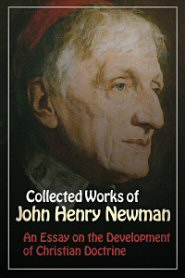
An Essay on the Development of Christian Doctrine by Bl John Henry Newman, 379 pages

Published in 1845, the year Bl John Henry Newman converted to Catholicism, An Essay on the Development of Christian Doctrine is, in many ways, more of an apologetic work than Apologia Pro Vita Sua, which was written decades later.  The Oxford Movement had attempted to establish Anglicanism as the faithful inheritor of the pure apostolic tradition, avoiding both Protestant errors and Roman accretions, and here the leader of that movement concludes that what he formerly regarded as accretions were, in fact, logical developments, and that such developments must take place in any living institution.

Much of the book is taken up by Newman's explication of the sources of distinctively Catholic* doctrines in the writings of the Church Fathers, demonstrating them as following naturally upon already accepted premises, assimilating thoroughly with the whole.  Of more general interest are the opening chapters, where Newman lays out his principles of faithful development and of corruption, which apply to any institution.  The entirety is masterful, and massively influential - the ideas presented here played a major role at the Second Vatican Council.


* - Where "Catholic" is opposed to "Protestant".  The Orthodox, sadly, were not part of the conversation.

Saturday, May 17, 2014

Saint Gregory of Nazianzus


Cover image for St. Gregory of Nazianzus : an intellectual biography / John A. McGuckin.St Gregory of Nazianzus (or St Gregory Nazianzen, or St Gregory the Theologian) was born in Cappadocia, now part of eastern Turkey, in the fourth century.  As a student in Athens he became the intimate friend of St Basil the Great, a relationship that shaped both their lives, for good and for ill.  After Basil's death, Gregory served as Bishop of Constantinople and presided over the early sessions of the First Council of Constantinople, the interpretation of which would be greatly shaped by his writings.  Likewise, Gregory and Basil's contrasting views on the nature of asceticism would have an impact on Eastern monasticism that continues to this day.

McGuckin attempts a deep psychological study of St Gregory, and largely succeeds, but occasionally he overreaches the facts.  Too much of the book depends on accepting McGuckin's analysis of the subtext of Gregory's writings, and faith in his powers of interpretation is weakened by the occasional jarring mistake, as when he conflates the story of Noah's drunkeness with that of Lot.  Likewise, there is too much focus on episcopal power politics to the detriment of the actual ideas involved.

This is an interesting treatment of one of the central figures in Christian history, and a figure who is too neglected in the West, but it never rises above its flaws.  Perhaps someday St Gregory will get the English language biography he deserves, but until then McGuckin's work will have to suffice.