Showing posts with label Tiger Reed. Show all posts
Showing posts with label Tiger Reed. Show all posts
Saturday, August 8, 2015
Conviction, Kelly Loy-Gilbert

This is one of the better YA novels I have read recently, and it covers a lot of ground thematically. The story revolves around Braden, a high school baseball pitcher poised to be drafted into the minors after senior year, and his father, a conservative Christian radio host on trial for murder. Gilbert does a nice job of setting up a suspenseful plot as well as fleshing out Braden's character, as his musings and thought process are believable. As a reader, you want to shake Braden out of certain modes of thinking, and if this was a movie, I would be yelling at the screen. The other characters aren't as compelling and their interactions with Braden feel stiff. I kept asking myself if people would really treat other this way in real-life. If you don't like baseball, and passages about someone's relationship to God, then this book is not for you. I enjoyed the difficult topics the book tackled, and would recommend this to our teens.

Thursday, August 6, 2015
Hold Still, Sally Mann
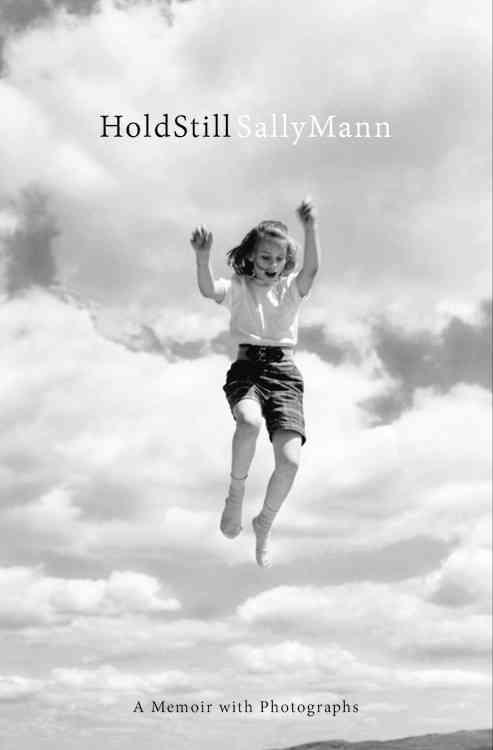 Sally Mann is one of my favorite photographers, and she proves with this memoir that she is a more than capable writer as well. I blew through this almost 500 page book faster than I have read anything lately, it was that engrossing. Most well known for her notoriously controversial book of photographs, Immediate Family (1992), Sally Mann is one of our most celebrated contemporary photographers. She presents the reader with a book that speaks about her craft, her family history, and her own coming of age in a manner that speaks to a genuine self awareness . The book is not organized in a linear fashion and flips back and forth from her own immediate history to that of her older relatives with ease, and doesn't feel out of place or forced. One of the nicer things about this book is that she has a wonderful collection of high quality matte images that are interspersed throughout the narrative and these really lend to the telling of her history and her musings on the nature of photography and its impact on our memories and our lives. Just great.
 Go Set A Watchman, Harper Lee

I put this on hold a long while ago, and was thrilled to get a chance to read something else by Harper Lee- the author of mine and many other folks' childhood. I have read and re-read To Kill A Mockingbird many times, and gotten something from it each time as I have grown older. In graduate school, the first semester was dedicated to making many (failed) monotypes, woodcuts, and drawings about Scout and Tom Robinson, and sculptures about Boo Radley.
I want to say that I am probably one of the few people that isn't completely disappointed with Go Set A Watchman. I went into reading this without the expectation of greatness, knowing that this would be a different experience. It was different, and this isn't the same kind of book that To Kill a Mockingbird was, which I am kind of happy about. This book was more complex, more of its time, without any tidy resolutions. The rhetoric towards the end of the book I had to skim through because I found it to be upsetting, yet I found the characters to be more believable, and sad. I feel that the release of this book is fitting for the times we live in- the character of Atticus Finch being knocked down from his ivory tower is relevant, and necessary. If you look around the Internet, people are so upset by this- and angry that this character could be painted as a racist. I don't understand why this is such a surprise, though. The prose style is still quite good, and the stronger points of the book are when Jean- Louise flashes back to points in her upbringing. A worthy read.
Thursday, December 4, 2014
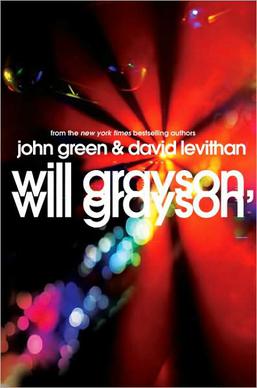
Will Grayson, Will Grayson, John Green & Levithan
Will Grayson, Will Grayson. John Green & David Levithan, 2010. 310 pages
 This book got me from the first page, as good teen fiction should always do. I thought it was hilarious, and I am a tough critic. The character of Tiny Cooper could quite possibly be one of the most entertaining fictional gay men I have ever felt like I've known. He also reminds me of a few people I grew up with, which made him more plausible as a character for me, at least. Especially my friend who used to pretend he was Stevie Nicks by wrapping himself in a sheet and twirling around. Tiny Cooper made this book. Ok, I'm done.
 This book got me from the first page, as good teen fiction should always do. I thought it was hilarious, and I am a tough critic. The character of Tiny Cooper could quite possibly be one of the most entertaining fictional gay men I have ever felt like I've known. He also reminds me of a few people I grew up with, which made him more plausible as a character for me, at least. Especially my friend who used to pretend he was Stevie Nicks by wrapping himself in a sheet and twirling around. Tiny Cooper made this book. Ok, I'm done.
That aside, I recommend this book to everyone. It is funny, charming, awkward in the way the adolescence can be, and very well written. I loved that it was set in this area of the country, and I love that both Green and Levithan present the reader with dimensional LGBTQ characters. These characters do not struggle with their sexual orientation as much as trying to deal with interpersonal relationships like everyone else at this age struggle to do. I did have the idea from the cover and book jacket description that there would be more of a science fiction angle, but was not disappointed to find out that this was not so.
Wednesday, December 3, 2014
Winger, Andrew Smith
Winger, Andrew Smith 2013 438 pages

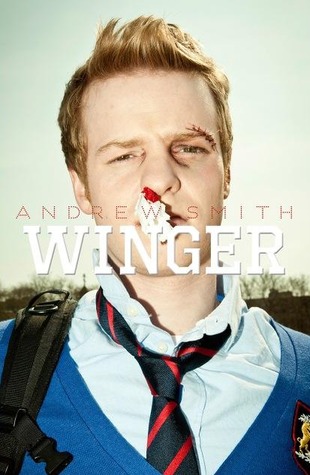
I wanted to dislike this book. It came recommended by most of the Youth Services staff over here at Central, but I just couldn't see how I could like a character as privileged as Ryan Dean West. I was proven wrong, and I am glad for that. This book was funny and endearing, and kind of made me want to cry. Ryan Dean West is fourteen and a junior at his boarding school. This scenario is nightmarish for anyone to think about. Picture yourself at fourteen and being younger than everyone else in your grade by two years. That just sounds awful.
The book opens with Ryan Dean having to deal with the fact that he is living in the dorm set a part for troublemakers, and his roommate is a total bully. Along with his crush on his best friend who thinks he is a little kid, Ryan Dean's prospects for junior year don't start off that promising. The book deals with some heavy subject matter in a way that is palatable for teen readers. Andrew Smith is an excellent writer and I was really pleased to read this.
Bad Feminist, Roxane Gay
 Bad Feminist is a collection of essays that is worth reading, whether you agree with Roxane Gay or not. One of the more refreshing aspects of these essays is that you do not need to be steeped in theoretical aspects of second or third wave feminism in order to comprehend what she is trying to say. In this way, she reminded me of Audre Lorde, whose essays were also written in an economic prose that simply gets to the point. The personal nature of the essays won me over as well, especially in the essays where she speaks about the Sweet Valley High books or her essays in response to watching The Help, Django Unchained, and Twelve Years A Slave. I also appreciated her analysis of the character Katnis from the Hunger Games in the essay "What We Hunger For" as well. While the book is far from perfect, the topics are relevant. This is a great book to read with other people and discuss (or argue about).
The Cat At The Wall, Deborah Ellis
The Cat At the Wall, Deborah Ellis, 2014 152 pages
 I heard about this title at a recent Youth Services Meeting, and when it came into Central, I thought I would see if it was any good. This is a short chapter book that packs a punch for readers of all ages. I could not put this book down. Ellis deftly crafts a narrative that deals with the complexities of the Israeli/Palestinian conflict in a way that is visceral, moving, and inventive.
 I heard about this title at a recent Youth Services Meeting, and when it came into Central, I thought I would see if it was any good. This is a short chapter book that packs a punch for readers of all ages. I could not put this book down. Ellis deftly crafts a narrative that deals with the complexities of the Israeli/Palestinian conflict in a way that is visceral, moving, and inventive.
This is the story of a little girl who dies and is reincarnated as a stray cat in the city of Bethlehem. It is told from her perspective, and flashes back periodically to her life back in Bethlehem, Pennsylvania. What I really like about the whole story is that Ellis does not tell us what to think about this conflict or give us a convoluted history of the conflict. She creates a narrative around the experiences of a few people, and a stray cat who may be able to make a difference. Worth the time to read.
Wednesday, October 15, 2014
Beautiful Music For Ugly Children, Kristin Cronn-Mills
 Beautiful Music For Ugly Children, Kristin Cronn-Mills, 2012, 271 pages
Gabe is about to graduate high school and seems to be on the cusp of everything. Except that most people do not know him by the name Gabe, they know him as Elizabeth. He has a radio show on his town's community station called Beautiful Music For Ugly Children, (much like St.Louis's own KDHX ) where he is comfortable being Gabe on the air. The story follows Gabe through his coming out to his community as a trans-dude and some of the adversity he faces as a result of this.
The writing is pretty good, (except some of the music references are off, in my humble opinion) but I felt like Gabe's story could have been a bit more nuanced as per his developing gender identity. I do however, think this was an earnest effort by the author, who did her research. Describing an experience like transitioning gender is no easy task, especially if the author is a cis-gendered person. What saved the book for me, was that she included a note that functioned like a PSA at the end, although I might have like to have seen it at the beginning of the book. Again, this would be a great book for questioning youth, as Gabe's character is fleshed out in a believable way.
The letter Q : Queer Writers' Notes To Their Younger Selves

The letter Q : Queer Writers' Notes To Their Younger Selves, edited by Sarah Moon, 281 pages
Sunday, October 12, 2014
Vitamin D2: New Perspectives In Drawing
 Vitamin D2: New Perspectives In Drawing 351 pages, 2013
The second installment in the Vitamin D series (and there is also a Vitamin P for Painting), this is an excellent selection of contemporary drawing. The layout and images of the work are clear, and there are short essays accompanying each artist's work that is featured. When I was in graduate school, the first volume was invaluable to my research and studio practice, and this second volume should be no different for anyone interested in looking at a serious monograph that presents a wide array of what people are drawing now, and how they are drawing.
Drawing as a medium is a serious endeavor these days, and this book gives the reader an idea of just how versatile drawing can be. Vitamin D2 is a book for anyone interested in contemporary drawing, at any level. There are some really lovely images and exciting ways that artists are approaching the medium.
Deliver us From Evie
Deliver Us From Evie, M.E. Kerr 1994 177 pages
 This is an older LGBT YA title, but I remembered reading M.E. Kerr when I was a kid, and was curious to see how the writing held up over time. The story still felt relevant, but the pop culture references did not hold up in the slightest, although I was amused to be reading about the main character's tape collection, especially the K.D. Lang tape they make mention of. I also enjoyed that the story was set on a farm in rural Missouri. Evie is an eighteen year old who is on the cusp of becoming an adult and deciding what kind of future she wants to have fore herself. She has always been different, and tough, but always herself. Then she meets Patty, who changes everything. Obviously, there is going to be some drama surrounding their blossoming romance, but what made the story readable was that it was told from the perspective of her sixteen year old brother. I thought that this was a great way to talk about how coming out issues affect family members. Kerr also gives readers a character who challenges gender stereotypes, and also challenges the stereotypes of what gays and lesbians "look" like, which was so relevant at the time this book was published.
 This is an older LGBT YA title, but I remembered reading M.E. Kerr when I was a kid, and was curious to see how the writing held up over time. The story still felt relevant, but the pop culture references did not hold up in the slightest, although I was amused to be reading about the main character's tape collection, especially the K.D. Lang tape they make mention of. I also enjoyed that the story was set on a farm in rural Missouri. Evie is an eighteen year old who is on the cusp of becoming an adult and deciding what kind of future she wants to have fore herself. She has always been different, and tough, but always herself. Then she meets Patty, who changes everything. Obviously, there is going to be some drama surrounding their blossoming romance, but what made the story readable was that it was told from the perspective of her sixteen year old brother. I thought that this was a great way to talk about how coming out issues affect family members. Kerr also gives readers a character who challenges gender stereotypes, and also challenges the stereotypes of what gays and lesbians "look" like, which was so relevant at the time this book was published.
Knockout Games, G. Neri
 Knockout Games, G. Neri 298 pages
This book disturbed me from the very beginning to the very end, and I have to say that I really enjoyed it. A new girl moves to St. Louis amidst the divorce of her parents, and has a really hard time fitting in at her new high school. She ends up falling in with a group of kids who play a game known as the Knockout Game. One of the more enjoyable parts of reading this book was the fact that it was set here, and that G. Neri gives SLPL a shout out, but the book felt familiar. He is able to discuss issues of race and class in a way that is palatable for teens and so very relevant to our times and climate surrounding the city as of late.
Wednesday, April 16, 2014
The Faraway Nearby
The Faraway Nearby, Rebecca Solnit 259 pages
 This is Rebecca Solnit's follow up to The Field Guide to Getting Lost, which I also just recently finished. This book felt a little heavier, as it deals with a myriad of issues that all of us go through in life, beginning with her discussion of her mother's Alzheimer's disease. Solnit is able to weave her personal experience with astute observations of the world around her. The main theme has to do with the idea of storytelling, and some of its various manifestations in the world. The prose is lyrical, and ties together themes in refreshing ways for those who have not read her work before. I can't say that this book is better than A Field Guide, but it resonated with me quite a bit. When she writes about art, and the act of reading, I would have underlined an highlighted the book like a madman if it wasn't a library copy.
This is Rebecca Solnit's follow up to The Field Guide to Getting Lost, which I also just recently finished. This book felt a little heavier, as it deals with a myriad of issues that all of us go through in life, beginning with her discussion of her mother's Alzheimer's disease. Solnit is able to weave her personal experience with astute observations of the world around her. The main theme has to do with the idea of storytelling, and some of its various manifestations in the world. The prose is lyrical, and ties together themes in refreshing ways for those who have not read her work before. I can't say that this book is better than A Field Guide, but it resonated with me quite a bit. When she writes about art, and the act of reading, I would have underlined an highlighted the book like a madman if it wasn't a library copy.
Madness, Rack, & Honey
Madness, rack, and honey : collected lectures. Mary Ruefle. 326 pages.
 The title of this book caught my eye when I was looking up lists of poetry books on Goodreads. The book turned out to be something I want to have in my own personal library at home. Mary Ruefle is an accomplished American poet who teaches and is sometimes required to give lectures although she dislikes public speaking. Her solution to this problem is to read these lectures straight off the page.
The most surprising thing about this book is that while it concerns itself with poetry, it isn't always about poetry. It is a book that is about the creative mind of ideas, notions, ways to think about poetry, writing, living. It is not another dry instructional book about how to write poetry, which is a gift to a world over saturated with such things. Read it. Lovely in ways I have a hard time trying to describe.
The Days of Anna Madrigal
The Days of Anna Madrigal, Armistad Maupin, 270 pages
 The Days of Anna Madrigal is the ninth and final installment of Armistead Maupin's Tales of the City Series, which began in 1978. Even if you have not read the aforementioned series before, this is still a lively book with a lot to offer the reader. Maupin initially published Tales of the City in serialized form in The San Fransico Chronicle, one of the first examples of gay characters viewed as equals to their straight counterparts of its kind.
This is a fast read that is humorous and endearing for the reader. I would have to say that its target audience is probably for readers over the age of thirty, but still entertaining to say the least.
The Days of Anna Madrigal is the ninth and final installment of Armistead Maupin's Tales of the City Series, which began in 1978. Even if you have not read the aforementioned series before, this is still a lively book with a lot to offer the reader. Maupin initially published Tales of the City in serialized form in The San Fransico Chronicle, one of the first examples of gay characters viewed as equals to their straight counterparts of its kind. This is a fast read that is humorous and endearing for the reader. I would have to say that its target audience is probably for readers over the age of thirty, but still entertaining to say the least.
Blood, Bones, & Butter
Blood, bones, & butter : the inadvertent education of a reluctant chef. Gabrielle Hamilton.
291 pages
 For anyone who has ever worked in the restaurant business, sometimes reading or watching shows about people who work in kitchens can feel a little too close to home. It can be like working an extra shift for the week. Normally, I shy away from these types of memoirs because of this, (most definitely away from Hell's Kitchen or the like) but Gabrielle Hamilton does a fantastic job here.
The road for Hamilton begins in her childhood, in the kitchen of her mother- and then moves towards owning her own restaurant in New York many years later. Her descriptions of the often soul sucking environment of kitchens both near and far are honest, as well as the joy one can also find in these places. I found myself both rooting for her, laughing, and even disliking her in some parts- especially when she talks about cooks who burn themselves just not being careful enough. Her descriptions of the food are by far some of my favorite parts as the flavors shift with the rhythms of her life. Riveting, in a take no prisoners kind of way, which is how you have to be if you want to survive as a chef.
291 pages
For anyone who has ever worked in the restaurant business, sometimes reading or watching shows about people who work in kitchens can feel a little too close to home. It can be like working an extra shift for the week. Normally, I shy away from these types of memoirs because of this, (most definitely away from Hell's Kitchen or the like) but Gabrielle Hamilton does a fantastic job here. The road for Hamilton begins in her childhood, in the kitchen of her mother- and then moves towards owning her own restaurant in New York many years later. Her descriptions of the often soul sucking environment of kitchens both near and far are honest, as well as the joy one can also find in these places. I found myself both rooting for her, laughing, and even disliking her in some parts- especially when she talks about cooks who burn themselves just not being careful enough. Her descriptions of the food are by far some of my favorite parts as the flavors shift with the rhythms of her life. Riveting, in a take no prisoners kind of way, which is how you have to be if you want to survive as a chef.
How Architecture Works, A Humanist's Toolkit
How Architecture Works, A Humanist's Toolkit, Witold Rybczynski. 355 pages. 2013
 This is a splendid volume that can serve as an introduction to Architecture in general. Rybczynski makes Architecture approachable with very clear passages and stories that address the practical concerns of the architect as well as their aesthetic considerations as well. He has been widely published, and serves as the perfect guide for readers curious about how contemporary architecture works. The book flows well and may just tempt the reader to experience architecture in a different way.
This is a splendid volume that can serve as an introduction to Architecture in general. Rybczynski makes Architecture approachable with very clear passages and stories that address the practical concerns of the architect as well as their aesthetic considerations as well. He has been widely published, and serves as the perfect guide for readers curious about how contemporary architecture works. The book flows well and may just tempt the reader to experience architecture in a different way.
Monday, March 31, 2014
The Walking Dead Compendium One

The Walking Dead Compendium One, by Robert Kirkman and others, 1088 pages
Before Tiger did his blog post on this book I was unaware of
this series. But after reading his post and listening to him talk about it, I
knew I had to read it eventually.
If you enjoy zombie movies or zombie fiction this compendium
is a must read for you. The zombies follow the classic slow moving, attracted
to noise and smell genre. They have none of the Hollywood tricks that to make
them scarier like the ability to climb or run. But they don’t need them. Despite
being a comic the imagery as style allow for the classic jump scare type
moments you would expect.
The turnover on characters is rather fast though and just
when you are starting to like a person or cheer for them to make it to the end
they go and die, much like the Song of
Ice and Fire series. I still enjoyed the compendium and must mirror what
Tiger said “It was hard to put down”.
I look forward to reading the second compendium to see how
this all might end.
Tuesday, January 28, 2014
Our Guys
Our Guys: The Glen Ridge Rape and the Secret Life of the Perfect Suburbs, Bernard Lefkowitz
516 pages
 This is a book that you would have to get from the stacks, and its just as well. While I do enjoy reading True Crime, sometimes it is more disturbing than I would like. What was most upsetting was that something like this even happened in the first place, let alone reading an account of the whole egregious event. I was outraged every time I picked up the book and read more. This book is fairly old, and he crime happened five or six years before the book came out. It was also a grueling read because it was simply way too long, and Lefkowitz rehashes a lot of points along the way.
The main thing that kept me hanging on through this was the examination of the affluent suburb where the accused were born and raised, and of the attitudes of the people who lived there at the time. No one wanted to believe this could happen, but it was a place not unlike any other in the country. The perpetrators of this crime were young men who were outwardly successful in sports, and in school, yet rarely had to suffer any real consequences for their actions. Glad to be done with this one.
516 pages
This is a book that you would have to get from the stacks, and its just as well. While I do enjoy reading True Crime, sometimes it is more disturbing than I would like. What was most upsetting was that something like this even happened in the first place, let alone reading an account of the whole egregious event. I was outraged every time I picked up the book and read more. This book is fairly old, and he crime happened five or six years before the book came out. It was also a grueling read because it was simply way too long, and Lefkowitz rehashes a lot of points along the way.The main thing that kept me hanging on through this was the examination of the affluent suburb where the accused were born and raised, and of the attitudes of the people who lived there at the time. No one wanted to believe this could happen, but it was a place not unlike any other in the country. The perpetrators of this crime were young men who were outwardly successful in sports, and in school, yet rarely had to suffer any real consequences for their actions. Glad to be done with this one.
The Murder Room
The Murder Room, PD James, 415 pages
 I can't believe I have never read PD James before now. Perhaps I wasn't ready, but wow can she write a suspenseful mystery! In the last year or so, I have become enamored of British mysteries. This may have something to do with enjoying Masterpiece Mystery on PBS as well as other BBC mysteries that are floating around Netflix. I just find the writing to be a little better, the narratives more twisted, and the characters more engaging.
The Murder Room is number 12 in a series of novels centered around Adam Dalgleish; a poet, a detective, and a very private man. James masterfully takes her time in setting up the crime, and it took at least a hundred pages before anything major happens. I was most surprised by her eloquent use of language; most of her characters are well spoken, and her description of their habits and of the landscape around them made the book worth reading regardless of the mystery. The story may not be as modern or gritty as people may be used to when reading mystery, and I don't feel that it takes anything away from it. Sometimes its refreshing to read a book where cursing, sex, and graphic violence aren't what keeps the reader turning pages.
I can't believe I have never read PD James before now. Perhaps I wasn't ready, but wow can she write a suspenseful mystery! In the last year or so, I have become enamored of British mysteries. This may have something to do with enjoying Masterpiece Mystery on PBS as well as other BBC mysteries that are floating around Netflix. I just find the writing to be a little better, the narratives more twisted, and the characters more engaging.The Murder Room is number 12 in a series of novels centered around Adam Dalgleish; a poet, a detective, and a very private man. James masterfully takes her time in setting up the crime, and it took at least a hundred pages before anything major happens. I was most surprised by her eloquent use of language; most of her characters are well spoken, and her description of their habits and of the landscape around them made the book worth reading regardless of the mystery. The story may not be as modern or gritty as people may be used to when reading mystery, and I don't feel that it takes anything away from it. Sometimes its refreshing to read a book where cursing, sex, and graphic violence aren't what keeps the reader turning pages.
Subscribe to:
Posts (Atom)