Showing posts with label Rome. Show all posts

Monday, October 6, 2025

Life of Robert Southwell

The Life of Robert Southwell, Poet and Martyr by Christopher Devlin, 324 pages

Born into a well-connected family in England in the middle of the sixteenth century, as a teenager Robert Southwell, possibly under the influence of recusant relations, converted to Catholicism and departed to the Continent where he could practice his faith freely, beyond the reach of Protestant persecution.  Attracted, like many devout young men of the time, to the Society of Jesus, he entered the Jesuits after an initial rejection and became first a student and later a professor at the English College in Rome.  He left behind this position to become a missionary in his homeland, where he managed to minister to the Catholic community for several years before finally being cornered, captured, tortured, and executed.  Southwell's poetry, much of it written while in hiding, would serve as an inspiration to Shakespeare, Jonson, Donne, and Hopkins, among others, while his holy life and martyrdom led to his canonization in 1970, 14 years after this biography was published.

In the author's note that begins this biography, Christopher Devlin connects Southwell with St Edmund Campion, the illustrious Jesuit scholar and martyr of the preceding generation, and refers readers to the "brilliant study" of Campion by Evelyn Waugh.  Just as Southwell lived happily in the shadow of Campion, so Devlin writes in the shadow of Waugh.  While Devlin cannot match Waugh's literary genius, he compensates with thorough scholarship, something sorely needed when the historical record is so fragmentary.  

Sunday, January 8, 2023

The Lipstick Bureau

The Lipstick Bureau by Michelle Gable 464 pages

Normally, I’m a big fan of author Michelle Gable’s. I fell in love with her work with her debut novel, “A Paris Apartment;” then again with her fourth (“The Summer I Met Jack”) and fifth (The Bookseller’s Secret”) novels. This woman can write historical fiction!

In this, her sixth novel, we get a World War II saga that is based on the real life OSS operative Lauwers. It never fails to surprise me that with all the WWII-era books out there based on real figures that there is anyone left to influence a novel.

This one is a little different. Instead of resistance groups, concentration camps and those left behind on the home front, author Gable takes readers into the moral operations within the OSS (predecessor to the CIA).

Czech-born Niki Novotna has become an American, a newlywed with a failing marriage, and stationed in bomb-shattered, yet liberated Rome.  Her job is to write false propaganda that can dropped behind enemy lines. Looking as if the leaflets were produced in Germany, they disseminate such false information that Hitler is dead, the Allies are closer than then they think and the end of the war is very near.

Then Niki’s job is to get the prepared publications in the enemy’s hands.  That is the hard part! She comes up with a rather unorthodox way to get the information to the enemy, especially since the Air Force and the Army are more interested in dropping bombs than dropping propaganda. Her new idea borders on violating the Geneva Convention.

This book looks at the interactions of the Special Operations: Rome than how the enemy perceives the information.

Niki and her officemates are referred to as “The Lipstick Bureau,” but there were as many men in the office as women. Maybe it includes the “other” group of Italian women Niki paid to get the information out.

Y’all know how I love dual narratives. Most of the book takes place from 1943-45 and 1989. It doesn’t work. It wasn’t necessary and could have easily been deleted. However, it had to stay because this book is loosely based on the real-life operative, Barbara Lauwers, and their efforts to help win the war.

I found the office workings often tedious and lacking a forceful plot. Therefore, “The Lipstick Bureau” received 3 out of 5 stars in Julie’s world.


Saturday, May 25, 2019

How Catholic Art Saved the Faith

How Catholic Art Saved the FaithHow Catholic Art Saved the Faith: The Triumph of Beauty and Truth in Counter-Reformation Art by Elizabeth Lev, 295 pages

Every Catholic knows (or ought to know, but, times being what they are, likely doesn't) about the great saints who led the Catholic Reformation customarily, but misleadingly, called the Counter-Reformation: Charles Borromeo and Robert Bellarmine, Teresa of Avila and John of the Cross, Thomas More and John Fisher, Philip Neri and Francis de Sales, Ignatius Loyola and Peter Canisius, and many others.  Along with this litany, however, there was a corresponding movement in the arts, which boldly reasserted the claims of the Catholic Church in the works of artists including Caravaggio and Bernini, Titian and Rubens, Guido Reni and Artemisia Gentileschi.  In How Catholic Art Saved the Faith, Elizabeth Lev demonstrates how the art of what she calls the Catholic Restoration incarnated doctrine and thus used beauty to convey truth.

Lev has an intimate familiarity with the great art of Rome, and this enables her to not only present the works themselves, but present them in their proper spatial and devotional as well as historical context.  This alone would make the book worthwhile, although her focus on Rome means that she omits a great deal of art produced elsewhere - notably in Spain - and her focus on the visual arts means that other arts are barely mentioned - St Philip's role in creating the oratorio, for instance.  Amusingly, where Catholic medievalists, mostly based in northern Europe, have tended to disparage the Baroque (and therefore the churches of Rome), Lev slights the Gothic.  The book is printed on high-quality paper with full-color illustrations liberally sprinkled throughout, but unfortunately some of these reproductions, taken from public domain sources, are disappointingly poor in quality.

Friday, April 5, 2019

Rape of Lucrece

Image result for Rape of LucreceThe Rape of Lucrece by William Shakespeare, 118 pages

The Rape of Lucrece is one of Shakespeare's few narrative poems, written as a complement to his earlier Venus and Adonis.  Where that poem followed the comic pursuit of a beautiful young man by a lust-crazed woman, this one portrays the tragic violation of a virtuous woman by a lust-crazed man.  The subject is a tale from Livy's history, which begins with Collatinus' boasts of his wife Lucrece's proven devotion which provoke the cruel desire of Sextus Tarquin, the heir to the throne.  In the aftermath of his crime, Lucrece publicizes the outrage before killing herself, an act which provides the spark for the overthrow of the Roman monarchy and the institution of the Republic.  Shakespeare picks up the thread with Tarquin's arrival at Collatinus' villa while the master is away at war, pretending friendship while working himself up to assault.

     'Then, childish fear, avaunt! debating die!
     Respect and reason wait on wrinkled age!
     My heart shall never countermand mine eye:
     Sad pause and deep regard beseems the sage;
     My part is youth, and beats these from the stage...'

This provides Shakespeare an excellent opportunity to demonstrate both his legendary poetic gifts and keen psychological insight, and illustrates an understanding of the struggle between freedom and tyranny where freedom is oriented towards virtue while tyranny is slavery to vice, with ordered liberty opposed to lawless libertinism.

     While she, the picture of true piety,
     Like a white hind under the gripe's sharp claws,
     Pleads, in a wilderness where there are no laws,
          To the rough beast that knows no gentle right,
          Nor aught obeys but his foul appetite.

Friday, August 10, 2018

Satyricon

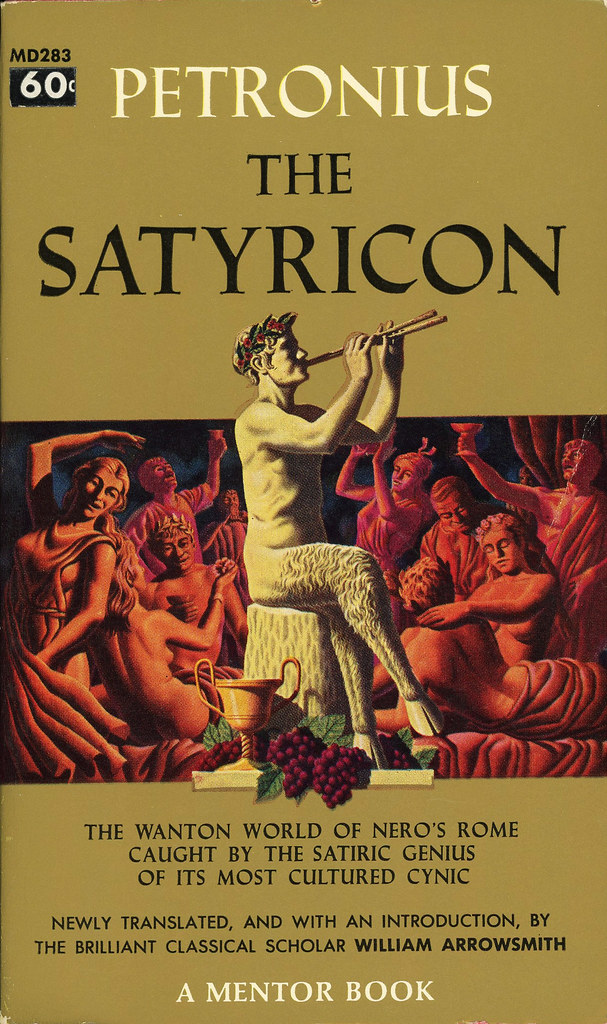
Image result for Petronius The SatyriconThe Satyricon by Petronius, translated by WC Firebaugh, 253 pages

One of the first novels, the sprawling Satyricon survives only in fragments, but fortunately these fragments form a more or less continuous text comprising most of books fifteen and sixteen of the original.  The story follows a group of well-educated but impoverished friends and rivals as they make their way through the decadent society of southern Italy during the reign of Nero, falling into and out of adventures ranging from the orgiastic rites of Priapus to the interminable dinner party of the wealthy bore Trimalchio.  At the center of many of these episodes is the beauty of the former gladiator Encolpius' boy lover Giton, a source of desire and therefore conflict for men and women alike.

As aimless as it is obscene, for the modern reader Petronius will recall Hunter S Thompson at his best or Jack Kerouac at his most popular.  It is certainly testament to the truth of Qoheleth's adage that there is nothing new under the sun.

Wednesday, June 27, 2018

Marius the Epicurean

Image result for Marius the Epicurean Pater WalterMarius the Epicurean: His Sensations and Ideas by Walter Pater, 467 pages (2 vols)

The great aesthetician Walter Pater's celebrated novel is superficially a fictional biography of a literary Roman aristocrat in the reign of Marcus Aurelius, but primarily it is an exploration of the culture of that era, as well as that of Pater's own Victorian era and indeed all eras.  Marius the Epicurean is therefore about ideas rather than characters, an exposition of the author's aesthetic and cultural theories.  Pater never drops his modern viewpoint, and while it can be jarring at first to hear a second-century philosopher compared to Rousseau's Savoyard Vicar, the reader may gradually come to appreciate the author's awareness of the historical moments of both himself and his characters.

Saturday, June 23, 2018

Poems and Letters

Image result for Poems and Letters SidoniusPoems and Letters (Volume 1) by St Sidonius Apollinaris, translated by WB Anderson, 241 pages

The 5th century is generally regarded as the century that saw the end of the Roman Empire in the West.  In 410, Alaric sacked Rome.  A few decades later, the Vandals took possession of North Africa, while the Anglo-Saxons invaded Roman Britain and Attila ravaged Italy and Gaul.  Finally, in 476, the Emperor Romulus was deposed by his general Odoacer, who sent the imperial insignia to Constantinople.

Sidonius Apollinaris witnessed much of this history.  Born into the aristocracy of Roman Gaul, he died under the heel of the barbarian Burgundians.  He composed a panegyric celebrating the accession of his father-in-law Avitus as Emperor, and another a few years later exalting Avitus' usurper Majorian, and another a few years later celebrating the accession of Majorian's successor's successor, Anthemius.  As bishop of Auvergne, he rallied the people during the siege of that city by the Goths, and was imprisoned by the victors after the city fell.  After his release he resumed his ministry to the vanquished, as well as his correspondence with figures ranging from his fellow Gallic bishops to barbarian kings and princes.

Admittedly, even the best poems of Sidonius have more antiquarian than aesthetic interest.  The fading of the classical world is exemplified by the Christian saint's invocation of pagan deities in praise of ephemeral emperors created and destroyed by barbarian generals.  More subtle are Sidonius' overriding concern with form at the expense of sense and his own distance from the literary masters of Augustan Rome he strives to imitate.  And yet the decadence itself presumes continuity, and Sidonius and his correspondents provide ample evidence of the stubborn persistence of Latin culture despite political disintegration.

Monday, January 8, 2018

Rome and Jerusalem

Rome and JerusalemRome and Jerusalem: The Clash of Ancient Civilizations by Martin Goodman, 557 pages

In 66 AD, Jewish rebels seized control of the city of Jerusalem and declared the foundation of a new state of Israel free from Roman control.  Four years later, the armies of Rome recaptured Jerusalem.  Hundreds of thousands of men, women, and children died by violence or starvation, tens of thousands more were enslaved, while thousands of real or suspected rebels were crucified, sometimes as many as five hundred at a time.  The Temple, the center of Jewish life and worship, was completely destroyed, never to be rebuilt, its treasures carted off to adorn the triumph of the victorious general, Titus, son and heir of Emperor Vespasian.

This "Jewish War", described in detail by Josephus, is the centerpiece but not the subject of Martin Goodman's Rome and Jerusalem.  His focus is not the conflict itself, but its causes and consequences.  Through a detailed analysis of the societies and cultures of the Jews and Romans, he dissents from the conventional view that the bloody showdown was inevitable, while contending that it was responsible for a seismic shift in Roman attitudes towards Jews that would resonate for millennia.   Unfortunately, in order to reach these conclusions, Goodman is forced to stretch the evidence to the breaking point.  He often writes as if people are only allowed a single motivation for any action, so that attacks by poor Jews against their wealthier coreligionists can be dismissed as class warfare without any component of opposition to Roman power or influence, despite the obvious parallels with the Maccabean revolt, which was as much a struggle of poorer rural Jews against the Hellenizing urban elite as with the Syrian king.  Another problem is his tendency to selectively generalize from the acknowledged diversity of social groups - for example, since many Jews were comfortable with certain aspects of Hellenism, Goodman concludes that first century Hellenism and Judaism were essentially compatible, effectively papering over the existence of large numbers of Jews and Gentiles who passionately believed that they were fundamentally incompatible.  This reaches absurd levels in his treatment of the early Church, when he dishonestly elides the early Jewish persecutions of Christians in order to mystify the break between the two communities, then imagines that those same Christians would voluntarily disassociate themselves from Jews in order to escape from Roman antisemitism despite themselves being under an imperial death sentence.  Then, too, he sometimes slides into the error of evaluating a period with the full benefit of hindsight, so that he imagines the inhabitants of Herodian Jerusalem, not as chafing under a corrupt alien dynasty with the knowledge that the security of their holy place was dependent upon the unpredictable whims of distant pagan emperors and their functionaries, but as enjoying a golden age of peace and prosperity which was cut tragically short by war precisely because that is how it appears in retrospect. 

This overreach is a considerable and unnecessary flaw.  Goodman's exploration of the Roman and Jewish cultures of antiquity is excellent, not in spite of but precisely because of his recognition of the heterogeneity of each and his awareness of their broad similarities as well as their particular differences.  Likewise, he generally avoids the trap of imagining that even the most authoritarian of ancient societies much resembled modern totalitarianism.  It would be a far stronger book if it was not driven by the author's overriding determination to discover a single source for all of European antisemitism.  Goodman succeeds as a historian of fact but ultimately fails in his analysis.

Friday, August 11, 2017

Eastern Schism

Image result for The Eastern Schism A Study of the Papacy and the Eastern Churches During the XIth and XIIth Centuries Runciman, StevenThe Eastern Schism: A Study of the Papacy and the Eastern Churches during the XIth and XIIth Centuries by Steven Runciman, 170 pages

In the simplified standard account, the great schism between the sees of Rome and Constantinople - and therefore between the Catholic and Orthodox churches - began with the excommunication of the Ecumenical Patriarch by papal legates in 1054.  As Steven Runciman elaborates, however, this was only one dramatic moment in a long process of ecclesiastical, theological, cultural, linguistic, and political estrangement - the roots of the schism predate Christianity and the sometimes heroic efforts to reverse it continue to this day.

Runciman struggles for objectivity and largely succeeds, but admits his own sympathies lie with the Byzantines - a slant which, as he argues, is more than compensated for by the fact that most Western studies of the schism tilt in the other direction.  The result is a balanced and nuanced presentation of the history of the most momentous split in the history of Christianity, necessary to understand the persistent divisions between what St John Paul II famously described as the "two lungs" of the Church.

Monday, June 26, 2017

Jerome

JeromeJerome: His Life, Writings, and Controversies by JND Kelly, 339 pages

It sometimes seems as if the number of biographies of St Augustine of Hippo could fill a small library by themselves, with his own Confessions remaining the best.  By contrast, there are very few biographies of his interlocutor and rival St Jerome.  This is certainly not because he lived an uneventful life - to the contrary, wherever Jerome went, controversy swirled around him.  As Kelly ably reveals, this was the result of a character as passionately loyal to his friends as he was hostile to his enemies, "violently opinionated" with an "habitual tendency to exaggerate".  Jerome is best known as the translator who produced the bulk of the definitive Latin version of the Bible, the Vulgate, but in Kelly's biography this is secondary to Jerome's involvement in a range of contemporary disputes both theological and personal.  The result is a work which manages to be both lively and eminently scholarly.

This is not to say that Kelly lacks weaknesses - particularly troublesome is his consistent chronological snobbery that smirks at Jerome's sexual morality and airily waves about the latest word in biblical criticism as if it were the last word.  Throughout, it is clear that Kelly's own views are the yardstick by which he measures Jerome's successes and failures, and this colors somewhat his analysis of Jerome's mindset and motives.  Nonetheless, his solid scholarship compensates for these flaws, as the book is anchored solidly enough for the reader to dissent from Kelly's evaluations.

Saturday, May 27, 2017

Borromini and the Roman Oratory

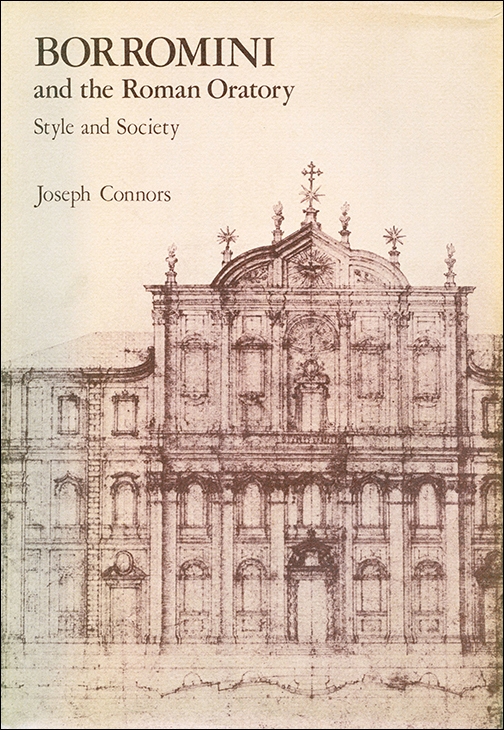
Borromini and the Roman Oratory: Style and Society by Joseph Connors, 112 pages

The construction of a new complex to house the followers of St Philip Neri began even before the saint's death in 1595, but the main work did not take place until some four decades later.  At that time, the Oratorians hired a then-unknown young architect, Francesco Borromini, to complete the design.  Borromini not only faced the difficulties of integrating his own ideas into the previous plans and the work that had already been completed, but also a struggle between the Oratorians' desire for modesty and his own stylistic exuberance, the latter only heightened by his youthful desire to distinguish himself.  Distinguish himself he did, and the Oratory, particularly its famous facade, is still admired as a masterpiece of Baroque architecture.

Connors documents the development of the Oratory project through a detailed exploration of the available sources.  In his telling, the development of the Oratory is revealed, not as a static act of creation on an inert object, but as a dialogue between the buildings and the people who lived, worked, and prayed within them, shaping and being shaped by one another, and between the complex and the city surrounding it, and, ultimately, between matter and spirit.

Wednesday, May 10, 2017

Metamorphoses

Metamorphoses by Ovid, translated by Rolfe Humphries, 392 pages

Ovid's Metamorphoses is a source for many of the most enduring tales and memorable characters in literature - Phaethon, Adonis, Narcissus, Orpheus, Icarus, Midas, Arachne, Pygmalion, Atalanta, and many others besides.  Even when the stories are familiar due to repetition, the manner in which they are artfully interwoven is delightful.  Some of the tales are surprisingly brief, others deliberately drawn out.  Ovid peppers his tales with humor, as when Perseus slays the wedding guests

     ...and Dorylas,
     who was very rich, and the end of all his fortune
     Was a spear jabbed through the groin...

Apollo, Venus, Bacchus, and Cupid - the gods of rapture - preside over Ovid's living tapestry of tales of transformation, but some of the most memorable passages concern more direct personifications - Famine, Sleep, Rumor.  In the closing chapters he brings the story up to his own day, and ends with a fully justified boast,

     Now I have done my work.  It will endure,
     I trust, beyond Jove's anger, fire and sword,
     Beyond Time's hunger.  The day will come, I know,
     So let it come, that day which has no power
     Save over my body, to end my span of life
     Whatever it may be.  Still, part of me,
     The better part, immortal, will be borne
     Above the stars; my name will be remembered
     Wherever Roman power rules conquered lands,
     I shall be read, and through all centuries,
     If prophecies of bards are ever truthful,
     I shall be living, always.

Friday, March 24, 2017

Bernini and the Art of Architecture

Bernini and the Art of ArchitectureBernini and the Art of Architecture by TA Marder, 321 pages

When Maffeo Cardinal Barberini became Pope Urban VIII in 1623, one of the first messages he sent was to his favorite artist, Gian Lorenzo Bernini:  "It is a great fortune for you to see Barberini made Pope, but our fortune is even greater to have Bernini alive in our pontificate."  Bernini was not only known throughout Europe as a great sculptor, he was also recognized as the greatest practitioner of the characteristically Baroque art of bel composto, the unified use of painting, sculpture, and architecture.  

It is fitting, therefore, that there should be an extensive study of Bernini's major architectural projects written for a mass audience.  That is precisely what TA Marder delivers in Bernini and the Art of Architecture - an accessible in-depth examination of Bernini's career as an architect, studying not only his great surviving works such as his Fountain of the Four Rivers, the Cornaro chapel, and his magnificent contributions around and within St Peter's Basilica, but also showcasing lesser known works and projects that were never completed, such as his design for the bell towers at St Peter's and planned renovations of the Pantheon and the Louvre.

As much a biography as it is a survey of artworks, Marder's book emphasizes Bernini's development as an architect and his struggles with the caprices of fortune, fame, and patronage, and the book is both more enlightening and more interesting as a result.

Monday, September 26, 2016

In No Strange Land

Cover image for In No Strange Land: The Embodied Mysticism of Saint Philip Neri by Jonathan Robinson of the Oratory, 274 pages

In No Strange Land is not quite a biography, although it has biographical elements, and Robinson has clearly put a great deal of thought and study into his understanding of St Philip Neri's life and work.  Robinson's main goal, however, is to examine the ways in which mysticism is inevitably embodied within a religious context, and that it cannot be abstracted outside of that context without serious deformation.  This presents a direct challenge to the school of thought which is epitomized by William James' The Varieties of Religious Experience.

While Robinson's study of mysticism is a solid contribution to an unfortunately underdeveloped field, it is the biographical elements of his book that will interest most readers.  St Philip Neri lived in a time of crisis and upheaval in the Church and in the world, and pursued his own unique vocation of reform and renewal, crafting a work that has reverberated down the centuries.  Sadly, he still has not received a great biographical study, but Robinson, like Bl John Henry Newman before him, provides fragments towards one.

Wednesday, April 13, 2016

Roman Pilgrimage

Cover image for Roman Pilgrimage: The Station Churches by George Weigel, Elizabeth Lev, and Stephen Weigel, 401 pages

Across many cultures, across many eras, the concept of pilgrimage was and is highly esteemed.  The modern western worldview, with its flat earth where every point is interchangeable with every other, is the exception.  Yet large numbers of people still travel to places like Compostela, Jerusalem, and Rome (not to mention Mecca, the Ganges, and Gettysburg), seeking something greater than themselves.  In addition to physical pilgrimages, there also exist chronological ones - Lent, for example, or Ramadan.  Combining the physical and the temporal, in the past few decades students and faculty at the Pontifical College of North America have revived the traditional medieval Lenten pilgrimage to the "station churches" of Rome.  It is this practice, both ancient and new, which is the subject of Roman Pilgrimage.

George Weigel, noted papal biographer (Witness to Hope) and Catholic commentator (Evangelical Catholicism), weaves together the station, the Mass readings, and the readings from the Divine Office for each day into a reflection that walks the reader one day at a time down the road of Lent and beyond, through Easter Week to Divine Mercy Sunday.  This is supplemented with architectural, artistic, and historical commentary on each station by Elizabeth Lev, author of The Tigress of Forli.  A generous sprinkling of gorgeous pictures of Rome's historic churches, taken by Stephen Weigel, tie the whole together, along with maps tracing the pilgrimage routes through the Eternal City.  The result is a spiritually, intellectually, and aesthetically rich guide to "the ultimate pilgrimage" - from Holy Thursday through Good Friday and Holy Saturday to Easter Sunday - through death into new life.

Friday, January 15, 2016

428 AD

Cover image for 428 AD: An Ordinary Year at the End of the Roman Empire by Giusto Traina, translated by Allan Cameron, 132 pages

428 AD was the year the last King of Armenia was deposed and the year Nestorius was installed as Archbishop of Constantinople.  It was two years after the completion of Augustine's City of God and one year before the Vandal invasion of Africa.  It was a year when the Roman Empire seemed more united than divided, when Theodosius II ruled in the East, Aetius fought in the West, and St Simeon Stylites remained atop his pillar.  It was not a crucial year, or a historic turning point, and that is precisely the interest of Traina's portrait of an "ordinary year" in late antiquity.

This is not to say that the book is narrowly confined to a single year - past and future are shadowed everywhere as Traina methodically circles the Mediterranean, from Armenia across Europe to Britain, then east across North Africa to Persia.  At times those shadows grow a little too long, and the author allows his foreknowledge to color his interpretation of the moment.  This impinges directly upon the best effect of the book's conceit - that in the year 428, the future was not yet written.

Friday, November 20, 2015

Odes of Horace

Cover image for The Odes of Horace by Horace (Quintus Horatius Flaccus), translated by David Ferry, 160 pages 

In the sixth ode of the first book, dedicated to Augustus' general Agrippa, the victor of Actium, Horace protests that to sing his subject's virtues properly would require an epic poet in the manner of Homer and Virgil, whereas

     It falls to me to make up easygoing
     Songs about such battlefields as parties,
     Epic encounters between young men and women.

So David Ferry renders it.  Contrast this with John Conington's Victorian era translation:

     Feasts are my theme, my warrior maidens fair,
     Who with pared nails encounter youths in fight.

Or A.S. Kline's more contemporary translation:

     I sing of banquets, of girls fierce in battle
     With closely-trimmed nails, attacking young men.

Obviously Ferry's translation is more equivalent than literal here, and on that level he succeeds admirably.  His rendition of Horace's poetry has an ease and a confidence that makes it seem effortless without being superficial, to the point where it is easy to imagine the odes being performed or even composed at one of the poet's dinner parties.  Unfortunately, it also misses some of Horace's gems, like the girls fighting with their nails in amorous combat, an image, so striking in itself, that also echoes his earlier references to "the wrath that filled Pelides' breast" and "crafty Ulysses' long sea-wanderings" better than "epic encounters between young men and women".

On the other hand, Ferry translates the thirteenth ode of the fourth book more literally

     ...your graying hair and yellowing teeth

while Conington transformed that description

     The white has left your teeth
     And settled on your brow.

Ferry is not deaf to metaphor, but he clearly prizes accessibility over ornament.  Whether the readers' values agree will determine their reception of this translation.

Wednesday, August 26, 2015

St Philip Neri

St Philip Neri: An Informal Biography by Marcel Jouhandeau, translated by George Lamb, 129 pages

St Philip Neri was born in Florence in the early sixteenth century, but he moved to Rome at the age of 18 and remained there until his death 62 years later.  Renowned in equal measures for his deep piety and joyful spontaneity, he attracted a circle of admirers who would gather for music, prayers, lectures, and discussions.  In time, this was formalized as the Congregation of the Oratory.  Neri's humility and humor made him equally at home with common laborers and princes of the Church, while his mystic ecstasies he kept hidden from the world.

Jouhandeau's unconventional biography is roughly divided into two halves - a personality sketch and a personal history.  This matches the saint's own unconventional, prankish behavior, such as shaving only one side of his face or dancing during audiences with Cardinals.  The author writes less like a biographer than an admiring contemporary, painting a vivid, attractive portrait of the man but being somewhat unjust towards some of those around him - Oratorian and historian Caesar Baronius and Pope St Pius V in particular.

Monday, January 12, 2015

Aeneid

Cover image for The Aeneid by Publius Virgilius Maro, translated by Robert Fitzgerald, 417 pages

The Aeneid is, of course, the poetic epic of Rome, self-consciously created as a Latin counterpart to Homer and as a paean to the glories of Augustus.  Unfortunately, the reputation of Virgil's masterpiece has suffered as a result of these origins, leading to it being considered by some as an inferior imitation and the flattering work of a court toady.  

It may be these things, yet it is a remarkable artistic creation as well.  The character of Dido outshines Calypso, Circe, Nausicaa, and even Penelope.  The survivors' account of the fall of Troy evokes horror as nothing in Homer does.  Most remarkably, the diabolical pride of Turnus, who is driven to fight Aeneas even when he knows he is clearly outmatched, who would rather die in battle than be second to anyone, becomes unexpectedly poignant when viewed in the light of the civil wars that convulsed Rome in the half century before Augustus.

Wednesday, January 7, 2015

De Officiis

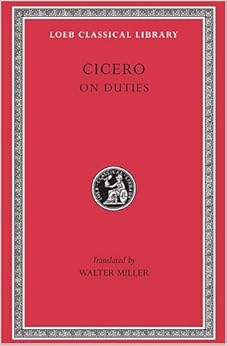
De Officiis by Marcus Tullius Cicero, translated by Walter Miller, 202 pages

In De Officiis (literally "On Duties" or less literally "On Moral Obligations"), Cicero attempts a concise summary of his ethical views, in the form of a letter to his son studying at Athens.  The whole is divided into three parts, considering in turn whether an act is moral, whether an act is expedient, and what ought to be done when morality and expediency conflict.  His argument with regard to the last question is that they cannot conflict in reality, only in appearance - immorality is always inexpedient, and morality always expedient.

Tully's consideration of morality follows the traditional model of the four cardinal virtues - prudence, justice, fortitude, and temperance - but "prudence" he considers a subset of "wisdom", founded on the quest for Truth, the highest of human aspirations and the first duty, but one which few can really pursue.  The other three he sees as necessary for sustaining human communities, without which, he maintains, no life worth living is possible.

The Loeb Classical Library edition includes the Latin original with the English translation on facing pages.