Showing posts with label Stoicism. Show all posts

Wednesday, August 19, 2015

On Friendship

De Amicitia by Marcus Tullius Cicero, translated by WA Falconer, 52 pages

Tully's De Amicitia ("On Friendship") takes the form of a dialogue between Gaius Laelius, a distinguished Roman statesman, and his two sons-in-law, one of whom is Quintus Mucius Scaevola, Cicero's own mentor and his supposed source.  Throughout, Laelius refers to his own recently deceased friend, Scipio Africanus, as the foremost model of friendship and virtue. 

For Cicero, friendship is a vital, necessary component of human life.  He follows Aristotle in declaring that the highest, most enduring form of friendship is that which is rooted in virtue.  The sharing of virtue not only grounds friendship on a foundation which can withstand the challenges of life, but reveals true friendship as a commingling of personalities, a communion of persons.

Wednesday, June 3, 2015

Art of Living

Cover image for The Art of Living: The Classical Manual on Virtue, Happiness, and Effectiveness by Epictetus, translated by Sharon Lebell, 113 pages

Epictetus was a Stoic philosopher and rhetor of the early 2nd century.  Born a slave, by the time of his death he was widely known and respected - amongst his admirers were the Emperor Hadrian and the future Emperor Marcus Aurelius.  His lectures were reconstructed by his disciple Flavius Arrian as The Discourses, which originally consisted of eight books (four survive).  The Enchiridion ("Handbook" or "Manual") is a distillation of Epictetus' teachings into a set of brief lessons, designed for an audience that would be bored or confused by the full Discourses.

This is the starting point for Lebell's translation of this classic - to render Epictetus in language that appeals to a mass audience.  Purists should not be too offended - despite the occasional lapse into the vulgarity of self-help jargon, Lebell generally accurately captures the meaning of the original.  Certainly, she doesn't attempt to soften Epictetus' message that the "good life" is a life spent in continual pursuit of the good, which means a life of rigorous virtue and detachment from worldly pleasures.

An easy introduction to a great classical philosopher.

Wednesday, January 7, 2015

De Officiis

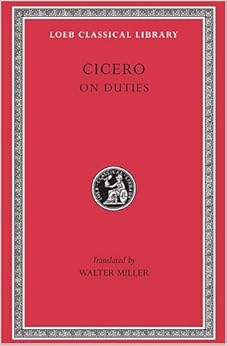
De Officiis by Marcus Tullius Cicero, translated by Walter Miller, 202 pages

In De Officiis (literally "On Duties" or less literally "On Moral Obligations"), Cicero attempts a concise summary of his ethical views, in the form of a letter to his son studying at Athens.  The whole is divided into three parts, considering in turn whether an act is moral, whether an act is expedient, and what ought to be done when morality and expediency conflict.  His argument with regard to the last question is that they cannot conflict in reality, only in appearance - immorality is always inexpedient, and morality always expedient.

Tully's consideration of morality follows the traditional model of the four cardinal virtues - prudence, justice, fortitude, and temperance - but "prudence" he considers a subset of "wisdom", founded on the quest for Truth, the highest of human aspirations and the first duty, but one which few can really pursue.  The other three he sees as necessary for sustaining human communities, without which, he maintains, no life worth living is possible.

The Loeb Classical Library edition includes the Latin original with the English translation on facing pages.