Showing posts with label Communism. Show all posts

Thursday, July 2, 2020

Liberty, Equality, and Fraternity

Liberty, Equality, and Fraternity by Ven Fulton J Sheen, 170 pages

Written in 1938, as fascists and communists in Europe and America gathered their forces for their pending assault against the liberal order, Liberty, Equality, and Fraternity diagnoses the troubles of the time in terms of the internal contradictions of the slogans of the bloody revolution which established that order.  The liberals exalt freedom above all, the totalitarians demand equality, and as the values each proposes are seemingly incommensurable, their differences cannot be peacefully resolved absent a higher unifying principle.  Sheen finds this principle in fraternity, the principle which animates Catholic social teaching, which he advances as a cure for the world's ills.

Liberty, Equality, and Fraternity was written early in Sheen's public career, and suffers from a lack of focus.  After ably establishing his argument, Sheen proceeds to ramble on at length about the threat of communist subversion in the US - a timely warning, but one not directly connected to the main theme of the book or of much interest to a reader eighty years later.  Sheen's analysis of both liberalism and totalitarianism as sharing the same dehumanizing character despite their irreconcilable differences, however, remains powerful.

Tuesday, January 21, 2020

Shining Path

The Shining PathThe Shining Path: Love, Madness, and Revolution in the Andes by Orin Starn and Miguel La Serna, 355 pages

On Christmas Eve, 1980, a group of rebels invaded the home of a well-off sugar farmer in a remote canyon in the Peruvian Andes.  The guerrillas dragged the landowner to a nearby chapel where they tortured him to death, leaving "Long Live the People's War" spray-painted on a farmhouse wall.  He was the first to die in that war, launched a few months earlier by a sect of Maoist revolutionaries calling themselves the Peruvian Communist Party but invariably referred to in the foreign press by the more romantic name Shining Path.  Their barbaric struggle would drag on for over a decade and leave over 70000 dead, roughly half killed by the Shining Path themselves, the other half split between the regular army and village militias.  

It is difficult to write a history of a guerrilla insurgency, which by its very nature is fluid and avoids decisive battles.  It is even more difficult without reliable sources from within the movement.  Starn and La Serna attempt to overcome these difficulties, and paint a broader picture of Peru in the last decades of the twentieth century, by concentrating on the personal stories of those touched by the conflict, from slum activist Maria Elena Moyano to novelist and presidential candidate Mario Vargas Llosa to policeman Marco Miyashiro to peasant militiaman Narciso Sulca.  As a result, those who expect either a thorough history or an exploration of the inner workings of the insurrection are likely to be disappointed.  They are unlikely to be bored, or to soon forget some of the unexpected people and places introduced.

Tuesday, August 20, 2019

Judgment in Moscow

Judgment in MoscowJudgment in Moscow: Soviet Crimes and Western Complicity by Vladimir Bukovsky. translated by Alyona Kojevnikov, 626 pages

Usually, when a criminal regime is removed from power, there is a reckoning, whether in the form of war crimes trials or truth and reconciliation commissions.  When the USSR collapsed, however, there was no judgment passed upon the men and women who had brutally tyrannized millions for generations.  In the opinion of dissident Vladimir Bukovsky, there could be only one reason for this lapse - the criminals had not really been defeated.  To the contrary, they remained at the levers of power, fully prepared to reassert themselves in time.  And so it happened.

Judgment in Moscow was originally published, in Russian, in 1996.  It was soon translated into a number of languages, but English was not one of them - until now.  In Bukovsky's account, this was due to the unwillingness of his publishers at Random House to market a book documenting  how Western elites fundamentally misunderstood the Soviet nightmare, deliberately or accidentally supported its continuation, and finally helped its engineers escape justice.  This unwillingness was itself a demonstration of the urgent need for an honest accounting for the history of Soviet tyranny and the struggle against it, a need which has tragically continued to be unmet.  The long-delayed publication of Bukovsky's book is at least a small step in that direction.

Friday, May 3, 2019

Pol Pot

Pol PotPol Pot: Anatomy of a Nightmare by Philip Short, 449 pages

When the Khmer Rouge captured the Cambodian capital of Phnom Phen in 1975, no one - not even the revolutionaries themselves - knew exactly what would happen next.  Indeed, at that time the identity of the communists' ultimate leader was unknown to any outside of their own innermost circle.  Saloth Sar, who took the revolutionary name Pol Pot, had been content to be a face in the crowd of Khmer Rouge officials, but he now held the power of life and death over seven million people.  For at least a fifth of that population, that power would be death.

Jacob Burckhardt famously declared that "the essence of tyranny is the denial of complexity."  It may be significant, then, that Pol Pot's brother-in-law once described him as having "a very simplistic vision of things."  It is not a mistake that Philip Short repeats in his study of the Cambodian dictator, rather, he provides detailed intersecting accounts of the breakdown of Cambodian politics, the rise of the Khmer Rouge, and the making of the man Pol Pot.  Unfortunately, this sometimes suggests obfuscation rather than accuracy, as the author seems to be at pains to highlight just about any negative influence on the Khmer Rouge other than progressive dogma, primarily blaming various elements of the Khmer national character for the regime's policies - an absurd explanation given the poverty of the Khmer precedents when contrasted with the rich global pattern of Marxist mass murder.  It is distasteful for other reasons as well, as Short confesses when he notes that his description of the Khmer as a uniquely lazy people "will raise hackles."

Monday, April 30, 2018

Witness

WitnessWitness by Whittaker Chambers, 799 pages

In 1948, Whittaker Chambers, then an editor at Time magazine, testified before the House Un-American Activities Committee.  He informed the committee of his long years in the Communist Party, first as a member of the "open" American Communist Party, later as a member of the Soviet Communist underground, assisting in the subversion of the US government, until his break with the Party in the mid-'30s.  Among the names Chambers named was that of Alger Hiss, then a highly placed official in the State Department.  The confrontation between Hiss and Chambers, as Hiss unsuccessfully sued Chambers for libel and then was himself convicted of perjury, polarized the nation.  Some saw Chambers' testimony as evidence of a vast Communist conspiracy, others as dangerous lies that had to be exposed, and still others believed that, even if what he said was true, it still had to be discredited lest it encourage the wrong kind of thinking.

Seventy years later, Witness, Chambers' autobiography written shortly after the conclusion of the Hiss case, can be read as a historical document chronicling a time when much of America's elites, faced with a choice between defending American institutions and providing cover for an aggressive dictatorship bent on subverting them, chose to side with Stalin.  More significantly, it can also be read as the story of the ultimately spiritual struggle of one man, sunk deep in darkness but saved by the light, who found the grace to witness to the truth in that world-historical moment.

Monday, November 27, 2017

Killing Wind

The Killing WindThe Killing Wind: A Chinese County's Descent into Madness During the Cultural Revolution by Tan Hecheng, translated by Stacy Mosher and Guo Jian, 464 pages

Jiang Xiaochu was a 22 year old engineering student when the Cultural Revolution began in Hunan.  As his father, a former teacher, had been censured for supposedly holding counterrevolutionary views and relegated to farm labor several years earlier, the entire Jiang family were considered suspect "black elements".  Fearing for his safety as turmoil enveloped the university, Xiaochu returned to his native town.  Ever since his father's censure, the Jiang family had devoted themselves to Mao Zedong Thought, and he believed that their conspicuous loyalty would persuade their neighbors to overlook their past.  So strong was his faith that when his father and brother were arrested, Xiaochu went to the local authorities to argue for their release.  He was arrested as well, and killed beside them.  His mother and sister were gang-raped by the executioners, but survived to tell their story to investigators - including journalist Tan Hecheng - two decades later.  Tan's original article chronicling the investigation was censored by China's Communist authorities, but became the germ for his exhaustive study, The Killing Wind, where the story of Jiang Xiaochu and his family joins the stories of nearly 5000 other victims of the Cultural Revolution in the small county of Daoxian.

Stalin is famously supposed to have said, "One death is a tragedy, a million is a statistic."  The number of people killed in the Cultural Revolution is unknown, but almost certainly over a million, and possibly several millions.  Tan Hecheng, chronicling the violence in a single county, manages to combine the statistics with personal stories that preserve the tragic, human scale.  Unfortunately, the sheer scale and disorder of the killing wind inevitably makes the narrative difficult to follow at times.  Tan intended his report as a reckoning with history, insisting that the horrors committed cannot - must not - be forgotten, not only out of a sense of justice for the victims and survivors, but also due to a commitment to the truth.  Meanwhile, on the other side of the Pacific, where many Americans increasingly regard their political opponents as irredeemable deplorables against whom violence is acceptable, Tan Hecheng's study of how what Che Guevara famously described as the "extremely useful hatred that turns men into effective, violent, merciless, and cold killing machines" is fostered and exploited is as timely as it is powerful.

Wednesday, August 2, 2017

Lenin, Stalin, and Hitler

Lenin, Stalin, and HitlerLenin, Stalin, and Hitler: The Age of Social Catastrophe by Robert Gellately, 594 pages

The closing years of the First World War saw an unprecedented wave of human liberation sweep across Europe.  The repressive tyrannies that had shackled the human spirit for so many centuries, particularly the traditional regimes of the Russian, German, Habsburg, and Ottoman empires, were at long last swept away.  Idealists were finally free to pursue lofty visions of a better world without superstitious nonsense about human limitations, and they found their visionaries in such men as Lenin, Stalin, and Hitler.  The screams of their tens of millions of victims echo still today, even if many, now as then, seem deaf to them.

Although he certainly identifies the many similarities his subjects shared, Gellately also highlights differences, notably the contrast between Hitler's "consensus dictatorship" as against the Soviet Bolshevik dictatorship, resulting in revolutionary Communism as opposed to evolutionary Nazism, expressed in differences between the "arbitrary and sweeping terror" under Lenin and Stalin and the "aimed terror" of Hitler.  While providing surprises and insights even for those familiar with the period, Lenin, Stalin, and Hitler manages to be an accessible introduction to the darkest chapter in human history so far, from the conditions which encouraged so many to commit themselves to the inhuman ideologies of Leninism, Stalinism, and Hitlerism, through the clash of those ideologies in a social catastrophe "so utterly unprecedented in all its many horrific faces, that it raised questions about the very meaning and future of Western civilization."

Saturday, June 24, 2017

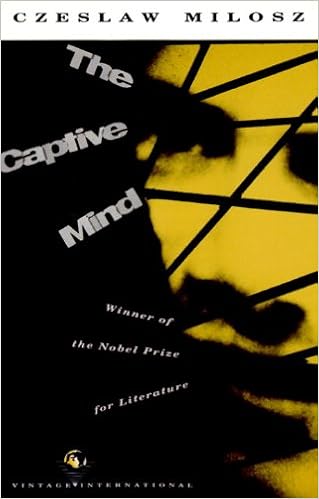
Captive Mind

The Captive Mind by Czeslaw Milosz, translated by Jane Zielonko, 251 pages

In his 1953 book The Captive Mind, Polish poet Czeslaw Milosz describes the place of an intellectual under socialism, a situation he compares to that of a violinist in a concentration camp.  Through a series of essays he analyzes the seductiveness of the System, especially in the East, where the world wars had thoroughly wiped away the past and the Soviet way seemed the only path to the future.  He vividly exposes the tragedy of thought under an ideology which not only prohibits opposition but demands approval, necessitating a thoroughgoing dissimulation which approaches schizophrenia.

Naturally, a book like The Captive Mind could never have been written under communism, and indeed Milosz wrote it following his defection to the United States in 1951.  He evocatively describes the tragedy of a poet living in isolation from his linguistic community, so that the book serves simultaneously as a justification for his own decision to leave and an explanation for the decisions of others to stay.  At the heart of the book are Milosz's biographies of four typical writers - a Catholic, a cynic, a Communist, and a nationalist - and the self-mutilation they must perform to survive under Stalinism.

Wednesday, May 3, 2017

Spies in the Vatican

Spies in the VaticanSpies in the Vatican: The Soviet Union's Cold War Against the Catholic Church by John Koehler, 273 pages

Virtually from the moment of its birth, the Soviet Union sought the end of religion amongst its people and throughout the world.  When mass murder failed, the Soviets began a campaign of infiltration and subversion.  Although the Catholic Church was targeted from the outset, when the Second World War left the USSR in control of puppet states throughout Eastern Europe the neutralization of the Church became an even higher priority.  The record of this shadow war waged by the Soviets and their proxies against the Church is the subject of John Koehler's Spies in the Vatican.

Although the book briefly summarizes earlier periods, the bulk concerns the pontificate of St John Paul II and his connection with the Solidarity movement, including, most explosively, possible Soviet involvement in the assassination attempt against the Pope in 1981.  Unfortunately, Spies in the Vatican lacks any kind of cohesion.  The book reads like "random moments in the history of Warsaw Pact espionage" rather than a thorough history of communist subversion of the Catholic Church.  This slipshod approach is aggravated by numerous textual errors - "seize fire", "assassimate", "Let sleeping dogs die".  At the same time, Koehler demonstrates considerable expertise concerning the history, organization, and records of various intelligence agencies, especially the East German Stasi, and he writes with unwavering moral clarity.

Wednesday, July 27, 2016

Plot to Kill God

Cover image for The Plot to Kill God: Findings from the Soviet Experiment in Secularization by Paul Froese, 199 pages

When the Bolsheviks seized power in 1918, their Communist ideology predicted that with the destruction of the old political order religion would gradually but inevitably wither away - an especially plausible theory for Russians, for whom the Orthodox Church and the tsarist regime were virtually indistinguishable.  When this did not happen, the Soviet perspective on religion shifted from that of symptom to that of disease, resulting in a more active persecution.  Attempts to destroy religious belief ranged from the desecration of churches and mass murder of clergy to the integration of atheist propaganda with every subject in the school curriculum and the institution of atheist rituals to replace the traditional religious ceremonies solemnizing birth, marriage, and death.

Froese takes the results of this Soviet attempt to impose atheism on its population as an empirical test of various theories of secularization.  In his view, the Soviet experience invalidates theories which attribute religious belief to ignorance, indoctrination, political utility, social pressure, or mass enthusiasm.  According to Froese's economic model, although the Soviets were somewhat successful in diminishing the supply of religion from traditional institutions, they were utterly unable to eliminate the demand for religion.  This suggests that the Soviet regime never correctly understood the nature of that demand.

The Plot to Kill God is not a history of Soviet anti-religious policies, but an analysis of the results of those policies.  There are a number of typographical problems ("Protestants sects", "League of Militant Atheist", "ingenuity in alluding authorities"), but those mostly disappear after the first dozen pages.  There are also some suspect claims and sweeping generalizations ("secular alternatives to religious marriage ceremonies, for example, have always existed") somewhat sloppily thrown about without support.  Neither of these flaws affects Froese's argument, which is strong enough to deserve more thorough study.

Saturday, June 11, 2016

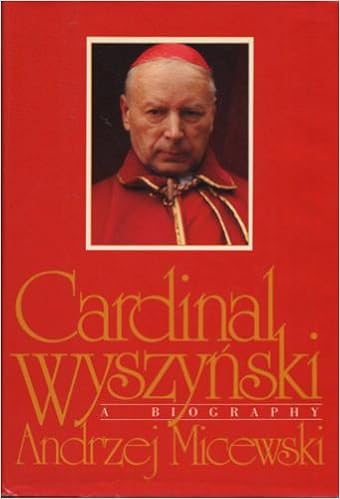
Cardinal Wyszynski

Cardinal Wyszynski: A Biography by Andrzej Micewski, translated by William and Katarzyna Brand, 463 pages

Stefan Wyszynski became Archbishop of Warsaw and Primate of Poland in 1948.  He remained in that position for 33 years, all of them spent under an aggressively atheist totalitarian dictatorship.  During that time, he lead the Church in Poland through his nine-year Great Novena of the Millennium (the first millennium of Polish Christianity, 966-1966) to the consecration of Poland to the Virgin Mary "to bring aid to the universal Church and the family of man."  Although he died in 1981, he survived long enough to see his junior colleague, the Archbishop of Cracow, elected Pope, and in many ways St John Paul II carried forward Wyszynski's program into the universal Church. 

The author describes his nearly 500 page book as merely a "sketch of his biography... intended only as initial research into his life."  A large portion of the text is taken up by paraphrases of the minutes of committee meetings - hardly the exciting, dramatic material one might hope for in a record of over three decades of resistance to tyranny.  Yet Micewski repeatedly makes the obvious comparison between Wyszynski and Cardinal Mindszenty of Hungary in order to contrast their approaches to Communist oppression, the former attempting to accommodate the authorities wherever possible without compromising core principles, while the latter refused to even speak of dialogue with his persecutors.  This starkly demonstrates Micewski's central theme, that Stefan Wyszynski not only had the courage to be a martyr, but also the wisdom to be a true pastor.

Saturday, May 28, 2016

Homo Sovieticus

Cover image for Homo Sovieticus by Alexander Zinoviev, translated by Charles Janson, 206 pages

Homo Sovieticus is an unconventional novel - there is no plot, and the characters are caricatures with names like "Enthusiast" and "Writer".  The book is divided into small - half a page to two page long - anecdotes in which the narrator, a cynical Soviet emigre who describes himself as an Agent of the Soviet State, reflects on the life of an ASS in the Soviet Union and the life of an ASS in the West.

Zinoviev's perspective, driven home in one cynical, self-important vignette after another, is that something resembling the dialectic of Marxism is at work in history, but rather than a force for liberation, it is an idiot god fumbling about with human lives.  The individual is insignificant, rather, it is the masses that decide things, and the masses are venal, blind, and cruel.  The only meaningful difference between East and West is that in the USSR a desire to be free of the masses makes one an individual, while in the West such a desire only buries one deeper within the mass.

Monday, May 9, 2016

Fools, Frauds, and Firebrands

Cover image for Fools, Frauds, and Firebrands: Thinkers of the New Left by Roger Scruton, 288 pages

Thinkers of the New Left began as a series of articles, collected into the book of that title in 1985.  The 2015 Fools, Frauds, and Firebrands is not just a thirtieth anniversary reissue, but also a substantial revision.  Its continuing value is attributable to the fact that its targets are not the political opponents of a day but the ideologues themselves - Galbraith, Sartre, Foucalt, Habermas, Lacan, Gramsci, Said, Badiou, Zizek.  Not that the book is placidly intellectual - the author describes it as "a provocation" and it is certainly provocative, but it is also thoughtful and well-reasoned. 

While Scruton develops an individual criticism for the thought of each of his subjects, certain themes recur.  Most of the thinkers accept some variation of Foucalt's "exposure" of society as nothing more than a power struggle between individuals and institutions of repression.  The "nonsense machine" of cant is employed in order to obfuscate reality and persuade others that capitalism and democracy, each predicated on individual freedom, are in actuality occult systems of domination and subjugation.  All human interaction is reduced to incommensurable power struggles between abstracts, whether abstract individuals (Sartre) or abstract classes (Lukacs).  These abstracts are, in turn, privileged above particular realities, so that the opinions and desires of actual workers can be ignored in favor of the interests of the working class, which can only be divined by the intelligentsia.  This completes a vicarious identification of comfortable intellectuals with the oppressed masses, wherein the worker ends up objectified, not by the market, but by the intellectual who makes of him a fetish.  Above all, the subjects refuse to meaningfully engage with opposing viewpoints, all arguments being rejected beforehand as badthink, excluded by the nonsense machine.  This, more than anything else, demonstrates them to be fundamentally unserious, because uninterested in intellectual work except insofar as it can serve as either an incitement to or a replacement for revolutionary activity.

The serial nature of the original articles shows in the chapters, which generally form self-contained units, but this is a strength rather than a weakness, since it allows Scruton to treat his subjects as individuals rather than as members of the opposition.  Scruton rarely stoops to comment on the personal lives of his subjects, even while he expresses genuine regret at instances where ideological conformity seems to have crippled philosophical development, notably in the cases of Sartre and Lukacs.  Above all, he insists on the particular and the real, on the inherent tension between the ideals of freedom and equality, since any real freedom inevitably produces inequality, and the corresponding importance of the mediating, conserving, mutually-reinforcing roles of civil society, institutional accountability, and the rule of law.

Monday, April 4, 2016

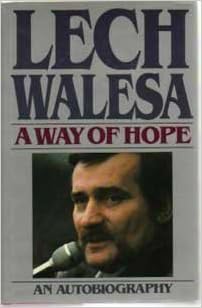
Way of Hope

A Way of Hope: An Autobiography by Lech Walesa, 311 pages

Lech Walesa was an electrician in the Gdansk shipyards who became a leader in the labor struggles around which Solidarity coalesced.  Two years after the publication of the English edition of A Way of Hope, Solidarity would force the collapse of the Communist government in Poland, the first domino in the collapse of the Warsaw Pact and ultimately the USSR itself.  At that time Walesa would become the first democratically elected President of postwar Poland.  Part of the interest this book holds is that it was written in the midst of the struggle, when the outcome was anything but clear.

The book was originally published in a French translation of the Polish manuscript, being banned in the author's native land.  The style is clumsy and awkward, but this only enhances the evident honesty of the book.  Scenes of chaos, such as the riots during the 1970 strike, are remembered as a confused jumble of impressions, not smoothed out into a clear narrative.  Frequently reminiscences from friends and family are interposed, simply dropped right into the middle of a chapter, but these help round out the portrait of the man and his time, often revealing more about the author than the sections he wrote himself. 

The book presents Walesa as a very human figure, entirely fallible and often out of his depth, whose greatest virtue seems to be his sheer mulish stubbornness.  It is difficult to read A Way of Hope without thinking of Havel's greengrocer, the ordinary man who simply refuses to continue to be complicit in a lie.  Indeed, Walesa's status as a worker was self-confessedly part of his success - the workers instinctively distrusted the intellectuals in the movement but accepted him as one of their own, supporting him in spite of the inevitable missteps and setbacks.  The book is clear, too, about his greatest assets - Walesa "was strong because he spoke the language of truth", and, as he said of Bl Jerzy Popielusko, he was determined "to answer evil with virtue."

Wednesday, March 30, 2016

Living in Truth

Living in Truth by Vaclav Havel, edited by Jan Vladislav, 294 pages

This collection of essays was published in 1986, on the occasion of the author receiving the Erasmus Prize for his "opinion that every human being must personally bear his or her responsibility" and his opposition to "all threats to a humane culture".  In the included writings, Havel defies a "revolutionary ideology in which the ideal of man's total liberation has a central place" but whose anthropology imagines man as a "creature whose only aim is self-preservation", and therefore brings about "the gradual erosion of all moral standards, the breakdown of all criteria of decency and the widespread destruction of confidence in the meaning of values such as truth, adherence to principles, sincerity, altruism, dignity, and honour."  He advocates instead a society of voluntary associations which respects the private sphere of individual conscience.

The Havel revealed in these essays is not a political figure, if "political" refers to a programmatic approach to concrete issues and specific problems.  He is, rather, a cultural, social, and ultimately moral critic.  This is consistent with his characterization of the "dissident" as simply an individual who affirms that certain values are worth suffering and, potentially, dying for.  His dissent is therefore not limited to the peculiarities of communist Czechoslovakia, but extends to the West and the twenty-first century as well, for he rejects both the faceless power of impersonal technocracy and the cynicism that is the natural result of the wreck of utopianism.

Living in Truth also includes tributes to Havel from literary figures including Samuel Beckett, Milan Kundera, Arthur Miller, and Tom Stoppard.

Wednesday, March 2, 2016

Havel

Cover image for Havel: A Life by Michael Zantovsky, 517 pages

Vaclav Havel was born into a wealthy, culturally active Czech family in 1936.  After the Second World War, his family background resulted in him being actively discriminated against by the Communist government installed by the victorious Soviets, and the marginalized young man naturally gravitated to the bohemian scene in Bohemia.  A successful career as a playwright developed in tandem with a role as one of the most visible and eloquent dissidents in the Warsaw Pact, a role which repeatedly landed him in prison, but ultimately helped produce the Velvet Revolution by which the Czechoslovakian Communist regime was overthrown.  Reinventing himself as a politician as much out of necessity as choice, Havel became President of the newly free Czechoslovakia, only to have the country split into Czech and Slovak halves beneath him.

Biographer Zantovsky was Havel's friend and sometime spokesman, and his intimate knowledge of his subject is an important asset in dealing with such a complex, and sometimes contradictory, figure.  He does not conceal, although he does try to explain, his friend's shortcomings as a statesman and as a man.  Zantovsky's greatest revelation is the extent to which Havel's philosophy of "living in truth" was the result of his experience as a dissident, rather than the cause, as was his non-dogmatic experiential approach to that truth.  Indeed, in Zantovsky's telling, much of Havel's approach to politics was shaped, not so much by the hubris of the Communist regime, but by his own experiences of humiliation at the hands of that regime, both large and small.  Nothing shines through as clearly as Havel's humility - his awareness, based partially on bitter experience but also on a playwright's instincts, that nothing worthwhile could be accomplished alone.

Monday, January 4, 2016

Reflections on a Ravaged Century

Cover image for Reflections on a Ravaged Century by Robert Conquest, 298 pages

Robert Conquest is firmly established as one of the finest historians of the Soviet Union, with his reputation benefiting rather than suffering in the long run from his clarity about the nature of the regime.  Reflections on a Ravaged Century is a look back at the twentieth century experience of totalitarianism, and at what made the Nazi and Soviet ideologies so appealing to so many, especially intellectuals.  Conquest begins with the understanding that the values which have guided Western civilization are neither self-evident nor universal, but rather appeal to a certain temperament encouraged by a certain culture, and he continues to warn against the danger of political enthusiasms, including those enthusiasms which present themselves as being coldly rational.  Finally, he considers what the new century might hold, fearing current trends which point towards a future where the interests of big government and big business converge to establish the servile state.

It is a cliche that everything changed after 9/11, and it is certainly impossible to read a speculative book from 1999 without some sense of disconnection.  Likewise, this book was written before Putin took over from Yeltsin, so that the shape of post-Soviet Russia was still very fluid, with the strong possibility of a far left or far right government in the near future.  It is remarkable, however, how much the currents flowing beneath the surface have continued despite the unforeseen - despite momentous changes, in 1989 as in 2001, there is much that has not changed.

Sunday, December 6, 2015

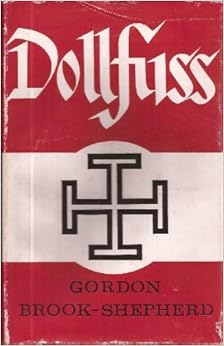
Dollfuss

Dollfuss by Gordon Brook-Shepherd, 284 pages

In 1932, Engelbert Dollfuss, until then a little known government minister and agrarian reformer, accepted the office of Chancellor of Austria.  In 1933 he closed Parliament and outlawed the Marxist and Nazi parties, leading to a brief civil war between government-backed militias and socialist paramilitaries which climaxed in the use of artillery to reduce socialist strongholds in the working class suburbs of Vienna.  In 1934, after a little over a year of dictatorial rule, he was murdered during a coup attempt by Austrian Nazis.

Shepherd firmly situates Dollfuss' public career in the context of the particular problems of his time and place, only briefly surveying his life before becoming Chancellor in order to devote the bulk of the book to the labyrinthine politics of interwar Austria.  In this account, Dollfuss' primary aim - and his legacy - was the cultivation of a distinct Austrian identity which was independent of the departed Habsburgs and resilient enough to resist the pan-Germanism which animated both the far right and far left.

Saturday, June 13, 2015

Magic Lantern


When the world changed in 1989, Timothy Garton Ash was there.  In June, he was with Solidarity leaders in Warsaw on the night of the first free elections in Poland since World War II, then he was in Budapest to witness the funeral of Imre Nagy, the hero of the 1956 revolt against Soviet domination.  In November, he walked across the space in Berlin where the Wall once stood, then sat in on strategy sessions with Vaclav Havel in the Magic Lantern Theater in Prague.

It is in the Magic Lantern that the book not only gets its name but its theme.  The peaceful revolutions of 1989 were largely made by intellectuals, but, in Ash's view, were remarkably free from new ideas.  The "revolutionaries" brought down their governments by holding them accountable to their own standards and the standards of their Western neighbors.  With the use of naked force declared illegitimate by the national governments and (even more importantly) the Soviets, the communist system was exposed as an empty fortress.  This is very much an eyewitness account of the drama as it unfolded, seen from the best seats in the house, written while the echoes were still ringing off the walls.

Thursday, April 9, 2015

Catch You Later, Traitor

Catch You Later, Traitor by Avi, 296 pages


When Pete’s teacher tells the class that Pete’s dad is a communist and a traitor, Pete is confused and angry.  He knows that his dad loves America.  When he asks his dad about it, he admits that when he was a teenager he joined the Communist party, but realized that it was a mistake.  Now, Pete has an FBI agent following him around, trying to find out what he knows about his dad, his dad is worried about losing his job and going to jail, and no one in Pete’s class will talk to him anymore.  Pete is certain that his dad hasn’t told him the whole story and he is determined to find out the rest, just like the detectives in the stories that he loves.  This is a really good realistic historical story that has some elements of adventure and mystery to it as well.  A lot of kids would probably like it.