Showing posts with label Nazi Germany. Show all posts

Tuesday, June 30, 2020

Three Faces of Fascism

Fascism in Its Epoch - WikipediaThree Faces of Fascism: Action Francaise, Italian Fascism, National Socialism by Ernst Nolte, translated by Leila Vennewitz, 462 pages

Almost as soon as Mussolini coined the term in 1919, "fascism" began to be used as a slur, and the widely divergent views of those who have claimed the label have generated almost as much confusion as those who have stuck the label on others.  This has led some to question whether a coherent ideology that can be called "fascism" exists beyond whatever happens to be necessary to justify the leader's will to power, a view grounded in Mussolini's famous exaltation of action over thought and bolstered by the tendency since 1945 of considering fascism primarily as a subset of totalitarianism.  Nonetheless, as Ernst Nolte carefully explicates in this seminal study, twentieth century fascism has unique characteristics which definitively separate it from both more traditional forms of reaction and Marxism.

As Nolte understands it, fascism is identifiable by its denial of the possibility of a future world free from sin and injustice, a denial he alternately describes as "resistance to transcendence" and "hostility to history".  This not only places fascism in direct opposition both to traditional religion and various forms of socialism, it contributes to a worldview which imagines history as a ceaseless struggle without end or ultimate meaning.  Yet the salvific promises of fascism become progressively evident throughout his study - embryonically in Maurras' secularized Catholicism, haltingly in Mussolini's braggadaccio, fully in Hitler's megalomania.  His argument is further undercut by a certain amount of special pleading, as when he dismisses the lack of terror in fascist Italy with the claim that the black shirt terrorism accompanying Mussolini's rise sufficed for the duration of his reign.  If these flaws diminish the value of Nolte's conclusions, however, they do not affect the depth and thoroughness of his examination of the intellectual roots and branches of fascist politics.

Saturday, June 9, 2018

They Thought They Were Free

They Thought They Were FreeThey Thought They Were Free: The Germans 1933-45 by Milton Mayer, 378 pages

Journalist Milton Mayer visited Germany in the '30s, reporting on developments there and attempting, unsuccessfully, to get an interview with Hitler.  He returned a decade later to a very different Germany, now occupied by the Allies.  This time, instead of staying in Berlin, he settled in the town of Marburg, where, with some difficulty, he befriended and extensively interviewed ten men who had lived through the Nazi era.  The results form the basis of They Thought They Were Free.  

The first half of the book concentrates on the interview subjects and their experiences, the second half on Mayer's own analysis of Germany and the German people.  The former is far more interesting than the latter, especially given the passage of time.  The personal testimony of the ten men, all of whom had joined the Nazi party at some point, some before but most after Hitler's rise to power, provides a compelling witness to how gradually "decent" men were convinced to accept the unthinkable, how the acceptance of lesser outrages today can lead to the acceptance of greater crimes tomorrow, and how easy it is to ignore injustice when it is happening to someone else.  Movingly, two of the subjects recall moments before the war when they deliberately avoided Jewish acquaintances, not out of fear of being associated with them, but out of shame at their own complicity in the rising tide of anti-Semitism.

The second portion of the book is dominated by Mayer's own views on the effectiveness of the Allied occupation, which are extremely pessimistic.  While the experience of subsequent decades seem to contradict this, it is perhaps worth asking how much the German character has actually changed beyond the rejection of militarism.  Unfortunately, the analysis in this section also raises the suspicion that Mayer's conclusions predated (and therefore partially predetermined) his experiences.

Monday, September 11, 2017

Hitler's Religion

Hitler's ReligionHitler's Religion: The Twisted Beliefs That Drove the Third Reich by Richard Weikart, 286 pages

Identifying a person's religious beliefs can be difficult in the best of circumstances.  The very concept of religion is itself notoriously difficult to define, and the task of disentangling what a person actually believes from what they profess requires considerable insight even when it is one's own self.  The matter is further complicated when the subject is a public figure with a vested interest in dissimulation.  Then, too, a person's religious views do not often remain static and unchanging throughout their lives.  But when the subject is Adolf Hitler, the modern world's foremost icon of evil, the tangled question becomes a matter of considerable rhetorical weight.  Was he an example of the depths to which modern godlessness can sink or a fanatic whose antisemitism was rooted in an admittedly somewhat unorthodox Christianity?  Was he an occultist in league with diabolic forces or a neo-pagan anticipating a restoration of the old Norse religion?

Based on an analysis of Hitler's speeches, writings, and the testimony of those close to him, Richard Weikart concludes that Hitler was none of these things.  Hitler's religious beliefs were vague and inchoate, but certain beliefs remained consistent.  He definitively rejected Christianity, reimagining Jesus as a Gentile warrior killed for attacking "Jewish materialism".  He was not an atheist or an agnostic, as his constant faith that he was the chosen instrument of Providence endured even at the very end.  He was thoroughly dismissive of any form of occultism or pagan revivalism, mocking those in his entourage who involved themselves in such things.  Instead, Hitler was a believer in a form of "scientific pantheism" which imagined that the will of God was embodied in Darwinian "laws of eternal fight and upward struggle".

Despite the sensationalistic subtitle, the book is carefully reasoned, though not perfectly organized.  Weikart demonstrates both a clear command of the primary sources and a familiarity with a wide range of scholarship.

Wednesday, August 2, 2017

Lenin, Stalin, and Hitler

Lenin, Stalin, and HitlerLenin, Stalin, and Hitler: The Age of Social Catastrophe by Robert Gellately, 594 pages

The closing years of the First World War saw an unprecedented wave of human liberation sweep across Europe.  The repressive tyrannies that had shackled the human spirit for so many centuries, particularly the traditional regimes of the Russian, German, Habsburg, and Ottoman empires, were at long last swept away.  Idealists were finally free to pursue lofty visions of a better world without superstitious nonsense about human limitations, and they found their visionaries in such men as Lenin, Stalin, and Hitler.  The screams of their tens of millions of victims echo still today, even if many, now as then, seem deaf to them.

Although he certainly identifies the many similarities his subjects shared, Gellately also highlights differences, notably the contrast between Hitler's "consensus dictatorship" as against the Soviet Bolshevik dictatorship, resulting in revolutionary Communism as opposed to evolutionary Nazism, expressed in differences between the "arbitrary and sweeping terror" under Lenin and Stalin and the "aimed terror" of Hitler.  While providing surprises and insights even for those familiar with the period, Lenin, Stalin, and Hitler manages to be an accessible introduction to the darkest chapter in human history so far, from the conditions which encouraged so many to commit themselves to the inhuman ideologies of Leninism, Stalinism, and Hitlerism, through the clash of those ideologies in a social catastrophe "so utterly unprecedented in all its many horrific faces, that it raised questions about the very meaning and future of Western civilization."

Wednesday, December 21, 2016

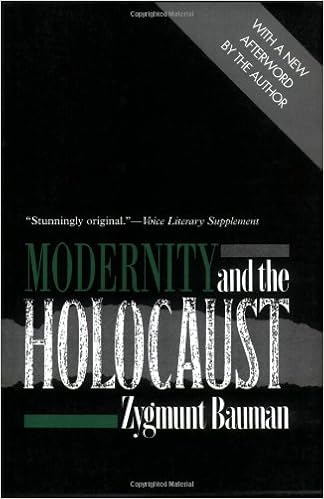
Modernity and the Holocaust

Modernity and the Holocaust by Zygmunt Bauman, 207 pages

In Modernity and the Holocaust sociologist Bauman attempts to explicate how the Holocaust, far from being the uncharacteristic irruption of atavistic drives and premodern ways of thinking it is so often reflexively (or, perhaps, defensively) characterized as, was, in fact, distinctively modern.  In Bauman's view, while modernity did not make the Holocaust inevitable, it did make it possible.  Indeed, in Bauman's account, modernity was crucial in virtually every element of the genocide.  Obviously, modern technological sophistication was necessary to manufacture the vast machinery of death that is virtually unique to the Holocaust.  But perhaps even more necessary was the organizational sophistication of the modern state, which created a distance between the actual killing and those responsible, both those giving the orders and those carrying them out.  

The most important element of the "elective affinity" between modernity and the Holocaust, Bauman maintains, is the foundation of the latter in the former's characteristic confidence in the power of man to reshape himself and his society.  The Holocaust is unthinkable without a belief in social engineering, a hygenic logic that demands the efficient removal of any threat to public health.  Modern genocide is not the spontaneous product of passion, but a planned, rational process.  The anti-ethical space in which the Holocaust took place was prepared by a technocratic outlook which "scientifically" excluded all considerations besides efficiency and technique, with moral concerns further displaced by the innate consequentialism of progressivism - the belief that history will justify any crime in the glorious future that is always aborning.  The monopolization of violence and authority by the modern state meanwhile leave society physically defenseless against injustice, but, even more importantly, the ideology of rational calculation and enlightened self-interest on which the modern state is founded leaves individuals morally unequipped for resistance.

It is these qualities which separate modern genocide from more traditional forms of mass murder - the latter was aimed at destroying communities, the former with the complete physical annihilation of a class of people, the latter was a passing disorder, the former an enduring order, the latter was a violent attack entirely from without, while the former involved the suborned collusion of the victims themselves.  In considering these characteristics of the Holocaust as a product of modernity, Bauman does more than contribute to our understanding of a specific historical event, he forces a reconsideration of the "legitimizing myth" of modernity itself.

Friday, June 3, 2016

Church of Spies

Cover image for Church of Spies: The Pope's Secret War Against Hitler by Mark Riebling, 250 pages

Church of Spies is a history of the clandestine contacts between German anti-Nazi circles and the Vatican of Pope Pius XII, centering on the combative Munich lawyer Josef Mueller, nicknamed "Joey Ox", who worked as a go-between for Admiral Wilhelm Canaris, head of German Military Intelligence, and Church leaders in Germany and Rome.  Between Mueller's connection to Canaris and a circle of Jesuits working with General Ludwig Beck, the pope and his agents - dubbed the "Black Chapel" by the SS - were tied directly or indirectly to virtually every German resistance group, including Claus van Stauffenburg's conspiracy, Dietrich Bonhoeffer, and the White Rose.

There are some surprises in Riebling's book, especially how early the alliance between the Pope and the anti-Hitler plotters was forged - already during the Phoney War of 1939 contacts were established with the British government for a Vatican-brokered peace agreement in the event of Hitler's overthrow.  Unfortunately, the book is marred somewhat by Riebling's sensationalistic tendencies (Catholic Action is described as "a practice" used "to cultivate influence agents" and form "'front' groups"), a fault which is exacerbated by his sloppiness (he tells the story of the Scholls without even mentioning their comrade Christoph Probst, who was arrested and executed with them).  These flaws do not stop the book from being consistently interesting and intensely dramatic, but the book would have been superior if it had dealt less with the remarkable personal story of Mueller and more with the discussions within the resistance concerning the aftermath of a successful coup which, Riebling hints, laid the groundwork for post-war Germany and Europe.

Monday, January 4, 2016

Reflections on a Ravaged Century

Cover image for Reflections on a Ravaged Century by Robert Conquest, 298 pages

Robert Conquest is firmly established as one of the finest historians of the Soviet Union, with his reputation benefiting rather than suffering in the long run from his clarity about the nature of the regime.  Reflections on a Ravaged Century is a look back at the twentieth century experience of totalitarianism, and at what made the Nazi and Soviet ideologies so appealing to so many, especially intellectuals.  Conquest begins with the understanding that the values which have guided Western civilization are neither self-evident nor universal, but rather appeal to a certain temperament encouraged by a certain culture, and he continues to warn against the danger of political enthusiasms, including those enthusiasms which present themselves as being coldly rational.  Finally, he considers what the new century might hold, fearing current trends which point towards a future where the interests of big government and big business converge to establish the servile state.

It is a cliche that everything changed after 9/11, and it is certainly impossible to read a speculative book from 1999 without some sense of disconnection.  Likewise, this book was written before Putin took over from Yeltsin, so that the shape of post-Soviet Russia was still very fluid, with the strong possibility of a far left or far right government in the near future.  It is remarkable, however, how much the currents flowing beneath the surface have continued despite the unforeseen - despite momentous changes, in 1989 as in 2001, there is much that has not changed.

Sunday, December 6, 2015

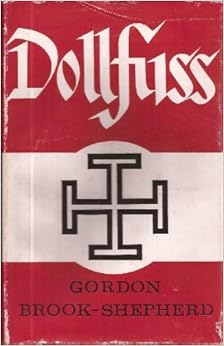
Dollfuss

Dollfuss by Gordon Brook-Shepherd, 284 pages

In 1932, Engelbert Dollfuss, until then a little known government minister and agrarian reformer, accepted the office of Chancellor of Austria.  In 1933 he closed Parliament and outlawed the Marxist and Nazi parties, leading to a brief civil war between government-backed militias and socialist paramilitaries which climaxed in the use of artillery to reduce socialist strongholds in the working class suburbs of Vienna.  In 1934, after a little over a year of dictatorial rule, he was murdered during a coup attempt by Austrian Nazis.

Shepherd firmly situates Dollfuss' public career in the context of the particular problems of his time and place, only briefly surveying his life before becoming Chancellor in order to devote the bulk of the book to the labyrinthine politics of interwar Austria.  In this account, Dollfuss' primary aim - and his legacy - was the cultivation of a distinct Austrian identity which was independent of the departed Habsburgs and resilient enough to resist the pan-Germanism which animated both the far right and far left.

Monday, November 16, 2015

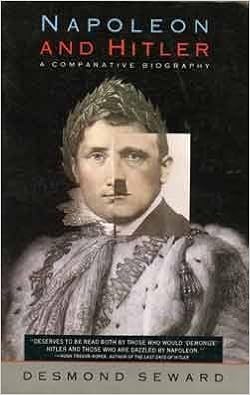
Napoleon and Hitler

Napoleon and Hitler: A Comparative Biography by Desmond Seward, 303 pages

Napoleon Bonaparte and Adolf Hitler are the two great "men from nowhere" in modern European history.  The parallels are obvious: born into obscurity, foreigners in the nations they ruled, they inherited states reeling from war and civil strife, conquered Europe, met disaster in Russia, and were ultimately defeated by a combination of all the other great powers against them.  There are glaring differences, too - Napoleon was an officer who won glory as a general which he then parleyed into dictatorship, Hitler an enlisted man who gained power through a later political career; Napoleon was a military genius, Hitler was not; Napoleon attempted to start a dynasty, Hitler did not; Napoleon survived to help shape his legacy, Hitler did not.  Most obviously, though millions died in the Napoleonic Wars, Bonaparte never targeted whole peoples for extermination.

According to Desmond Seward, both the differences and similarities run deeper than is generally appreciated.  Napoleon's use of military backing to seize power is paralleled by Hitler's paramilitary support.  Both leaders professed a jingoistic nationalism, but both were also deeply ambivalent about the people they ruled.  Most importantly - and damningly - both men "were incapable of rational compromise, an incapacity which meant their doom" and that of so many of their followers and foes.

Wednesday, June 25, 2014

German Genius

Cover image for The German genius : Europe's third renaissance, the second scientific revolution, and the twentieth century / Peter Watson.

The whole history of Germany has been overshadowed by the Holocaust.  It is hard to argue with that statement.  For many, the words "German" and "Germany" immediately evoke images of Hitler and the swastika, and for many English speakers they do not represent much else.  Yet in the eighteenth and nineteenth century Germany was a center - very nearly the center - of science and culture, making considerable contributions to human knowledge and achievement, indeed, the very terms "culture" and "genius" derive much of their power from how they were defined in German society.  It is these too often forgotten German roots of modernity that are the focus of the first part of Peter Watson's book.  The second part deals with Nazism itself, and how it grew within and interacted with German thinking, and how German thought has attempted to come to terms with the Nazi legacy.

 This is a very ambitious work, but Watson's talent is not quite a match for that ambition.  Perhaps it's because I just read The Long Nineteenth Century, which was largely concerned with providing context and nuance for this era, but The German Genius seems tremendously oversimplified.  Watson's shallow understanding of some of the figures is underlined by his tendency to quote what others have said about them rather than what they themselves said, and to define deep bodies of work by those quotations.  This sometimes results in the figures surveyed seeming isolated, so that while at its best (usually in sections dealing with science or art), The German Genius approaches works like Voltaire's Bastards and Rites of Spring, it more often reads like a biographical encyclopedia.  This is exacerbated by the tight focus on German thinkers, which leads to absurdities such as Marx and Engels being discussed without any mention of Proudhon or Bakunin.  Furthermore, this narrowness of scope makes the book's idolatry of Darwin even more odd.  Watson sometimes acknowledges that nineteenth century German politics did not follow the contours we might expect (progressives, for example, were aggressively nationalistic), but at other times he writes as if they do.  He presents honestly the many differing perspectives on German history advanced by German scholars, but doggedly follows a Lukacs-inspired narrative throughout.

With all of my criticisms and disagreements this is, nonetheless, the kind of work I would like to see more of, in that it actually treats ideas seriously and not as mere appendages of power politics.  The breadth of its ambition is laudable, but marred by the narrowness of its execution.

Friday, January 10, 2014

Hellsing Volume 2

Hellsing Vol 2 by Kohta Hiranko, 188 pages

This is the second book in a ten volume set that follows the Hellsing Agency. For those that didn't read the previous reviews or the series yet, the Hellsing Agency hunts downs and kills vampires and other supernatural creatures that are causing trouble. In this volume Hellsing is nearly destroyed in a sudden attack by the mysterious group called Milleinum.

Before continuing I want apologize for calling the books I was reading anime instead of manga. As I found out anime only refers to the animated TV shows and movies, while manga is the written books.

This volume, like the first is very well illustrated and is very bloody. There are scenes where arms and legs are getting ripped off people, violent head exploding gunshots and someone is set on fire. There is also a vampire that can use some sort of dark magic where he some how shape shifts into a shadow dog with lots of eyes, but asides from being impressive is also confusing.

Overall I am still enjoying the series and plan to finish it, though maybe not with a post per book.

Friday, November 29, 2013

In the Garden of Beasts: Love, Terror, and an American Family in Hitler's Berlin, Eric Larson

In the Garden of Beasts: Love, Terror, and an American Family in Hitler's Berlin
Eric Larson,  488 pages, 2011


        William Dodd was the first American ambassador sent to Germany during Hitler's rise to power in 1933.  He brought his family with him, and in the next four years they lived in Berlin, bearing witness to Germany's transformation under Hitler.  Dodd worked as a history professor at the University of Chicago beforehand and was not Roosevelt's first choice for the position.  Initially, I was unsure of how engaging this family would be on paper, but I was sure Larson would find a way to make these people a little more compelling.  He did not disappoint in the the slightest.
        
         The Dodds become fascinating in ways I did not expect- The book reads like a suspense thriller where you know the ending ahead of time. We all know what happened after Nazi Germany invaded Poland in 1939, and Larson is able to produce a picture of life inside Germany before all of that.  He gives us a portrait of a family who were imperfect, well meaning, fairly middle class, and naive to a certain point. 

         William Dodd believed that he should live only on his paycheck his post as ambassador provided him, and this immediately set him apart not only from certain ideas of others in the State Department, but also at odds with diplomatic life within Berlin as well. I really felt for him as he fell further out of favor and became more and more alarmed at the Nazi Regime's practices and brutality.  There is a sense of total powerlessness and frustration as he must temper what he says, how he acts, and decides which functions to attend.  His daughter is also compelling, as a young woman who initially believes that the Nazi party was doing productive things in Germany and slowly becomes aware of their violent agenda.  Through lovers, friends, and her father, her perspective shifts radically during her stay in Berlin.

           Disturbing on many levels, In the Garden of Beasts offers its readers a different approach to history, one that hopefully will encourage the reader to investigate and read more on World War II. Great.