Showing posts with label Italy. Show all posts

Friday, September 26, 2025

Mornings in Florence

Mornings in Florence, Being Simple Studies of Christian Art for English Travellers by John Ruskin, 115 pages

Mornings in Florence takes the form of a guidebook, wherein the reader is instructed how to profitably spend six successive mornings in Florence examining the art and architecture of the late Middle Ages and early Renaissance.  It is a book written in open contempt for the guidebooks of Ruskin's day, and it is undoubted that he would have been no more impressed by Mr Steves in our day than he was by Mr Murray in his own.  Moving back and forth between Santa Maria Novella, Santa Croce, and the Duomo, the purpose here is less to tell the reader what he should see as how he should see.  And this is a gift that extends to much more than the appreciation of Cimabue and Giotto and Botticelli, great as they are: "Easy or not, it is all the sight required of you in this world - to see things, and men, and yourself - as they are."

Ruskin is able to see things as they are, not because of his excellent education or refined sensibility or even because he was an incredible snob, but because he was not a materialist, not even unconsciously.  Whatever the truths or errors of his personal metaphysics, Ruskin was able to hear that "higher wisdom, governing by her presence, all earthly conduct, and by her teaching, all earthly art, Florence tells you, she obtained only by prayer."

Thursday, August 7, 2025

Leopard

The Leopard by Giuseppe Tomasi di Lampedusa, translated by Archibald Colquhoun, 320 pages

Don Fabrizio, Prince of Salinas, would be perfectly content ruling over his large family, amusing himself with his mistress, indulging in his passion for astronomy, playing with his dog, and watching over his hereditary estates with benevolent indifference.  Unfortunately for him, history has other plans, as Garibaldi's revolutionaries lay siege to Palermo, with Fabrizio's own nephew, the dashing Tancredi, joining them in their effort to overthrow the monarchy.  Even in the security of his country estate at Donnafugata, the prince has to reckon with his eldest daughter Concetta's love for Tancredi and his nephew's growing affection for the bourgeois beauty Angelica.

The Leopard is a masterpiece.  It is not a dramatic novel - most of the major external conflicts are resolved without struggle or comment.  The real drama is social, historical, psychological, and, in the end, metaphysical.  Despite the sentimentality of its characters, it is a remarkably unsentimental work.  There is much to attract us in the passing world of the Sicilian nobility, but the novel does not romanticize them.  CS Lewis famously remarked that there is no "magic about the past.  People were no cleverer then than they are now; they made as many mistakes as we.  But not the same mistakes.  They will not flatter us in the errors we are already committing; and their own errors, being now open and palpable, will not endanger us."  So it is with The Leopard - the novel unfolds for the reader a universe of values which overlaps but significantly diverges from those of liberal modernity and allows him to judge between them.

Saturday, July 15, 2023

Casalvento (House of the Wind)

Casalvento (House of the Wind) by Gudrun Cuillo 312 pages


I love novels set in Italy; it is such a beautiful country with rich, varies and wonderful traditions; As soon a I knew Gudrun Cuillo’s book, Casalvento, was set in Italy, it became a must-read. Like any good novel, it sent me down the Google rabbit hole of researching the “House of the Wind.”  I learned that it is set in the real Casalvento (House of the Wind) of Radda and Livernano in Chianti Siena, Italy. I am especially appreciative that the publishers include a small map on the inside cover to help me understand exactly where it is located.


The protagonist, Erika Germoglio, is so unhappy that she doesn’t know that she is unhappy. Oh, she has a successful consulting business, a high-profile fiancĂ©, an exquisitely decorated Manhattan Upper Side apartment and she finally has se a wedding date. Erika’s life is black and white, literally. The apartment she shares with Craig is decorated in black and white, and the only two colors in her closet are black and white.


She has never been busier when she is notified that her grandfather has passed away and left her “Casalvento, a house and a vineyard, and Livernano, a medieval village turned bed-and-breakfast, both in the Chianti region of Tuscany.”


A grandfather? She never knew that she had a living relative! And why did he never try to contact her, especially when her parents died? Those answers await willing readers!


She heads to Italy, intent on selling everything so she can get back to her real life. However, there is a clause in her grandfather’s that “to keep or sell Casalvento and Livernano, she must live there and learn the business of the two estates for five months.”

Furious and agitated agrees to wait out the will’s terms, then sell it and move on with her life. Especially her long-awaited marriage to Craig.

Unable to relax enjoy the scenery, Erika helps in the winery and the vineyards as the days go by and Erika comes to know the people who worked for her grandfather, she finds herself increasingly drawn to the slower pace of life that Italy offers. Plus, she is drawn more and more to “Paolo, Casalvento's intelligent, compassionate, and strikingly handsome estate manager and wine maker.”

As her feelings for Paolo intensify, she knows she must make her choice between the two men, and the life each has to offer. While Erika struggles to make plans, her grandfather’s lawyer gives her letters, four in total, that he left behind explaining his reasoning.

Although the novel is predictable, there were a couple of gasp-worthy twists that made me keep reading., Casalvento (House of the Wind) receives 4 out of 5 stars in Julie’s world.

Tuesday, August 10, 2021

Borgias

The Borgias: The Hidden History by GJ Meyer, 431 pages

Everyone knows that after Rodrigo Borgia became Pope Alexander VI, he commenced an orgy of depravity the likes of which Rome had not seen since the days of Caligula and Nero.  Together with his bastard children, Cesare and Lucrezia, Alexander organized a criminal campaign of self-aggrandizement on a massive scale, while still finding time for some recreational murder and incest.

It's a wonderful story, featuring the darkest corruption in the holiest of places, playing upon popular prejudice and prurience, and as such it has been told and retold, most recently in hit TV shows and novels.  The only problem, according to GJ Meyer, is that very little of it is true.  Most of it is based on rumors spread by the rivals of the Borgias, given added currency by growing Italian nationalism and the Spanish origins of the family, their undisguised ambitions, and the almost complete collapse of their power after the death of Alexander, all of which was taken up and amplified by anti-Catholic polemicists in the centuries following the Reformation, eventually becoming engrained in conventional history alongside the Black Legend.  Going further than merely pointing out the obvious problems with the Borgia legend - the obviously invented operatic scenes, the supposed poisons whose effects are different from every poison known to modern medical science, the many positive accounts of Rodrigo's character before his election and Lucrezia's character after his death - Meyer challenges the most deeply ingrained myth of all, presenting strong circumstantial evidence suggesting that Cesare, Lucrezia, and their siblings were not, in fact, the illegitimate children of Rodrigo Borgia, but the legitimate children of his nephew.

The Borgias is not merely a debunking of myths.  Meyer turns the true story of the Borgias into a compelling story of ambition and intrigue, all while admirably informing the reader on the politics and culture of Renaissance Italy, a haphazard collection of independent and semi-independent states continually forming alliances and feuds with each other and the French and Spanish empires beyond the peninsula.

Thursday, July 15, 2021

Meeting in Positano

Meeting in Positano (translated from the Italian by Brian Robert Moore) by Goliarda Sapienza 256 pages

What attracted me to this novel was that it was set in Positano, a town south of Naples on the Amalfi coast. I love Italian settings. Picking up the book paid off because Positano is more than a setting; it’s a character in the book.  Author Sapienza does a wonderful job describing its beauty.

Sapienza worked as an actress from the late 1940s to the early ‘50s.  She made six films and after worked dried up, she worked in other areas of the movie industry. However, after her death in 1996, her husband found several novels that she had written and began publishing them.

In this novel, she is scouting locations and meets Erica Beneventano, a lovely widow. The two women become very intimate friends, not lovers but almost. This story is a bit confusing. First, I was never completely sure who the narrator was. It’s supposed to Goliarda, but at times I felt as if the words were coming from Erica. And at other times, the plot seemed more like a memoir than a fictional piece, especially since author Goliarda uses her own name as her character’s name (that was really off-putting).

Basically this is Erica’s life story. The book could also be labeled as “based on a true story,” with Erica taking the lead as most of the story was hers. As Goliarda goes about her movie business, the two women become very close, not lover-close, by closer than sisters.

Life was not easy for Erica. She was a middle sister, forced to go to work at an early age, married to one of her father’s ex-business associates and forced to have an abortion that results in her inability to conceive more children Sometimes I couldn’t follow the plot, which I found quite frustrating. But the beauty of the writing and the descriptions kept me reading. 

I was dismayed at the end when I found an Afterword by Goliarda’s husband, Angelo Pellegrino. The back of the book also contained a timeline of Goliarda’s life and pictures of Positano. I wish I had read them first. I believe if I had, I wouldn’t have had such a hard time following the book’s action.  Therefore, “Meeting in Positano” receives 3 out of 5 stars in Julie’s world.


Wednesday, November 11, 2020

Last Voyage of the Valentina

Last Voyage of the Valentina by Santa Montefiore   416 pages

I first learned of English author Santa Montefiore by reading the Royal Rabbits of London series that she co-authors with her husband.  I wanted to read one that was entirely hers, so I chose Last Voyage of the Valentina, mainly because half of the story takes place on Italy’s Amalfi Coast.

 The story focuses on Alba who lives in the London suburb of Chelsea on a houseboat named the Valentina, named after her deceased mother. Alba is one of the unhappiest characters that I have come across in recent memory. She hates to be alone, which explains why she has a steady stream of fellows going in and out of her boat each and every night.

Alba is basically a slob, but one day when she peers under her bed and finds a rolled up piece of paper wedged between the slats. It’s one of the three portraits her father drew of her mother before she died. She takes the portrait to her father’s home, hoping this might ease the chasm between them.  It also stirs something deep inside Alba….the need to find her mother’s family.

The novel weaves back and forth between 1945 Italy when her parents met and courted to 1971 London, Alba’s time.

The story is a rather predictable and I didn’t get as much Amalfi Coast scenery as I would have liked.  Therefore, Last Voyage of the Valentina receives 3 out of 5 stars in Julie’s world. 


Tuesday, June 30, 2020

Three Faces of Fascism

Fascism in Its Epoch - WikipediaThree Faces of Fascism: Action Francaise, Italian Fascism, National Socialism by Ernst Nolte, translated by Leila Vennewitz, 462 pages

Almost as soon as Mussolini coined the term in 1919, "fascism" began to be used as a slur, and the widely divergent views of those who have claimed the label have generated almost as much confusion as those who have stuck the label on others.  This has led some to question whether a coherent ideology that can be called "fascism" exists beyond whatever happens to be necessary to justify the leader's will to power, a view grounded in Mussolini's famous exaltation of action over thought and bolstered by the tendency since 1945 of considering fascism primarily as a subset of totalitarianism.  Nonetheless, as Ernst Nolte carefully explicates in this seminal study, twentieth century fascism has unique characteristics which definitively separate it from both more traditional forms of reaction and Marxism.

As Nolte understands it, fascism is identifiable by its denial of the possibility of a future world free from sin and injustice, a denial he alternately describes as "resistance to transcendence" and "hostility to history".  This not only places fascism in direct opposition both to traditional religion and various forms of socialism, it contributes to a worldview which imagines history as a ceaseless struggle without end or ultimate meaning.  Yet the salvific promises of fascism become progressively evident throughout his study - embryonically in Maurras' secularized Catholicism, haltingly in Mussolini's braggadaccio, fully in Hitler's megalomania.  His argument is further undercut by a certain amount of special pleading, as when he dismisses the lack of terror in fascist Italy with the claim that the black shirt terrorism accompanying Mussolini's rise sufficed for the duration of his reign.  If these flaws diminish the value of Nolte's conclusions, however, they do not affect the depth and thoroughness of his examination of the intellectual roots and branches of fascist politics.

Thursday, April 2, 2020

The Star-Crossed Sisters of Tuscany


 The Star-Crossed Sisters of Tuscany by Lori Nelson Spielman 400 pages

 By the time this book is released to the public, hopefully the Coronavirus Pandemic is over.  Back when I was reading this in March 2020, the world was gripped with stay-at-home orders, exhausted medical staffs and too few supplies for said medical staffs. For me, though, this book was a relief.  Since going back to visit Italy is on my bucket list, it was a welcome respite from the bad news. Thank you, Natalie S. from Penguin Random House for sending me an Advanced Readers Copy.

It’s been more than two-hundred years since Filomena Fontana put a curse on her sister and cursing all second-born daughters forever after, causing them to never find true love. Based on the fact that all Fontana second-born daughters have never married, contemporary Fontanas believe the curse is real.

Fast forward to 2018 in Brooklyn, New York. At twenty-nine, Emilia, a second-born daughter, is happy with her life in the family bakery.  She makes a cannoli to die for say customers.  She works in the bakery with her father and nonna. Dad is a quiet man, but Nonna Rosa is a hard woman, expecting perfection and to be obeyed. Emilia has an apartment that she shares with a cat named Claws. Her best friend is a man she has known since they went to school together as children.

Out of the blue, a letter from her great-aunt Poppy arrives, inviting Emilia and her cousin, Lucy, to accompany her on a trip to Italy. The goal is to be at the cathedral on her eightieth birthday to meet the man she fell in love with in 1959. Aunt Poppy is estranged from the family, but Emilia remembers her sending birthday and Christmas cards. Nonna Rosa is against the trip and makes her wishes known.

Needless to stay, Emilia defies Nonna and off they go. The scenery is gorgeous; the trio’s adventures are alternately fun and sad, and family secrets are revealed…and there is a happy ending. 

I was sad when the story ended. I had come to love these characters as they navigated through uncharted territories.   The Star-Crossed Sisters of Tuscany?” receives 6 out of 5 stars in Julie’s world.


Wednesday, January 31, 2018

Ornament & Illusion

Ornament & IllusionOrnament & Illusion: Carlo Crivelli of Venice, edited by Stephen J Campbell, 215 pages

Although, as the subtitle indicates, Carlo Crivelli was Venetian, he spent most of his career in the Marches, the semi-independent cities and towns on the Adriatic side of the Papal States.  Working outside the main centers of Italian art and culture, he was overlooked by Vasari, and despite acquiring fame in the late nineteenth century, critics of the twentieth tended to dismiss him as backward-looking and provincial.  The bulk of Ornament & Illusion is an argument against that conclusion.

It is readily apparent that Crivelli was a master equally adept at rendering the gorgeous and the grotesque.  The essays included here further explicate the ways in which his work combined the original and the traditional for deliberate affect, particularly his use of ornamentation to create a sense of interaction between the image and the viewer.

Wednesday, December 13, 2017

Etruscan Myth

Etruscan Myth, Sacred History, and LegendEtruscan Myth, Sacred History, and Legend by Nancy Thomson de Grummond, 233 pages

The Etruscans dominated northern Italy in early antiquity, until overwhelmed by Gallic invasions and the rising might of Rome.  Indeed, many of the early kings of Rome were Etruscans, but later Roman writers possessed little knowledge of Etruscan culture beyond rumors and speculation.  Today, although the Etruscan language is mostly understood, there is little to read, and certainly nothing providing a deep exposition of their religion.  Therefore, like their classical counterparts, modern scholars are tempted to resort to speculation to fill some quite considerable gaps.

Fortunately, de Grummond is well aware of the perils of this temptation.  Most of our evidence for Etruscan beliefs comes from their art, especially the engravings on hand mirrors which seem to have been widely used for divination.  Since some of the figures represented are obviously adaptations of Greek gods and heroes, it is particularly easy to assume all of them are, or to forget that the Etruscan versions of these characters are not mere duplicates of the Hellenic originals.  De Grummond consciously avoids falling into these traps.  This is vitally important, since it is precisely where Etruscan religion is original that it is most interesting, although unfortunately the careful fidelity to what can be known also makes the text extremely dry.

Saturday, December 9, 2017

Man of the Beatitudes

A Man of the BeatitudesA Man of the Beatitudes: Pier Giorgio Frassati by Luciana Frassati, translated by Dinah Livingstone, 179 pages

Bl Pier Giorgio Frassati was born in Turin in 1901, the only son of the wealthy publisher of Italy's largest newspaper, La Stampa.  Despite the religious indifference of his parents - and the outspoken hostility of their social circle - Frassati developed into a young man of deep piety, secretly praying the rosary late at night, sneaking out of the house in the early morning for Eucharistic adoration.  Even more frightening to his parents were his forays into the slums, offering help (and, more vitally, compassion) to those in need.  These excursions became even more dangerous after the fascists rose to power, as both Frassatis, father and son, were outspoken foes of Mussolini and potential targets of blackshirt violence, but in the end it was a less dramatic threat that claimed him, as on one of his charitable visits he contracted a fatal case of polio, from which he died at the age of 24.  His canonization cause was begun less than a decade later, and he was beatified in 1990 by St John Paul II, who extolled him as a "man of the eight beatitudes."

It is natural to be suspicious of hagiography, and equally suspicious of biographies written by loved ones.  Yet, oddly, in the case of Man of the Beatitudes these difficulties cancel each other out to a significant extent, as Luciana was too close to her brother to reimagine him as some plaster saint, yet too impressed by him to pretend to understand him fully.  The result is a book that is, fittingly, both intimate and mysterious.

Friday, July 28, 2017

Lyric Poetry

Lyric PoetryLyric Poetry; Etna by Pietro Bembo, translated by Mary P Chatfield, 125 pages

Pietro Bembo was a man who could only have lived during the Italian Renaissance - after being trained as a Venetian diplomat, he became an accomplished humanist who helped restore the popularity of the works of Petrarch and Boccaccio, then the lover of Lucrezia Borgia, and finally a cardinal of the Holy Roman Church.  He embodies those traits which seem so puzzling or scandalous to so many in other times and places - particularly the combination of a genuine concern for virtue and a deep religiosity with casual hedonism.  His poetry - presented here as a translation of his own compilation, the Carminum libellus, along with works he omitted and works attributed to him and included in later editions - reflects this curious mixture, shifting between paganized hymns, comic insults, and lurid eroticism.  Also included in this volume is Bembo's dialogue Etna, a reconstruction of a conversation with his father retelling the author's exploration of the famous Sicilian volcano, in which he seamlessly combines classicism and scientific inquiry.

Wednesday, June 28, 2017

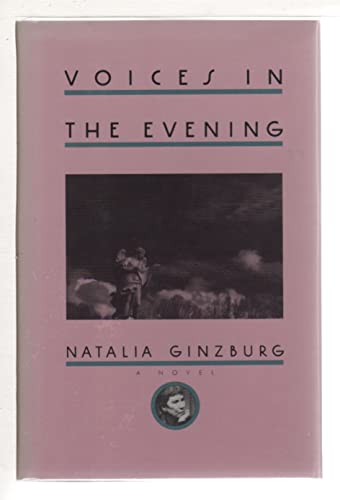
Voices in the Evening

Voices in the Evening by Natalia Ginzburg, translated by DM Low, 171 pages

Natalia Ginzburg's Voices in the Evening intertwines the lives, loves, and losses of a group of upper middle class men and women living in a provincial Italian town before, during, and after the Second World War.  The war, as well as the fascist government that preceded and precipitated it and the social changes that follow in its wake, affects the characters like a natural disaster, more something that happens to them rather than something in which they meaningfully participate.  The focus is instead on the relationships among the characters as they evolve down through the years.

As the title implies, the stories of the novel are told primarily through dialogue, the characters talking to and about one another.  There is no overarching plot, the novel being tied together by the setting, the characters, and the theme that, in this world at least, happiness is like water - impossible to hold on to.

Wednesday, March 29, 2017

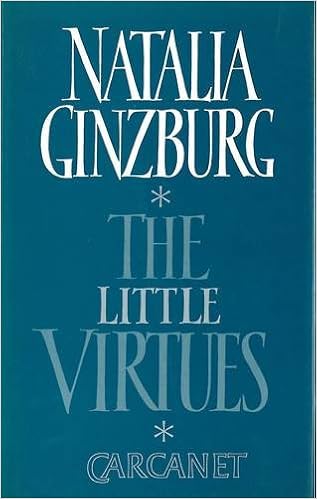
Little Virtues

The Little Virtues by Natalia Ginzburg, translated by Dick Davis, 110 pages

The first story, or essay, or memoir collected in The Little Virtues is titled "Winter in the Abruzzi".  Only a few pages long, it recalls a time when the author and her family were forced to move to a small town in the rustic Abruzzo region east of Rome as a consequence of their outspoken opposition to the fascist government.  Delicately she describes the life of the village, recalling the sound of the bells calling the old women to Benediction, the miserliness of the local grocer, the time the snow melted and everyone's houses flooded, the taste of oranges that have begun to rot, all the daily routines they had to endure while waiting for the war to end and their real lives to resume.  She concludes by telling, briefly, how her husband was arrested and tortured to death.  That time in Abruzzo was the last time they would spend together, and those everyday experiences are revealed as life itself.

This is a theme that runs throughout The Little Virtues.  Ginzburg does not inspire the reader to great acts of heroism, but to everyday mindfulness.  Her work is characterized by a humble clarity, receptiveness to reality, openness to gift, quiet beauty and deep meaning.

Friday, October 21, 2016

Divorce of Henry VIII

Cover image for The Divorce of Henry VIII: The Untold Story from Inside the Vatican by Catherine Fletcher, 214 pages

Although he is mentioned in neither the title nor the subtitle, Catherine Fletcher's inside story on the most momentous divorce in history is really the story of Gregorio Casali.  As "our man in Rome" for the English monarch, Casali spearheaded efforts to secure a favorable judgement from Pope Clement VII.  Simultaneously, Gregorio worked to advance the far-flung interests of his family, and used his family to advance the interests of his client.  The manner in which these interests interacted, combined and conflicted, forms much of the drama of the story.

Fletcher writes well, smoothly guiding the reader through the intricacies of Renaissance diplomacy, although the book might have benefited from a collective introduction of all the members of the Casali family rather than a piecemeal approach.  The Divorce of Henry VIII is an intriguing, informative tale of Renaissance diplomacy, even if it sheds little light on the "great matter" at its heart.

Wednesday, July 13, 2016

Mussolini

Cover image for Mussolini by RJB Bosworth, 428 pages

Benito Mussolini was the first of the fascist dictators.  Il Duce ruled Italy for over twenty years, pursuing a policy of national unity through the subordination of all things to the state, with the state incarnate in the charismatic flesh of the dictator.  For much of that time Mussolini was widely perceived, by foreigners as well as Italians, as one of the most talented and dynamic European leaders.  In the end, however, Italy was humiliatingly crushed in the Second World War, and Mussolini himself was killed by partisans, his corpse hung from a meathook in a public square in Milan.  In the public imagination he is often reduced to Hitler's "ignoble second", and implicitly associated with Nazi crimes without receiving the benefit of Hitler's luciferian glamour.  Nor have historians been much kinder, often considering him, in the words of AJP Taylor, "a vain, blundering boaster without either ideas or aims".

Bosworth contradicts some of these views.  Mussolini was capable of great ruthlessness, but he talked about the supposed value of ruthlessness more often than he actually acted ruthlessly.  He was the most intellectual of twentieth century tyrants, with the possible exception of Lenin, and one of the few to have something resembling a traditional domestic arrangement, despite his habitual adulteries.  The picture of Mussolini that emerges is that of a born journalist who never outgrew the habit of concentrating on the headlines and letting the stories write themselves.

Bosworth's central interest is not in Mussolini the man, however, but in the interaction between Mussolini and society.  There have been a number of analyses of Nazi Germany (most famously by Goldhagen) which have highlighted the fact that Germans under Nazism tended to "work toward" Der Fuehrer, attempting to anticipate his will rather than waiting for an explicit order.  Bosworth uncovers similar examples in Fascist Italy, notably in fulfilling the dictator's brutal rhetoric with real crimes.  The author also convincingly demonstrates that although Italian fascism was the ideology for which the adjective "totalitarian" was coined, it never managed to overcome the strong Italian commitment to family, region, and religion, but instead was forced to work around or through these more durable institutions.

Thursday, April 28, 2016

Together at the Table: A Novel of Lost Love and Second Helpings


Together at the Table: A Novel of Lost Love and Second Helpings; Book 3 in the Two Blue Doors Series by Hillary Manton Lodge    320 pages

When I saw that this third book in Hillary Manton Lodge’s Two Blue Door Series was available for review from Blogging for Books, I jumped at the opportunity to review it (and it didn’t hurt that I got it for FREE!).

I was highly irritated at the end of Book Two. The story just stopped; literally it just stopped. It was a wonderful read until that point. I was eager to know what happened between Juliette and Neil. And would she learn the truth about the man she thought was her grandfather and the man who may have been? Book Three does not disappoint.

When we last saw Juliette, her mother had been diagnosed with cancer; the restaurant she opened with her brother, Nico, was off to a good start; she had traveled to Italy to meet both her paternal and maternal relative and try to solve the mystery of who was her grandfather; but her long-distance romance with Memphis-based immunologist Neil McLaren had ended.

Since then, her mother has died, leaving a gaping hole in the family. No one is quite over the shock. The restaurant is a success. She is dating the sous-chef Adrian. She has read the letters she discovered by her grandmother, but hasn’t had the time to follow up, and she is not over Neil McLaren, no matter what comes out of her mouth.

Taking a break from her hectic schedule, she takes a walk on Portland’s riverfront with Adrian. There in the distance is a familiar figure. Could it be Neil?  Her heart tells her it is.


In a delightful novel, Manon Lodge ties up all the loose ends and give readers a satisfying conclusion. I’ll miss these characters and hope that she reconsiders and gives us a fourth Two Blue Doors. I think it’s doable.  

Wednesday, January 27, 2016

Civilization of the Renaissance

Cover image for The Civilization of the Renaissance in Italy by Jacob Burckhardt, translated by SGC Middlemore, 394 pages

One of the classics of cultural history, Burckhardt's The Civilization of the Renaissance in Italy was first published in 1860 in German.  In it, Burckhardt surveys the literature of Italy during that ill-defined period called the Renaissance, and identifies the Italian city-states, with their intellectual ferment, financial prosperity, incessant wars, political upheavals, and social mobility, as the incubators of the modern concept of individuality.

That Burckhardt forms his conclusions based upon the literature of the period inevitably causes problems - just as a history of the US in the late twentieth century that used the portrayal of life in cop shows and action movies as a major source might very well conclude that Americans lived in constant fear of attack by neo-Nazis and Russian terrorists, Burckhardt's sources sometimes lead him in the direction of overly dramatic declarations.  The author is fully aware of these problems - as shown in a section in which he compares the efficacy of actual poisons to the purported properties ascribed to poisons by Renaissance chroniclers - but he is not always able to overcome them - as when he claims the existence of a "nest of witches" near Nurcia on the evidence of a letter that itself reports claims that witches and demons congregate in a local cave as a mere rumor.  Meanwhile, in keeping with his time, Burckhardt saw nothing of value in the Counter-Reformation or the Baroque style that accompanied it.  The book is only passingly concerned with the visual arts, which will frustrate readers who expect a book on the Renaissance to focus on art history.

Burckhardt mastered a vast range and body of material, and his survey of Italian Renaissance culture is rich and compelling.  In many ways, some of the best works on the Renaissance since his time (Hiram Haydn's The Counter-Renaissance) have been explorations of features and perplexities he identified.

Thursday, January 21, 2016

If You Were Me and Lived in...Italy: A Child's Introduction to Cultures Around the World

If You Were Me and Lived in...Italy: A Child's Introduction to Cultures Around the World by Carole P. Roman   30 pages
Author Carole P. Roman takes her 16th book in the “A Child's Introduction to Cultures Around the World” to Italy. Along with illustrator Kelsa Wierenga, Roman explores what a childr’s daily life would be like if he/she lived lo Stivale or “the boot.”

Along with the mini-geography lesson, readers also receive a mini-history lesson and experience daily life, from football (do they really call it football in Italy?) to going to Nonno and Nonna’s house for Sunday dinner.

I like that Wierenga chose to illustrate the book with both a boy and a girl. I also like the pronunciation key for the unfamiliar words.

I give If You Were Me and Lived in...Italy: A Child's Introduction to Cultures Around the World 4 out of 5 stars. Why 4? The part about the football really bothered me.


Friday, May 29, 2015

Reservations for Two

Reservations for Two by Hillary Manton Lodge     305 pages


Reservations for Two is the second book in the “Two Blue Doors” trilogy. I wasn’t able to get my hands on the first volume, A Table by the Window, before I started reading this installment. When I first started reading, I wondered if I should wait to get a copy of the first novel. However, Juliette and Neil pulled my quickly into their story.

Juliette is a food-writer turned restaurateur, soon to open her own place with her brother Nico in Portland.  Neil is a scientist living in Memphis. The only thing they are sure about is that they love each other. Neither is in a position to pull up roots and move across the county. Not only is the new restaurant keeping Juliette in Oregon, but her mother is rapidly deteriorating from ovarian cancer. I never did get how they met, and I think that’s probably in the first book.

They are headed to France and Italy where Juliette is not only spending time with her extended family, learning more about cuisine and her relatives. One of the things that has sent her on this trip is the knowledge that the man she called Grandfather was not her biological ancestor. She’s hoping that some of the family, especially a grand-aunt suffering from dementia, can provide some information.

None of the family seems to have the answers. Yet Juliette finds a treasure-trove of letters between her grandmother, her great-aunt, and even the man who may be her ancestor that were written in the late 1930s and through the 1940s. She photographs the letters into her laptop so handling them doesn’t make them crumble.

Juliette doesn’t have much time to read them with all the things that are on her plate. But beginning about halfway through the book, she starts to dive into her grandmother’s past.

I was pulled quickly into the story. Before I reached page 20, I felt as if what happened in Book One no longer mattered. Reservations for Two is a great read until the end. Then the story just ends; it just stops. I went to turn the page and was greeted by a Reader’s Guide. I was so irritated that I wanted to throw my paperback copy across the room. There’s not conclusion to what’s happening now. There are a few clues as to what Book Three will bring, but I have to wait until May 2016 before it will be published.

I have mixed emotions about whether I would recommend this book to my friends. I LOVED the plot and characters, but that abrupt ending did me in. I hate to inflict that on any reader.

 I received this book for free from Blogging for Books.