Showing posts with label Dictators. Show all posts

Saturday, October 27, 2018

Children of Monsters

Children of MonstersChildren of Monsters: An Inquiry into the Sons and Daughters of Dictators by Jay Nordlinger, 248 pages

Children of Monsters is a fascinating study of the lives of the children (and grandchildren) of twenty of history's worst tyrants, from Mussolini to Castro.  As might be expected, none of them escaped entirely unscathed from their fathers' legacies.  As might also be expected, each lived with their legacy in a unique way.  Some became monsters (Uday Hussein, Nicu Ceausescu), others dissidents (Alina Castro, Hussein Khomeini), some few became tyrants themselves (Bashar Assad, Jean-Claude Duvalier), and at least two became jazz musicians (Romano Mussolini played piano, Taban Amin played guitar - the former performed with Ella Fitzgerald, Duke Ellington, and Dizzy Gillespie, among others, and married Sophia Loren's sister).  As is the way of the world, irony abounds - one of Tojo's daughters married an American and settled in Honolulu, Pol Pot's daughter graduated university with a degree in accounting.

Journalist Nordlinger adopts a conversational tone which helps compensate for some of the uncertainties surrounding his subjects - as dictatorships attempt to control all information about the lives of their leaders, facts are sometimes hard to come by, and Nordlinger is continually forced to resort to words like "reportedly", "allegedly", and "apparently".  This also, intentionally or not, decreases the personal distance between author, readers, and subjects, bringing the horrors and the tragedies (as well as the more mundane triumphs) home.

Wednesday, July 13, 2016

Mussolini

Cover image for Mussolini by RJB Bosworth, 428 pages

Benito Mussolini was the first of the fascist dictators.  Il Duce ruled Italy for over twenty years, pursuing a policy of national unity through the subordination of all things to the state, with the state incarnate in the charismatic flesh of the dictator.  For much of that time Mussolini was widely perceived, by foreigners as well as Italians, as one of the most talented and dynamic European leaders.  In the end, however, Italy was humiliatingly crushed in the Second World War, and Mussolini himself was killed by partisans, his corpse hung from a meathook in a public square in Milan.  In the public imagination he is often reduced to Hitler's "ignoble second", and implicitly associated with Nazi crimes without receiving the benefit of Hitler's luciferian glamour.  Nor have historians been much kinder, often considering him, in the words of AJP Taylor, "a vain, blundering boaster without either ideas or aims".

Bosworth contradicts some of these views.  Mussolini was capable of great ruthlessness, but he talked about the supposed value of ruthlessness more often than he actually acted ruthlessly.  He was the most intellectual of twentieth century tyrants, with the possible exception of Lenin, and one of the few to have something resembling a traditional domestic arrangement, despite his habitual adulteries.  The picture of Mussolini that emerges is that of a born journalist who never outgrew the habit of concentrating on the headlines and letting the stories write themselves.

Bosworth's central interest is not in Mussolini the man, however, but in the interaction between Mussolini and society.  There have been a number of analyses of Nazi Germany (most famously by Goldhagen) which have highlighted the fact that Germans under Nazism tended to "work toward" Der Fuehrer, attempting to anticipate his will rather than waiting for an explicit order.  Bosworth uncovers similar examples in Fascist Italy, notably in fulfilling the dictator's brutal rhetoric with real crimes.  The author also convincingly demonstrates that although Italian fascism was the ideology for which the adjective "totalitarian" was coined, it never managed to overcome the strong Italian commitment to family, region, and religion, but instead was forced to work around or through these more durable institutions.

Monday, November 16, 2015

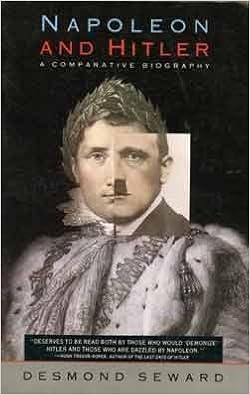
Napoleon and Hitler

Napoleon and Hitler: A Comparative Biography by Desmond Seward, 303 pages

Napoleon Bonaparte and Adolf Hitler are the two great "men from nowhere" in modern European history.  The parallels are obvious: born into obscurity, foreigners in the nations they ruled, they inherited states reeling from war and civil strife, conquered Europe, met disaster in Russia, and were ultimately defeated by a combination of all the other great powers against them.  There are glaring differences, too - Napoleon was an officer who won glory as a general which he then parleyed into dictatorship, Hitler an enlisted man who gained power through a later political career; Napoleon was a military genius, Hitler was not; Napoleon attempted to start a dynasty, Hitler did not; Napoleon survived to help shape his legacy, Hitler did not.  Most obviously, though millions died in the Napoleonic Wars, Bonaparte never targeted whole peoples for extermination.

According to Desmond Seward, both the differences and similarities run deeper than is generally appreciated.  Napoleon's use of military backing to seize power is paralleled by Hitler's paramilitary support.  Both leaders professed a jingoistic nationalism, but both were also deeply ambivalent about the people they ruled.  Most importantly - and damningly - both men "were incapable of rational compromise, an incapacity which meant their doom" and that of so many of their followers and foes.

Monday, April 13, 2015

Aftershocks of History

Cover image for Haiti: The Aftershocks of History by Laurent Dubois, 370 pages

"Poorest nation in the Western Hemisphere" is a description that, as Laurent Dubois notes, has at times seemed almost an official part of the name of the country of Haiti.  After the 2010 earthquake, there was a great deal of speculation as to why, with some religious fundamentalists claiming that an alleged deal with the devil was to blame, while some secular fundamentalists laid the blame on the Haitian people's failure to embrace some particular version of "progress".

Dubois gives a readable, interesting, colorful tour through the eventful history of Haiti.  Born out of the only successful slave revolt in history, the country has endured decades of international ostracism, republics, monarchies, military dictatorships, a twenty year American occupation, and both Papa and Baby Doc.  Dubois demonstrates that it is the common people of the countryside who have suffered most, and also how they and their culture have proven indestructible.  What he fails to do is give a compelling answer to the central question, or any meaningful hope that things will improve.

Monday, September 15, 2014

The Tyrant's Daughter


The Tyrant’s Daughter by J.C. Carleson
295 pages

Laila always lived a privileged life as the daughter of the ruler of a middle-eastern country but now that her father has been assassinated and the rest of her family has fled the country and is living in the United States, everything has changed.  Although she likes some parts of living in the United States, she doesn’t really understand everything.  Items like breakfast cereal, which was a luxury where she grew up, is available freely in the United States and everyone takes it for granted.  Laila, now that she can access the internet, has been finding out information about her father that she never knew and didn’t want to know.  She had no idea that her father was a major source of the turmoil in her country.  Meanwhile, her mother has been working with the United States government and speaking with Laila’s uncle, the one responsible for her father’s death.  Laila doesn’t know what her mother is up to, but knows that she wants her little brother, Bastien, who is only 7 years old, to be in charge of their country, as he should have been.  An interesting peek into what the life of a dictator’s family might be like, especially after the ruler is overthrown, a lot of teens who like stories that open new worlds might like this book.