Showing posts with label slavery. Show all posts

Monday, March 22, 2021

Yellow Wife

Yellow Wife by Sadeqa Johnson  288 pages

I came of age when the Old South was in its final death throes, and I was no stranger to the horror stories of slavery. This well-researched, oftentimes hard to read, story evokes those stories that I heard as a kid.

Pheby Delores Brown lives on the Bell Plantation in Virginia with her mother, Ruth.  Sired by Master Jacob, he has promised Ruth that Pheby would be educated and freed on her eighteenth birthday. Pheby believes that she will have a good life and is in love with one of the other slaves, Essex Henry. But after her mother dies and Jacob is away traveling on business, Jacob’s wife, Miss Delphina, decides that the uppity young woman must learn that she is in charge.

Delphina sells Pheby to a notorious slave trader, Rubin Lapier, who reigns over Devil’s Half Acre, an infamous jail in Richmond where slaves are taken to be sold or to have their spirits broken. The beatings and whippings, described in minute detail, some of the slaves must endure is the stuff of nightmares. After a torturous walk from the Bell Plantation in Charles City to Richmond, Pheby is chosen by Rubin to be his mistress.

Pheby is treated better than most as Rubin sets her up with sewing clothes for the incoming slaves, especially the ones who he puts to work as prostitutes. Rubin wastes no time in making Pheby is mistress. As the year go by, Pheby longs for the promises of education and freedom that were denied her and she longs for her one true love, Essex.

By the time Essex is brought to the jail, Pheby has had several children with Rubin; Children he dotes on. They are raised in his home where Pheby now lives and sleeps in a bedroom across the hall from Rubin. He even introduces her as the the Mistress of the Jail.

But Pheby cannot forget the man who has her heart, and she does whatever she can to make things better for him.

Author Johnson does not shy away from the realities of slavery, from the fears of being sold to harsher masters, from the fear of the whip and from the fear of familial separation that haunt a slave’s every waking and sleeping minute.

This is not an easy book to read. I swear as I read, I could hear the crack of the whip, the screams as flesh is torn open.

I was disappointed in the ending. It seemed like Johnson got tired of writing and just wound it up. I was planning on giving Yellow Wife 6 out of 5 stars, but the ending forced me to lower its rating to 5 out of 5 stars in Julie’s world. 


Wednesday, November 11, 2020

The Day Lincoln Lost

 The Day Lincoln Lost by Charles Rosenberg   432 pages

I’ve been an admirer of Abraham Lincoln and his family since I first learned of him in grade school.  I’m always up for reading anything about him, be it fiction or fact.  I admit, however, that I was a tad skeptical of the premise of this novel, that Lincoln lost the 1860 election (that premise was born strictly from reading the title). Alternative history isn’t my thing.

I wasn’t sure how this story would start, but I was hooked from the very beginning. It’s Kentucky in 1860. Twelve-year-old Lucy Battelle, a slave, is about to be sold. It’s probably a good thing given that Riverview’s current master, Ezekiel Goshorn, is quite cruel and quite inept to run a plantation.  However, Lucy has heard what happens to slaves who are sold “Down South.” So she runs away.

She runs and runs. She is discovered in one of her hiding place, but her discoverer was an abolitionist. He takes her to Springfield, Illinois, where she is to be placed on the Underground Railroad. Goshorn also makes his way to Springfield. Unfortunately she is captured.

Across town, Abby Kelly Foster, a fiery abolitionist, is making a speech about the evils of slavery. Seems everyone, almost, who was any one is Springfield was there. After the speech, the crowd bursts out into the square and create a small riot, and Lucy escapes again.

Foster is arrested on inciting a riot and is jailed. She manages to convince Lincoln to represent her, although the damage that may be caused to the upcoming presidential election and the Republican Party is high.

It’s quite interesting to watch/hear Lincoln decide what to do.  He takes the case and hope for the best. The trial becomes a circus, with the election coming closer and closer.  Then the story goes into an in-depth look that Constitution’s Twelfth Amendment, which was quiet apropos given that the United States, when I was reading this, was undergoing a crisis of leadership. The Twelfth Amendment is about the Electoral College, which I don’t really understand. Therefore given all that about the Twelfth Amendment and that Lincoln didn’t lose anything as far as the title is concerned, The Day Lincoln Lost receives 4 out of 5 stars in Julie’s world.


Tuesday, June 30, 2020

12 Years a Slave

12 Years a Slave by Solomon Northrup     259 pages

This is the true story of Solomon Northrup, born a free man like his father before him in New York state.   He was living the life most people wish for, a loving family, wife, two children, a beautiful house, respect from his family, neighbors and peers and a good livelihood to make it all work.   Solomon enjoyed playing the fiddle and was so good at it, he got lots of bookings one such booking led him into the notice of two scoundrels who coerced him to join them to play violin at their "circus."   They wooed him with the promise of such a fortune in money he could not refuse and gladly went with his new 'friends."    Alas they were deceivers and drugged him and bound him, stole all of his papers and sold him downstream to slavers who put him on the block and sold him.   The poor man had no way to prove his status as a Freeman and ended up being forced into manual labor and continued beatings from many of the slave owners he was farmed out to.  Many were bullies, cruel, heartless souls who took out their moods on him with lashes from the whip, their fists, their dogs or their cat o' nine tails.    Though everyone he came in contact with knew he was different they assumed him to be a slave from Georgia as was forged on his bill of sale and put him to manual labor from dawn to dusk at whatever hard tasks they came up with.    How this poor man endured and he also describes the terrible situations the other slaves on the plantations and farms he worked on went through.   The tearing apart of families and the shameless treatment dealt by man and woman alike are enough to bring tears to the readers eyes.  Thank God for the abolitionist who helped him out of his trouble and back home with a measure of justice dealt to those who treated him so badly.    Excellent book.  I recommend it to all ages.   It harsh but truth is that way sometimes and cannot be ignored if we are to learn from the past.   

 Posted by Shirley J.

Thursday, March 28, 2019

The Tubman Command


The Tubman Command by Elizabeth Cobbs    336 pages


I had been seeing/hearing a lot of buzz about this book, and I was excited to read it. I learned about Harriet Tubman and the Underground Railroad in grade school, but can’t say that I knew all that much about the woman. I’ve visited historic homes who had tunnels that claimed to be points on that infamous line and have stood in the darkened tunnel, aghast at the fear those poor people must have felt.  But fear is what kept them pressing on.


This story takes place in South Carolina, in May 1863. The tide had not yet turned for the Union Army, and many feared that the United States would split into two countries. From the book jacket:


’The Tubman Command’ tells the story of Tubman at the height of her powers, when she devises the largest plantation raid of the Civil War. General David Hunter places her in charge of a team of black scouts even though skeptical of what one woman can accomplish. For her gamble to succeed, “Moses” must outwit alligators, overseers, slave catchers, sharpshooters, and even hostile Union soldiers to lead gunships up the Combahee River. Men stand in her way at every turn--though one reminds her that love shouldn’t have to be the price of freedom.


I had high hopes for this novel. However, the use of dialect made it difficult, for me to read. I was often bored and kept getting thrown out of the story by the dialect. Therefore, “The Tubman Command” receives 1 out of 5 stars in Julie’s world.


Thursday, January 31, 2019

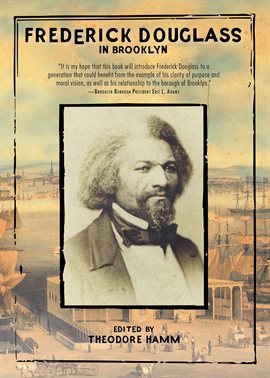
FREDERICK DOUGLASS IN BROOKLYN


Frederick Douglass In Brooklyn

Edited by Theodore Hamm  222 pages

https://slpl.bibliocommons.com/item/show/1387932116

Reviewed by Rae C.


I try to read anything that Douglass has written or texts of speeches he has given and this book is fantastic!  Douglass at his best, with a lot of Brooklyn history as well.  This is an imprint of Akashic, a truly unique publisher.  All fans of Douglass should read this.  Some of the material will be familiar, but much won't.  Not to be missed is Douglass' speech on John Brown, including his esteem for Brown as a family man (apparently the men and the women cleared the dinner dishes).

And his speeches on Lincoln, while a little bit of blind hero-worship, also illustrate the contrast between how Lincoln related to Douglass, compared to other powerful men, i n particular one abolitionist:
On one occasion a well-known abolitionist said to me. “Come, Douglass, let’s walk down Broadway together.  I’m never ashamed to walk with a Negro.”  It never occurred to him that I might be ashamed to walk with him. 

Sources of Danger to the Republic is as relevant today as it was then.  And What Shall Be Done with The Negro? is still all to frighteningly relevant.
…Inferior race! It is an old argument. All nations have been compelled to meet in in some form or the other since mankind have been divided into strong and week, oppressors and oppressed.  Whenever and wherever men have been oppressed and enslaved, their oppressors and enslavers have in every instance found a warrant for such oppression and enslavement in the alleged character of their victims.  The very vices and crimes which slavery generates are usually charged in the peculiar characteristic of the race enslaved.  When the Normans conquered the Saxons, the Saxons were a coarse, unrefined, inferior race.  When the United States wants to possess herself of Mexican territory, the Mexicans are an inferior race.  When Russia wants a share of the Ottoman Empire, the Turks are an inferior race, the sick man of Europe.  So, too, when England wishes to impose some new burden on Ireland, or excuse herself for refusing to remove some old one, the Irish are denounced as an inferior race.  But this is a monstrous argument.
                Now, suppose it were true that the Negro is inferior instead of being an apology for oppression and proscription, it is an appeal to all that is noble and magnanimous in the human soul against both.  When used in the service of oppression, it is as if one should say, “That man is weak; I am strong, there I will knock him down, and as far as I can I will keep him down.  Yonder is an ignorant man. I am instructed, there I will do what I can to prevent his being instructed and to withhold from him the means of education.  There is another who is low in his associations, rude in his manners, coarse and brutal in his appetites, therefore I will see to it that his degradation shall be permanent, and that society shall hold out to him no motives or incitements to a more elevated character.”  I will not stop here to denounce this monstrous excuse for oppression.  That men can resort to it shows that when the human mind is once completely under the dominion of pride and selfishness, the reasoning faculties are inverted if not subverted.

                I should like to know what constitutes inferiority and the standard of superiority.  Must a man be as wise as Socrates, as learned as Humboldt, as profound as Bacon, or as eloquent as Charles Sumner, before he can be reckoned among superior men?  Alas! if this were so, few even of the most cultivated of the white race could stand the test. 

It is so well put together, the source and footnotes help to really paint a full picture of the world Douglass was living in and the challenges he faced every time he was invited to speak somewhere. For example, Tilton's comments on the 5 directors of Brooklyn Academy of Music who (unsuccessfully) opposed Douglass speaking engagement February 8, 1866:
"We understand the names of the five dissenting directors are to be written on shells and deposited in the Brooklyn Historical Society's collection of Long Island fossils."

Saturday, January 27, 2018

Ashes

Ashes by Laurie Halse Anderson, 298 pages

As the Revolutionary War rages on, Isabel and Curzon have narrowly escaped Valley Forge--but their relief is short-lived. Before long they are reported as runaways, and the awful Bellingham is determined to track them down. With purpose and faith, Isabel and Curzon march on, fiercely determined to find Isabel's little sister Ruth, who is enslaved in a Southern state--where bounty hunters are thick as flies. Heroism and heartbreak pave their path, but Isabel and Curzon won't stop until they reach Ruth, and then freedom, in this grand finale to the acclaimed New York Times bestselling trilogy from Laurie Halse Anderson.” This was a great finale.  Teens who like historical fiction should definitely read these books.

Tuesday, January 23, 2018

The Invention of Wings

The Invention of Wings by Sue Monk Kidd (3 stars, audio, 384 pages)

This novel follows the dual narrative of Sarah Grimke and one of her family’s slaves, Handful. It takes place in Charleston, South Carolina in 1803 when Handful is given to Sarah as a birthday present, and spans the next several decades as the women age, both together and apart. Both women have ambition for anything but what they have. Kidd takes on not only slavery, but also women’s rights.

I appreciate that the book did not try to catalog the more visceral bodily horrors of slavery. That’s the route seen often in books or films on the topic, and while it has a place, it gets a disproportionate share of the coverage. While there is certainly punishment in the novel, it primarily happens off-page. Instead, the book focuses on the mental horrors inflicted by slavery - the day-in, day-out tedium of knowing there’s no hope for change. This is echoed in Sarah’s helplessness in response to her social station, and magnified by a speech impediment. Kidd takes care to not entirely conflate the plight of slaves and the plight of women, however, having Handful openly mock Sarah for trying to commiserate.

The author’s approach was realistically told. So many novels are built around high-impact events that change everything. In this book, very little changed. Even after the important events - punishments, scandals, deaths - everything reverts to normal for the next several years. This mirrors the conflicts confronted by Sarah and Handful. As they push to change their corners of the world, the world’s resistance to change pushes back, smothering them in turn.

At the same time, the decades-long scale of the book tired me. The story might be better told if it were shorter. Large swaths of Sarah’s tale felt irrelevant, like the scandals involving Sarah’s father and suitor, or her endless time with the Quakers. Now, I did not know that this was a fictionalized account of actual people. I caught some name dropping with Lucretia Mott and Theodore Weld, but the Author’s Note actually surprised me a bit. (To be fair, if I had looked at the book in any detail instead of just grabbing one at random, or if I had been curious enough to Google some names, I would have known this sooner.) Knowing that the author was trying to stick close to history may have helped me look past some of the boring bits. I’m not convinced I should, though. 


I would have liked to see more of Sarah engaging with her life’s work by the end, instead of some of the earlier irrelevant stuff. Handful’s story was solid throughout, but I similarly would have liked just a little more from her at the end and seen her life past that point. The voice acting of Jenna Lamia and Adepero Oduye was superb.

Friday, December 22, 2017

Thick As Thieves

Thick As Thieves by Megan Whaley Turner, 337 pages

"Kamet, a secretary and slave to his Mede master, has the ambition and the means to become one of the most powerful people in the Empire. But with a whispered warning the future he envisioned is wrenched away, and he is forced onto a very different path."  I feel like every book in this series is better than the last.  I liked the first one just well enough to keep reading the series and I’m so glad I did because I didn’t want to put this one down.  Kamet was intriguing.  Mostly likeable, he still had a lot of flaws.  I was totally on his side from beginning to end.  This is a great series for teens who like adventure that has a fantastical bent.

Thursday, March 23, 2017

Unbound

Unbound by Ann E. Burg, 345 pages

The day nine-year-old Grace is called to work in the kitchen in the Big House, everyone warns her to keep her head down and her thoughts to herself, but the more she sees of the oppressive Master and his hateful wife, the more she questions things until one day her thoughts escape--and to avoid being separated she and her family flee into the Dismal Swamp, to join the other escaped slaves who live there.”  This novel in verse was a good story.  I would recommend it to kids who like historical fiction.

Thursday, December 15, 2016

Counted with the Stars


Counted with the Stars (Book 1: Out of Egypt series) by Connilyn Cossette      352 pages

The sub-genre of Biblical fiction is, surprisingly, new to me. I have never encountered it prior to reading Connilyn Cossette’s Counted with the Stars. I enjoy Christian fiction and cannot get enough historical fiction so I eagerly delved into this novel.

This is the story of the Exodus of the Hebrews from Egypt. I didn’t understand the terminology of the timeframes (i.e.: 1st Day of Akhet, Season of inundation), but that didn’t interfere with the story at all. The timeline for the novel is basically 1447-8 BC. That was enough for me to place the story.

A thirteen-year-old Egyptian girl, Kiya, is sold into slavery to settle the debts her father incurred from his failed business. She is sold to his friend, Shefu, as a handmaiden for his wife, Tekurah. Tekurah lives to humiliate her slaves, and the fact that Kiya is a favorite of her husband’s infuriates her. She treats Kiya worse, if that is possible, than the Hebrew slaves.

Kiya befriends another slave, Shira, and the girls become best friends. Together they endure their indentured life. As Kiya does her best to satisfy her mistress, the ten plagues are visited upon Egypt. Author Cossette does an amazing job in making reader’s skin crawl with the lizards, lice, frogs, grasshoppers, etc. that invade the desert country. They came a little too close together in my mind. It was like one day for each of the plagues.

As the Hebrews are forced to flee Egypt to escape the deaths of first-born sons, Kiya decides to follow them. As the review from Publisher’s Weekly stated, “Readers will smell the fear on Passover night, feel the wonder of the Red Sea crossing, and sympathize with the starving and thirsting of those escaping in the wilderness.”

Attention of detail and well-developed characters make this a stand-out novel. As I read in “A Note From the Author,” I learned that names in Ancient Egyptian culture are extremely important. I wish Cossette had given us more information about that, but since I didn’t know that while I was reading, that is really an afterthought.

One of thhe things that I liked was the blue Cloud that seemed to follow  Moses. It was like a biblical version of the Northen Lights.

There is one area where the names were an issue, especially in the beginning. Many of the characters names began with “s,” which was confusing. Sometimes I had to flip back to remember who was who, especially in regards to the secondary characters. It is for this reason, I give Counted with the Stars (Book 1: Out of Egypt series) 4 out 5 stars.

Monday, August 31, 2015

Middle Passage

Middle Passage by Charles Richard Johnson, 209 pages

Rutherford Calhoun is a free African American from Illinois living in New Orleans.  He’s a thief and con who gets in trouble with bill collectors and a schoolteacher who wants to marry him.  Desperate to escape, he stows away on a ship that ends up being a slaver.  He gets a lot more than he bargains for, but despite the horror of the trip, he learns a little bit more about himself.  Although this was a hard book to read, I liked it.  People who are not afraid of a little horror and like historical fiction might want to read this.

Wednesday, July 22, 2015

The mechanical

The Mechanical by Ian Tregillis
471 Pages


"In an early 20th century where history took a decidedly different turn, the world is divided in two: the realm of the Dutch and their mechanical servitors in the empire ruled by the Brassworks Throne and the battered and pathetic remnants of France living in exile in the New World. Jax is a Clakker, a mechanical man built to obey the will of the humans who used alchemy to set him in motion. When a quirk of chance frees him from the geas ("alchemical binding") that usually controls all Clakkers absolutely, he will do anything to retain his free will. Meanwhile, in New France, Berenice is the spymaster charged with finding a way to defeat the Dutch, but she overreaches when she tries to capture a Clakker."

An interesting start to what might be a new series.  Tregillis not only creates a fascinating alternate world but explores free will and self-awareness.

Monday, May 11, 2015

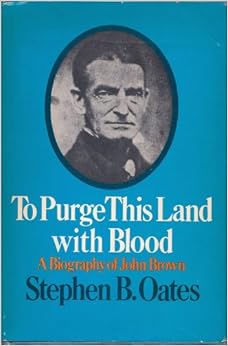
To Purge This Land with Blood


"He said if a man stood between him and what he considered right, he would take his life as coolly as he would eat his breakfast."  So spoke Mahala Doyle about the man who ordered her husband and two sons hacked to death outside their Kansas cabin for the crime of supporting the anti-abolitionist Law and Order Party.  The man was John Brown, and he had come to Kansas to fight against slavery in the name of God and Justice.  A friend of Frederick Douglass, Ralph Waldo Emerson, and Henry Thoreau, in 1859 Brown and a handful of supporters attacked the federal armory at Harpers Ferry, Virginia - the spark intended to ignite a slave revolt throughout the South.  Brown was captured, tried for treason and murder, convicted, and executed.

Was Brown a hero who fought, unsuccessfully but selflessly, for an end to centuries of slavery?  Or was he a madman, a religious fanatic, a bitter failure driven by hatred?  In Stephen Oates' telling, he was a little bit of both, and perhaps also something more.  On the morning of his execution, Brown prophesied that "the crimes of this guilty land will never be purged away but with Blood."  His life and death continue to pose questions about when violence is a suitable response to injustice.

Monday, April 13, 2015

Aftershocks of History

Cover image for Haiti: The Aftershocks of History by Laurent Dubois, 370 pages

"Poorest nation in the Western Hemisphere" is a description that, as Laurent Dubois notes, has at times seemed almost an official part of the name of the country of Haiti.  After the 2010 earthquake, there was a great deal of speculation as to why, with some religious fundamentalists claiming that an alleged deal with the devil was to blame, while some secular fundamentalists laid the blame on the Haitian people's failure to embrace some particular version of "progress".

Dubois gives a readable, interesting, colorful tour through the eventful history of Haiti.  Born out of the only successful slave revolt in history, the country has endured decades of international ostracism, republics, monarchies, military dictatorships, a twenty year American occupation, and both Papa and Baby Doc.  Dubois demonstrates that it is the common people of the countryside who have suffered most, and also how they and their culture have proven indestructible.  What he fails to do is give a compelling answer to the central question, or any meaningful hope that things will improve.

Thursday, October 23, 2014

The Laura Line

The Laura Line by Crystal Allen, 328 pages


Laura and her best friend, Sage, are picked on at school because they are overweight.  Laura mostly tries to not let it bother her, but Sage sometimes gets upset because she wants to be popular.  Laura’s parents are going to have to leave for two weeks for Army Reserves training and while Laura is going to miss them, she is excited that her Aunt Carmen is coming to stay with her.  At the last minute, her aunt cancels and Laura is horrified to find out that she is going to stay with her grandmother instead.  On her grandmother’s property is an old slave shack.  The shack embarrasses Laura and she has never been in it.  Then her teacher surprises everyone with a field trip to the shack.  Laura doesn’t want any of her classmates to see the shack and tries to think of ways to get the trip cancelled.  Her teacher makes a deal with her.  If she will go in and the shack and can’t find even one amazing thing then she will cancel the trip.  Laura agrees, sure that there is nothing in the shack that is amazing, but she might be surprised by what she finds about her family, and all of her female ancestors that make up the Laura Line.  A good contemporary story about growing up and being bullied with some interesting historical information thrown in.  A lot of older elementary kids would probably like this story.

Wednesday, July 2, 2014

From Slave to Priest

Cover image for From slave to priest : a biography of the Reverend Augustine Tolton (1854-1897), first black American priest of the United States / Caroline Hemesath ; with a foreword by Harold Burke-Sivers.

Father Augustine Tolton was born on a plantation near Hannibal, Missouri in 1854.  Both his parents were slaves.  His father escaped at the outbreak of the Civil War, and his mother followed with the children shortly thereafter, but the couple were never reunited, his father having died of dysentery.  Tolton grew up in Quincy, Illinois, and from an early age the Church was at the center of his life.  Thanks to sympathetic priests he was able to acquire an education, largely through private tutoring.  His desire to become a priest was long frustrated by the unwillingness of any American seminary to accept him, a difficulty that was ultimately overcome by his admission to a seminary in Rome.  He was ordained a priest at the Basilica of St John Lateran - the cathedral of Rome - in 1886, at the age of 31.  He was assigned to the diocese of Alton, Illinois, but was subsequently transferred to the Archdiocese of Chicago, where he became the pastor of St Monica's Church on the south side.

Although Father Tolton acquired a certain level of celebrity as the first American Catholic priest of primarily African descent* and was recognized as an eloquent speaker, he was less successful at the day to day work of running a parish.  His meekness and humility, which were remarked upon by all who knew him, frustrated those, both at his time and later, who would have preferred a more assertive leader.  Those same qualities of quiet holiness did not go officially unrecognized, however - his cause for canonization was officially opened in 2010.
 
Sister Hemesath's biography is a pious, popular work, full of invented dialogue both internal and external.  Those looking for an inspiring story will be pleased, those who would prefer a "realistic" account will not.  Those looking for more insight are referred to The History of Black Catholics in the United States, which covers Father Tolton's career and places it in a wider context.


* - Father Tolton is identified in the subtitle as "the first black priest of the United States".  There were several mixed race priests in the US in the mid-nineteenth century, including a bishop and a president of Georgetown University, but they did not self-identify as "black".  Likewise there were centuries worth of black priests outside the US, especially in Africa and Latin America - which is why the Roman seminary did not balk at Tolton's race.

Monday, May 12, 2014

Hidden Girl: The true story of a modern-day child slave

Hidden Girl: The true story of a modern-day child slave by Shyima Hall, 232 pages

This is a true story told by a girl who was sold into slavery by her family when she was eight years old. Shyima was born in Egypt to a poor Muslim family. She was the seventh of eleven children and at a young age was often made responsible for her younger siblings, as her older brothers went to school and her older sisters were either married or working outside the home, as were her parents. Although slavery is illegal in Egypt, it is still a fairly common practice. Shyima was sold to a family who subsequently moved to the United States. She tells of her terrible childhood with this family and her subsequent rescue through the aftermath of trying to adjust to a normal life. It’s a compelling story, simply told. I would think that this book would have a lot of appeal to teens as well as adults.

Thursday, March 27, 2014

Property


Property by Valerie Martin
196 pages

This book was difficult to read in some ways.  It was well written and a really good story, but the main character is a difficult character.  Manon is the wife of a sugar plantation owner who is bored and angry that her husband has children with the slave she brought with her to the marriage.  Because her husband is awful, you want to be able to identify with Manon, but her views on slavery and the way she treats their property aren’t really any better than her husband.  It’s an interesting look into what the mindset of the average white southerner probably was at the time but it’s disconcerting to read an account from this perspective and to want to identify with someone who is on the owning side of slavery.  Anyone who has an interest in this time period in history will probably like this book.

Thursday, January 23, 2014

The Invention of Wings


The Invention of Wings by Sue Monk Kidd  373 pages


If I tell you this is a Oprah 2.0 book club pick, you might immediately discount it.  However it doesn't have the usually amount of misery and hopelessness you find in an Oprah pick, and Kidd has proven herself to be an able writer so give it a chance.  Set in the early 19th century, the book is nominally about the lives of two true-life sisters Sarah and Angelina Grimke who were early abolitionists with southern plantation roots.  But the true story is between Sarah and the slave Hetty (Handful) who was gifted to Sarah on her 11th birthday.

The novel deals with the choices and limitations that were placed on women in that day and age and how each character deals with those limitations.  Handful sums it up best when she tells Sarah that Sarah's body is free but her mind is enslaved, while Hetty's body is enslaved but her mind is free.  The book is filled with instances where both characters are beaten down by the institution of slavery and the expectations of society towards females.

Besides the relationship between Hetty and Sarah, Kidd richly illustated the relationships between Sarah and her mother and Hetty and her mother.  The novel does get a little bogged down in the last 3rd as Sarah moves north and her interactions with Hetty grow fewer but comes back in the end.